

Recent from talks
Sub-orbital spaceflight
Knowledge base stats:
Talk channels stats:
Members stats:
Sub-orbital spaceflight
A sub-orbital spaceflight is a spaceflight in which the spacecraft reaches outer space, but its trajectory intersects the surface of the gravitating body from which it was launched. Hence, it will not complete one orbital revolution, will not become an artificial satellite nor will it reach escape velocity.
For example, the path of an object launched from Earth that reaches the Kármán line (about 83 km [52 mi] – 100 km [62 mi] above sea level), and then falls back to Earth, is considered a sub-orbital spaceflight. Some sub-orbital flights have been undertaken to test spacecraft and launch vehicles later intended for orbital spaceflight. Other vehicles are specifically designed only for sub-orbital flight; examples include crewed vehicles, such as the X-15 and SpaceShipTwo, and uncrewed ones, such as ICBMs and sounding rockets.
Flights which attain sufficient velocity to go into low Earth orbit, and then de-orbit before completing their first full orbit, are not considered sub-orbital. Examples of this include flights of the Fractional Orbital Bombardment System.
A flight that does not reach space is still sometimes called sub-orbital, but cannot officially be classified as a "sub-orbital spaceflight". Usually a rocket is used, but some experimental sub-orbital spaceflights have also been achieved via the use of space guns.
By definition, a sub-orbital spaceflight reaches an altitude higher than 100 km (62 mi) above sea level. This altitude, known as the Kármán line, was chosen by the Fédération Aéronautique Internationale because it is roughly the point where a vehicle flying fast enough to support itself with aerodynamic lift from the Earth's atmosphere would be flying faster than orbital speed. The US military and NASA award astronaut wings to those flying above 50 mi (80 km), although the U.S. State Department does not show a distinct boundary between atmospheric flight and spaceflight.
During freefall the trajectory is part of an elliptic orbit as given by the orbit equation. The perigee distance is less than the radius of the Earth R including atmosphere, hence the ellipse intersects the Earth, and hence the spacecraft will fail to complete an orbit. The major axis is vertical, the semi-major axis a is more than R/2. The specific orbital energy is given by:

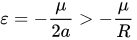
where is the standard gravitational parameter.

Hub AI
Sub-orbital spaceflight AI simulator
(@Sub-orbital spaceflight_simulator)
Sub-orbital spaceflight
A sub-orbital spaceflight is a spaceflight in which the spacecraft reaches outer space, but its trajectory intersects the surface of the gravitating body from which it was launched. Hence, it will not complete one orbital revolution, will not become an artificial satellite nor will it reach escape velocity.
For example, the path of an object launched from Earth that reaches the Kármán line (about 83 km [52 mi] – 100 km [62 mi] above sea level), and then falls back to Earth, is considered a sub-orbital spaceflight. Some sub-orbital flights have been undertaken to test spacecraft and launch vehicles later intended for orbital spaceflight. Other vehicles are specifically designed only for sub-orbital flight; examples include crewed vehicles, such as the X-15 and SpaceShipTwo, and uncrewed ones, such as ICBMs and sounding rockets.
Flights which attain sufficient velocity to go into low Earth orbit, and then de-orbit before completing their first full orbit, are not considered sub-orbital. Examples of this include flights of the Fractional Orbital Bombardment System.
A flight that does not reach space is still sometimes called sub-orbital, but cannot officially be classified as a "sub-orbital spaceflight". Usually a rocket is used, but some experimental sub-orbital spaceflights have also been achieved via the use of space guns.
By definition, a sub-orbital spaceflight reaches an altitude higher than 100 km (62 mi) above sea level. This altitude, known as the Kármán line, was chosen by the Fédération Aéronautique Internationale because it is roughly the point where a vehicle flying fast enough to support itself with aerodynamic lift from the Earth's atmosphere would be flying faster than orbital speed. The US military and NASA award astronaut wings to those flying above 50 mi (80 km), although the U.S. State Department does not show a distinct boundary between atmospheric flight and spaceflight.
During freefall the trajectory is part of an elliptic orbit as given by the orbit equation. The perigee distance is less than the radius of the Earth R including atmosphere, hence the ellipse intersects the Earth, and hence the spacecraft will fail to complete an orbit. The major axis is vertical, the semi-major axis a is more than R/2. The specific orbital energy is given by:
where is the standard gravitational parameter.
Recent media