Hubbry Logo
logo
SpaceShipOne
Community hub

SpaceShipOne

logo
0 subscribers
Read side by side
from Wikipedia

SpaceShipOne is an experimental air-launched rocket-powered aircraft with sub-orbital spaceflight capability at speeds of up to 3,000 ft/s (2,000 mph) / 910 m/s (3,300 km/h) using a hybrid rocket motor. The design features a unique "feathering" atmospheric reentry system where the rear half of the wing and the twin tail booms folds 70 degrees upward along a hinge running the length of the wing; this increases drag while retaining stability. SpaceShipOne completed the first crewed private spaceflight in 2004. That same year, it won the US$10 million Ansari X Prize and was immediately retired from active service. Its mother ship was named "White Knight". Both craft were developed and flown by Mojave Aerospace Ventures, which was a joint venture between Paul Allen and Scaled Composites, Burt Rutan's aviation company. Allen provided the funding of approximately US$25 million.

Key Information

Rutan has indicated that ideas about the project began as early as 1994 and the full-time development cycle time to the 2004 accomplishments was about three years.[citation needed] The vehicle first achieved supersonic flight on December 17, 2003, which was also the one-hundredth anniversary of the Wright Brothers' historic first powered flight. SpaceShipOne's first official spaceflight, known as flight 15P, was piloted by Mike Melvill. A few days before that flight, the Mojave Air and Space Port was the first commercial spaceport licensed in the United States. A few hours after that flight, Melvill became the first licensed U.S. commercial astronaut. The overall project name was "Tier One" which has evolved into Tier 1b with a goal of taking a successor ship's first passengers into space.

The achievements of SpaceShipOne are more comparable to those of the X-15 than to those of orbiting spacecraft like the Space Shuttle. Accelerating a spacecraft to orbital speed requires more than 60 times as much energy as accelerating it to Mach 3. It would also require an elaborate heat shield to safely dissipate that energy during re-entry.[1]

SpaceShipOne's official model designation is Scaled Composites Model 316.

Design

[edit]

Design goal

[edit]

The Scaled Composites Model 316,[2] known as SpaceShipOne, was a spaceplane designed to:

  • Carry three humans (one of them a pilot) in a sea-level pressurized cabin.
  • Be propelled by rocket from an altitude of 15 km (9.3 mi) to in excess of 100 km (62 mi).
  • Reenter atmosphere and shed kinetic energy in an aerodynamically stable configuration.
  • Glide transonically and subsonically.
  • Land horizontally on a standard runway.

Vehicle description

[edit]

The fuselage is cigar-shaped, with an overall diameter of about 1.52 m (5 ft 0 in). The main structure is of a graphite/epoxy composite material. From front to back, it contains the crew cabin, oxidizer tank, fuel casing, and rocket nozzle. The craft has short, wide wings, with a span of 5 m (16 ft) and a chord of 3 m (9.8 ft). Large vertical tailbooms are mounted on the end of each wing, with horizontal stabilizers protruding from the tailbooms. It has gear for horizontal landings.

The overall mass of the fully fueled craft is 3,600 kg (7,900 lb), of which 2,700 kg (6,000 lb) is taken by the fully loaded rocket motor. Empty mass of the spacecraft is 1,200 kg (2,600 lb), including the 300 kg (660 lb) empty motor casing.[3][4]

Originally the nozzle protruded from the back, but this turned out to be aerodynamically disadvantageous. In June 2004, between flights 14P and 15P, a fairing was added, smoothly extending the fuselage shape to meet the flared end of the nozzle. On flight 15P the new fairing overheated, due to being black on the inside and facing a hot, black nozzle. The fairing softened, and the lower part crumpled inwards during boost. Following that flight the interior of the fairing was painted white, and some small stiffening ribs were added.

The craft has a single unsteerable and unthrottleable hybrid rocket motor, a cold gas reaction control system, and aerodynamic control surfaces. All can be controlled manually. See the separate section below concerning the rocket engine.

The reaction control system is the only way to control spacecraft attitude outside the atmosphere. It consists of three sets of thrusters: thrusters at each wingtip control roll, at the top and bottom of the nose control pitch, and at the sides of the fuselage control yaw. All thrusters have redundant backups, so comprising twelve thrusters in all.

The aerodynamic control surfaces of SpaceShipOne are designed to operate in two distinct flight regimes, subsonic and supersonic. The supersonic flight regime is of primary interest during the boost phase of a flight, and the subsonic mode when gliding. The craft has separate upper and lower rudders, and elevons. These are controlled using aviation-style stick and pedals. In supersonic mode the trim tabs are controlled electrically, whereas the subsonic mode uses mechanical cable-and-rod linkage.

The wings of SpaceShipOne can be pneumatically tilted forwards into an aerodynamically stable high-drag "feathered" shape. This removes most of the need to control attitude actively during the early part of reentry: Scaled Composites refer to this as "care-free reentry". One of the early test flights actually performed re-entry inverted, demonstrating the flexibility and inherent stability of Burt Rutan's "shuttlecock" design. This feathered reentry mode is claimed to be inherently safer than the behavior at similar speeds of the Space Shuttle. The Shuttle undergoes enormous aerodynamic stresses and must be precisely steered in order to remain in a stable glide. (Although this is an interesting comparison of behavior, it is not an entirely fair comparison of design concepts: the Shuttle starts reentry at much higher speed than SpaceShipOne, and so has some very different requirements. SpaceShipOne is more similar to the X-15 vehicle.)

An early design called for a permanently shuttlecock-like shape, with a ring of feather-like stabilising fins. This would have made the spacecraft incapable of landing independently, requiring mid-air retrieval. This was deemed too risky, and the hybrid final design manages to incorporate the feathering capability into a craft that can land in a conventional manner. The tiltable rear sections of the wings and the tailbooms are collectively referred to as "the feather".

The landing gear consists of two widely separated main wheels and a nose skid. These are deployed using springs, assisted by gravity. Once deployed, they cannot be retracted inflight.

The spacecraft is incapable of independent takeoff from the ground. It requires a launch aircraft to carry it to launch altitude for an air launch.

The parts of the craft that experience the greatest heating, such as the leading edges of the wings, have about 6.5 kg (14 lb) of ablative thermal protection material applied. The main ingredient of this material was accidentally leaked to Air and Space[clarification needed]. If it flew with no thermal protection, the spacecraft would survive reentry but would be damaged.

The spacecraft's aerodynamic design has an acknowledged "known deficiency" that makes it susceptible to roll excursions. This has been seen on SpaceShipOne flight 15P where wind shear caused a large roll immediately after ignition, and SpaceShipOne flight 16P where circumstances not yet fully understood caused multiple rapid rolls. This flaw is not considered dangerous, but in both of these flights led to the achievement of a much lower altitude than expected. The details of the flaw are not public.

Cabin

[edit]

The spacecraft cabin, designed to hold three humans, is shaped as a short cylinder, diameter 1.52 m (5 ft 0 in), with a pointed forward end. The pilot sits towards the front, and two passengers can be seated behind.

The cabin is pressurized, maintaining a sea level breathable atmosphere. Oxygen is introduced to the cabin from a bottle, and carbon dioxide and water vapor are removed by absorbers. The occupants do not wear spacesuits or breathing masks, because the cabin has been designed to maintain pressure in the face of faults: all windows and seals are doubled.

The cabin has sixteen round double-pane windows, positioned to provide a view of the horizon at all stages of flight. The windows are small compared to the gaps between them, but there are sufficiently many for human occupants to patch together a moderately good view.

The nose section can be removed, and there is also a hatch below the rear windows on the left side. Crew ingress and egress is possible by either route.

Spaceplane navigation

[edit]

The core of the spacecraft avionics is the System Navigation Unit (SNU). Together with the Flight Director Display (FDD), it comprises the Flight Navigation Unit. The unit was developed jointly by Fundamental Technology Systems and Scaled Composites.

The SNU is a GPS-based inertial navigation system, which processes spacecraft sensor data and subsystem health data. It downlinks telemetry data by radio to mission control.

The FDD displays data from the SNU on a color LCD. It has several distinct display modes for different phases of flight, including the boost phase, coast, reentry, and gliding. The FDD is particularly important to the pilot during the boost and coast phase in order to "turn the corner" and null rates caused by asymmetric thrust. A mix of commercial and bespoke software is used in the FDD.

Hybrid rocket engine

[edit]

Tier One uses a hybrid rocket engine supplied by SpaceDev, with solid hydroxyl-terminated polybutadiene (HTPB, or rubber) fuel and liquid nitrous oxide oxidizer. It generates 88 kN (20,000 lbf) of thrust, and can burn for about 87 s (1.45 min).

The physical layout of the engine is novel. The oxidizer tank is a primary structural component, and is the only part of the engine that is structurally connected to the spacecraft: the tank is in fact an integral part of the spacecraft fuselage. The tank is a short cylinder of diameter approximately 1.52 m (5 ft 0 in), with domed ends, and is the forwardmost part of the engine. The fuel casing is a narrow cylinder cantilevered to the tank, pointing backwards. The cantilevered design means that a variety of motor sizes can be accommodated without changing the interface or other components. The nozzle is a simple extension of the fuel casing; the casing and nozzle are actually a single component, referred to as the CTN (case, throat, and nozzle). Burt Rutan has applied for a patent on this engine configuration.

There is considerable use of composite materials in the engine design. The oxidizer tank consists of a composite liner with graphite/epoxy over-wrap and titanium interface flanges. The CTN uses a high-temperature composite insulator with a graphite/epoxy structure. Incorporating the solid fuel (and hence the main part of the engine) and the ablative nozzle into this single bonded component minimizes the possible leak paths.

The oxidizer tank and CTN are bolted together at the main valve bulkhead, which is integrated into the tank. There are O-rings at the interface to prevent leakage; this is the main potential leak path in the engine. The ignition system, main control valve, and injector are mounted on the valve bulkhead, inside the tank. Slosh baffles are also mounted on this bulkhead. Because the oxidizer is stored under pressure, no pump is required.

The tank liner and the fuel casing are built in-house by Scaled Composites. The tank over-wrap is supplied by Thiokol. The ablative nozzle is supplied by AAE Aerospace. The oxidizer fill, vent, and dump system is supplied by Environmental Aeroscience Corporation. The remaining components—the ignition system, main control valve, injector, tank bulkheads, electronic controls, and solid fuel casting—are supplied by SpaceDev.

The CTN must be replaced between firings. This is the only part of the craft, other than the fuel and oxidizer themselves, that must be replaced.

The solid fuel is cast with four holes. This has the disadvantage that it is possible for chunks of fuel between the holes to become detached during a burn and obstruct the flow of oxidizer and exhaust. Such situations tend to rapidly self-correct.

The oxidizer tank is filled and vented through its forward bulkhead, on the opposite side of the tank from the fuel and the rest of the engine. This improves safety. It is filled to a pressure of 4.8 MPa (700 psi) at room temperature.

The nozzle has an expansion ratio of 25:1, which is optimized for the upper part of the atmosphere. A different nozzle, with an expansion ratio of 10:1, is used for test firing on the ground. The nozzles are black on the outside, but for aerodynamic testing, red dummy nozzles are used instead.

The rocket is not throttleable. Once lit, the burn can be aborted, but the power output cannot otherwise be controlled. The thrust in fact varies, for two reasons. Firstly, as the pressure in the oxidizer tank decreases, the flow rate reduces, reducing thrust. Secondly, in the late stages of a burn the oxidizer tank contains a mixture of liquid and gaseous oxidizer, and the power output of the engine varies greatly depending on whether it is using liquid or gaseous oxidizer at a particular moment. (The liquid, being far denser, allows a greater burn rate.)

Both the fuel and oxidizer can be stored without special precautions, and they do not burn when brought together without a significant source of heat. This makes the rocket far safer than conventional liquid or solid rockets. The combustion products are water vapour, carbon dioxide, hydrogen, nitrogen, nitrogen oxides and carbon monoxide.

The engine was upgraded in September 2004, between flights 15P and 16P. The upgrade increased the oxidizer tank size, to provide greater thrust in the early part of the burn, allow a longer burn, and delay the onset of the variable thrust phase at the end of the burn. Prior to the upgrade the engine generated 76 kN (17,000 lbf) of thrust and could burn for 76 s (1.27 min). After the upgrade it was capable of 88 kN (20,000 lbf) thrust and an 87 s (1.45 min) burn.

Launch aircraft

[edit]
White Knight One launch aircraft

Tier One's launch aircraft, Scaled Composites Model 318, known as White Knight, is designed to take off and land horizontally and attain an altitude of about 15 km (9.3 mi), all while carrying the Tier One spacecraft in a parasite aircraft configuration. Its propulsion is by twin turbojets: afterburning J-85-GE-5 engines, rated at 15.6 kN (3,500 lbf) of thrust each.

It has the same cabin, avionics, and trim system as SpaceShipOne. This means it can flight-qualify almost all components of SpaceShipOne. It also has a high thrust-to-weight ratio and large speed brakes. These features combined allow it to be used as a high-fidelity moving platform flight simulator for SpaceShipOne. White Knight is also equipped with a trim system which (when activated) causes it to have the same glide profile as SpaceShipOne; this allows the pilots to practice for landing SpaceShipOne. The same pilots fly White Knight as fly SpaceShipOne.

The aircraft's distinctive shape features long, thin wings, in a flattened "W" shape, with a wingspan of 25 m (82 ft), dual tailplanes, and four wheels (front and rear at each side). The rear wheels retract, but the front ones, which are steerable, are permanently deployed, with small fairings, referred to as "spats", in front. Another way to look at the overall shape is as two conventional planes, with very thin fuselages, side by side and joined at their wingtips, with the cockpit and engines mounted at the point of joining.

Although White Knight was developed for certain roles in the Tier One program, it is a very capable aircraft in its own right. Scaled Composites describe it as a "high-altitude research aircraft".

Flight profile

[edit]

SpaceShipOne takes off from the ground, attached to White Knight in a parasite configuration, and under White Knight's power. The combination of SpaceShipOne and White Knight can take off, land, and fly under jet power to high altitude. A captive carry[5] flight is one where the two craft land together without launching SpaceShipOne; this is one of the main abort modes available.

For launch, the combined craft flies to an altitude of around 14 km (8.7 mi), which takes about an hour. SpaceShipOne is then drop-released, and briefly glides unpowered. Rocket ignition may take place immediately, or may be delayed. If the rocket is never lit then SpaceShipOne can glide down to the ground. This is another major abort mode, in addition to being flown deliberately in glide tests.

The rocket engine is ignited while the spacecraft is gliding. Once under power, it is raised into a 65° climb, which is further steepened in the higher part of the trajectory. The maximum acceleration during ascent was recorded at 1.70G.[6]

By the end of the burn the craft is flying upwards at some multiple of the speed of sound, up to about 900 m/s (3,000 ft/s) and Mach 3.5, and it continues to coast upwards unpowered (i.e. ballistically). If the burn was long enough then it will exceed an altitude of 100 km (62 mi), at which height the atmosphere presents no appreciable resistance, and the craft experiences free fall for a few minutes.

While at apogee the wings are reconfigured into high-drag mode. As the craft falls back it achieves high speeds comparable to those achieved on the way up; when it subsequently reenters the atmosphere it decelerates violently, up to 5.75G. At some altitude between 10 km (6.2 mi) and 20 km (12 mi) it reconfigures into low-drag glider mode, and glides down to a landing in about 20 minutes.

White Knight takes longer to descend, and typically lands a few minutes after SpaceShipOne.

Specifications

[edit]

Data from astronautix.com[3]

General characteristics

  • Crew: One
  • Length: 27 ft 11 in (8.5[7] m)
  • Wingspan: 26 ft 11 in (8.2[8] m)
  • Diameter: 5 ft 0 in (1.52 m)
  • Wing area: 160 sq ft (15 m2)
  • Empty weight: 2,646 lb (1,200 kg)
  • Gross weight: 7,937 lb (3,600 kg)
  • Aspect Ratio: 1.6
  • Powerplant: 1 × SpaceDev N2O/HTPB hybrid rocket, 16,500 lbf (73.5 kN) thrust
  • Isp: 250 s (2.5 km/s)
  • Burn time: 80 seconds

Performance

  • Maximum speed: Mach 3.09 (2370 mph, 3815 km/h)
  • Range: 40 mi (65 km, 35 nmi)
  • Service ceiling: 367,000 ft (112,000 m)
  • Rate of climb: 82,000 ft/min (420 m/s)
  • Wing loading: 49 lb/sq ft (240 kg/m2)
  • Thrust/weight: 2.08

Development and winning the X Prize

[edit]
Flight 16P taxi pre launch
Launch of the rockets on SpaceShipOne
A crowd watches as SpaceShipOne makes its second flight
(L to R) Marion Blakely (FAA), Mike Melvill; Richard Branson, Burt Rutan, Brian Binnie, and Paul Allen reflect on a mission accomplished (October 4, 2004)
SpaceShipOne Flight Sept 2004
Mike Melvill SpaceShipOne Government Zero 15P

SpaceShipOne was developed by Mojave Aerospace Ventures (a joint venture between Paul Allen and Scaled Composites, Burt Rutan's aviation company, in their Tier One program), without government funding. On June 21, 2004, it made the first privately funded human spaceflight. On October 4, it won the US$10 million Ansari X Prize, by reaching 100 kilometers in altitude twice in a two-week period with the equivalent of three people on board and with no more than ten percent of the non-fuel weight of the spacecraft replaced between flights. Development costs were estimated to be US$25 million, funded completely by Paul Allen.[9]: 10, 80–111 

During its test program, SpaceShipOne set a number of important "firsts", including first privately funded aircraft to exceed Mach 2 and Mach 3, first privately funded crewed spacecraft to exceed 100km altitude, and first privately funded reusable crewed spacecraft.[9]: 80–111 

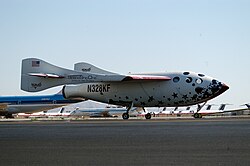
SpaceShipOne was registered with the FAA as N328KF.[10] N is the prefix for US-registered aircraft; 328KF was chosen by Scaled Composites to stand for 328 kilofeet (about 100 kilometers), the officially designated edge of space. The original choice of registry number, N100KM, was already taken. N328KF is registered as a glider, reflecting the fact that most of its independent flight is unpowered.

SpaceShipOne's first flight, 01C, was an uncrewed captive flight test on May 20, 2003. Glide tests followed, starting with flight 03G on August 7, 2003. Its first powered flight, flight 11P, was made on December 17, 2003, the 100th anniversary of the first powered flight.

On April 1, 2004, Scaled Composites received the first license for suborbital rocket flights to be issued by the US Office of Commercial Space Transportation. This license permitted the company to conduct powered test flights over the course of one year. On June 17, 2004, under the leadership of airport CEO Stuart O. Witt, Mojave Airport reclassified itself as the Mojave Air and Space Port.[11]

Flight 15P on June 21, 2004, was SpaceShipOne's first spaceflight, and the first privately funded human spaceflight. There were a few control problems,[12] but these were resolved prior to the Ansari X PRIZE flights that followed, with flight 17P to 112 km on October 4, 2004,[13] winning the prize.

The SpaceShipOne Team was awarded the Space Achievement Award[14] by the Space Foundation in 2005.

Flights

[edit]

On 17 December 2003—on the 100th anniversary of the Wright brothers first powered flight of an aircraftSpaceShipOne, piloted by Brian Binnie on Flight 11P, made its first rocket-powered flight and became the first privately built craft to achieve supersonic flight.[9]: 8 

SpaceShipOne landing

All of the flights of SpaceShipOne were from the Mojave Airport Civilian Flight Test Center. Flights were numbered, starting with flight 01 on May 20, 2003. One or two letters are appended to the number to indicate the type of mission. An appended C indicates that the flight was a captive carry, G indicates an unpowered glide, and P indicates a powered flight. If the actual flight differs in category from the intended flight, two letters are appended: the first indicating the intended mission and the second the mission actually performed.

SpaceShipOne flights
Flight Date Top speed Altitude Duration Pilot
01C May 20, 2003 14.63 km[15] 1 h 48 min uncrewed
02C July 29, 2003 14 km[3] 2 h 06 min Mike Melvill
03G August 7, 2003 278 km/h 14.33 km[15] 19 min 00 s Mike Melvill
04GC August 27, 2003 370 km/h[15] 14 km[3] 1 h 06 min Mike Melvill
05G August 27, 2003 370 km/h 14.69 km[15] 10 min 30 s Mike Melvill
06G September 23, 2003 213 km/h 14.26 km[15] 12 min 15 s Mike Melvill
07G October 17, 2003 241 km/h 14.08 km[15] 17 min 49 s Mike Melvill
08G November 14, 2003 213 km/h 14.42 km[15] 19 min 55 s Peter Siebold
09G November 19, 2003 213 km/h 14.72 km[15] 12 min 25 s Mike Melvill
10G December 4, 2003 213 km/h 14.75 km[15] 13 min 14 s Brian Binnie
11P December 17, 2003 Mach 1.2 20.67 km[15] 18 min 10 s Brian Binnie
12G March 11, 2004 232 km/h 14.78 km[15] 18 min 30 s Peter Siebold
13P April 8, 2004 Mach 1.6 32.00 km[15] 16 min 27 s Peter Siebold
14P May 13, 2004 Mach 2.5 64.43 km[15] 20 min 44 s Mike Melvill
15P June 21, 2004 Mach 2.9 100.124 km[15] 24 min 05 s Mike Melvill
16P September 29, 2004 Mach 2.92 102.93 km[15] 24 min 11 s Mike Melvill
17P October 4, 2004 Mach 3.09 112.014 km[13][15] 23 min 56 s Brian Binnie
North American X-15Space ShuttleBuranSpaceShipOneBoeing X-37Atlas V
SpaceShipOne ranks among the world's first spaceplanes in the first 50 years of human spaceflight, with the North American X-15, Space Shuttle, Buran, and Boeing X-37. SpaceShipOne is the second spaceplane to have launched from a mother ship, preceded only by the North American X-15.

The flights were accompanied by two chase planes—an Extra 300 owned and flown by Chuck Coleman, and a Beechcraft Starship.[16]

Astronauts

[edit]

The SpaceShipOne pilots came from a variety of aerospace backgrounds. Mike Melvill is a test pilot, Brian Binnie is a former Navy pilot, and Peter Siebold is an engineer at Scaled Composites. They qualified to fly SpaceShipOne by training on the Tier One flight simulator and in White Knight and other Scaled Composites aircraft.

Retirement

[edit]
SpaceShipOne now hangs in the National Air and Space Museum in Washington, D.C.

SpaceShipOne's space flights were watched by large crowds at Mojave Spaceport. A fourth suborbital flight, Flight 18P, was originally scheduled for October 13, 2004. However, Burt Rutan decided not to risk damage to the historic craft, and cancelled it and all future flights.

On July 25, 2005, SpaceShipOne was taken to the Oshkosh Airshow in Oshkosh, Wisconsin. After the airshow, Mike Melvill and crew flew the White Knight, carrying SpaceShipOne, to Wright-Patterson Air Force Base in Dayton, Ohio, where Melvill spoke to a group of about 300 military and civilian personnel. Later in the evening, Melvill gave a presentation at the Dayton Engineers Club, entitled "Some Experiments in Space Flight", in honor of Wilbur Wright's now-famous presentation to the American Society of Mechanical Engineers in 1901 entitled "Some Experiments in Flight." The White Knight then transported SpaceShipOne to the Smithsonian Institution's National Air and Space Museum to be put on display. It was unveiled on Wednesday October 5, 2005 in the Milestones of Flight gallery and is now on display to the public in the main atrium with the Spirit of St. Louis, the Bell X-1, and the Apollo 11 command module Columbia.

Commander Brian Binnie donated the flight suit and checklist used during his Ansari X Prize-winning flight to an auction benefitting Seattle's Museum of Flight. Entertainer and fundraising auctioneer Fred Northup Jr. purchased the flight suit and checklist book, and the flight suit is on display at the museum's Charles Simonyi Space Gallery.

A piece of SpaceShipOne's carbon fiber material was launched aboard the New Horizons mission to Pluto in 2006.[17]

Replicas

[edit]
Normal configuration of SpaceShipOne replica
Normal configuration
Feathered configuration of SpaceShipOne replica
Feathered configuration
EAA replica in both feathered and normal configuration.

A year after its appearance in the Oshkosh Airventure airshow, the Experimental Aircraft Association featured a full-scale replica of the spacecraft in a wing of its museum which housed other creations of Burt Rutan. Using the same fiberglass molds as the original, it was so exact in its replication—despite not having any doors or interior—that it was dubbed "Serial 2 Scaled" by Scaled Composites. Each detail in its appearance was matched, down to the N328KF registration number on its fuselage. It is so precise that, during a 7-minute video presentation held every hour on the half hour in the museum, it can display the two different modes of its 'feathering' ability, albeit through the aid of pulleys and wires (there is no machinery in the replica).[18]

Other full-scale replicas are at the William Thomas Terminal at Meadows Field Airport in Bakersfield[19][20] the Mojave Spaceport's Legacy Park alongside the original Roton Atmospheric Test Vehicle,[citation needed] the Flying Heritage Collection at Paine Field in Everett,[21] and Google's Mountain View Campus.[22]

SpaceShipOne was also made into a model rocket in 2004.[23]

Subsequent spacecraft

[edit]

With the success of Tier One meeting its project goals, a successor project started in 2004 was Tier 1b. The successor ships are named SpaceShipTwo and White Knight Two. The name of the joint venture between Virgin Group and Scaled Composites is called The Spaceship Company, with a goal of carrying passengers under the name Virgin Galactic, a spaceliner with an initial target of a commercial fleet of five spacecraft.[24][25]

In August 2005, Virgin Galactic stated that if the upcoming suborbital service with SpaceShipTwo would be successful, the follow-up would be known as SpaceShipThree.[26][27]

On 13 December 2018, VSS Unity achieved the SpaceShipTwo project's first suborbital space flight, VSS Unity VP-03, with two pilots, reaching an altitude of 82.7 kilometres (51.4 mi), and officially entering outer space by US standards.[28][29]

[edit]

See also

[edit]

References

[edit]
[edit]
Revisions and contributorsEdit on WikipediaRead on Wikipedia
from Grokipedia
SpaceShipOne was an experimental air-launched suborbital spaceplane developed by Scaled Composites, designed to demonstrate the feasibility of private human spaceflight and space tourism through a reusable rocket-powered vehicle.[1] Funded primarily by Microsoft co-founder Paul Allen, the project aimed to create an affordable, robust spacecraft capable of carrying passengers beyond the Kármán line (100 km altitude) for brief periods of weightlessness.[1] The spaceplane's innovative design featured a composite graphite-epoxy structure measuring approximately 28 feet in length with a 60-inch diameter cabin for up to three occupants, powered by a hybrid rocket motor using nitrous oxide and solid rubber fuel.[2] It was air-launched from the White Knight carrier aircraft, which elevated it to approximately 47,000 feet before ignition, allowing for efficient suborbital trajectories reaching speeds over Mach 3 and altitudes exceeding 100 km.[2] A key engineering highlight was its "feathering" reentry system, where the wings and tail could pivot upward at a 65-degree angle to provide aerodynamic stability during atmospheric reentry, reducing thermal stress without traditional heat shields.[1] SpaceShipOne's development began in the early 2000s under aerospace engineer Burt Rutan, with the first unpowered glide test on August 7, 2003, followed by the first powered flight on December 17, 2003.[2] The program culminated in three historic crewed spaceflights: on June 21, 2004, pilot Mike Melvill reached 100.1 km in the world's first private human spaceflight, experiencing three minutes of weightlessness; on September 29, 2004, Melvill again piloted to 103 km despite an in-flight anomaly involving excessive rolling; and on October 4, 2004, Brian Binnie achieved a record 112 km altitude.[2][3] These missions secured the $10 million Ansari X Prize for Scaled Composites by completing two suborbital flights above 100 km within two weeks, carrying the equivalent mass of three people.[1] The achievements of SpaceShipOne marked a pivotal shift in space exploration, proving that non-governmental entities could safely send humans to space and inspiring the commercial space industry, including subsequent ventures like Virgin Galactic's SpaceShipTwo.[2] It earned prestigious awards, such as the 2004 Collier Trophy for aeronautical achievement, and is now preserved in the Smithsonian National Air and Space Museum's Boeing Milestones of Flight Hall as a symbol of innovative private aerospace engineering.[1]

Background and Development

Origins and Funding

The concept of private spaceflight gained momentum in the mid-1990s amid growing interest in reducing the costs and risks associated with space access, traditionally dominated by government programs. A pivotal catalyst was the announcement of the X Prize in May 1996 by the X Prize Foundation, which offered a $10 million reward to the first privately funded team to build and fly a reusable spacecraft capable of carrying three people to an altitude of 100 kilometers (62 miles) above Earth, landing safely, and repeating the feat within two weeks.[4] This initiative, inspired by early 20th-century aviation prizes like the Orteig Prize that spurred Charles Lindbergh's transatlantic flight, aimed to spur innovation in commercial space travel and demonstrate the viability of non-governmental efforts.[5] Burt Rutan, a renowned aerospace designer known for his work on unconventional aircraft, played a foundational role through his company, Scaled Composites. Founded by Rutan in April 1982 as an independent aerospace research firm, Scaled Composites specialized in rapid prototyping and cost-effective development of experimental vehicles, producing over 40 innovative aircraft designs by the early 2000s that emphasized lightweight composites and simplified engineering to lower barriers in aviation and space.[6] The company's track record in low-cost innovation positioned it ideally for ambitious private ventures, including early conceptual work on suborbital vehicles influenced by the X Prize.[7] The SpaceShipOne project was formally launched in April 2001 under the codename "Tier One," with primary funding from Microsoft co-founder Paul Allen through his investment firm, Vulcan Inc., totaling approximately $25 million—entirely private capital without any government subsidies.[8] This investment enabled Scaled Composites to pursue a secretive full-scale development program focused on achieving suborbital spaceflight via an air-launched, reusable spacecraft that prioritized innovative, low-risk engineering principles to validate the economics of commercial space access.[9] Allen's commitment stemmed from his long-standing interest in space exploration, viewing the project as a step toward affordable human spaceflight for tourism and research.[10] Following the funding commitment, the project transitioned to its design phase under Rutan's leadership, setting the stage for the vehicle's engineering and testing.[11]

Design Objectives

The primary design objective for SpaceShipOne was to achieve suborbital flight beyond the Kármán line at 100 kilometers altitude twice within a two-week period using the same vehicle, while carrying the equivalent of three crew members (one pilot and ballast representing two passengers), in compliance with the Ansari X Prize competition rules.[12] This goal emphasized demonstrating private-sector capability for repeatable human spaceflight without extensive refurbishment between missions.[11] A core focus was on reusability to enable frequent operations with minimal maintenance, to drastically reduce costs compared to expendable systems.[13] The design aimed for an operational cost per flight of approximately $80,000, achieved through simple turnaround procedures and avoidance of major overhauls.[14] Innovation in propulsion centered on a hybrid rocket motor using non-toxic liquid nitrous oxide and solid fuel, selected to simplify handling, eliminate the hazards of liquid or solid propellants, and support rapid reusability.[11] The reentry system incorporated a novel "feathering" mechanism, where the wing and tail pivoted to a high-drag configuration for passive aerodynamic stability during atmospheric descent, minimizing pilot workload and structural stress without active control surfaces.[11] Risk mitigation was prioritized through a modular airframe allowing independent ground testing of subsystems, extensive pre-flight simulations, and air-launch from 50,000 feet via the White Knight carrier aircraft to reduce dynamic pressure and g-forces during boost.[11] These objectives were pursued under private funding from Paul Allen, enabling Scaled Composites to prototype and validate the concept within a $25 million budget.[11]

Key Personnel and Partnerships

Burt Rutan served as the chief designer of SpaceShipOne at Scaled Composites, the aerospace company he founded in 1982.[15] His design drew on extensive prior experience with innovative composite aircraft, including the Rutan Voyager, which achieved the first nonstop, nonrefueled circumnavigation of the Earth in 1986.[16] Rutan's vision for suborbital spaceflight aligned with the Ansari X Prize objectives for private manned missions.[17] Paul Allen, cofounder of Microsoft, acted as the primary funder and visionary backer, investing approximately $25 million through Mojave Aerospace Ventures, a joint venture he established with Scaled Composites to support the project.[18] Allen's inspiration stemmed from Rutan's concepts for making space travel more accessible via reusable, privately developed vehicles.[19] Within the Scaled Composites team, Doug Shane functioned as the operations director and chief test pilot, overseeing flight operations and contributing to early powered test flights.[20] Dan Kreigh led the structural engineering efforts, ensuring the airframe's integrity using advanced composite materials for the demanding suborbital environment.[21] These contributions were made under the umbrella of Mojave Aerospace Ventures, which coordinated the overall development without direct NASA funding, relying instead on private investment.[18] Partnerships were limited to maintain control over the project, with SpaceDev selected as the exclusive supplier for the hybrid rocket motor components, utilizing nitrous oxide as the oxidizer and rubber-based hydroxy-terminated polybutadiene as the fuel.[22] The Federal Aviation Administration provided regulatory advisory input, issuing the first U.S. commercial manned suborbital launch license to Scaled Composites on April 1, 2004, to facilitate testing and operations from Mojave Airport.[23]

Technical Design

Airframe and Configuration

SpaceShipOne's airframe utilized advanced composite construction, consisting of carbon fiber reinforced with epoxy resin and a foam core sandwich structure, to achieve high strength-to-weight ratios essential for suborbital operations. This material choice resulted in an empty weight of approximately 1,300 kg, while the gross weight reached about 3,900 kg when fully loaded for flight.[1][24] The design emphasized simplicity and robustness, drawing from Scaled Composites' expertise in composite fabrication to minimize manufacturing complexity and costs.[2] The vehicle's overall configuration adopted a blended wing-body layout, measuring roughly 28 ft in length and featuring a 16 ft wingspan with straight, low-aspect-ratio wings optimized for subsonic gliding and ascent performance. Twin tail booms extended from the wingtips, supporting horizontal stabilizers and rudders for control, while the blended body reduced aerodynamic drag during atmospheric phases. Cold gas thrusters, powered by nitrogen, provided precise attitude control during the vacuum portion of the flight, enabling orientation adjustments without aerodynamic surfaces.[25][24] This airframe geometry also accommodated the hybrid engine's thrust profile, ensuring structural integrity under powered ascent loads.[2] A distinctive aerodynamic feature was the feathering mechanism, which allowed the rear portions of the wings and tail booms to rotate upward by 65 degrees, transforming the vehicle into a high-drag, shuttlecock-like shape for stable reentry. This reconfiguration, actuated pneumatically by the pilot, was deployed during reentry (typically above 50,000 ft) and retracted during descent, permitting a hands-off descent with inherent stability. The system dramatically increased drag to decelerate the spacecraft gently, limiting peak heating to manageable levels around 350°C and obviating the need for heavy ablative shields or complex thermal tiles.[2][11] By relying on this passive aerodynamic solution, the airframe achieved reentry with reduced aero-thermal stresses, prioritizing reusability and pilot safety over traditional high-heat mitigation approaches.[24]

Propulsion and Engine

SpaceShipOne employed a hybrid rocket propulsion system, utilizing nitrous oxide as the liquid oxidizer and hydroxyl-terminated polybutadiene (HTPB) rubber as the solid fuel.[26][27] This non-toxic combination offered enhanced safety compared to traditional liquid or solid rockets, as ignition requires the simultaneous presence of both components, preventing accidental detonation.[28] The nitrous oxide was stored in a composite tank that also served as a structural bulkhead. The tank was instrumented for pressure and temperature monitoring. Flight test logs indicate that temperature was controlled via bleed air heating from the White Knight carrier aircraft, maintaining N2O pressure variations to less than 6 psi during climbs to launch altitude.[29] The hybrid motor case incorporated burn-through sensors (fiber optic) to detect anomalies such as unusual burning and automatically shut the N2O valve if needed. No specific sensor models or detailed tank-mounted instrumentation are described in available sources. The engine, designated the SpaceDev SD010, featured a single nozzle and was designed for restart capability, allowing potential multiple burns if needed, though operational flights used a single burn sequence.[30][29] Development of the motor was conducted in-house at Scaled Composites in collaboration with SpaceDev, which provided key components and expertise in hybrid technology.[31][11] The system underwent extensive ground testing, including 11 research and development hot-fire firings over nine months followed by three qualification tests using flight hardware, to validate performance and reliability prior to integration.[11] These tests confirmed the motor's stability and combustion characteristics on a mobile test stand.[29] In flight, the engine ignited shortly after release from the carrier aircraft at approximately 50,000 feet (15 km) altitude, delivering peak thrust of 16,800 lbf (74.7 kN) for durations typically around 76 seconds, as demonstrated in key powered flights.[30][32] While not continuously throttleable, the hybrid design allowed for burn termination if required, providing operational flexibility.[2] The motor's performance propelled SpaceShipOne to suborbital velocities exceeding Mach 3, with thrust governed by the standard rocket equation:
F=m˙ve+(PePa)Ae F = \dot{m} v_e + (P_e - P_a) A_e
where FF is thrust, m˙\dot{m} is the effective exhaust mass flow rate, vev_e is exhaust velocity, PeP_e and PaP_a are exit and ambient pressures, and AeA_e is nozzle exit area.[33]

Cabin and Avionics

The cabin of SpaceShipOne was a pressurized compartment designed for a shirt-sleeve environment, enabling crew members to fly without full spacesuits during nominal operations.[2] Featuring a 60-inch (1.52-meter) diameter, the cabin accommodated three occupants in continuous composite shell seats with energy-absorbing structures and conformal cushions laced to the airframe for enhanced safety during high-g maneuvers.[2][11] It included sixteen 9-inch (23-centimeter) round dual-pane windows, arranged to provide horizon visibility throughout the flight profile while minimizing structural stress from pressure differentials.[34] The environmental control system (ECS) maintained cabin pressure with CO2 scrubbing capabilities, supported by onboard oxygen supply for breathable air.[2][11] Pilots wore pressure suits as a precaution against potential cabin depressurization, with emergency egress facilitated by canopy jettison mechanisms.[35] Avionics in SpaceShipOne centered on a battery-operated inertial navigation system (INS) augmented by GPS, known as the FunTech RacerView, which processed sensor data to compute position, attitude, angle of attack, sideslip, and velocity.[11] This system delivered steering commands for boost and approach phases via a color LCD flight director display, with a backup attitude/GPS configuration for redundancy.[11] The avionics suite also handled health monitoring and telemetry downlink, integrating with the overall navigation framework to execute the suborbital flight profile autonomously where possible.[2][11] Flight controls employed a hybrid approach with manual subsonic actuation via stick and rudders, electric supersonic trim for stability at high dynamic pressures, and a cold-gas reaction control system (RCS) using nitrogen thrusters for attitude orientation in zero-gravity conditions.[2] Elevons and rudders managed trajectory during powered flight, augmented by electric stabilizer trim to support manual inputs.[11] The RCS provided precise, low-thrust corrections in vacuum, triggered directly by pilot stick limits to maintain orientation without aerodynamic surfaces.[36]

Carrier Aircraft and Launch Mechanism

The White Knight, designated Model 318 by Scaled Composites, was a twin-fuselage, high-altitude carrier aircraft designed specifically to transport and launch SpaceShipOne, the experimental suborbital spacecraft. Built by Scaled Composites in Mojave, California, it featured a unique configuration with two parallel fuselages connected by wings and a central horizontal stabilizer, providing stability and space for the payload beneath the center wing. Powered by three Williams FJ44-1 turbofan engines, White Knight achieved a service ceiling of approximately 50,000 feet (15,000 meters), enabling it to carry SpaceShipOne to optimal launch altitudes while minimizing atmospheric drag on the subsequent rocket burn. Its first flight occurred on August 1, 2002.[37] SpaceShipOne was mated to White Knight's underbelly via structural pylons, positioning the spacecraft horizontally for aerodynamic efficiency during the climb. The launch mechanism involved the carrier aircraft ascending to an altitude above 45,000 feet (13,700 meters), where the copilot would release the spacecraft, allowing it to separate cleanly and begin a controlled freefall. Following release, the SpaceShipOne pilot glided the vehicle for about 20 seconds to transition from the carrier's speed to the rocket's ignition profile before firing the hybrid engine. This air-drop system was integral to the Tier One program, enabling multiple missions with the same carrier.[2] The operational role of White Knight significantly reduced the propellant requirements for SpaceShipOne compared to a ground launch, as the high-altitude release avoided the need for the rocket to overcome initial low-altitude drag and gravity losses, thereby lowering overall vehicle weight and cost. In the event of an abort after release, SpaceShipOne's glider-like design permitted a safe unpowered return to the runway, enhancing mission safety without relying on the carrier for recovery. White Knight's specifications included a wingspan of 83 feet (25 meters) and a payload capacity of up to 7,000 pounds (3,200 kilograms), supporting its reuse across the 17-flight test program and subsequent missions.[38][24]

Operational Profile

Flight Sequence

The flight sequence of SpaceShipOne began with its aerial release from the White Knight carrier aircraft at approximately 50,000 feet (15 km) altitude, initiating Phase 1.[11] Following the drop, the vehicle glided and oriented itself for about 20 seconds to achieve the proper attitude for ignition, relying on its aerodynamic stability during this unpowered transition.[2] In Phase 2, the hybrid rocket engine ignited shortly after release, burning for roughly 76 seconds and providing thrust to accelerate the vehicle from subsonic speeds to over Mach 3 (approximately 2,300 mph or 3,700 km/h).[3] This powered ascent propelled SpaceShipOne from around 48,000 feet to an apogee exceeding 100 km (62 miles), crossing the Kármán line into space while experiencing peak dynamic pressures of up to 260 knots equivalent airspeed and vertical accelerations reaching 3.3 g.[11] The sequence depended on the hybrid engine's controlled thrust for this vertical boost phase.[2] Phase 3 commenced near the coast phase's peak, with the vehicle's unique feathering system deploying at approximately 220,000 feet (67 km) while still in weightlessness, rotating the wings and tail to a 65-degree angle for maximum drag.[11][39] This configuration enabled a stable, passive reentry, decelerating from Mach 2.5 to subsonic speeds in about 3 minutes through altitudes from 200,000 feet down to 85,000 feet (26 km), with peak loads of 5.5 g sustained above 4 g for 16 seconds.[11] Transitioning to Phase 4, the feathering system was retracted at around 70,000 feet (21 km), restoring the vehicle's aerodynamic shape for controlled gliding.[11][39] SpaceShipOne then descended in a 15- to 20-minute glide at about 105 knots equivalent airspeed, covering a crossrange of over 200 miles (320 km) before touching down on the Mojave Airport runway at approximately 75 knots.[11][2] For contingencies, SpaceShipOne incorporated abort modes such as an engine-out glide from the drop altitude or a ballistic reentry using the feathering system for stability without active control inputs.[11] SpaceShipOne's navigation system relied on an integrated inertial navigation system (INS) augmented by GPS to determine position, attitude, velocity, and flight path without dependence on ground-based radar. The core component was a battery-operated INS/GPS unit developed by Fundamental Technology Systems, based on the FunTech RacerView architecture, which calculated key parameters such as angle of attack, sideslip, and equivalent airspeed while providing backup attitude and altitude data from GPS and velocity indicators. This setup delivered real-time flight director cues to the pilot via a color LCD Flight Director Display (FDD), including steering commands for boost trajectory shaping, reentry targeting, and landing approach guidance.[11][40][41] The vehicle's control systems operated in three distinct modes to handle varying flight regimes: manual subsonic controls using traditional pushrods and cables connected to a sidestick and rudder pedals for low-speed operations; electric actuators for supersonic elevons and rudders during boost and high-dynamic-pressure phases, augmented by electric stabilizer trim to assist manual inputs; and a cold-gas reaction control system (RCS) for attitude adjustments in zero-gravity coast and reentry. Pilots maintained primary authority over these systems, with no full autopilot implementation, allowing direct override for trajectory corrections during ascent and descent. These controls built on the cabin avionics hardware to ensure responsive handling across suborbital profiles.[2][11][42] During reentry, the feathering mechanism—consisting of articulated winglets and tail booms that rotated upward to 65 degrees—increased drag for stable, high-angle-of-attack descent, deployed manually by the pilot during weightlessness to minimize thermal and structural loads.[2][43][39] The RCS provided roll control in this configuration, while conventional aerodynamic surfaces like elevons handled pitch and yaw stabilization upon unfeathering at approximately 70,000 feet. This approach enabled a predictable reentry footprint without active guidance beyond pilot-monitored cues.[2][43][11] Custom software algorithms within the flight navigation unit optimized trajectories by processing INS/GPS data to generate precise steering commands, ensuring alignment with mission apogee targets and reentry corridors through iterative boost and coast adjustments. Developed collaboratively by Scaled Composites and avionics partners, this software was validated via six-degree-of-freedom simulations and integrated ground tests prior to flight.[11][40]

Safety Features

SpaceShipOne incorporated several redundancies to enhance crew safety during its high-risk suborbital profile. The hybrid rocket engine, utilizing non-toxic nitrous oxide and solid rubber fuel, was inherently safer than traditional liquid or solid propellant systems due to its non-explosive nature, reducing the risk of catastrophic failure if a breach occurred.[17] Electrical power for critical systems was provided by rechargeable lithium batteries, offering a reliable backup source independent of the main propulsion.[36] Additionally, the feathering system featured redundant pneumatic actuators to ensure reliable deployment of the wing and tail configuration for emergency reentry stability.[43] Key abort options were designed to protect the pilot in various failure scenarios. The innovative feathering mechanism allowed the vehicle to transition to a high-drag, stable orientation for atmospheric reentry, even if the engine failed mid-burn, preventing uncontrolled tumbling and enabling a safe glide to landing.[44] For low-altitude emergencies, the cockpit canopy could be jettisoned, providing clear access for the pilot to egress and deploy a personal parachute.[36] These features complemented the air-launch mechanism's inherent flexibility, allowing mission abort at multiple points during the carrier aircraft's climb.[45] Safety was validated through rigorous pre-powered testing, including eight unpowered glide flights starting in August 2003, which confirmed the vehicle's handling, feathering deployment, and reentry characteristics without reliance on propulsion.[25] Pilots wore oxygen masks and lightweight flight suits suitable for cabin pressurization up to launch altitudes around 50,000 feet, with the design prioritizing rapid decompression protection over full vacuum-rated pressure garments.[36] Regulatory oversight further ensured operational safety; in 2003, the Federal Aviation Administration issued an experimental airworthiness certificate for SpaceShipOne, alongside a launch license, enabling developmental flights under strict conditions.[46] Across its 17 test flights, including three reaching space, the vehicle experienced no major incidents, demonstrating the effectiveness of these integrated safety measures.[39]

Testing and Achievements

Initial Test Flights

The initial test flights of SpaceShipOne began with unpowered glide tests to validate the vehicle's aerodynamic stability and handling characteristics after release from the White Knight carrier aircraft. These tests were essential for confirming the design's performance in subsonic regimes before progressing to powered missions. Over the course of the program, SpaceShipOne completed 11 unpowered flights, including captive carries and glides, which progressively expanded the flight envelope and tested systems integration.[47][39] The first free-flight glide, designated 03G, occurred on August 7, 2003, with test pilot Mike Melvill at the controls. Released from approximately 47,000 feet (14,300 meters) at 125 knots, the 19-minute flight demonstrated clean separation from White Knight, stable handling across 60% of the subsonic envelope, and a smooth landing at Mojave Air and Space Port. This milestone confirmed the accuracy of ground-based simulator predictions and paved the way for additional glides that refined control inputs and feather reentry system deployment. Subsequent glides, such as 04G through 10G, incorporated avionics checks, pilot familiarization for new crew like Pete Siebold, and cold-flow tests of the nitrous oxide propulsion components without ignition.[47][39] Transitioning to powered tests, the first rocket-assisted flight, 11P, took place on December 17, 2003, piloted by Brian Binnie. Following a 15-second burn of the hybrid rocket motor, SpaceShipOne achieved supersonic speeds and an apogee of 67,800 feet (20,700 meters) during its 18-minute, 10-second duration. Although the mission successfully validated motor ignition and transonic handling, a post-landing issue caused the left main landing gear to collapse, requiring three weeks of repairs. This flight marked the initial powered envelope expansion, addressing early concerns with roll stability during feather reentry.[47][39] The second powered flight, 13P on April 8, 2004, with Pete Siebold piloting, extended the envelope further with a 40-second burn, reaching an apogee exceeding 105,000 feet (32 kilometers) in 16 minutes, 27 seconds. Ignition was delayed by shock-induced stall buffet, but the vehicle handled supersonic conditions nominally, including feather recovery, and landed smoothly. Iterative fixes from prior tests, such as enhanced servo responses, improved overall system reliability. The third powered test, 14P on May 13, 2004, piloted by Melvill, featured a 55-second burn to an apogee of 211,400 feet (64.4 kilometers) over 20 minutes, 44 seconds, testing reaction control systems and feather stability despite an inoperative flight director display during boost, which was resolved via reboot.[47][39] A key milestone came with flight 15P on June 21, 2004, again piloted by Melvill, which achieved the program's first spaceflight above the Kármán line. The 76-second burn propelled the vehicle to Mach 2.8 and an apogee of 328,491 feet (100.1 kilometers) in a 24-minute, 5-second mission, earning Melvill his commercial astronaut wings. Despite loss of primary pitch trim control—requiring backup systems—and a reentry path deviation south of the target, the flight successfully demonstrated full suborbital capability and iterative resolutions to propulsion and control issues from earlier tests. These initial powered successes, comprising three of the eventual six rocket flights in the 17-flight program, built foundational data toward meeting suborbital requirements.[47][39]

Ansari X Prize Flights

SpaceShipOne's successful bid for the Ansari X Prize culminated in two qualifying suborbital flights conducted within six days in late 2004, demonstrating the vehicle's reusability and ability to carry the equivalent of three crew members to an altitude exceeding 100 kilometers (62 miles). These flights, designated 16P and 17P, met the competition's stringent requirements for a privately developed, non-governmental spacecraft to perform two such missions within 14 days without significant structural replacement. The Ansari X Prize, established to spur innovation in private spaceflight, offered $10 million to the first team achieving this milestone.[5] The first qualifying flight, 16P, launched on September 29, 2004, from the Mojave Air and Space Port in California. Piloted by Mike Melvill, SpaceShipOne was released from its White Knight carrier aircraft at approximately 15 kilometers (50,000 feet) altitude and ignited its hybrid rocket motor, burning for 77 seconds to reach a peak apogee of 102.9 kilometers (337,700 feet). To simulate a three-person crew as required by the prize rules, the vehicle carried 180 kilograms of water ballast in addition to the pilot. During the ascent, the spacecraft experienced significant rolling motion due to a nitrous oxide leak affecting the oxidizer flow, prompting ground control to advise aborting the burn; however, Melvill stabilized the vehicle using reaction control thrusters and continued to a successful feather reentry configuration at around 65 kilometers (213,000 feet), where the wings and tail folded upward for aerodynamic stability. The 24-minute flight concluded with a safe landing, marking the first competitive attempt in the Ansari X Prize.[3][29][48] Just five days later, on October 4, 2004, SpaceShipOne undertook its second qualifying flight, 17P, again departing from Mojave. Brian Binnie served as pilot for this mission, which repeated the launch sequence with the hybrid motor firing for 83 seconds, propelling the spacecraft to a record-breaking apogee of 112 kilometers (367,500 feet) and a maximum speed of Mach 3.09. As in the previous flight, water ballast equivalent to two additional crew members was onboard to fulfill the three-person requirement. The ascent proceeded smoothly without the rolling issues encountered earlier, and the feather system deployed flawlessly during reentry, enabling a controlled glide back to the runway after a 24-minute duration. This flight not only secured the Ansari X Prize but also surpassed the altitude record set by the X-15 rocket plane in 1963. The event was broadcast live to a global audience, underscoring the achievement as a pivotal moment for private space exploration.[29][49][1] These back-to-back successes highlighted SpaceShipOne's reliability, with the combined apogees exceeding 214 kilometers (704,000 feet) and both flights reusing over 95% of the vehicle's structure by dry mass. The Ansari X Prize was formally awarded to Mojave Aerospace Ventures—comprising Scaled Composites and financier Paul Allen—immediately following the October 4 landing in Mojave, in a ceremony attended by thousands and officiated by X Prize Foundation representatives. This victory validated years of development and paved the way for subsequent commercial space ventures.[50][51]

Pilots and Mission Roles

SpaceShipOne's success relied heavily on the expertise of its two primary test pilots, Mike Melvill and Brian Binnie, who brought decades of experience in experimental and high-performance aircraft to the Scaled Composites program. Both pilots were instrumental in validating the vehicle's design through a series of test flights, demonstrating its capabilities in suborbital operations without government funding. Their contributions extended beyond flying to include systems evaluation and risk mitigation during the demanding ascent and reentry phases. Mike Melvill, a veteran test pilot and vice president of operations at Scaled Composites, served as the primary pilot for SpaceShipOne's inaugural spaceflight on June 21, 2004, reaching an altitude of 100 kilometers and becoming the first person to pilot a privately funded spacecraft into space. With expertise honed through thousands of hours in high-performance and experimental aircraft, including over 150 different types, Melvill conducted multiple early test flights, such as the first captive carry and glide on August 7, 2003, where he evaluated the vehicle's handling and avionics at altitudes up to 47,000 feet. His background in rocket-powered gliders and unconventional designs, developed under Burt Rutan's guidance at Scaled Composites, positioned him to manage the hybrid rocket engine ignition and feather reentry system effectively during these missions. Brian Binnie, a retired U.S. Navy commander and test pilot with 21 years of flight experience, including a bachelor's in aerospace engineering and a master's in fluid mechanics from Brown University, piloted SpaceShipOne's record-setting final Ansari X Prize flight on October 4, 2004, achieving 112 kilometers (367,500 feet) and securing the $10 million prize for the team. Binnie also handled key early powered flights, such as the first supersonic test on December 17, 2003, where he exceeded Mach 1.2 despite a landing gear anomaly, and a post-prize demonstration flight that further validated the vehicle's performance envelope. His naval aviation background, encompassing advanced flight testing in high-risk environments, complemented the program's need for precise control during rocket burn and zero-gravity phases. In their roles, Melvill and Binnie acted as primary pilots responsible for ascent control, engine management, and reentry maneuvering, while serving secondarily in navigation and systems monitoring due to the spacecraft's compact two-seat configuration, which limited operations to a single active pilot without a dedicated payload specialist. Both underwent extensive training at Scaled Composites, including over 20 glide simulations in the vehicle and White Knight carrier aircraft to familiarize themselves with feather transition and emergency procedures. In recognition of their achievements, the Federal Aviation Administration awarded Melvill commercial astronaut wings after flight 15P in June 2004 and Binnie his after flight 17P on October 4, 2004, making them the first recipients of commercial astronaut wings. Their combined efforts not only ensured the X Prize victory but also paved the way for commercial human spaceflight.

Specifications and Performance

Physical Dimensions

SpaceShipOne featured a compact design optimized for air-launch from its carrier aircraft, White Knight, with key dimensions including a length of 28 ft (8.5 m). Its height measured 8.5 ft (2.6 m), accommodating a pressurized cabin approximately 5 ft (1.5 m) in diameter.[52] The vehicle's wingspan varied depending on configuration: 16 ft (4.9 m) in the unfeathered state for atmospheric flight and gliding, expanding to 26 ft (7.9 m) in the feathered reentry mode via its unique pivoting wing and tail structure. The wings provided a total area of 160 sq ft (15 m²), yielding an aspect ratio of 1.6 that supported stable low-speed handling during launch and landing phases. In terms of mass, SpaceShipOne had an empty weight of 2,150 lb (980 kg) and a maximum takeoff weight of 8,600 lb (3,900 kg), reflecting its lightweight composite construction and hybrid propulsion system.[2] The payload bay was minimal in volume, primarily utilized during the Ansari X Prize flights to carry water ballast equivalent to 198 lb (90 kg) for simulating crew mass requirements.[53]

Engine and Fuel Details

SpaceShipOne's propulsion system featured a hybrid rocket engine co-developed by Scaled Composites and SpaceDev, designed to provide reliable suborbital thrust using a combination of liquid and solid propellants. The engine employed nitrous oxide (N₂O) as the oxidizer, stored as a liquid at ambient temperature, and a solid fuel grain composed of hydroxyl-terminated polybutadiene (HTPB), with the propellant mixture consisting of approximately 70% nitrous oxide and HTPB fuel in an oxidizer-to-fuel mass ratio of about 8:1. This hybrid configuration offered advantages in safety and simplicity, as the propellants were non-toxic and the system avoided the complexities of fully liquid or solid rockets.[54] The fuel load for the engine included a total propellant mass of approximately 5,300 lb (2,400 kg), enabling a total propellant consumption that supported the vehicle's ascent profile. The engine delivered a thrust of approximately 16,800 lbf (74.7 kN), with some sources citing up to 20,000 lbf (89 kN) during burns, reflecting the characteristic build-up in hybrid rocket performance as the combustion stabilized. The specific impulse was approximately 250 seconds, providing efficient energy conversion for the suborbital mission.[55] Operational parameters included a burn time of 60 to 76 seconds for the Ansari X Prize flights, during which the engine operated at a chamber pressure of 1,000 psi and featured a nozzle with an expansion ratio of 8:1 to optimize exhaust velocity at the vehicle's operating altitudes. This configuration contributed to a delta-v of approximately 1,000 m/s from the burn, sufficient to propel SpaceShipOne from its drop altitude to apogee above the Kármán line when integrated with the airframe's mass balance.[54]

Flight Capabilities

SpaceShipOne was designed for suborbital flights, achieving a maximum altitude of 112 kilometers (367,500 feet) during its final powered mission, Flight 17P, on October 4, 2004.[29] This apogee exceeded the Kármán line, qualifying it as a spaceflight under international standards, while the vehicle's operational profile began with a release from its White Knight carrier aircraft at approximately 50,000 feet (15 kilometers).[47] The spacecraft's powered ascent reached peak speeds of up to Mach 3.25 (about 2,186 miles per hour), demonstrating its capability for hypersonic velocities within the upper atmosphere.[29] During ascent, pilots experienced G-forces of 3 to 4 times Earth's gravity, primarily from the hybrid rocket motor burn lasting 76 to 83 seconds across its three spaceflights.[24] Reentry imposed higher loads, with peak decelerations up to 5.4 G occurring above 100,000 feet as the vehicle transitioned from ballistic to feathered configuration for controlled descent.[29] The downrange distance varied by mission but typically spanned 20 to 30 miles, as evidenced by Flight 15P covering approximately 22 miles (35 km) from release to landing. Total flight endurance for SpaceShipOne from carrier release to touchdown ranged from 24 to 25 minutes, encompassing powered ascent, coast phase with about 3 minutes of weightlessness, and unpowered glide back to the Mojave Desert runway.[29] Including the White Knight's 60-minute climb-out, the complete mission profile lasted 1 to 1.5 hours.[11] These capabilities were suborbital by design, lacking the velocity for orbital insertion, and the same vehicle successfully completed three consecutive spaceflights, validating its reusability for private human space access.[47] This performance precisely met the Ansari X Prize requirements for reaching 100 kilometers altitude twice within two weeks using the same spacecraft.[2]

Legacy and Aftermath

Retirement and Preservation

SpaceShipOne completed its final operational flight, designated 17P, on October 4, 2004, when pilot Brian Binnie piloted it to an apogee of 112 kilometers, clinching the $10 million Ansari X Prize with two successful suborbital missions within a two-week period.[50] Following this milestone, the vehicle was immediately retired from active service as Scaled Composites and its partners pivoted resources toward developing SpaceShipTwo, a scaled-up design intended for commercial space tourism operations with Virgin Galactic.[56] In March 2005, Microsoft co-founder Paul G. Allen, who had solely funded the SpaceShipOne program, announced the donation of the spacecraft to the Smithsonian Institution's National Air and Space Museum.[57] The vehicle was formally transferred and unveiled on October 5, 2005, at the museum's Steven F. Udvar-Hazy Center in Chantilly, Virginia, where it remained on public display for nearly two decades alongside other aviation icons.[30] As part of the National Air and Space Museum's multiyear renovation project, SpaceShipOne was carefully transported from the Udvar-Hazy Center to the museum's flagship building on the National Mall in Washington, D.C., arriving in March 2024 to undergo conservation and preparation for reinstallation.[58] It now anchors the renovated Boeing Milestones of Flight Hall, which reopened to the public on July 28, 2025, coinciding with celebrations of the program's legacy around the 20th anniversary of its pioneering suborbital flights in 2004.[59] The exhibit features the spacecraft in a re-entry configuration with its feather system deployed, accompanied by pilot Mike Melvill's flight suit.[60] The accompanying White Knight carrier aircraft, which air-launched SpaceShipOne on all 21 of its flights, was retired from service in 2014 following its last mission to Everett, Washington.[37] It is preserved as a static display in the Flying Heritage & Air Museum collection at Paine Field.[61]

Replicas and Exhibitions

Scaled Composites, the company that developed SpaceShipOne, produced six full-scale replicas using the original molds from the vehicle's construction, enabling accurate representations for non-flight purposes such as ground demonstrations and public engagement. These replicas are structurally similar to the original but lack propulsion systems, making them unsuitable for flight while allowing interactive displays that highlight the spacecraft's innovative design features, including its feathering reentry mechanism.[62] One prominent replica resides at the EAA AirVenture Museum in Oshkosh, Wisconsin, where it has been on exhibit since July 2006, accompanying multimedia presentations on the historic civilian spaceflights and inspiring visitors through educational programs on experimental aviation. This display complements the original SpaceShipOne's preservation at the Smithsonian National Air and Space Museum by extending public access to the vehicle's legacy.[9][62][1] Other replicas serve in various U.S. museums to promote STEM education and aerospace history. For instance, a full-scale model is featured in the Charles Simonyi Space Gallery at the Museum of Flight in Seattle, Washington, debuted in 2023 alongside events discussing the path to private spaceflight. Similarly, a replica hangs in the Flying Heritage & Air & Space Museum in Everett, Washington, installed in 2009 above historic rocket planes to contextualize suborbital innovation. These exhibits have toured airshows like EAA AirVenture Oshkosh, where they draw crowds to demonstrate SpaceShipOne's role in advancing accessible space travel.[63][64][65]

Influence on Successor Programs

SpaceShipOne's technological achievements directly influenced the development of SpaceShipTwo, the suborbital spaceplane operated by Virgin Galactic. In 2004, Virgin Galactic licensed the core technologies from Scaled Composites, including the hybrid rocket engine and the innovative feathering reentry system, to create a scaled-up version capable of carrying six passengers alongside two pilots.[66][67] SpaceShipTwo retained the feathering mechanism—where the vehicle's tail section pivots upward to increase drag and stability during atmospheric reentry—but adapted it for larger-scale operations, marking a key evolution from SpaceShipOne's experimental design.[68] The vehicle's first unpowered glide flight occurred in 2010, with powered test flights beginning in 2013, culminating in Virgin Galactic's inaugural commercial suborbital flight on June 29, 2023, which carried an all-Italian crew to an altitude above 80 kilometers. From 2023 to 2024, Virgin Galactic conducted seven commercial research flights with VSS Unity before pausing to develop the Delta class fleet.[69][70] The success of SpaceShipOne and its Ansari X Prize victory in 2004 inspired the X Prize Foundation to launch subsequent competitions, including the Google Lunar X Prize announced in 2007, which aimed to spur private innovation in robotic lunar exploration by challenging teams to land a spacecraft on the Moon and travel 500 meters across its surface.[5][71] This follow-on prize built on the momentum from SpaceShipOne's demonstration of privately funded human spaceflight, encouraging broader participation from non-governmental entities and fostering a wave of entrepreneurial ventures in space technology. Additionally, SpaceShipOne's hybrid rocket engine, which combined a solid fuel grain with liquid nitrous oxide oxidizer, was adopted in SpaceShipTwo's RocketMotorTwo system, providing safer and more controllable propulsion for suborbital missions; this approach also influenced other developers, such as Sierra Nevada Corporation, which leveraged hybrid technology from SpaceShipOne for subsequent propulsion applications in commercial space vehicles.[72][73] SpaceShipOne paved the way for the commercial suborbital tourism market by proving the viability of reusable, air-launched spaceplanes, enabling Virgin Galactic to establish a framework for paying customers to experience weightlessness and views of Earth's curvature. This legacy continues with the Delta Class spaceships, announced in 2023 and entering ground testing in 2024, which evolve the feathering system through advanced actuators supplied by Bell Textron to support higher flight cadence—up to eight missions per month per vehicle—while maintaining compatibility with the existing mothership fleet for cost efficiency.[74][75] By late 2025, Delta prototypes were undergoing systems integration, with initial flights targeted for 2026 to accelerate revenue generation from research payloads and private astronauts.[76][77] The vehicle's flights also played a foundational role in the U.S. Federal Aviation Administration's (FAA) commercial astronaut framework, as pilots Mike Melvill and Brian Binnie became the first recipients of FAA Commercial Astronaut Wings in 2004 for crossing the 50-mile altitude boundary on suborbital missions.[78] This recognition established precedents for licensing private human spaceflight operations, influencing subsequent FAA regulations that govern informed consent, safety systems, and crew qualifications for commercial launches and reentries. Over the two decades since, SpaceShipOne's demonstration of private-sector feasibility has contributed to the growth of the NewSpace economy, catalyzing investments in suborbital and orbital ventures; for instance, Virgin Galactic's reservation backlog as of late 2024 represented approximately $190 million in potential future revenue from over 700 booked flights, underscoring the enduring economic ripple effects of accessible space tourism.[79][80][81]

References

User Avatar
No comments yet.