


Community hub
Community hub
Recent from talks
Knowledge base stats:
Talk channels stats:
Members stats:
Squaring the circle
Squaring the circle is a problem in geometry first proposed in Greek mathematics. It is the challenge of constructing a square with the area of a given circle by using only a finite number of steps with a compass and straightedge. The difficulty of the problem raised the question of whether specified axioms of Euclidean geometry concerning the existence of lines and circles implied the existence of such a square.
In 1882, the task was proven to be impossible, as a consequence of the Lindemann–Weierstrass theorem, which proves that pi () is a transcendental number. That is, is not the root of any polynomial with rational coefficients. It had been known for decades that the construction would be impossible if were transcendental, but that fact was not proven until 1882. Approximate constructions with any given non-perfect accuracy exist, and many such constructions have been found.

Despite the proof that it is impossible, attempts to square the circle have been common in mathematical crankery. The expression "squaring the circle" is sometimes used as a metaphor for trying to do the impossible. The term quadrature of the circle is sometimes used as a synonym for squaring the circle. It may also refer to approximate or numerical methods for finding the area of a circle. In general, quadrature or squaring may also be applied to other plane figures.
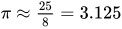
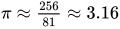
Methods to calculate the approximate area of a given circle, which can be thought of as a precursor problem to squaring the circle, were known already in many ancient cultures. These methods can be summarized by stating the approximation to π that they produce. In around 2000 BCE, the Babylonian mathematicians used the approximation , and at approximately the same time the ancient Egyptian mathematicians used . Over 1000 years later, the Old Testament Books of Kings used the simpler approximation . Ancient Indian mathematics, as recorded in the Shatapatha Brahmana and Shulba Sutras, used several different approximations to . Archimedes proved a formula for the area of a circle, according to which . In Chinese mathematics, in the third century CE, Liu Hui found even more accurate approximations using a method similar to that of Archimedes, and in the fifth century Zu Chongzhi found , an approximation known as Milü.



The problem of constructing a square whose area is exactly that of a circle, rather than an approximation to it, comes from Greek mathematics. Greek mathematicians found compass and straightedge constructions to convert any polygon into a square of equivalent area. They used this construction to compare areas of polygons geometrically, rather than by the numerical computation of area that would be more typical in modern mathematics. As Proclus wrote many centuries later, this motivated the search for methods that would allow comparisons with non-polygonal shapes:
The first known Greek to study the problem was Anaxagoras, who worked on it while in prison. Hippocrates of Chios attacked the problem by finding a shape bounded by circular arcs, the lune of Hippocrates, that could be squared. Antiphon the Sophist believed that inscribing regular polygons within a circle and doubling the number of sides would eventually fill up the area of the circle (this is the method of exhaustion). Since any polygon can be squared, he argued, the circle can be squared. In contrast, Eudemus argued that magnitudes can be divided up without limit, so the area of the circle would never be used up. Contemporaneously with Antiphon, Bryson of Heraclea argued that, since larger and smaller circles both exist, there must be a circle of equal area; this principle can be seen as a form of the modern intermediate value theorem. The more general goal of carrying out all geometric constructions using only a compass and straightedge has often been attributed to Oenopides, but the evidence for this is circumstantial.
The problem of finding the area under an arbitrary curve, now known as integration in calculus, or quadrature in numerical analysis, was known as squaring before the invention of calculus. Since the techniques of calculus were unknown, it was generally presumed that a squaring should be done via geometric constructions, that is, by compass and straightedge. For example, Newton wrote to Oldenburg in 1676 "I believe M. Leibnitz will not dislike the theorem towards the beginning of my letter pag. 4 for squaring curve lines geometrically". In modern mathematics the terms have diverged in meaning, with quadrature generally used when methods from calculus are allowed, while squaring the curve retains the idea of using only restricted geometric methods.
A 1647 attempt at squaring the circle, Opus geometricum quadraturae circuli et sectionum coni decem libris comprehensum by Grégoire de Saint-Vincent, was heavily criticized by Vincent Léotaud. Nevertheless, de Saint-Vincent succeeded in his quadrature of the hyperbola, and in doing so was one of the earliest to develop the natural logarithm. James Gregory, following de Saint-Vincent, attempted another proof of the impossibility of squaring the circle in Vera Circuli et Hyperbolae Quadratura (The True Squaring of the Circle and of the Hyperbola) in 1667. Although his proof was faulty, it was the first paper to attempt to solve the problem using algebraic properties of . Johann Heinrich Lambert proved in 1761 that is an irrational number. It was not until 1882 that Ferdinand von Lindemann succeeded in proving more strongly that π is a transcendental number, and by doing so also proved the impossibility of squaring the circle with compass and straightedge.
Hub AI
Squaring the circle AI simulator
(@Squaring the circle_simulator)
Squaring the circle
Squaring the circle is a problem in geometry first proposed in Greek mathematics. It is the challenge of constructing a square with the area of a given circle by using only a finite number of steps with a compass and straightedge. The difficulty of the problem raised the question of whether specified axioms of Euclidean geometry concerning the existence of lines and circles implied the existence of such a square.
In 1882, the task was proven to be impossible, as a consequence of the Lindemann–Weierstrass theorem, which proves that pi () is a transcendental number. That is, is not the root of any polynomial with rational coefficients. It had been known for decades that the construction would be impossible if were transcendental, but that fact was not proven until 1882. Approximate constructions with any given non-perfect accuracy exist, and many such constructions have been found.
Despite the proof that it is impossible, attempts to square the circle have been common in mathematical crankery. The expression "squaring the circle" is sometimes used as a metaphor for trying to do the impossible. The term quadrature of the circle is sometimes used as a synonym for squaring the circle. It may also refer to approximate or numerical methods for finding the area of a circle. In general, quadrature or squaring may also be applied to other plane figures.
Methods to calculate the approximate area of a given circle, which can be thought of as a precursor problem to squaring the circle, were known already in many ancient cultures. These methods can be summarized by stating the approximation to π that they produce. In around 2000 BCE, the Babylonian mathematicians used the approximation , and at approximately the same time the ancient Egyptian mathematicians used . Over 1000 years later, the Old Testament Books of Kings used the simpler approximation . Ancient Indian mathematics, as recorded in the Shatapatha Brahmana and Shulba Sutras, used several different approximations to . Archimedes proved a formula for the area of a circle, according to which . In Chinese mathematics, in the third century CE, Liu Hui found even more accurate approximations using a method similar to that of Archimedes, and in the fifth century Zu Chongzhi found , an approximation known as Milü.
The problem of constructing a square whose area is exactly that of a circle, rather than an approximation to it, comes from Greek mathematics. Greek mathematicians found compass and straightedge constructions to convert any polygon into a square of equivalent area. They used this construction to compare areas of polygons geometrically, rather than by the numerical computation of area that would be more typical in modern mathematics. As Proclus wrote many centuries later, this motivated the search for methods that would allow comparisons with non-polygonal shapes:
The first known Greek to study the problem was Anaxagoras, who worked on it while in prison. Hippocrates of Chios attacked the problem by finding a shape bounded by circular arcs, the lune of Hippocrates, that could be squared. Antiphon the Sophist believed that inscribing regular polygons within a circle and doubling the number of sides would eventually fill up the area of the circle (this is the method of exhaustion). Since any polygon can be squared, he argued, the circle can be squared. In contrast, Eudemus argued that magnitudes can be divided up without limit, so the area of the circle would never be used up. Contemporaneously with Antiphon, Bryson of Heraclea argued that, since larger and smaller circles both exist, there must be a circle of equal area; this principle can be seen as a form of the modern intermediate value theorem. The more general goal of carrying out all geometric constructions using only a compass and straightedge has often been attributed to Oenopides, but the evidence for this is circumstantial.
The problem of finding the area under an arbitrary curve, now known as integration in calculus, or quadrature in numerical analysis, was known as squaring before the invention of calculus. Since the techniques of calculus were unknown, it was generally presumed that a squaring should be done via geometric constructions, that is, by compass and straightedge. For example, Newton wrote to Oldenburg in 1676 "I believe M. Leibnitz will not dislike the theorem towards the beginning of my letter pag. 4 for squaring curve lines geometrically". In modern mathematics the terms have diverged in meaning, with quadrature generally used when methods from calculus are allowed, while squaring the curve retains the idea of using only restricted geometric methods.
A 1647 attempt at squaring the circle, Opus geometricum quadraturae circuli et sectionum coni decem libris comprehensum by Grégoire de Saint-Vincent, was heavily criticized by Vincent Léotaud. Nevertheless, de Saint-Vincent succeeded in his quadrature of the hyperbola, and in doing so was one of the earliest to develop the natural logarithm. James Gregory, following de Saint-Vincent, attempted another proof of the impossibility of squaring the circle in Vera Circuli et Hyperbolae Quadratura (The True Squaring of the Circle and of the Hyperbola) in 1667. Although his proof was faulty, it was the first paper to attempt to solve the problem using algebraic properties of . Johann Heinrich Lambert proved in 1761 that is an irrational number. It was not until 1882 that Ferdinand von Lindemann succeeded in proving more strongly that π is a transcendental number, and by doing so also proved the impossibility of squaring the circle with compass and straightedge.