Hubbry Logo
Sri Lanka Standard TimeSri Lanka Standard TimeMain
Open search
Sri Lanka Standard Time
Community hub
Sri Lanka Standard Time
logo
8 pages, 0 posts
0 subscribers
Be the first to start a discussion here.
Sri Lanka Standard Time
from Wikipedia

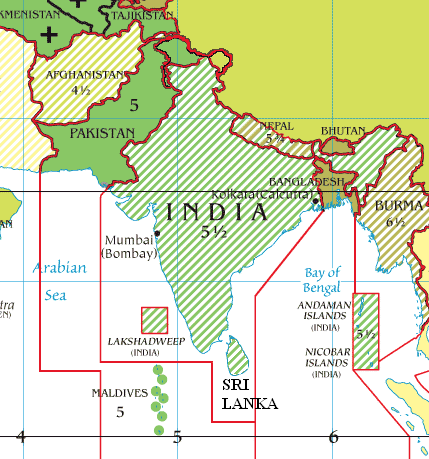
Sri Lankan Standard Time (SLST) (Sinhala: ශ්‍රී ලංකාවේ සම්මත වේලාව, romanized: Shri Lankavay Sammatha Velava, Tamil: இலங்கை நியம நேரம், romanized: Ilaṅkai niyama nēram) is the time zone for Sri Lanka. It is 5 hours and 30 minutes ahead of GMT/UTC (UTC+05:30) as observed since 15 April 2006.[1]

Key Information

Sri Lanka does not currently observe daylight saving time.

History

[edit]

On 15 April 2006, Sri Lanka Time reverted to match Indian Standard Time calculated from the Allahabad Observatory in India 82.5° longitude East of Greenwich, the reference point for GMT. This time zone applies to the entirety of Sri Lanka.

Since 1880, the time zone in Sri Lanka (or formerly, Ceylon) has varied from UTC+05:30 to UTC+06:30.

  • In 1880, Ceylon observed UTC+05:30.
  • During World War II, in January 1942, when the Japanese were on the verge of invading Ceylon, the official time shifted to UTC+06:00.
  • In September 1942, the official time further advanced to UTC+06:30.[citation needed]
  • When the war ended in 1945, Ceylon reverted to UTC+05:30 to be in the same time zone as India. However, in May 1996, Sri Lanka switched to UTC+06:30 for daylight saving during a severe power shortage in Sri Lanka.[2]
  • In October 1996, official time was moved back by half an hour to UTC+06:00. However, Tamil Tiger-controlled areas observed a time zone of UTC+05:30.[3]
  • On April 15. 2006, the government changed the official time to UTC+05:30. By doing so, Sri Lanka aimed to align its time zone with that of India. English writer Sir Arthur C. Clarke, who was then staying in Sri Lanka, protested against the switch, arguing that it would make life inconvenient to everyone who has to relate to the rest of the world.[3][4]

Sri Lanka briefly observed daylight saving time during World War II.

See also

[edit]

References

[edit]
Revisions and contributorsEdit on WikipediaRead on Wikipedia
from Grokipedia
Sri Lanka Standard Time (SLST) is the official time zone observed uniformly across the island nation of , defined as a fixed offset of five hours and thirty minutes ahead of (UTC+05:30). This offset has been standard since 15 April 2006, when reverted from UTC+06:00—a shift implemented in May 1996—to align more closely with for enhanced trade and coordination, adopting effectively the same timing as while maintaining its distinct designation. Sri Lanka does not observe , with the last such adjustment occurring in 1945 during , ensuring year-round consistency that avoids the administrative and economic disruptions of seasonal clock changes. Historically, the zone's application dates to the late under British colonial rule as Ceylon Mean Time, evolving through minor variations but remaining one of the world's few half-hour deviations from UTC, shared only with among sovereign states.

Technical Definition

UTC Offset and Designation

Sri Lanka Standard Time (SLST) designates the official observed throughout the country, fixed at an offset of UTC+05:30 without seasonal adjustments. This half-hour deviation from standard hourly UTC increments distinguishes SLST among global time zones, matching the offset used in and a few other regions. The designation SLST replaced earlier nomenclature such as Ceylon Time (CT) and has remained the standard abbreviation since its formal adoption. SLST applies uniformly across Sri Lanka's territory, encompassing the entire island nation without sub-zones, regional variations, or exceptions for administrative divisions. This nationwide consistency ensures synchronized civil, commercial, and governmental operations, reflecting the country's centralized timekeeping policy.

Geographical and Astronomical Basis

Sri Lanka lies between longitudes 79°31' E and 81°53' E, spanning approximately 2°22' or 9 minutes of , given of 15° per hour (equivalent to 4 minutes per degree). The country's approximate of 80°42' E corresponds to a local offset of UTC +5 hours 23 minutes, derived by dividing the longitude by 15° per hour (80.7° ÷ 15 ≈ 5.38 hours). This positions within the band justifying a +5 hour base offset, with the additional 23 minutes reflecting finer astronomical alignment beyond whole-hour zones. Sri Lanka Standard Time adopts UTC +5:30, equivalent to mean solar time at the 82°30' E meridian (5.5 hours × 15° = 82.5°), a practical that rounds upward from the country's central solar derivation for regional uniformity. This half-hour offset, shared with neighboring , prioritizes colonial-era standardization across the subcontinent over a strict per-country meridian, as both territories fall within longitudes where solar times cluster around +5:20 to +5:40 without exceeding 30 minutes deviation from the chosen meridian. Within Sri Lanka, uniform SLST application results in local mean solar noon deviations of 2 to 12 minutes from clock noon. In central areas like (79°54' E), clock time leads local mean solar time by about 10 minutes ((82.5° - 79.9°) × 4 minutes/degree ≈ 10.4 minutes); eastern extremities near 81°53' E show minimal offset (≈2.5 minutes), while western edges at 79°31' E reach up to 12 minutes. These small variances, confirmed by longitude-based calculations and solar observations, support nationwide synchronization without sub-zonal adjustments.

Historical Evolution

Colonial Period Adoption

Prior to the adoption of , timekeeping in Ceylon relied on local mean solar time determined at individual locations, such as ports and administrative centers, resulting in variations of up to 20 minutes across the island due to longitudinal differences. These discrepancies complicated coordination for expanding infrastructure, particularly the Ceylon Government Railway, whose first line opened in 1864 and grew to connect major cities by the late , necessitating uniform timetables to prevent scheduling errors and operational delays. On 1 January , British colonial authorities introduced Ceylon Time as UTC+05:30, aligning it with the newly established to synchronize railway operations, telegraphic communications, and administrative functions across the colony. This offset corresponded to the 82°30' E meridian, selected for its central position relative to Ceylon's longitude span of approximately 79°42' to 81°52' E, ensuring practical uniformity without excessive deviation from local solar noon in key areas like . The shift was driven by empirical requirements of modern transport and governance, as railways had previously operated on ad hoc approximations like Madras Mean Time for cross-border consistency, but local variations persisted inland, impeding efficient freight and passenger movement. Astronomical determinations for precise implementation were initially referenced to Indian observatories, with subsequent refinements enabled by the establishment of the in for ongoing distribution via telegraphs and time balls at the harbor.

Post-Independence Modifications

Following independence from the on February 4, 1948, Ceylon (renamed in 1972) retained the UTC+05:30 offset for Standard Time, as reinstated after the wartime advance concluded in 1945. This continuity avoided disruptions to daily routines in a predominantly reliant on solar cues for farming and coastal activities. The post-independence governments eschewed or offset alterations through the 1970s and 1980s, even as global oil crises prompted widespread adoption of clock shifts for purported energy savings in industrialized nations. This steadfast adherence to UTC+05:30—aligned closely with the island's mean based on 82°30'E —prioritized operational consistency over experimental measures, given from equatorial regions showing negligible electricity reductions from DST amid year-round daylight patterns. No legislative or administrative changes to the were enacted during this era, preserving nationwide without regional variations.

1996–2006 Shift and Reversion

In May 1996, amid a severe electricity crisis, the Sri Lankan government under President Chandrika Kumaratunga advanced clocks by one hour to UTC+06:30 as an emergency measure to conserve energy by extending evening daylight and reducing peak-hour consumption. This temporary adjustment aligned with broader daylight-saving principles during the power shortage, which had led to widespread blackouts and industrial disruptions. On October 26, 1996, clocks were then set back 30 minutes to establish UTC+06:00 as the new permanent standard time, motivated by expectations of continued modest energy savings alongside improved synchronization with East Asian trading partners' business hours for enhanced economic competitiveness. The UTC+06:00 offset persisted for a decade, but evaluations revealed negligible reductions in and use, failing to deliver the projected efficiencies from the initial energy rationale. This misalignment with India's UTC+05:30—Sri Lanka's largest trading partner—exacerbated scheduling frictions in cross-border commerce, communications, and financial transactions, while northern regions controlled by the (LTTE) independently maintained UTC+05:30, creating de facto dual time zones within the country and complicating national coordination. The shift also deviated further from Sri Lanka's longitudinal mean (approximately UTC+05:20), potentially hindering dawn-aligned rural activities like farming, though quantitative data on impacts remained limited. On April 15, 2006, under President Mahinda Rajapaksa's administration, clocks were adjusted back 30 minutes to restore UTC+05:30, prioritizing renewed alignment with India and internal time uniformity over unproven economic gains from the experiment. This reversion addressed the practical failures of the prior decade, including the absence of verifiable energy benefits and the internal divisions fostered by non-compliance in LTTE-held areas, thereby reinstating a time standard better suited to Sri Lanka's geographic and trade realities.

Daylight Saving Time Practices

Early and Wartime Implementations

In response to the escalating threat of Japanese invasion during , Ceylon (present-day ) introduced on January 5, 1942, advancing clocks by one hour from the standard UTC+05:30 offset to UTC+06:30. This wartime measure aimed to conserve energy and resources by extending evening daylight for industrial and civilian activities. The implementation combined a base shift to UTC+06:00 with seasonal DST extensions to UTC+06:30, reflecting ad hoc adjustments amid conflict pressures rather than a standardized policy. The DST period persisted through 1945, with clocks remaining advanced during the war years to align with broader Allied efforts in resource optimization. On , 1945, following the war's end, the one-hour advance was reversed at 01:00 , reverting to UTC+05:30 and marking the conclusion of these trials. These implementations were confined to the national level without regional variations, underscoring their emergency-driven nature and temporary application amid geopolitical instability.

Post-War Usage and Final Abolition

Following the end of , Ceylon (now Sri Lanka) discontinued (DST) on October 16, 1945, by reverting clocks from UTC+06:30 to UTC+05:30, and the practice was not reinstated in the post-war period. This cessation aligned with the country's equatorial proximity, where seasonal daylight variation is minimal, typically spanning 11 to 13 hours annually due to the sun's path near the . Despite intermittent global experiments with DST during energy shortages, such as the 1973–1974 oil crisis, Sri Lanka maintained a fixed without seasonal adjustments, as records indicate no clock changes for DST purposes after 1945. Empirical assessments of DST's energy savings, often cited as under 1% in electricity consumption from extended daylight, proved insufficient to justify reimplementation in tropical settings, where baseline day lengths already minimize artificial lighting needs year-round. The permanent abolition reflected causal factors favoring clock stability over periodic shifts: in low-latitude regions, DST disrupts sleep-wake cycles without commensurate gains, contributing to documented health effects like increased cardiovascular incidents from circadian misalignment, as observed in broader studies of time changes. Sri Lanka's policy thus prioritized uniform timekeeping, avoiding the administrative and societal costs of biannual transitions, with no subsequent legislative attempts to revive DST amid ongoing challenges.

Current Implementation

Nationwide Uniformity

Sri Lanka Standard Time (SLST, UTC+05:30) is observed uniformly across the entirety of the country, including all such as the Northern and Eastern regions, without any subnational variations or exceptions. The legal definition establishes SLST as five hours and thirty minutes in advance of , mandating its use in official, commercial, and public contexts nationwide. This consistency is upheld by telecommunications infrastructure regulated under national standards and government timekeeping mechanisms, which propagate SLST via synchronized networks and public clocks. Precision in timekeeping is maintained through (NTP) synchronization to atomic clock-derived sources, often via GPS-referenced servers in the Sri Lankan , resulting in national deviations generally below one second under typical network conditions.

Synchronization with Regional Time Zones

Sri Lanka Standard Time (SLST), fixed at UTC+5:30, matches Standard Time exactly, allowing synchronized business operations, real-time coordination in sectors like shipping and finance, and no time adjustment for cross-border calls or meetings between the two countries. This alignment supports Sri Lanka's trade with , its largest partner, where shared timing aids efficient port-to-port logistics and just-in-time supply chains, as evidenced by the growth in bilateral commerce following the 2000 India-Sri Lanka . In contrast, SLST runs 30 minutes ahead of and Maldives Time (both UTC+5:00), necessitating brief offsets in scheduling joint ventures or exchanges with those neighbors. It lags 30 minutes behind (UTC+6:00), which can cause slight misalignments in regional South Asian forums or garment trade negotiations. These differences require minimal adaptation, such as shifting meetings by half an hour, but do not significantly hinder overall regional coordination. The identical offset with minimizes for its visitors—Sri Lanka's top tourist source, exceeding 300,000 annually pre-pandemic—enabling immediate engagement upon arrival without circadian disruption. With East Asian economies on UTC+8 (e.g., ) or UTC+9 (e.g., ), SLST creates a 2.5- to 3.5-hour lag, resulting in partial business hour overlaps (Sri Lanka's typical 9:00 AM to 5:00 PM aligning with afternoon starts there), which has not empirically justified past proposals for a UTC+6 shift despite occasional for closer East Asian ties.

Rationales and Impacts of Changes

Economic and Practical Motivations

The adoption of UTC+05:30 for Sri Lanka Standard Time originated from colonial-era decisions to synchronize clocks with India's standard meridian at 82.5°E longitude, which approximates the mean longitude of the subcontinent and optimizes solar noon alignment near midday for agricultural and manual labor schedules in a pre-industrial economy dependent on daylight for productivity. This offset, spanning roughly 75°E to 90°E, minimizes discrepancies between clock time and local apparent solar time across Sri Lanka's territory (79°E–82°E), reducing fatigue from mismatched lighting for outdoor work that constituted over 50% of employment in the mid-20th century. The 1996 shift to was primarily driven by a severe electricity shortage, with the advancing clocks to extend evening daylight and purportedly cut demands by shifting activities earlier; however, post-implementation assessments by subsequent administrations found no measurable energy savings, as consumption patterns adapted without net reduction. Proponents claimed potential gains from a half-hour advance in overlapping for international telecommunications, but economic data from 1996–2006 revealed no attributable GDP uplift, with annual growth averaging 4.5% amid broader structural factors like export diversification rather than time alignment. Reversion to UTC+05:30 in April 2006 emphasized practical coordination with , Sri Lanka's proximate trading partner sharing the same offset, facilitating synchronized operations in cross-border commerce, finance, and transport where time mismatches previously complicated scheduling despite India absorbing only about 7% of Sri Lankan exports in that period. Preference for a fixed, non-DST policy in reflects equatorial latitude's minimal seasonal daylight variation (approximately 12 hours year-round), rendering clock shifts inefficient for energy or activity extension while introducing verifiable disruptions such as a 6% spike in traffic accidents immediately following transitions, as evidenced by broader studies on disruption and circadian misalignment. In tropical contexts, empirical analyses confirm negligible electricity savings from DST—often near zero or negative due to behavioral shifts—favoring timekeeping to sustain productivity without transitional costs.

Criticisms and Empirical Outcomes

Critics of Sri Lanka's adherence to UTC+5:30 have highlighted the half-hour offset's potential to hinder with East Asian economic hubs such as and , both on UTC+8, creating a 2.5-hour disparity that could impede real-time financial transactions and coordination. However, analyses of global communication patterns demonstrate that digital tools like , video conferencing, and automated trading systems have diminished the practical impact of such offsets, rendering the less substantive in an era of asynchronous global business. The 1996–2006 experiment advancing clocks to UTC+6:00, ostensibly to extend evening daylight and curb electricity demand amid shortages, yielded underwhelming results and was ultimately deemed a , prompting reversion to UTC+5:30 on April 15, 2006. Intended benefits, such as reduced lighting needs, proved insufficient to offset disruptions including altered work schedules and agricultural inefficiencies, where earlier sunrises better align with farmers' routines in a tropical context; the policy exacerbated internal divisions, with Tamil-majority areas informally retaining UTC+5:30, complicating during civil conflict. In broader discourse, half-hour offsets like UTC+5:30 face derision as outdated artifacts of colonial-era solar averaging—Sri Lanka's central meridian near 80°E aligns closely with +5:20 mean , justifying the compromise over full-hour zones. Retention prioritizes fidelity to local noon for circadian health and productivity at low latitudes (~7°N), where seasonal daylight variation is minimal and misalignment risks sleep disruption or reduced output, outweighing conveniences of uniform hourly grids; empirical time-zone studies corroborate that deviations from correlate with measurable economic drags in equatorial regions.

References

Add your contribution
Related Hubs
User Avatar
No comments yet.