Recent from talks
All channels
Be the first to start a discussion here.
Welcome to the community hub built to collect knowledge and have discussions related to Time in Pakistan.
Nothing was collected or created yet.
Time in Pakistan
View on Wikipediafrom Wikipedia

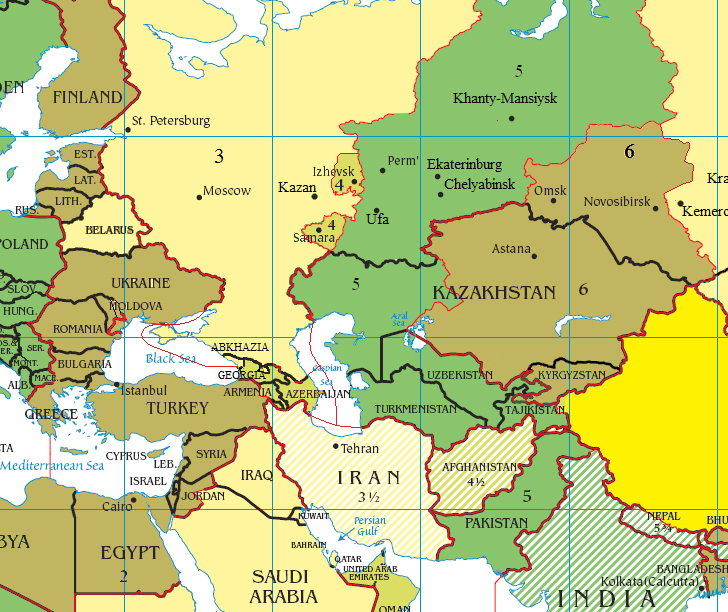
Pakistan uses one time zone, which is Pakistan Standard Time (PKT). This is UTC+05:00 — that is, five hours ahead of Coordinated Universal Time.
History
[edit]| Period in use | Time offset from GMT[1] | Notes |
|---|---|---|
| Prior until 1907 | UTC+04:28:12 | Local mean time based in Karachi |
| 1907–1951 | UTC+05:30 | |
| 1951–1971 | UTC+05:00 in West Pakistan UTC+06:00 in East Pakistan (today Bangladesh) |
Karachi Time (KART) Dacca Time (DACT) |
| 1971–present | UTC+05:00 in Pakistan | Pakistan Standard Time (PKT) |
Notation
[edit]Daylight saving time
[edit]Pakistan has experimented with Daylight Saving Time (DST) a number of times since 2002, shifting local time from UTC+05:00 to UTC+06:00 during various summer periods. Daylight saving time in Pakistan has not been observed since 2009.
IANA time zone database
[edit]The IANA time zone database contains one zone for Pakistan in the file zone.tab, named Asia/Karachi.
References
[edit]- ^ "Time Zone & Clock Changes in Karachi, Sindh, Pakistan". www.timeanddate.com.
Time in Pakistan
View on Grokipediafrom Grokipedia
Overview
Current Time Zone
Pakistan Standard Time (PKT) is the designated time zone for the entirety of Pakistan, equivalent to Coordinated Universal Time plus five hours (UTC+5:00). This offset remains constant throughout the year, with no implementation of daylight saving time or other seasonal adjustments.[2][8] PKT is derived from the 75th meridian east, which serves as the reference meridian for the UTC+5 time zone and aligns with Pakistan's adoption of this standard. This alignment ensures that the time zone reflects the global standard, promoting consistency in coordination with international schedules.[9]Geographical Coverage
Pakistan Standard Time (PKT), which is UTC+5, is observed uniformly across all regions of Pakistan, encompassing the four provinces of Punjab, Sindh, Khyber Pakhtunkhwa, and Balochistan, as well as the administrative territories of Gilgit-Baltistan and Azad Kashmir.[2] This nationwide application ensures synchronized timekeeping for governance, transportation, and daily life, with no regional variations or separate time zones within the country's borders.[9] Pakistan's territory extends longitudinally from approximately 60°50' E to 77°50' E, spanning about 17 degrees, which equates to roughly 68 minutes of difference in local solar time between the westernmost and easternmost points.[10] Despite this extent potentially aligning with parts of two standard time zones (as each 15 degrees of longitude corresponds to one hour of solar time), the country maintains a single time zone based on the 75° E meridian to facilitate national cohesion, economic coordination, and administrative efficiency. In practice, this uniformity leads to minor discrepancies between clock time and solar events in peripheral areas. For instance, in western regions near the border with Iran (around 61° E), solar noon occurs approximately 56 minutes earlier than clock noon, resulting in earlier sunsets and sunrises relative to PKT. Conversely, in eastern areas near the Indian border (around 75° E), solar noon aligns more closely with 12:00 PM, with only slight offsets. These variations, typically under an hour, are managed through standard national scheduling without adjustment, prioritizing consistency over precise solar alignment.[11]History
Pre-Independence Developments
The expansion of the railway network in British India during the 19th century marked a pivotal shift toward standardized timekeeping, driven by the need for coordinated schedules to prevent accidents and optimize operations across disparate regions. The first passenger railway line commenced operations in 1853, connecting Bombay to Thane, but early services relied on local solar times, resulting in discrepancies of up to several minutes between stations. By 1870, to address these issues, the railway authorities adopted Madras Time—derived from the Madras Observatory and approximately 5 hours and 21 minutes ahead of Greenwich Mean Time (UTC+5:21)—as the uniform standard for all railway timetables and signaling throughout British India, including territories now part of Pakistan. This initiative, supported by the colonial administration, extended to the burgeoning rail infrastructure in the northwest, such as lines reaching Lahore and beyond, fostering a rudimentary temporal unity in a subcontinent previously governed by myriad local clocks.[12] Parallel to railway developments, the telegraph system's rapid proliferation from the 1850s onward amplified the demand for precise, synchronized time across British India. Initiated with lines connecting Calcutta to Agra in 1853, the network grew to over 20,000 miles by 1870, enabling instantaneous communication for administrative, military, and commercial purposes. In 1862, the colonial government mandated the use of Madras mean time as the standard for all telegraph operations, ensuring clocks at stations were aligned to facilitate accurate transmission and reception of messages. This synchronization was particularly crucial for coastal ports like Karachi, which emerged as a vital gateway for international trade and undersea cable connections to Europe and the Middle East by the 1860s; time signals from observatories and telegraphs there supported maritime navigation and global coordination, reducing errors in shipping schedules and financial transactions.[13] The culmination of these efforts came in 1905, when the Government of India, advised by geologist Richard Dixon Oldham, officially adopted Indian Standard Time (IST) at UTC+5:30, calibrated to the 82.5° E meridian near Mirzapur (close to Allahabad). Effective from January 1, 1906, IST supplanted Madras Time and other local variants for civil, railway, and telegraph use across the entire subcontinent, encompassing present-day Pakistan and promoting administrative efficiency amid growing economic integration. Although major cities like Bombay continued informal use of local time until later, this unified system underscored the colonial imperative for temporal discipline, with ports such as Karachi aligning their operations to IST for seamless international linkages.[12]Post-Independence Adjustments
Following independence from British India in 1947, Pakistan initially continued using Indian Standard Time (UTC+5:30), which had been established across the subcontinent during colonial rule.[14] This arrangement persisted for four years until the government sought to establish a time standard more aligned with Pakistan's geographical position, particularly the longitude of major cities like Karachi (around 67°E), which better corresponded to UTC+5:00 for local solar noon. On September 29, 1951, at 23:30 IST, clocks were adjusted backward by 30 minutes to introduce Karachi Time (KART, UTC+5:00) in West Pakistan, while East Pakistan adopted a separate zone at UTC+6:00 by advancing clocks 30 minutes; the change took effect the next day and was recommended by mathematician Prof. Mahmood Anwar based on astronomical calculations. PKT corresponds to the 75° E meridian, aligning with the approximate central longitude of Pakistan.[15][16] The secession of East Pakistan and the formation of Bangladesh in December 1971 prompted a further clarification of Pakistan's time policy, as the country now comprised only the western territories. The existing UTC+5:00 offset for West Pakistan was retained and officially renamed Pakistan Standard Time (PKT) to reflect the unified national identity, eliminating the dual-zone system that had been in place since 1951.[16]Time Notation and Formats
Date Conventions
In Pakistan, the predominant format for writing and displaying dates in official and everyday contexts follows the day-month-year order, most commonly expressed numerically as DD/MM/YYYY. This convention aligns with practices in many South Asian and Commonwealth-influenced countries and is specified in technical standards for territory code 092. For instance, official documents from the Federal Board of Revenue require dates in the format dd/mmm/yyyy, such as 14-Aug-1947 for historical references like Pakistan's independence. Similarly, the State Bank of Pakistan employs DD-MM-YYYY in tender notices and financial instruments.[17][18][19] The Gregorian calendar serves as the civil standard for all secular and administrative purposes, having been officially adopted by the Government of Pakistan upon independence in 1947 as a continuation of colonial administrative practices. All government offices, legal proceedings, and public records adhere to this calendar for consistency in national documentation. However, the Islamic Hijri calendar is integrated alongside it for religious observances, determining dates for events such as Ramadan, Eid al-Fitr, and Hajj; the Ministry of Religious Affairs issues an annual official Hijri calendar based on sightings by the Ruet-e-Hilal Committee to guide these practices nationwide.[20][21] Variations appear in formal and fiscal contexts to reflect Pakistan's administrative structure. The fiscal year, which aligns with the agricultural and budgetary cycle, spans from July 1 to June 30 and is denoted in hyphenated form as YYYY-YY, for example, 2024-25 for the period July 1, 2024, to June 30, 2025; this notation is used in budget documents and tax filings by the Finance Division and Federal Board of Revenue. In media, such as the newspaper Dawn, dates are often rendered verbally as DD Month YYYY in article bylines and URLs, e.g., 10 November 2025, to enhance readability for English-speaking audiences. Government forms, including passport applications and tax returns, standardize on DD/MM/YYYY or DD-MMM-YYYY to minimize ambiguity in processing.[22][23][24] Within education systems, date notation mirrors official standards, with school calendars and academic records employing DD/MM/YYYY for enrollment dates, exam schedules, and term starts; for example, federal and provincial education boards list session commencements as 15-Aug-2025 for the academic year. This ensures uniformity in student documentation and aligns with broader administrative practices, though religious holidays are cross-referenced with Hijri dates in school timetables.[25]Time Display Standards
In Pakistan, the predominant convention for expressing clock time in everyday contexts is the 12-hour format, utilizing notations such as "2:30 PM" with AM/PM indicators to distinguish between morning and afternoon hours. This format prevails in casual conversations, print media, and broadcast journalism, reflecting cultural familiarity and alignment with regional practices in South Asia.[26] Official and military communications, however, adhere to the 24-hour format, such as "14:30," to ensure precision and avoid ambiguity, consistent with international standards for formal scheduling and operations. For instance, Pakistan Railways timetables list departure and arrival times in 24-hour notation, as seen in the Karachi Express schedule departing at 18:00 from Karachi Cantonment.[27] Similarly, armed forces documentation employs this system for operational clarity, mirroring global military protocols that prioritize unambiguous timekeeping. Cultural practices further reinforce the 12-hour style, particularly in the announcement of Islamic prayer times (Azan), which are typically broadcast or displayed using local conventions like "Fajr at 5:22 AM" across mosques and media outlets. This approach facilitates accessibility for the general populace, integrating seamlessly with daily religious observances.[28] Digital clock displays in public spaces, such as railway stations, airports, and urban billboards, generally follow these norms by defaulting to 12-hour formats for public-facing information, while transportation hubs and broadcasting systems incorporate 24-hour readouts for operational efficiency. For example, Pakistan Television (PTV) program guides list timings in 12-hour format, such as "0600am" for morning shows, enhancing viewer comprehension in media contexts.[29]Daylight Saving Time
Historical Implementation
Pakistan's first implementation of daylight saving time (DST) occurred during World War II under British colonial rule, as part of the broader Indian subcontinent's efforts to conserve energy and support the Allied war effort. Clocks were advanced by one hour from local mean time (approximately UTC+5:30) starting on September 1, 1942, at midnight, with the adjustment applied seasonally until the end of the war. The DST period ended on October 15, 1945, when clocks were set back by one hour at midnight, reverting to standard India Standard Time (IST). This trial lasted three years and was motivated primarily by wartime resource conservation, including electricity and fuel savings.[30][31] Following independence in 1947, Pakistan did not observe DST for several decades, but reintroduced it in response to energy shortages. In 2002, amid a national power crisis, the federal cabinet approved a one-hour clock advance from Pakistan Standard Time (PKT, UTC+5:00) to Pakistan Summer Time (PKST, UTC+6:00). The change took effect at midnight on April 7 (the first Sunday in April), with clocks turned forward by one hour, and reverted at midnight on October 6 (the first Sunday in October), when clocks were set back by one hour. This six-month trial aimed to reduce peak-hour electricity demand by shifting daylight hours, though it was discontinued afterward due to limited perceived benefits and public inconvenience.[32][33] DST was briefly revived in 2008 and 2009 to address ongoing energy crises exacerbated by rising demand and supply shortages. In 2008, clocks advanced one hour at midnight on June 1 to PKST, remaining in effect until November 1, when they were set back at midnight to PKT; the measure was intended to curtail evening power usage during summer months. The following year, the period was extended earlier, with the forward shift occurring at midnight on April 15 and the reversal on November 1, both at midnight. These implementations sought similar energy conservation goals but faced criticism for disrupting daily routines, particularly in rural areas, and were not renewed after 2009.[34][35]Current Policy and Rationale
Pakistan has not observed Daylight Saving Time (DST) since the end of its 2009 implementation, maintaining Pakistan Standard Time (PKT, UTC+5) as a fixed year-round standard under current government policy.[3] The decision to discontinue DST followed brief trials in 2002, 2008, and 2009, primarily aimed at addressing energy shortages, but was reversed due to insufficient parliamentary backing and perceived limited benefits.[36] The rationale for the ongoing suspension centers on minimal actual energy savings from past implementations, estimated at around 250 MW during peak periods but deemed inadequate to justify the change amid broader power crises.[36] Logistical disruptions to agriculture and industry, where fixed schedules align with natural light cycles for farming and manufacturing operations, further contributed to resistance, as did public opposition over shifted daily routines, including confusion in Islamic prayer timings that are solar-based.[37] Studies assessing DST's potential in Pakistan have highlighted geographical and seasonal factors yielding only modest electricity conservation, often below 0.5% of total usage, reinforcing the policy against reintroduction without stronger evidence.[38] The legal framework governing time standards in Pakistan stems from the Standard Time (Interpretation of References) Ordinance of 1943, which establishes PKT as the national reference, with any DST adjustments requiring executive notifications rather than statutory mandates.[39] Policy decisions on time adjustments fall under the purview of the Ministry of Energy (Power Division), which coordinates with parliamentary committees for implementation, as seen in the revocation of proposed 2010 DST plans.[36] In the 2010s and 2020s, debates on DST reintroduction have surfaced periodically amid energy challenges and climate change impacts, such as increased power demand from rising temperatures, but no changes have been enacted as of 2025.[40] For instance, in 2022, business leaders advocated for DST to boost economic productivity and reconstruction efforts, while a 2025 panel chaired by the Deputy Prime Minister was formed to evaluate winter DST's potential for energy savings and emission reductions, with a report due by November.[41] These discussions emphasize environmental benefits like reduced fossil fuel use but highlight ongoing concerns over public adaptation and sectoral disruptions.[41]Technical and International Standards
IANA Time Zone Database
The IANA Time Zone Database, also known as tzdata or the zoneinfo database, designates Pakistan's time zone with the identifier Asia/Karachi, which encapsulates Pakistan Standard Time (PKT) at a fixed offset of UTC+05:00. This representation applies uniformly across the country, reflecting the absence of daylight saving time (DST) since 2009, with no rules for future transitions. The database ensures that computational systems can accurately handle historical and current local times for locations in Pakistan by referencing this canonical identifier.[42] The entry for Asia/Karachi in the tzdata originated in early versions of the database to capture post-colonial time adjustments, including the permanent shift from UTC+05:30 to UTC+05:00 on September 30, 1951. Updates to the database have since incorporated retrospective DST observances, such as the one-hour advance from April 7 to October 6 in 2002, as detailed in the zone rules file. Further refinements addressed brief DST periods in 2008 (June 1 to November 1) and 2009 (April 15 to November 1), ensuring the historical record remains precise without affecting the current fixed offset. The 1971 separation of Bangladesh led to the official renaming to Pakistan Standard Time, with the tzdata reflecting any associated adjustments as of that period.[42][43] The database manages Pakistan's fixed offset through compiled binary files in the tzdata distribution, where Asia/Karachi specifies no ongoing DST transitions post-2009, simplifying queries for timestamps after that period. Relevant tzdata releases include version 2002n, which integrated the 2002 DST rules; 2008h for the 2008 extension; 2009k for the 2009 observance; and 2010g, which eliminated predictions for DST beyond 2009 in response to policy discontinuation. These updates are distributed via tarballs from the IANA repository, allowing systems to load the latest rules without altering the core UTC+05:00 standard (as of tzdata 2025b, released March 2025).[44] In computing applications, Asia/Karachi serves as the standard identifier in POSIX-compliant environments, set via the TZ environment variable (e.g.,TZ=Asia/[Karachi](/page/Karachi)) to apply PKT rules for date and time operations. On Microsoft Windows systems, it maps to the "Pakistan Standard Time" registry entry (display name: "(UTC+05:00) Islamabad, Karachi"), facilitating cross-platform consistency in software like calendars and databases. This integration supports seamless synchronization in global applications while adhering to Pakistan's uniform national time.[45]
