Hubbry Logo
Cervalces scottiCervalces scottiMain
Open search
Cervalces scotti
Community hub
Cervalces scotti
logo
8 pages, 0 posts
0 subscribers
Be the first to start a discussion here.
Cervalces scotti
Cervalces scotti
from Wikipedia

Cervalces scotti
Temporal range: Pleistocene–0.011
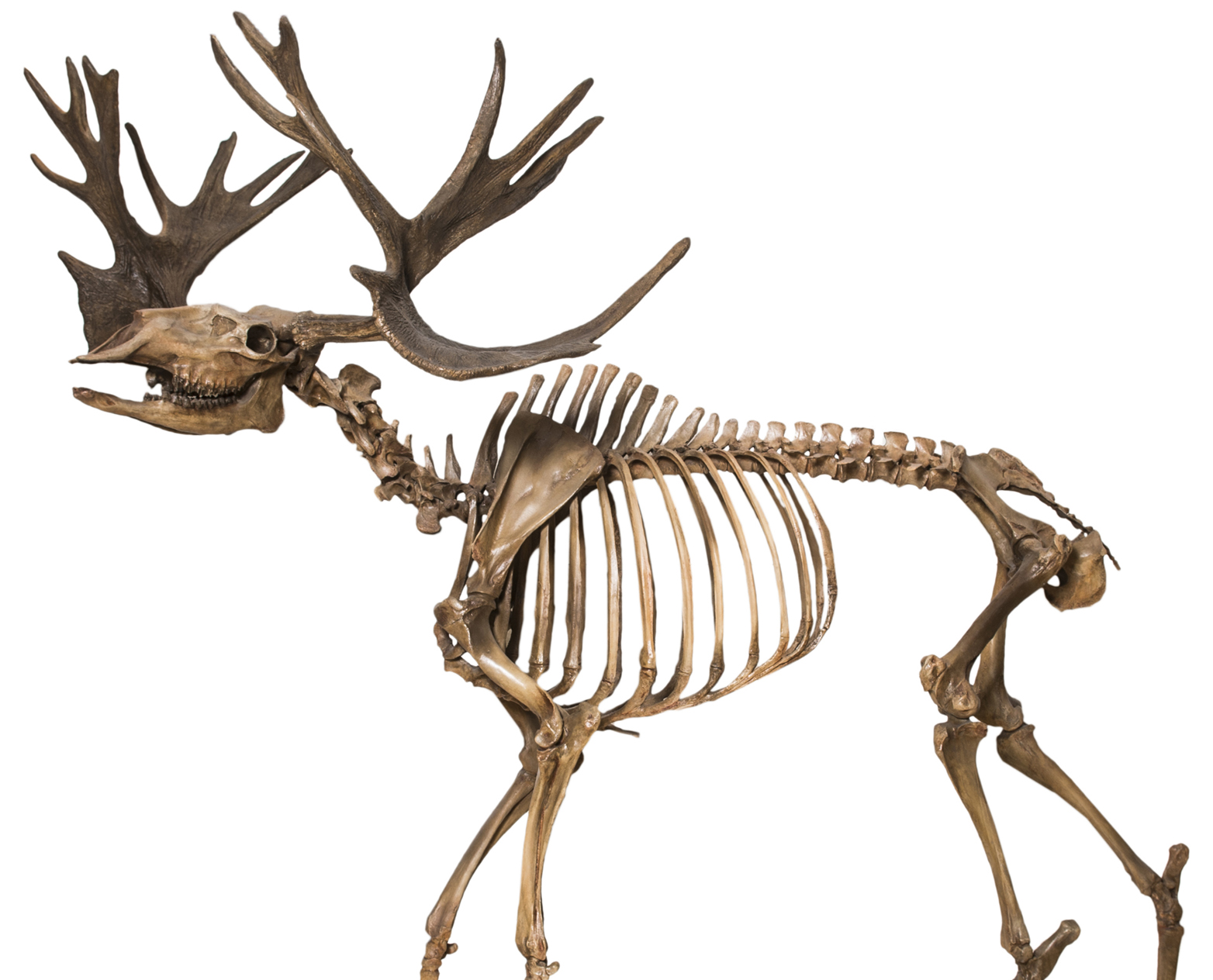
Replica skeleton at MUSE
Scientific classification Edit this classification
Kingdom: Animalia
Phylum: Chordata
Class: Mammalia
Order: Artiodactyla
Family: Cervidae
Subfamily: Capreolinae
Genus: Cervalces
Species:
C. scotti
Binomial name
Cervalces scotti
Lydekker, 1898

Cervalces scotti, also known as stag-moose, is an extinct species of large deer that lived in North America during the Late Pleistocene epoch.[1] It is the only known North American member of the genus Cervalces. Its closest living relative is the modern moose (Alces alces).

It had palmate antlers that were more complex than those of a moose and a muzzle more closely resembling that of a typical deer.[2]

Description

[edit]
Cervalces scotti size chart.

It was as large as the modern moose, with an elk-like head, long legs, and palmate antlers that were more complex and heavily branching than the moose.[3] Cervalces scotti reached 2.5 m (8.2 ft) in length and a weight of 708.5 kg (1,562 lb).[4][5] The stag-moose resided in North America during an era with other megafauna such as the woolly mammoth, ground sloth, long horn bison, and smilodon.[6] The species became extinct approximately 11,500 years ago, toward the end of the most recent ice age, as part of a mass extinction of large North American mammals.[7][8]

The first evidence of Cervalces scotti found in modern times was discovered at Big Bone Lick, Kentucky by William Clark, circa 1805. A more complete skeleton was found in 1885 by William Barryman Scott in New Jersey.[1] Mummified remains have also been found.[9] One of the most complete Cervalces skulls ever discovered was dredged from a pond in Kendallville, Indiana and dated to 13,500 BP.[10]

Extinction

[edit]

Cervalces scotti, like several other members of its genus, probably lived in marshes, swamps and bogs, as well as spruce-taiga floral communities. There were also surroundings ranging from tundra–mixed coniferous forests to deciduous woodlands. These sedges and willows may not have been suitable food products, but they provide an imagery of the ecology of the stag-moose. The change in flora and fauna due to complete deglaciation probably also affected the living conditions of the stag-moose in states like Iowa and Wisconsin, where the stag-moose was found at more than 20 sites.[11] The stag-moose reproduced more often than megaherbivores, and so the hypothesis is that the stag-moose's disappearance is linked to the emergence of the "true moose" instead.[12][13][14]

Palaeobiology

[edit]

Cervalces scotti is thought to have evolved from a population of Cervalces latifrons that migrated into North America probably sometime during the Middle Pleistocene.[15] It shared the spruce parkland ecosystem with other herbivorous megafauna, such as the caribou (Rangifer tarandus), the woodland musk-ox (Bootherium bombifrons), and the giant beaver (Castoroides sp.),[16][11] in a range from what is now southern Canada to Arkansas and from Iowa to New Jersey. As the glaciers retreated, moose (which had crossed the Bering land bridge from Asia)[17] may have populated the habitat of Cervalces scotti and caused its extinction by outcompetition.[1] Although there is no paleontological evidence that it was associated with humans,[18] other theories for its extinction have been proposed. Notably, there is speculation that hunting by newly arrived humans caused the extinction of Cervalces scotti and other large mammals.[19] Additionally, some have proposed a sudden extinction by disease, brought by small mammals in association with humans.[8] The oldest known fossil of Cervalces scotti was found in the bed of the Skunk River in Iowa, with the specimen dating back approximately 30,000 years ago. The area in which the fossil was found and the date implies that Cervalces scotti lived before a massive ice sheet covered the area in which it inhabited, which could also be a possible cause of its extinction.[20] Since the stag-moose resided in a woodland habitat, climate change and loss of natural pastures also could have played a role in its extinction.[21]

Cervalces scotti probably lived in a narrow geographic range, characterized by a spruce-dominant mixed conifer and deciduous wet woodland[22] which may have made it more vulnerable to extinction. Remains of Cervalces scotti found in modern-day Ohio have suggested that it and Homo sapiens could have possibly interacted. Fossils of both Cervalces scotti and other large extinct mammals in the area suggest that it may have been a frequent target of early human hunters.[23] Remains of the stag moose, along with Paleo Indian artifacts and the remains of the flat-headed peccary (Platygonus compressus), giant short-faced bear (Arctodus simus), and giant beaver were found in the Sheriden Cave in Wyandot County, Ohio.[24]

References

[edit]
[edit]
Revisions and contributorsEdit on WikipediaRead on Wikipedia
from Grokipedia
Cervalces scotti, commonly known as the stag-moose or elk-moose, was an extinct species of large deer in the family Cervidae that lived in during the epoch, approximately 40,000 to 11,500 years ago. This herbivore, intermediate in form between a modern (Alces alces) and (Cervus canadensis), stood about 1.8 meters (6 feet) at the shoulder and weighed around 708 kilograms (1,562 pounds), making it slightly larger than today's . It featured long, stilt-like legs adapted for traversing wetlands, an elk-like head with a long , and elaborate palmate antlers—flat and broad with thin, projecting tines—that could span over a meter. Fossils of C. scotti have been found across a wide range in the United States, from the Midwestern states like and to southern regions including , , , and , often in boggy or riverine deposits south of the receding ice sheets. It inhabited environments such as mires, spruce parklands, and mixed coniferous forests, where it browsed on aquatic plants during summer and woody twigs in winter, much like contemporary . Notable discoveries include a nearly complete from Kendallville, , dated to about 13,500 years old, and a 2022 find of a with partial antlers along the in , one of the southernmost records and dated to roughly 10,800–10,950 years ago. The species went extinct around 11,500 years ago at the end of the Pleistocene, coinciding with rapid climate warming and the arrival of Paleoindian hunters, though the exact causes—whether environmental shifts, human predation, or a combination—remain debated among paleontologists. C. scotti coexisted with like mastodons and was part of a diverse Ice Age ecosystem that supported large herbivores in post-glacial landscapes. Reconstructed skeletons, such as one displayed at the Indiana State Museum, highlight its unique adaptations and provide insights into the evolutionary history of North American deer.

Taxonomy and Discovery

Taxonomy

Cervalces scotti is classified within the family Cervidae, subfamily , and tribe , a group encompassing moose-like deer that includes the modern genus Alces and extinct forms such as Cervalces. This placement reflects its morphological affinities to both (Cervus) and (Alces), distinguishing it from other cervid tribes like the Cervini. The species originated evolutionarily from Eurasian ancestors in the tribe during the Middle Pleistocene, with C. scotti descending from populations of Cervalces latifrons that migrated to via the Bering land bridge. This migration occurred in the late Middle to early , allowing the species to establish in North American ecosystems. No of C. scotti are currently recognized, though genus-level classification remains debated, with some researchers proposing inclusion within Alces due to shared skeletal features, while others maintain Cervalces as distinct based on morphology and cranial differences. The genus name Cervalces derives from the Latin words cervus (deer) and alces (elk or moose), reflecting its intermediate characteristics, as coined by William B. Scott in 1885 for initial fossils he described. The specific epithet scotti honors the paleontologist William Berryman Scott, who discovered key specimens and contributed significantly to its early description; the species was renamed Alces scotti by Richard Lydekker in 1898 after earlier names were deemed preoccupied (later placed back in Cervalces by subsequent researchers).

Discovery History

The first fossils attributed to Cervalces scotti were collected from Big Bone Lick in around 1807 by during an expedition commissioned by President , who was interested in reports of large vertebrate remains from the site; these early specimens, including antlers and skull fragments, were initially misidentified as belonging to an oversized (Cervus canadensis) or related to modern . A more definitive partial recovered from a marl at , , allowed for its formal scientific description in 1885 by paleontologist William Berryman Scott, who named the species Cervalces americanus (later amended to C. scotti by Richard Lydekker in 1898 to honor Scott) and recognized it as a distinct extinct cervid with moose-like and elk-like traits. Early American paleontologists, including Joseph Leidy, played a key role in clarifying its affinities through examinations of Big Bone Lick material in the mid-19th century, distinguishing Cervalces scotti from extant (Alces alces) based on cranial and postcranial differences such as broader configurations and more elongated limbs. Significant 20th-century discoveries expanded knowledge of the species, including a nearly complete dredged from a pond near Kendallville in , in the 1980s and radiocarbon-dated to approximately 13,500 years , providing insights into preservation in bog environments. Additionally, a nearly complete unearthed near Chippewa Lake in , in 1988 represented one of the most intact specimens from the region, highlighting C. scotti's presence in Midwestern wetlands.

Fossil Record

The fossil record of Cervalces scotti is primarily known from deposits across eastern and central , with specimens often preserved in and fluvial environments that facilitated accumulation but led to fragmentation due to acidic conditions. The oldest known dates to approximately 30,000 years BP from the Skunk River bed in . One of the most significant early finds is a nearly complete articulated discovered in 1885 at , , by William Berryman Scott, originally described as Cervalces americanus and providing key anatomical details of the species' robust build. This specimen, from bog sediments, represents one of the best-preserved examples and dates to the based on stratigraphic context within the Rancholabrean land-mammal age (approximately 300,000 to 11,000 years ago). Additional notable specimens include a nearly complete skull dredged from a pond in Kendallville, Noble County, Indiana, dated via radiocarbon analysis to approximately 13,500 years before present (BP), offering insights into cranial morphology and antler attachment. More recently, an isolated skull with partial antler beams, dubbed the "JM Cervalces," was found in 2022 on a sandbar along the central Mississippi River Valley Delta (likely in Arkansas or Tennessee), estimated to date to approximately 10,800–10,950 years BP at the onset of the Younger Dryas based on associated late Pleistocene fauna; this represents one of the southernmost records and highlights the species' range extension. Fossils are distributed across multiple sites indicative of bog and riverine preservation, such as Big Bone Lick in , where early remains were collected around 1805 and confirm widespread occurrence in salt lick deposits; Lang Farm in , yielding a braincase and postcranial elements radiocarbon-dated to 11,405 ± 50 years BP; and an antler rack from , demonstrating variation in ornamentation. , often applied to bone or , consistently places these finds within the , aligning with the Rancholabrean stage. Preservation is typically partial, with acidic soils degrading bones over time, though rare soft-tissue examples—such as mummified forelimbs with preserved from Eldorado Creek, —reveal details of fur patterning and musculature not evident in skeletal remains alone.

Physical Description

Size and Morphology

Cervalces scotti was a large-bodied cervid, attaining a body length of approximately 2.5 , a shoulder of approximately 1.8 , and an estimated body mass of 700–710 kg, comparable to that of modern (Alces alces), which typically weigh 400–700 kg for males. The postcranial skeleton exhibited a robust yet lightweight build, with a relatively straight back supporting its tall stature and strong limbs adapted to forested and environments. Long, sturdy legs characterized the limb morphology, featuring elongated metapodials facilitating navigation through marshy terrain. Forelimbs were shorter relative to hindlimbs, contributing to proportions that supported agile movement in dense, vegetated habitats. Overall, C. scotti displayed skeletal features intermediate between modern (Cervus canadensis) and , including an elk-like facial structure with a narrower muzzle and elongated form, while the long bones were less robust than in Megaloceros giganteus but comparable to Alces. C. scotti was comparable in size to modern , with morphological features intermediate between and .

Antlers and Skull

The antlers of Cervalces scotti exhibited a palmate morphology with extensive branching and multiple tines, rendering them more intricate than the simpler palmations of the modern (Alces alces). These antlers featured a robust beam that extended laterally before dividing into subdivided palmations, often with pronounced tines, and were shed annually as in other cervids. Beam lengths in preserved specimens typically ranged from 200 to 500 mm, with burr diameters around 60–70 mm, though full spans could approach 2 meters in mature males, supporting their probable roles in display and intraspecific . The skull of C. scotti was elongated and narrow, akin to that of an (Cervus canadensis), characterized by large orbits, a short rostrum, and long contiguous with short premaxillaries—features distinguishing it from the broader-skulled Alces. The dental arcade included high-crowned molars adapted for browsing on abrasive , sharing cheek teeth morphology with Alces but with a stronger, more backward-inclined mandibular ramus. Skull lengths in mature specimens measured approximately 500 mm, with nasal widths around 160–190 mm. Sexual dimorphism was evident, with males bearing larger, more elaborate antlers than females, consistent with low overall dimorphism in the genus akin to solitary Alces bulls. Intraspecific variation occurred in antler size, with eastern specimens (e.g., from and ) often displaying longer beams and broader palmations compared to western ones (e.g., Kansas), potentially reflecting regional adaptations or nutritional differences. Fossil evidence includes well-preserved racks from sites such as , and the locality in , where palmate forms with distinct long-beam separations from the skull highlight differences from Eurasian relatives like C. latifrons, which had longer beams and less subdivided tines. Additional specimens from and further document this cranial morphology, often showing mature burrs without , indicating fall mortality in some individuals.

Distribution and Habitat

Geographic Range

Cervalces scotti occupied a geographic range across eastern and central during the , extending from southern , including sites in , southward to and , eastward to and , and westward to . The core of this distribution lay in the eastern and , where fossil records indicate a concentration in and environments. Fossil localities are densest in the , with numerous specimens recovered from , , and , as well as along the Mississippi Valley in states like and . Records are sparser in western areas, such as , and eastern coastal sites like . The temporal distribution of C. scotti spans the late Rancholabrean North American Land Mammal Age, from approximately 40,000 years ago to around 11,500 years ago near the Pleistocene-Holocene boundary. Fossils suggest range expansion during glacial maxima, correlating with broader availability of suitable forested habitats. This species likely originated from Eurasian ancestors that migrated into via the during the Pleistocene.

Environmental Preferences

Cervalces scotti inhabited wooded wetlands, marshes, and riverine forests during the , particularly within spruce- and mixed tundra-forest mosaics that characterized much of its range in . These environments were transitional, blending open with denser woodland elements, providing suitable cover and forage availability in low-lying areas near glacial margins. Fossils are frequently recovered from bogs and sinkholes, which acted as natural in these wet lowlands, accumulating remains in oxygen-poor sediments that preserved bones effectively. The species was adapted to the cool, moist conditions of the Wisconsinan glaciation, where mean annual temperatures were approximately 5–10°C lower than modern values, fostering a climate conducive to persistent snow cover and seasonal flooding. Elevated precipitation, including heavy winter snowfall, supported dense vegetation growth in floodplains and supported the proliferation of aquatic and semi-aquatic plant communities proximal to water bodies. Pollen records from associated fossil sites indicate dominance of Picea (spruce) alongside deciduous elements such as ash (Fraxinus), aspen (Populus), and elm (Ulmus), reflecting a moist boreal setting with interspersed broadleaf trees. This paleo-vegetation mosaic overlapped with the species' geographic boundaries, emphasizing its preference for hydrologically dynamic landscapes.

Paleobiology

Diet and Foraging

Cervalces scotti was a herbivorous browser, with a diet inferred to be similar to that of its modern relative, the (Alces alces), including twigs, bark, leaves, and green shoots from shrubs and trees, along with aquatic and telmatic vegetation in habitats. Evidence from associations, such as a vertebra found with wood in dated to approximately 10,300 years BP, supports consumption of woody materials like bark. Anatomical adaptations indicate a feeding strategy suited to abrasive vegetation. The of C. scotti exhibits patterns of consistent with mixed grinding and shearing actions, facilitating the processing of fibrous leaves, twigs, and bark, as inferred from morphological similarities to A. alces. Elongated maxillae and premaxillae in the anterior further suggest specialization for stripping foliage, while long legs and an extended enabled access to high branches in marshy and forested settings. Cranial features, including robust jaw musculature, aided in mastication of tough plant matter. Foraging likely occurred in shallow waters and peat bogs, targeting sedges and willows within spruce-taiga communities. Individuals probably browsed solitarily or in small groups, with seasonal movements to upland forests during drier periods to exploit available browse. Stable isotope analyses are limited but indicate a diet dominated by C3 , consistent with woody browse and minimal grass consumption.

Behavior and Ecology

Cervalces scotti is inferred to have exhibited a similar to that of the modern (Alces alces), living primarily as a solitary animal or in loose family groups consisting of a female and her offspring, with males becoming territorial during the breeding season known as the rut. Males likely used their large, palmate antlers for dominance displays and intraspecific combat to secure mating rights, a behavior analogous to that observed in Alces species. Reproductive patterns are reconstructed through morphological comparisons to Alces alces, suggesting seasonal breeding in the fall, with a period of approximately 8–9 months leading to the birth of one or occasionally two calves in spring or early summer. Calves would have been particularly vulnerable during their first year, relying on maternal protection in and habitats where predators such as saber-toothed cats (Smilodon fatalis) and scimitar cats (Homotherium serum) were present. As an intermediate-sized herbivore, C. scotti occupied a key niche in megafaunal communities, coexisting with species such as caribou (Rangifer tarandus), woodland musk oxen (Bootherium bombifrons), beavers (Castor canadensis), and mammoths (Mammuthus sp.) in transitional environments blending , spruce parklands, and mixed conifer-deciduous woodlands. Its browsing habits likely contributed to maintaining vegetation structure in these wet, forested ecosystems, while its geographic range overlapped temporally and geographically with early human populations during the terminal Pleistocene, as evidenced by a dated to approximately 11,700 years BP from . Predation pressure is indicated by bone modifications on C. scotti fossils, including spiral fracturing and gnaw marks on long bones consistent with scavenging by large carnivores shortly after death, as seen in a partial skeleton from Chippewa Lake, . Co-occurrence with serum fossils in sites like Tyson Spring Cave, , further suggests vulnerability to pack-hunting felids in open steppe-tundra settings.

Extinction

Timing

Cervalces scotti first appeared during the early , around 300,000 years ago, corresponding to the Illinoian glacial stage, as indicated by fossil finds ranging from that period onward. The species is biochronologically assigned to the Rancholabrean North American Land Mammal Age, which spans approximately 240,000 to 11,000 years and encompasses much of the . It persisted through multiple glacial- cycles, including the Sangamonian interglacial and the subsequent Wisconsinan glaciation, demonstrating adaptability to fluctuating climatic conditions across . The temporal range of C. scotti includes the , dated to roughly 26,000–19,000 years , during which the species maintained populations in unglaciated regions south of the Laurentide Ice Sheet. Fossil evidence points to relative abundance in the mid-Late Pleistocene, particularly in midwestern and eastern North American deposits, where remains are commonly associated with other Rancholabrean . However, dated specimens become less frequent after approximately 15,000 years , suggesting a gradual population decline toward the end of the Pleistocene. Survival into the terminal Pleistocene is confirmed by radiocarbon dates on bones from key sites, including 13,500 years for a from , and 11,405 ± 50 years for specimens from Lang Farm in . The youngest reliably dated fossils are from the site in New York at 10,370 ± 40 years . These dates underscore C. scotti's presence during the rapid warming that followed the .

Causes and Evidence

The extinction of Cervalces scotti is primarily attributed to climatic warming at the end of the Pleistocene, which drove significant habitat alterations across its range in eastern . As glaciers retreated around 11,700 years (), vegetation shifted from open and boreal spruce parklands—preferred by C. scotti—to closed-canopy forests, reducing available resources and fragmenting suitable wetlands and woodlands. This environmental transition, part of the broader Pleistocene-Holocene boundary upheaval, stressed populations adapted to cooler, moist conditions with heavy winter precipitation. Biotic competition exacerbated these pressures, particularly from the modern (Alces alces), which migrated southward from into shortly before or concurrent with the final glacial retreat. A. alces, with its more versatile browsing capabilities on emerging browse, occupied overlapping niches in wetlands and forests, likely outcompeting C. scotti in the changing landscape. Fossil records indicate C. scotti persisted through earlier interglacials but failed to adapt to this rapid biotic turnover. Human activities, aligned with the overkill hypothesis for megafaunal losses, represent another key factor, with evidence from Clovis-era sites (~13,000–11,000 BP) in suggesting exploitation. At locations like Sheriden Cave (Wyandot County), C. scotti remains co-occur with Clovis fluted points and butchery tools in stratified deposits dated to approximately 11,500 BP, indicating potential hunting pressure on declining herds during colonization of the Midwest. Broader archaeological patterns support human predation as a driver in regional megafaunal extinctions, though direct kill sites for C. scotti remain rare. Secondary contributors may have included nutritional stress from altered communities and possible transmission via or migrating contacts, though these lack direct corroboration for C. scotti. Supporting paleontological data reveal a marked decline in abundance after ~15,000 , as documented in regional databases, with isotopic analyses of late specimens showing subtle shifts toward C3-dominated diets amid vegetation changes, signaling ecological strain. No verifiable records exist after approximately 10,400 , despite well-preserved sites across the former range, underscoring the terminal timing of local extirpations.

References

Add your contribution
Related Hubs
User Avatar
No comments yet.