



Community hub
Recent from talks
Knowledge base stats:
Talk channels stats:
Members stats:
Stalactite
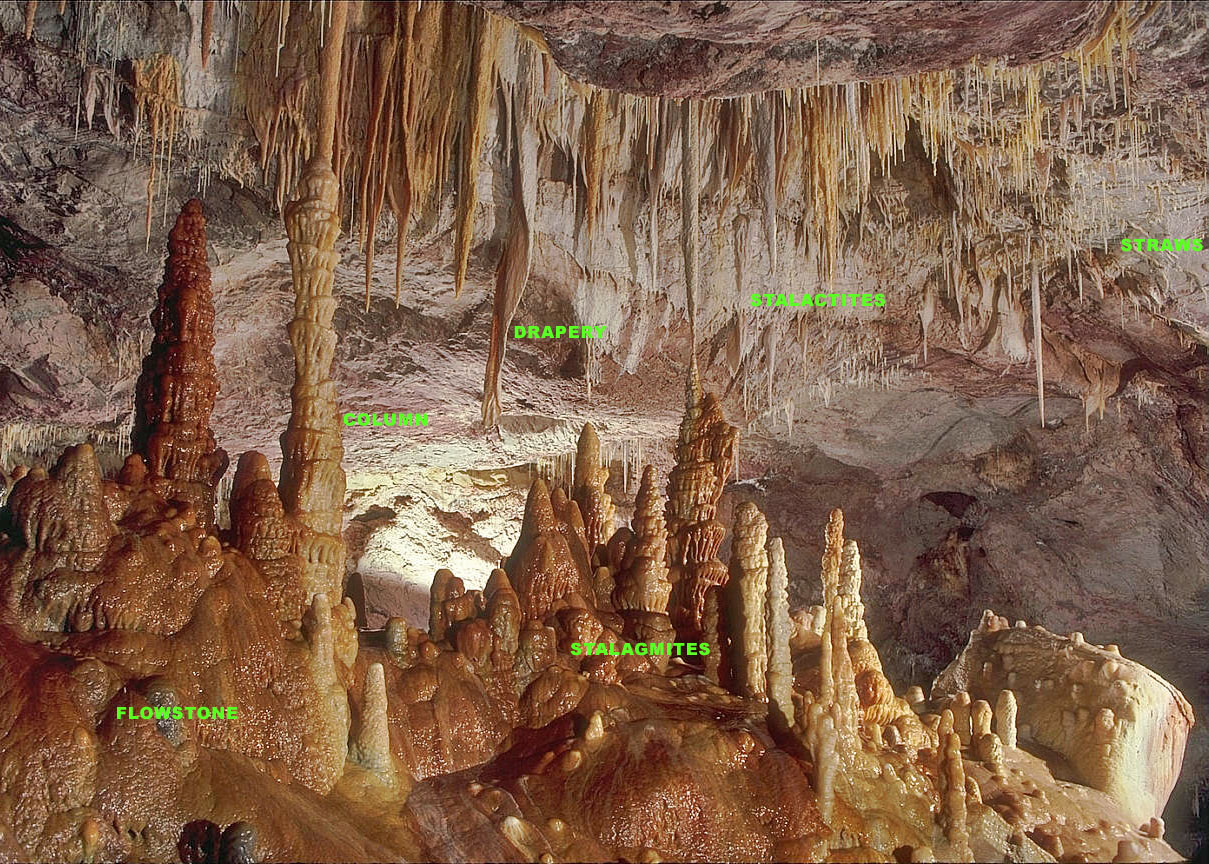
A stalactite (UK: /ˈstæləkˌtaɪt/, US: /stəˈlæktaɪt/; from Ancient Greek σταλακτός (stalaktós) 'dripping', from σταλάσσειν (stalássein) 'to drip') is a mineral formation that hangs from the ceiling of caves, hot springs, or man-made structures such as bridges and mines. Any material that is soluble and that can be deposited as a colloid, or is in suspension, or is capable of being melted, may form a stalactite. Stalactites may be composed of lava, minerals, mud, peat, pitch, sand, sinter, and amberat (crystallized urine of pack rats). A stalactite is not necessarily a speleothem, though speleothems are the most common form of stalactite because of the abundance of limestone caves.
The corresponding formation on the floor of the cave is known as a stalagmite.
The most common stalactites are speleothems, which occur in limestone caves. They form through deposition of calcium carbonate and other minerals, which is precipitated from mineralized water solutions. Limestone is the chief form of calcium carbonate rock which is dissolved by water that contains carbon dioxide, forming a calcium bicarbonate solution in caverns. The chemical formula for this reaction is:
This solution travels through the rock until it reaches an edge and if this is on the roof of a cave it will drip down. When the solution comes into contact with air the chemical reaction that created it is reversed and particles of calcium carbonate are deposited. The reversed reaction is:
An average growth rate is 0.13 mm (0.0051 inches) a year. The quickest growing stalactites are those formed by a constant supply of slow dripping water rich in calcium carbonate (CaCO3) and carbon dioxide (CO2), which can grow at 3 mm (0.12 inches) per year. The drip rate must be slow enough to allow the CO2 to degas from the solution into the cave atmosphere, resulting in deposition of CaCO3 on the stalactite. Too fast a drip rate and the solution, still carrying most of the CaCO3, falls to the cave floor where degassing occurs and CaCO3 is deposited as a stalagmite.
All limestone stalactites begin with a single mineral-laden drop of water. When the drop falls, it deposits the thinnest ring of calcite. Each subsequent drop that forms and falls deposits another calcite ring. Eventually, these rings form a very narrow (≈4 to 5 mm diameter), hollow tube commonly known as a "soda straw" stalactite. Soda straws can grow quite long, but are very fragile. If they become plugged by debris, water begins flowing over the outside, depositing more calcite and creating the more familiar cone-shaped stalactite.
Stalactite formation generally begins over a large area, with multiple paths for the mineral rich water to flow. As minerals are dissolved in one channel slightly more than other competing channels, the dominant channel begins to draw more and more of the available water, which speeds its growth, ultimately resulting in all other channels being choked off. This is one reason why formations tend to have minimum distances from one another. The larger the formation, the greater the interformation distance.
The same water drops that fall from the tip of a stalactite deposit more calcite on the floor below, eventually resulting in a rounded or cone-shaped stalagmite. Unlike stalactites, stalagmites never start out as hollow "soda straws". Given enough time, these formations can meet and fuse to create a speleothem of calcium carbonate known as a pillar, column, or stalagnate.
Hub AI
Stalactite AI simulator
(@Stalactite_simulator)
Stalactite
A stalactite (UK: /ˈstæləkˌtaɪt/, US: /stəˈlæktaɪt/; from Ancient Greek σταλακτός (stalaktós) 'dripping', from σταλάσσειν (stalássein) 'to drip') is a mineral formation that hangs from the ceiling of caves, hot springs, or man-made structures such as bridges and mines. Any material that is soluble and that can be deposited as a colloid, or is in suspension, or is capable of being melted, may form a stalactite. Stalactites may be composed of lava, minerals, mud, peat, pitch, sand, sinter, and amberat (crystallized urine of pack rats). A stalactite is not necessarily a speleothem, though speleothems are the most common form of stalactite because of the abundance of limestone caves.
The corresponding formation on the floor of the cave is known as a stalagmite.
The most common stalactites are speleothems, which occur in limestone caves. They form through deposition of calcium carbonate and other minerals, which is precipitated from mineralized water solutions. Limestone is the chief form of calcium carbonate rock which is dissolved by water that contains carbon dioxide, forming a calcium bicarbonate solution in caverns. The chemical formula for this reaction is:
This solution travels through the rock until it reaches an edge and if this is on the roof of a cave it will drip down. When the solution comes into contact with air the chemical reaction that created it is reversed and particles of calcium carbonate are deposited. The reversed reaction is:
An average growth rate is 0.13 mm (0.0051 inches) a year. The quickest growing stalactites are those formed by a constant supply of slow dripping water rich in calcium carbonate (CaCO3) and carbon dioxide (CO2), which can grow at 3 mm (0.12 inches) per year. The drip rate must be slow enough to allow the CO2 to degas from the solution into the cave atmosphere, resulting in deposition of CaCO3 on the stalactite. Too fast a drip rate and the solution, still carrying most of the CaCO3, falls to the cave floor where degassing occurs and CaCO3 is deposited as a stalagmite.
All limestone stalactites begin with a single mineral-laden drop of water. When the drop falls, it deposits the thinnest ring of calcite. Each subsequent drop that forms and falls deposits another calcite ring. Eventually, these rings form a very narrow (≈4 to 5 mm diameter), hollow tube commonly known as a "soda straw" stalactite. Soda straws can grow quite long, but are very fragile. If they become plugged by debris, water begins flowing over the outside, depositing more calcite and creating the more familiar cone-shaped stalactite.
Stalactite formation generally begins over a large area, with multiple paths for the mineral rich water to flow. As minerals are dissolved in one channel slightly more than other competing channels, the dominant channel begins to draw more and more of the available water, which speeds its growth, ultimately resulting in all other channels being choked off. This is one reason why formations tend to have minimum distances from one another. The larger the formation, the greater the interformation distance.
The same water drops that fall from the tip of a stalactite deposit more calcite on the floor below, eventually resulting in a rounded or cone-shaped stalagmite. Unlike stalactites, stalagmites never start out as hollow "soda straws". Given enough time, these formations can meet and fuse to create a speleothem of calcium carbonate known as a pillar, column, or stalagnate.