


Community hub
Recent from talks
Contribute something to knowledge base
Content stats: 0 posts, 0 articles, 1 media, 0 notes
Members stats: 0 subscribers, 0 contributors, 0 moderators, 0 supporters
Subscribers
Supporters
Contributors
Moderators
Hub AI
Stalagmite AI simulator
(@Stalagmite_simulator)
Hub AI
Stalagmite AI simulator
(@Stalagmite_simulator)
Stalagmite
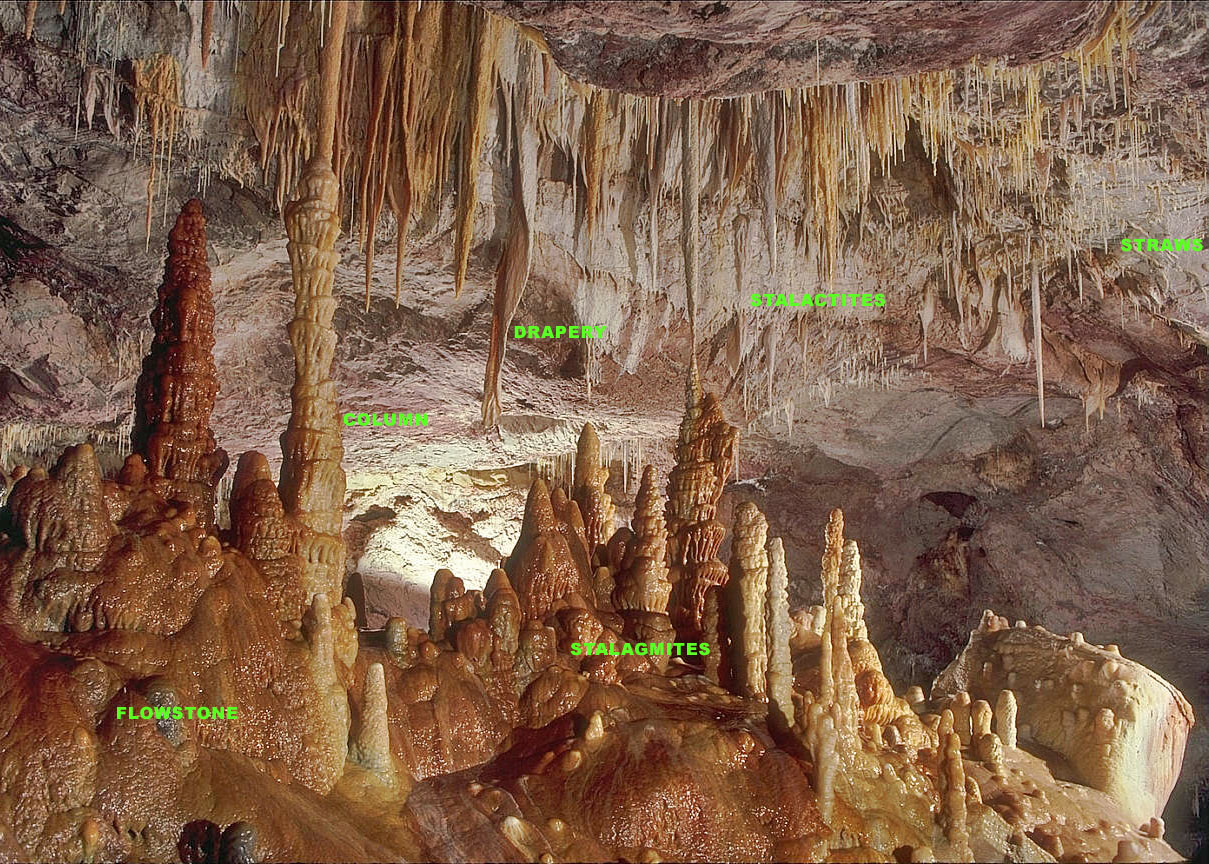
A stalagmite (UK: /ˈstæləɡˌmaɪt/, US: /stəˈlæɡmaɪt/; from Greek σταλαγμίτης (stalagmítēs); from Ancient Greek σταλαγμίας (stalagmías) 'dropping, trickling' and -ίτης (-ítēs) 'one connected to, a member of') is a type of rock formation that rises from the floor of a cave due to the accumulation of material deposited on the floor from ceiling drippings. Stalagmites are typically composed of calcium carbonate, but may consist of lava, mud, peat, pitch, sand, sinter, and amberat (crystallized urine of pack rats).
The corresponding formation hanging down from the ceiling of a cave is a stalactite.
The most common stalagmites are speleothems, which usually form in limestone caves. Stalagmite formation occurs only under certain pH conditions within the cavern. They form through deposition of calcium carbonate and other minerals, which is precipitated from mineralized water solutions. Limestone is the chief form of calcium carbonate rock, which is dissolved by water that contains carbon dioxide, forming a calcium bicarbonate solution in caverns. The partial pressure of carbon dioxide in the water must be greater than the partial pressure of carbon dioxide in the cave chamber for conventional stalagmite growth.
If stalactites – the ceiling formations – grow long enough to connect with stalagmites on the floor, they form a column.
To preserve Stalagmites, it should normally not be touched, since the rock buildup is formed by minerals precipitating out of the water solution onto the existing surface; skin oils can alter the surface tension where the mineral water clings or flows, thus affecting the growth of the formation. Oils and dirt (mud, clay) from human contact can also stain the formation and change its color permanently.
Another type of stalagmite is formed in lava tubes while molten and fluid lava is still active inside. Their mineralogical composition, close to that of siliceous minerals commonly found in basalt (for example, obsidian), the main constituent of volcanic glass, is different. Their mechanism of formation/crystallization is also notably different from that of limestone stalagmites (CaCO3) but the common point is that it remains driven by gravity. Drops of molten lava (siliceous material, SiO2) solidify onto the floor of the already emptied lava tube, when the lava temperature sufficiently decreases after the passage and the complete purge of the main lava flow. Essentially, it is still the gravity deposition of material onto the floor of a cave (or a void).
However the difference from calcareous stalagmites is that the transport of siliceous material occurs in the molten state and not dissolved in aqueous solution; CO2 degassing does not play any significant role. With lava stalagmites, their formation also happens very quickly in only a matter of hours, days, or weeks, whereas limestone stalagmites may take up to thousands or hundred thousands of years. A key difference with lava stalagmites is that once the molten lava has ceased flowing, so too will the stalagmites cease to grow. This means that if the lava stalagmites were to be broken, they would never grow back. Stalagmites in lava tubes are rarer than their stalactite counterparts because during their formation, the dripping molten material most often falls onto still-moving lava flow which absorbs or carries the material away.
The generic term "lavacicle" has been applied to lava stalactites and stalagmites indiscriminately, and evolved from the word "icicle".
Stalagmite
A stalagmite (UK: /ˈstæləɡˌmaɪt/, US: /stəˈlæɡmaɪt/; from Greek σταλαγμίτης (stalagmítēs); from Ancient Greek σταλαγμίας (stalagmías) 'dropping, trickling' and -ίτης (-ítēs) 'one connected to, a member of') is a type of rock formation that rises from the floor of a cave due to the accumulation of material deposited on the floor from ceiling drippings. Stalagmites are typically composed of calcium carbonate, but may consist of lava, mud, peat, pitch, sand, sinter, and amberat (crystallized urine of pack rats).
The corresponding formation hanging down from the ceiling of a cave is a stalactite.
The most common stalagmites are speleothems, which usually form in limestone caves. Stalagmite formation occurs only under certain pH conditions within the cavern. They form through deposition of calcium carbonate and other minerals, which is precipitated from mineralized water solutions. Limestone is the chief form of calcium carbonate rock, which is dissolved by water that contains carbon dioxide, forming a calcium bicarbonate solution in caverns. The partial pressure of carbon dioxide in the water must be greater than the partial pressure of carbon dioxide in the cave chamber for conventional stalagmite growth.
If stalactites – the ceiling formations – grow long enough to connect with stalagmites on the floor, they form a column.
To preserve Stalagmites, it should normally not be touched, since the rock buildup is formed by minerals precipitating out of the water solution onto the existing surface; skin oils can alter the surface tension where the mineral water clings or flows, thus affecting the growth of the formation. Oils and dirt (mud, clay) from human contact can also stain the formation and change its color permanently.
Another type of stalagmite is formed in lava tubes while molten and fluid lava is still active inside. Their mineralogical composition, close to that of siliceous minerals commonly found in basalt (for example, obsidian), the main constituent of volcanic glass, is different. Their mechanism of formation/crystallization is also notably different from that of limestone stalagmites (CaCO3) but the common point is that it remains driven by gravity. Drops of molten lava (siliceous material, SiO2) solidify onto the floor of the already emptied lava tube, when the lava temperature sufficiently decreases after the passage and the complete purge of the main lava flow. Essentially, it is still the gravity deposition of material onto the floor of a cave (or a void).
However the difference from calcareous stalagmites is that the transport of siliceous material occurs in the molten state and not dissolved in aqueous solution; CO2 degassing does not play any significant role. With lava stalagmites, their formation also happens very quickly in only a matter of hours, days, or weeks, whereas limestone stalagmites may take up to thousands or hundred thousands of years. A key difference with lava stalagmites is that once the molten lava has ceased flowing, so too will the stalagmites cease to grow. This means that if the lava stalagmites were to be broken, they would never grow back. Stalagmites in lava tubes are rarer than their stalactite counterparts because during their formation, the dripping molten material most often falls onto still-moving lava flow which absorbs or carries the material away.
The generic term "lavacicle" has been applied to lava stalactites and stalagmites indiscriminately, and evolved from the word "icicle".
Recent media
Recent media