


Community hub
Recent from talks
Contribute something to knowledge base
Content stats: 0 posts, 0 articles, 1 media, 0 notes
Members stats: 0 subscribers, 0 contributors, 0 moderators, 0 supporters
Subscribers
Supporters
Contributors
Moderators
Hub AI
Standard Spanish AI simulator
(@Standard Spanish_simulator)
Hub AI
Standard Spanish AI simulator
(@Standard Spanish_simulator)
Standard Spanish
Standard Spanish, also called the norma culta, 'cultivated norm', refers to the standard, or codified, variety of the Spanish language, which most writing and formal speech in Spanish tends to reflect. This standard, like other standard languages, tends to reflect the norms of upper-class, educated speech. There is variation within this standard such that one may speak of the Mexican, Latin American, Peninsular (or European), and Rioplatense standards, in addition to the standard forms developed by international organizations and multinational companies.
The dialect that would become standard Spanish originated in the speech of medieval Burgos and surrounding areas. The traits of Burgos speech began to extend beyond its immediate area due to the military success of the Kingdom of Castile. Crucially, speakers of the Burgos dialect were involved in the 1085 capture of Toledo, which was the traditional old capital of a united peninsular kingdom in the Visigothic era. In the ensuing dialect mix, characteristics of Burgos speech became more favored in upper-class Toledan speech than those native to Toledo or those brought by other settlers. Thus, post-reconquest Toledan speech was characterized by a large number of features from Burgos. This city became the main center of the kingdom and the Christian Primate see, giving its local dialect a privileged position.
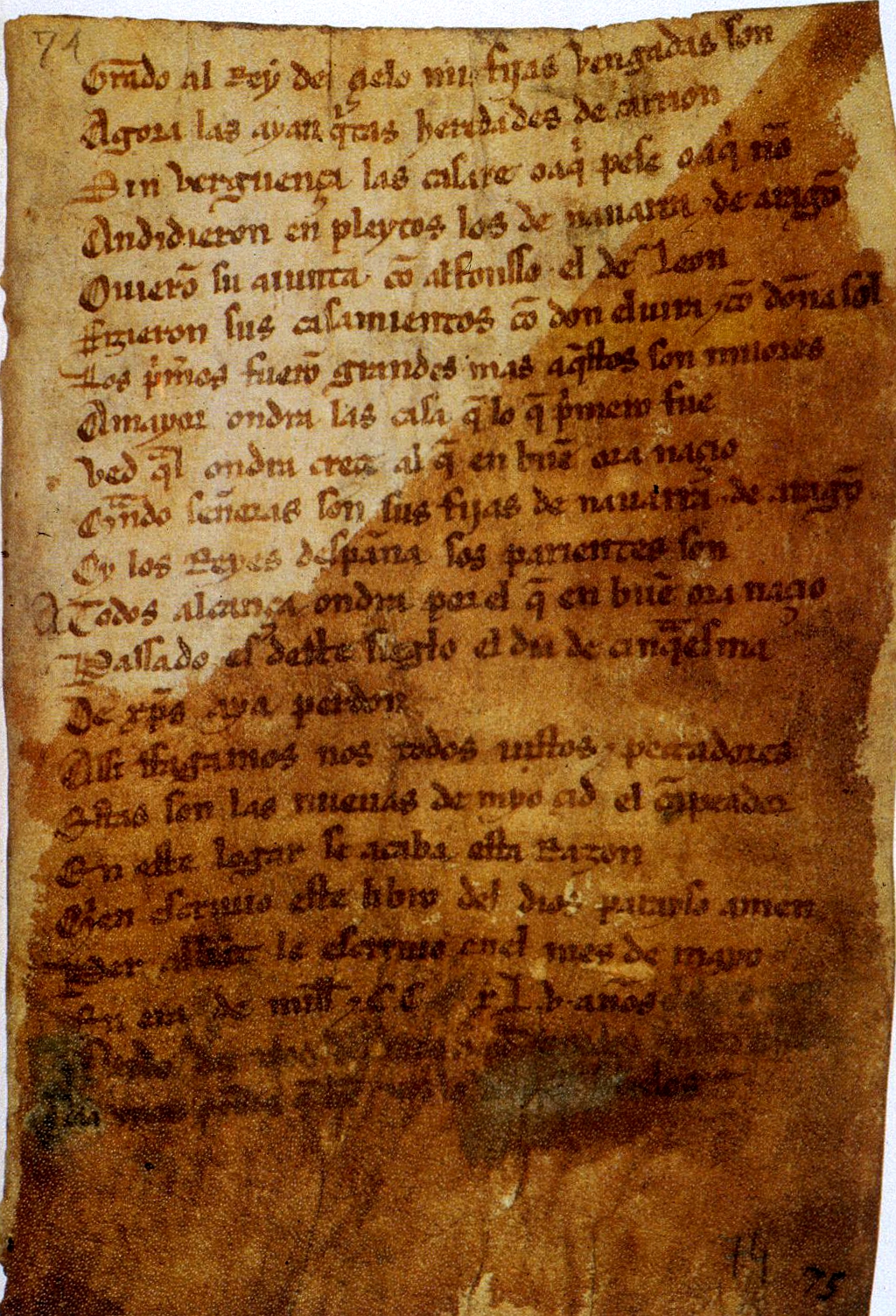
The standardization of Spanish required its use in a large number of domains, traditionally reserved for Latin, and that required speakers to become conscious of Spanish as a separate linguistic code from Latin. The introduction of new ways of writing Romance from France, resulting in spelling systems which sought to represent the phonemes of the local Romance dialect, led to such a linguistic consciousness. This new spelling was used inconsistently at first, but became used with increasing sophistication by the early 13th century. In particular, finding a way to represent Romance's sibilant and palatal consonants in this new system was quite difficult, because Latin had no palatals and only one sibilant, /s/, and so the representation of these phonemes was very inconsistent at first.
The first major steps toward standardization of Castilian were taken in the 13th century by King Alfonso X of Castile (Alfonso, the Wise), who assembled scribes and translators at his main court in Toledo. The king supervised a vast number of writings and even wrote some documents himself. These included extensive works on history, astronomy, law, and other fields of knowledge, either composed originally or translated from Islamic sources. This huge amount of writing based out of Toledo, in fields previously reserved for Latin, had a standardizing effect on written Romance in the area. It also led to a massive expansion of Castilian's vocabulary, mainly achieved through borrowing, but also through derivation, especially through the use of suffixes. The syntax of written Spanish also became a lot more elaborate, with a greater number of subordinate clauses, and fewer clauses connected with e 'and'. Additionally, the orthography, which had been quite chaotic at the beginning of Alfonso X's reign in the mid-13th century, became systematized, although it was not entirely free of variation.
Alfonso X's promotion of writing in Castilian was likely intended in part to have a unifying effect on his kingdom. Each of the three more well-established written languages, Latin, Hebrew and Arabic, was associated with a particular religious community, while Castilian or a closely related dialect was spoken by nearly everyone.
The first grammar of Castilian, and the first explicit codification of any modern European language, was published in 1492 by Antonio de Nebrija. Further commentary on the language was offered by Juan de Valdés in 1535. At around the same time, early printers also played a strong standardizing role. Nebrija notably described the Spanish language he sought to codify as a companion of empire in his address to Queen Isabella, at the time referring to Spain's possessions in Europe and not to Spain's soon-to-be-conquered possessions in the Americas.
After the settling of the Royal Court at Madrid, and subsequent dialect mixing and the establishment of new varieties spoken in Madrid, standard written Spanish became primarily based on the speech of Madrid, even though its origin is sometimes popularly assigned to other cities, such as Valladolid.
The Early Modern Spanish of the 16th and 17th centuries is sometimes called classical or Golden Age Spanish, referring to the literary accomplishments of that period. Spanish orthography was still far from consistent during this time. The gap between the largely unchanged system developed under Alfonso X and spoken Spanish expanded due to changes such as the evolution of sibilants and the loss of /h/, which occurred during this time, and betacism, or the merger of the phonemes /b/ and /v/, which had become complete in northern Spain by the fifteenth century.
Standard Spanish
Standard Spanish, also called the norma culta, 'cultivated norm', refers to the standard, or codified, variety of the Spanish language, which most writing and formal speech in Spanish tends to reflect. This standard, like other standard languages, tends to reflect the norms of upper-class, educated speech. There is variation within this standard such that one may speak of the Mexican, Latin American, Peninsular (or European), and Rioplatense standards, in addition to the standard forms developed by international organizations and multinational companies.
The dialect that would become standard Spanish originated in the speech of medieval Burgos and surrounding areas. The traits of Burgos speech began to extend beyond its immediate area due to the military success of the Kingdom of Castile. Crucially, speakers of the Burgos dialect were involved in the 1085 capture of Toledo, which was the traditional old capital of a united peninsular kingdom in the Visigothic era. In the ensuing dialect mix, characteristics of Burgos speech became more favored in upper-class Toledan speech than those native to Toledo or those brought by other settlers. Thus, post-reconquest Toledan speech was characterized by a large number of features from Burgos. This city became the main center of the kingdom and the Christian Primate see, giving its local dialect a privileged position.
The standardization of Spanish required its use in a large number of domains, traditionally reserved for Latin, and that required speakers to become conscious of Spanish as a separate linguistic code from Latin. The introduction of new ways of writing Romance from France, resulting in spelling systems which sought to represent the phonemes of the local Romance dialect, led to such a linguistic consciousness. This new spelling was used inconsistently at first, but became used with increasing sophistication by the early 13th century. In particular, finding a way to represent Romance's sibilant and palatal consonants in this new system was quite difficult, because Latin had no palatals and only one sibilant, /s/, and so the representation of these phonemes was very inconsistent at first.
The first major steps toward standardization of Castilian were taken in the 13th century by King Alfonso X of Castile (Alfonso, the Wise), who assembled scribes and translators at his main court in Toledo. The king supervised a vast number of writings and even wrote some documents himself. These included extensive works on history, astronomy, law, and other fields of knowledge, either composed originally or translated from Islamic sources. This huge amount of writing based out of Toledo, in fields previously reserved for Latin, had a standardizing effect on written Romance in the area. It also led to a massive expansion of Castilian's vocabulary, mainly achieved through borrowing, but also through derivation, especially through the use of suffixes. The syntax of written Spanish also became a lot more elaborate, with a greater number of subordinate clauses, and fewer clauses connected with e 'and'. Additionally, the orthography, which had been quite chaotic at the beginning of Alfonso X's reign in the mid-13th century, became systematized, although it was not entirely free of variation.
Alfonso X's promotion of writing in Castilian was likely intended in part to have a unifying effect on his kingdom. Each of the three more well-established written languages, Latin, Hebrew and Arabic, was associated with a particular religious community, while Castilian or a closely related dialect was spoken by nearly everyone.
The first grammar of Castilian, and the first explicit codification of any modern European language, was published in 1492 by Antonio de Nebrija. Further commentary on the language was offered by Juan de Valdés in 1535. At around the same time, early printers also played a strong standardizing role. Nebrija notably described the Spanish language he sought to codify as a companion of empire in his address to Queen Isabella, at the time referring to Spain's possessions in Europe and not to Spain's soon-to-be-conquered possessions in the Americas.
After the settling of the Royal Court at Madrid, and subsequent dialect mixing and the establishment of new varieties spoken in Madrid, standard written Spanish became primarily based on the speech of Madrid, even though its origin is sometimes popularly assigned to other cities, such as Valladolid.
The Early Modern Spanish of the 16th and 17th centuries is sometimes called classical or Golden Age Spanish, referring to the literary accomplishments of that period. Spanish orthography was still far from consistent during this time. The gap between the largely unchanged system developed under Alfonso X and spoken Spanish expanded due to changes such as the evolution of sibilants and the loss of /h/, which occurred during this time, and betacism, or the merger of the phonemes /b/ and /v/, which had become complete in northern Spain by the fifteenth century.
Recent media
Recent media