Hubbry Logo
Steering columnSteering columnMain
Open search
Steering column
Community hub
Steering column
logo
8 pages, 0 posts
0 subscribers
Be the first to start a discussion here.
Steering column
Steering column
from Wikipedia
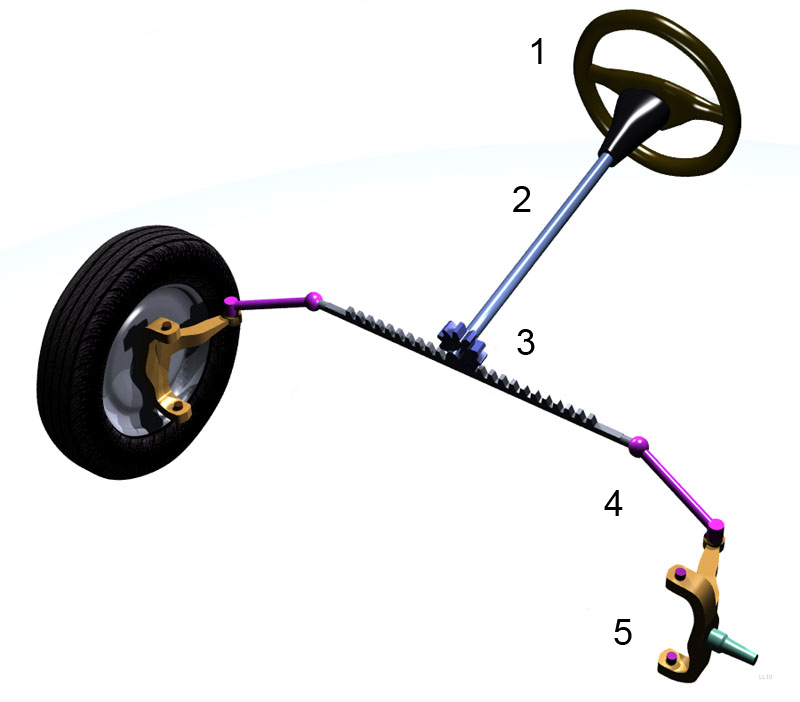
Simplified steering linkage:
1 steering wheel
2 case
3 Steering column (hidden by the case - blue dashed line)
4 Universal joint

The automotive steering column is a device intended primarily for connecting the steering wheel to the steering mechanism.

Secondary functions

[edit]

A steering column may also perform the following secondary functions:

  • energy dissipation management in the event of a frontal collision;
  • provide mounting for: the multi-function switch, column lock, column wiring, column shroud(s), transmission gear selector, gauges or other instruments as well as the electro motor and gear units found in EPAS and SbW systems;
  • offer (height and/or length) adjustment to suit driver preference

Steering lock

[edit]

Modern vehicles are fitted with a steering lock which is an anti-theft device. It is fitted to the steering column usually below the steering wheel. The lock is combined with the ignition switch and engaged and disengaged either by a mechanical ignition key or electronically from the vehicles electronic control unit. These locks were introduced on many General Motors products in 1969 drastically reducing thefts of these GM models,[1] and on Ford, Chrysler, and AMC products in 1970.

Collapsible column

[edit]

A common device to enhance car safety is the collapsible steering column. This is designed to collapse in the event of a collision to protect the driver from harm. The column can collapse after impact with a tolerance ring inserted between the inner shaft of the steering column and the external housing. The wavelike protrusions on the circumference of the tolerance ring act as a spring to hold the two parts in place in normal driving conditions. At a specific level of force, for example in the event of a collision, the tolerance ring allows the inner shaft to slip inside the housing, so the column can collapse, absorbing energy from the impact.[2] In 1967, General Motors introduced its 'energy absorbing' steering column which consisted of a lattice-mesh outer tube section which was designed to crush on impact whilst the inner shaft telescoped. This column design first appeared on Chevrolet vehicles, and was rolled out to all of GM's divisions worldwide in the following years.

In virtually all modern vehicles, the lower section of the inner shaft is articulated with universal joints which helps control movement of the column in a frontal impact, and also gives engineers freedom in mounting the steering gear itself.

Regulatory requirements

[edit]

In the United States, steering columns are governed by several federal regulatory requirements, notably FMVSS 108, 114 and 208. The Chinese directive GB15740- 2006 obligates Chinese car manufacturers to incorporate anti-theft mechanisms in their vehicles.[3] European Union Commission Directive 95/56/EC (1995) mandates all cars exported to European markets must be fitted with anti-theft security devices. This regulation also requires that a steering lock must be able to withstand forces of 100Nm applied to the steering wheel without failing.[4]

References

[edit]
Revisions and contributorsEdit on WikipediaRead on Wikipedia
from Grokipedia
The steering column is a critical mechanical component in automotive vehicles that connects the to the steering gear or mechanism, transmitting rotational from the driver to enable precise directional control of the front wheels by converting rotary motion into linear movement. Comprising primarily an outer tube affixed to the vehicle's bodywork and an inner steering shaft, it ensures high rotational rigidity while allowing smooth operation and absorbing road shocks to provide feedback to the driver. In modern automobiles, steering columns are engineered for multiple functions beyond torque transmission, including noise and vibration damping, low-friction rotation, and enhanced safety features such as collapsible designs to mitigate injury during collisions. They incorporate bearings—such as angular contact ball bearings, needle roller bearings, and four-point contact ball bearings—to support the shaft with clearance-free operation, high rigidity, and resistance to oscillations, while also facilitating anti-theft mechanisms that withstand up to 240 Nm of torque. Common types include rigid columns for fixed positioning, angularly adjustable ones for tilt variation, telescopically height-adjustable variants, and combined adjustable systems to accommodate diverse driver ergonomics. Integrated into the broader chassis and suspension systems, the steering column works with components like the pitman arm, tie rods, and steering gear types (e.g., worm-and-roller or rack-and-pinion) to maintain wheel alignment, vehicle stability, and overall handling safety. In power-assisted systems, it interfaces with electric or hydraulic units to reduce steering effort, and safety standards demand it endure impact tests simulating crashes, such as limiting rearward displacement to no more than 127 mm in a frontal barrier crash test at speeds up to and including 48 km/h (FMVSS 204) and the force transmitted to a body block to no more than 11,000 N at an impact speed of 24 km/h (FMVSS 203).

Overview

Definition and Purpose

The steering column is a critical mechanical assembly in automotive vehicles, consisting of a structural housing that encases a steering shaft, which serves as the primary conduit for transmitting rotational from the driver's to the vehicle's steering gear, such as a gearbox or rack-and-pinion system. This setup converts the driver's manual input into precise angular movement that directs the front wheels, enabling controlled changes in the vehicle's direction. Its primary purpose is to establish a reliable mechanical linkage between the driver and the wheels, ensuring responsive by efficiently transferring while accommodating adjustments for ergonomic comfort, such as tilt and telescoping mechanisms to suit different driver positions. In doing so, the steering column maintains structural integrity under varying loads, from light maneuvering to high- demands during evasive actions, thereby contributing to overall handling and . Introduced alongside early automobiles in the late , the column remains indispensable across diverse configurations, including traditional manual systems, hydraulic power-assisted setups, and modern electric power (EPS) variants, where it integrates seamlessly with electronic controls to enhance precision without altering its core transmissive role. In most passenger vehicles, it forms the backbone of front-wheel systems, linking directly to the rack or gear assembly beneath the to facilitate intuitive directional control.

Historical Evolution

The steering column originated in the late with the advent of horseless carriages, where rigid tiller-style mechanisms were employed for directional control, often mounted directly to the frame without a dedicated column shaft. These early designs prioritized and for low-speed , but their limited leverage made precise maneuvering challenging. By 1894, the transition to wheel-based steering began when French engineer Alfred Vacheron installed the first known on a et Levassor vehicle for the Paris-Rouen race, introducing a vertical column shaft to transmit rotational input to the front wheels via a rudimentary gear system. This innovation rapidly gained traction, with American manufacturers like adopting steering wheels by 1901, marking the shift from tillers to more intuitive column-integrated controls that improved handling at higher speeds. Key milestones in steering column evolution reflected growing emphasis on safety amid rising automobile adoption. In the 1930s, the collapsible steering column was invented following concerns over rigid shaft impalement in accidents, designing a telescoping prototype with energy-absorbing elements to mitigate frontal impacts, though widespread implementation lagged due to cost and regulatory absence. Post-World War II, the 1950s saw increased scrutiny of column-related injuries through crash analyses, revealing that rigid designs contributed to severe thoracic trauma in head-on collisions, prompting early safety research by organizations like the Society of Automotive Engineers. By the 1960s, energy-absorbing columns became standard, with General Motors introducing production models in 1967 featuring deformable steel mesh and plastic coatings to limit force transmission to the driver. Tilt mechanisms also emerged in this era, with Cadillac offering power tilt-and-telescope columns in 1965 for ergonomic adjustability, evolving into electronically controlled variants by the 1980s in luxury vehicles like those from Lincoln and Mercedes-Benz to enhance driver comfort and positioning. This progression was driven by a from rigid, durability-focused designs to flexible, occupant-protective ones, catalyzed by accident data showing steering columns as a primary source in frontal crashes. The U.S. (FMVSS) Nos. 203 and 204 mandated impact absorption and rearward displacement limits in the steering , with No. 203 requiring the system to limit force to no more than 11,120 Newtons when impacted by a test device at 24 km/h, and No. 204 limiting the upper end of the steering column to 127 mm rearward displacement in a 48 km/h frontal barrier crash, spurring universal adoption across U.S. manufacturers. In the , global harmonization accelerated through Economic Commission for (UN ECE) regulations, particularly ECE R21 on interior fittings and updates to ECE R79 on steering equipment, which incorporated column movement limits and energy absorption requirements for export markets, influencing designs in and to align with FMVSS principles. Mid-20th-century innovations, such as column-mounted stalks for lights and wipers introduced by in the 1940s, further integrated secondary controls without compromising core safety advancements.

Design and Components

Core Components

The steering column assembly primarily comprises an upper shaft, which connects directly to the , and a lower shaft, which interfaces with the steering gearbox to form the core structural backbone. These shafts are linked by universal joints or flexible couplings that accommodate angular misalignment and vehicle motion while maintaining structural integrity. Encasing the shafts is a protective tube, typically a cylindrical outer shell that shields internal components from debris and impacts. Support structures within the assembly include bearing mounts, such as needle or ball bearings, positioned at key points to ensure smooth rotational movement and minimize . The upper shaft often uses angular contact ball bearings for precise support, while the lower may employ needle roller bearings for axial loads. Adjustment mechanisms, like levers for tilt and telescoping, are integrated into the housing to allow driver-specific positioning. The assembly typically includes an housing integrated into the upper column for key access. Traditionally, steering columns are constructed from for its high strength and durability, providing robust resistance to torsional loads. In modern designs, aluminum alloys have been adopted to achieve weight reduction compared to steel equivalents, enhancing without compromising . Advanced applications incorporate carbon fiber reinforced (CFRP) composites for weight savings through processes like pullwinding and resin transfer molding. The assembly features modular construction, facilitating customization based on vehicle platform; typical lengths range from 700 to 1000 , and shaft diameters from 19 to 30 , scaled to accommodate compact cars versus larger SUVs. Shafts often feature splined ends for secure connections to the and gearbox. These splined ends are lubricated with graphite or lithium-based greases for internal spline interfaces to reduce friction, noise, and wear; however, for external dust boot-to-shaft contacts, silicone grease is preferred due to its compatibility with rubber and plastic components. The often includes collapsible elements as a structural feature to manage energy absorption in impacts.

Types and Variations

Steering columns are broadly classified into fixed and adjustable designs, with variations tailored to specific vehicle applications and requirements. Fixed steering columns are rigid, non-adjustable assemblies that maintain a constant position for the , prioritizing simplicity and cost-effectiveness in . These columns feature a solid shaft without mechanisms for movement, making them suitable for older vehicles or budget-oriented models where driver are secondary to affordability. For instance, they were commonly used in pre-1970s trucks, such as those from , to reduce production complexity and weight. Adjustable steering columns allow drivers to customize the wheel's position for improved comfort and accessibility, with subtypes including tilt-only, telescoping, or combined mechanisms. Tilt columns pivot the wheel vertically to accommodate varying driver heights, while telescoping versions enable horizontal extension or retraction of the shaft. Combination systems integrate both functions for greater flexibility, first introduced in the on luxury vehicles like models to enhance amid growing emphasis on driver convenience. Vehicle-specific variations adapt column length and configuration to cabin geometry and steering system integration. In sports cars, shorter columns are employed to align with lower seating positions, optimizing legroom and visibility in compact cockpits, as seen in models like the . SUVs often incorporate intermediate shafts between the column and steering gear to bridge the distance in elevated cabs, ensuring smooth transmission without excessive column length. Modern sedans frequently feature rack-and-pinion integrated columns, where the column directly interfaces with the rack mechanism for precise, compact steering response. Specialized steering columns address unique demands in commercial and emerging vehicle segments. Heavy-duty columns incorporate reinforced shafts and robust housings to withstand high torsional loads and vibrations in trucks and buses, as provided by suppliers like Bosch for medium- and heavy-commercial applications. In electric vehicles, post-2020 trends favor compact designs compatible with systems, which minimize mechanical linkages for reduced weight and space, exemplified in implementations by Nexteer that use stowable columns while retaining haptic feedback.

Mechanical Operation

Steering Transmission

The steering transmission mechanism in a vehicle's steering column converts the driver's rotational input from the into precise motion that directs the front wheels. This process begins with the steering shaft, which rotates freely within the column housing, transferring through splined connections that maintain axial alignment and prevent slippage even under varying loads. These splines ensure reliable engagement between the steering wheel hub, shaft, and downstream components like the gear, accommodating minor positional shifts without compromising motion integrity. To handle column tilt adjustments, which can introduce angular misalignments up to 30 degrees between the and the gear input, universal joints are integrated into the shaft assembly. These joints, typically cardan-type, allow the shaft to flex while transmitting rotational motion and efficiently, compensating for the non-collinear axes without significant efficiency loss. The overall system then interfaces with the steering gear—such as a rack-and-pinion or setup—where a typical gear reduction ratio of 15:1 amplifies the input, converting one full turn of the into approximately 24 degrees of wheel angle for responsive control. Steering columns are engineered to withstand driver-applied torques up to 50 Nm in manual steering systems, though typical efforts under normal driving conditions are lower, around 5-15 Nm, with higher values during parking maneuvers. In power-assisted systems, hydraulic or electric motors provide amplification directly at the shaft or pinion, multiplying this input torque by factors of 5 to 10 to ease operation, particularly at low speeds or during parking maneuvers. This assistance integrates seamlessly with the mechanical transmission, overlaying additional torque to reduce the driver's perceived effort while preserving road feel. Friction within the transmission is minimized through high-precision bearings supporting the shaft, such as angular contact ball or needle roller types, which maintain frictional s below 0.1 Nm under operational speeds. These bearings, often featuring tolerance rings or rubber , also absorb vibrations from road inputs, preventing steering wheel shimmy and ensuring smooth transfer. By oscillations effectively, they enhance durability and driver comfort without introducing backlash.

Secondary Functions

The steering column integrates several auxiliary controls to enhance driver convenience without requiring hands to leave the wheel. Control stalks, typically mounted on either side of the column, manage essential vehicle functions such as turn signals, windshield wipers, and headlights. These stalks originated in late-1930s designs by , with introducing electric turn signals as standard equipment in 1938 to improve signaling safety over hand gestures or mechanical arms. Today, they are standardized as multifunction switches, combining multiple operations into a single assembly for streamlined and reduced driver distraction. Instrument integration via the steering column has evolved to support data transmission. In vehicles prior to the , mechanical cables connected the transmission to gauges, often routed alongside or near the column assembly under the for efficient cabling. Modern systems utilize electronic signals over the Controller Area Network (, with column-mounted wiring harnesses facilitating communication between steering controls and vehicle ECUs for real-time data like speed and steering angle to the instrument cluster. Additional roles include housing wiring for the horn, typically activated via a button in the center, a feature dating to when the first horn button was integrated into the hub. The driver's module is centrally located in the hub, a placement standardized since the to optimize deployment during frontal impacts. The , positioned on the column for easy right-hand access while seated, activates the starter and electrical systems, combining convenience with integration into the column's lock mechanism. Over time, steering column functions have transitioned from mechanical linkages—such as cable-driven wipers and manual levers—to electronic switches, particularly post-1990s, enabling multiplexed wiring that reduces complexity and harness weight in vehicles. This shift supports advanced features like integration while maintaining compatibility with adjustable column positioning for optimal reach.

Safety Features

Collapsible Design

The collapsible design of a steering column is engineered to absorb during frontal impacts by allowing controlled deformation, thereby minimizing the transfer of forces to the driver. This is achieved through telescoping or mechanisms where sections of the column slide or crumple upon exceeding a predetermined load threshold, typically under high deceleration forces of 20-50 g encountered in crashes at speeds around 50 km/h. For instance, the column shortens by up to 127 mm to dissipate energy without rigid intrusion into the occupant compartment. Key mechanisms include plastic deformation zones engineered with weakened or scored metal sections that yield progressively, such as steel mesh or slotted tubes that crumple like an . These are often combined with energy-absorbing elements like helical springs or shear pins that fracture at specific forces, allowing the upper column to rearward. Honeycomb-structured inserts, made from aluminum or composite materials, can also be integrated to provide uniform crushing resistance, further distributing impact loads. This design was pioneered in the mid-1960s, with introducing energy-absorbing columns in 1967 models featuring crumpling steel mesh, followed by Ford in 1968, largely in response to safety advocacy following Nader's 1965 critique of automotive vulnerabilities. By preventing the steering column from penetrating the driver's chest or , the collapsible design significantly reduces the risk of severe injuries such as rib fractures or internal organ damage in frontal collisions. Compliance testing under Federal Motor Vehicle Safety Standard (FMVSS) No. 204 requires that, in a 48 km/h barrier crash, the column's rearward displacement must not exceed 127 mm, while FMVSS No. 203 limits the peak force transmitted to a simulated chest to 11,120 N (with no more than 5,650 N sustained for over 3 ms) during a 24 km/h impactor test on the . These standards ensure the system mitigates thoracic injury criteria, with NHTSA evaluations indicating that such features have prevented thousands of fatalities annually since their mandate in 1968. Traditional materials for collapsible columns are high-strength low-alloy steels with controlled yield strengths around 300-500 MPa in deformation zones, enabling predictable plastic hinging without brittle failure. Since the late , hybrid constructions incorporating magnesium alloys—such as AZ91D for upper jackets—have gained adoption for their 30-35% weight reduction over while maintaining energy absorption through die-cast capsules that deform at similar loads, enhancing overall vehicle efficiency without compromising crash performance.

Steering Lock Mechanisms

Steering lock mechanisms in primarily serve as anti-theft devices by preventing the steering shaft from rotating when the ignition is off, thereby immobilizing the and deterring unauthorized use. The basic mechanical lock, introduced in the late , typically involves a pin or bolt that engages a notch or groove in the steering shaft upon key removal. This design, patented by inventor Frank D. Carpenter and assigned to Arthur H. Hough in 1929, became a standard feature in automobiles, evolving from early aftermarket solutions to integrated components. These mechanisms are generally column-mounted, featuring a lock integrated near the that actuates a locking pin through mechanical linkage or, in later variants, a for electronic control. The pin extends into the shaft to block , while shear pins or breakaway elements in the assembly provide fail-safes, ensuring the lock does not engage unexpectedly during operation—such as due to or electrical faults—which could lead to loss of steering control. For instance, in traditional setups, slight steering wheel movement when the key is out releases a spring-loaded to secure the pin only when the is parked. Electronic immobilizers, integrated into steering column locks since the mid-1990s, enhance security by combining physical locking with engine disablement via transponder keys. These systems use a chip in the key that communicates with the (ECU); if an unauthorized key is detected, the ECU prevents or ignition, rendering the vehicle inoperable even if the steering is unlocked. The 1995 was among the first to employ such a system, and widespread adoption has reduced vehicle theft rates by up to 50%, according to data from the Highway Loss Data Institute (HLDI), an affiliate of the (IIHS). In keyless entry vehicles of the , steering lock mechanisms have advanced to fully electronic steering column locks (ESCLs) that automatically engage or disengage based on proximity authentication from a fob, often integrating with the vehicle's . These solenoid-actuated systems eliminate physical keys, using sensors to verify driver presence and authorization before unlocking the steering, further reducing theft vulnerabilities while maintaining seamless integration with push-button ignition switches. Manufacturers like Huf and Marquardt produce such ESCLs compliant with automotive safety standards, ensuring reliable operation without manual intervention. A common reliability issue with electronic steering column locks is the failure of the Electronic Steering Lock (ELV) module, designated as the J518 module in Audi vehicles. This fault is prevalent in models such as the A4, A5, A6, Q5, and Q7, particularly those manufactured from approximately 2005 to 2018. Symptoms typically include the steering wheel remaining locked, a "Steering Defective" warning displayed on the dashboard, inability to start the vehicle, and the instrument cluster failing to illuminate. This is a well-documented classic problem in automotive repair sources, often necessitating module repair or replacement to restore functionality.

Regulations and Standards

Global Regulatory Requirements

In the United States, Federal Motor Vehicle Safety Standard (FMVSS) No. 203 specifies requirements for the to limit the force transmitted to during impact, measured using a torso-shaped body block propelled at approximately 15 mph (24 km/h), with forces not exceeding 2,500 pounds except for brief intervals. Complementing this, FMVSS No. 204 mandates that the steering column's rearward displacement in a full-vehicle frontal barrier crash at 30 mph (48 km/h) must not exceed 5 inches (127 mm) relative to its pre-crash position, to minimize intrusion risks. As proposed in May 2025, NHTSA is considering amendments to exempt certain automated vehicles without steering wheels from these requirements. Additionally, FMVSS No. 114 requires a key-locking system that immobilizes the column when the ignition is off, preventing vehicle operation without the key to reduce theft-related incidents. In Europe and regions adhering to United Nations Economic Commission for Europe (UNECE) regulations, ECE Regulation No. 12 establishes uniform provisions for approving vehicles based on driver protection from the steering mechanism during impacts, requiring the steering system to absorb energy and limit thoracic and neck injury criteria in dynamic tests simulating frontal collisions at up to 50 km/h. These provisions emphasize non-intrusive designs that preserve steering functionality post-impact. Separately, ECE Regulation No. 116 mandates integrated lock mechanisms to secure the steering column against unauthorized use. Post-2018 amendments to ECE Regulation No. 79 incorporated compatibility with advanced driver assistance systems while maintaining core safety performance for steering equipment. In other major markets, Japan's (JIS) D 5812 outline requirements for steering locks integrated with ignition switches, ensuring reliable locking of the steering shaft to prevent , alongside durability tests for overall system integrity under repeated use. In , GB 11551-2014 sets criteria for occupant protection in frontal collisions, mandating energy-absorbing steering columns that limit driver injury risks through controlled deformation, harmonized with UN ECE Regulation No. 94 since 's accession to the 1958 Agreement in 2006. Global regulatory requirements for steering columns trace their evolution from voluntary guidelines developed by organizations like the Society of Automotive Engineers in the , which focused on basic impact resistance, to mandatory enforcement following the U.S. National Traffic and Motor Vehicle Safety Act of 1966, which spurred international adoption of performance-based standards emphasizing and anti-theft features. Compliance involves rigorous validation, with annual global testing efforts supporting production of over 80 million vehicles, ensuring adherence to these evolving frameworks.

Testing and Compliance

Testing and compliance for steering columns involve rigorous laboratory and simulation-based evaluations to ensure they meet safety and performance standards, such as those outlined in Federal Motor Vehicle Safety Standard (FMVSS) No. 204. These procedures verify the structural integrity under crash conditions, long-term durability, resistance to theft, and overall regulatory adherence, often using standardized and third-party oversight to mitigate risks like driver injury or unauthorized vehicle operation. Impact testing simulates frontal crashes through sled tests at speeds of 48 km/h (30 mph), measuring the rearward displacement and of the steering column to limit intrusion into the occupant compartment to no more than 127 mm (5 inches). These tests assess distance and the forces involved in energy absorption, using high-speed instrumentation compliant with SAE J211 standards for data accuracy in acceleration and displacement metrics. In full-vehicle evaluations, anthropomorphic test dummies instrumented per SAE J211 capture interaction forces, ensuring the column's deformation does not exceed thresholds that could cause chest or . Sled simulations allow isolated component validation before integrated crash tests, replicating barrier impact dynamics. Durability tests subject steering columns to accelerated life simulations equivalent to 200,000 km of operation, incorporating 1-2 million cycles of rotational movement, adjustment, and loading to mimic real-world usage. Vibration profiles follow ISO 16750-3 for mechanical loads, exposing the assembly to sinusoidal and random across ranges to detect in bearings, joints, and actuators. These cycles include tilt, telescoping, and inputs under varying loads, with post-test inspections for , looseness, or modes that could compromise control. The testing ensures the column maintains functionality over the vehicle's expected lifespan without excessive play or binding. Theft resistance evaluations for steering column locks include mechanical trials such as and bump key attacks to assess , alongside electronic scans to verify immobilizer effectiveness against unauthorized access attempts. For electronic steering column locks, compliance with ensures at ASIL levels up to D, testing the controller's response to faults that could disable the lock prematurely. These procedures simulate common theft techniques, measuring time-to-breach and failure rates to confirm the lock engages reliably when the vehicle is off, preventing steering wheel rotation. Certification processes rely on third-party validation from organizations like the (NHTSA) in the U.S. and in Europe, involving independent audits of test data against standards such as FMVSS 204. Manufacturers submit compliance reports, with NHTSA conducting confirmatory testing to verify performance; non-compliance can trigger recalls, as seen in the 2014 ignition switch issue, which affected over 25 million vehicles globally due to defects in the steering column-mounted switch leading to loss of and braking. These validations include reviews and physical re-testing to ensure ongoing adherence post-certification.

References

Add your contribution
Related Hubs
User Avatar
No comments yet.