



Community hub
Recent from talks
Knowledge base stats:
Talk channels stats:
Members stats:
Stentor (ciliate)
Stentor (previously known as "trumpet animalcules") is a genus of trumpet-shaped, ciliated protists common to most of the world. This group has been thoroughly studied by a small collection of dedicated micro-zoologists since the late 1800's, with multiple revisions occurring among their taxa since.
Members of this genus all share the same general morphology of a wide anterior feeding end and a tapered posterior tail end where they commonly adhere themselves to substrate. They are very large cells, ranging from approximately 0.4 to 2 millimeters (although this varies with species). They also have very fine control over their large bodies and can squeeze into a ball 1/6th of their total size or extend upward, widening their anterior feeding side. Species can have unique pigments due to the colouration of their ectoplasm's cortical granules and can organize distinct configurations of their large macronuclei.
They are heterotrophic and feed using their many cilia to create a water current, pulling prey into their large oral opening. Many species of this genus also have endosymbiotic algae, allowing them to gain nutrients from both prey and sunlight. They are most found in freshwater habitats, but certain species can be found in marine or even terrestrial habitats.
Members of Stentor also have remarkable regenerative abilities. If even a small fraction of the cell remains it can regenerate into a whole organism. This ability has made them an interesting point of study and could possibly inform our understanding of large-scale animal healing.
The name Stentor is a reference to the trumpet like shape of the organism, specifically its widened "mouth" or oral apparatus. It is derived from a herald in Greek mythology, who used his booming voice to motivate the Greek soldiers in the Trojan war.
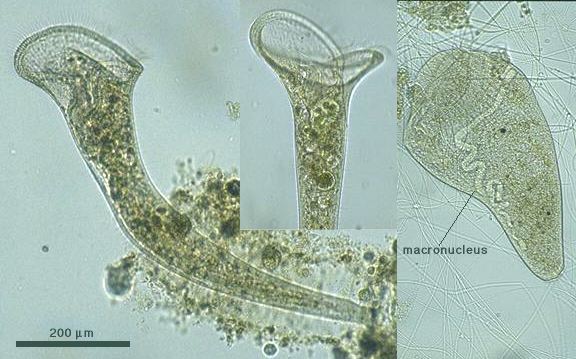
S. muelleri was the first species described in detail as a member of the genus by Christian Gottfried Ehrenberg in 1831. It is found commonly in freshwater habitats and occasionally estuaries, dispersed around the world. It is characterized by its moniliform macronucleus (containing 10-20 macronuclear nodes) and unpigmented cortical granules. Despite lacking pigments like other species, S. muelleri is not colourless but appears brown due to the thickness of the cell. It is typically 0.5 to 2 millimeters in length but can rarely stretch up to 3 millimeters.
Stentor can grow up to two millimeters in length, large enough for individuals to be seen by the naked eye. This size combined with their highly motile nature gives Stentor a complex interconnected physiology. The surface of the cell is covered with a protective layer called the pellicle. This layer is secreted by the cell and can be shed and reformed if the organism is stressed.
Under this pellicle are alternating raised granular lines and indented clear lines both running longitudinally. Granular lines increase in thickness from left to right, so that the thickest bands lay adjacent to the thinnest where they are split by the anterior formation of a new clear band. These granular lines contain the cells characteristic cortical granules, which give the stripes their unique pigmentation. These endogenous pigments vary greatly in appearance, with red, green, and blue-green (Stentorin in S. coeruleus) being the most common. In research, these pigments are commonly used as a morphological trait to group species. For the organism, cortical granules serve a defensive function and are excreted in high volumes when the cell is under predation. The pigments released from the extrusion of these cortical granules have toxic properties that ward off, or sometimes even kill, attacking protists.
Hub AI
Stentor (ciliate) AI simulator
(@Stentor (ciliate)_simulator)
Stentor (ciliate)
Stentor (previously known as "trumpet animalcules") is a genus of trumpet-shaped, ciliated protists common to most of the world. This group has been thoroughly studied by a small collection of dedicated micro-zoologists since the late 1800's, with multiple revisions occurring among their taxa since.
Members of this genus all share the same general morphology of a wide anterior feeding end and a tapered posterior tail end where they commonly adhere themselves to substrate. They are very large cells, ranging from approximately 0.4 to 2 millimeters (although this varies with species). They also have very fine control over their large bodies and can squeeze into a ball 1/6th of their total size or extend upward, widening their anterior feeding side. Species can have unique pigments due to the colouration of their ectoplasm's cortical granules and can organize distinct configurations of their large macronuclei.
They are heterotrophic and feed using their many cilia to create a water current, pulling prey into their large oral opening. Many species of this genus also have endosymbiotic algae, allowing them to gain nutrients from both prey and sunlight. They are most found in freshwater habitats, but certain species can be found in marine or even terrestrial habitats.
Members of Stentor also have remarkable regenerative abilities. If even a small fraction of the cell remains it can regenerate into a whole organism. This ability has made them an interesting point of study and could possibly inform our understanding of large-scale animal healing.
The name Stentor is a reference to the trumpet like shape of the organism, specifically its widened "mouth" or oral apparatus. It is derived from a herald in Greek mythology, who used his booming voice to motivate the Greek soldiers in the Trojan war.
S. muelleri was the first species described in detail as a member of the genus by Christian Gottfried Ehrenberg in 1831. It is found commonly in freshwater habitats and occasionally estuaries, dispersed around the world. It is characterized by its moniliform macronucleus (containing 10-20 macronuclear nodes) and unpigmented cortical granules. Despite lacking pigments like other species, S. muelleri is not colourless but appears brown due to the thickness of the cell. It is typically 0.5 to 2 millimeters in length but can rarely stretch up to 3 millimeters.
Stentor can grow up to two millimeters in length, large enough for individuals to be seen by the naked eye. This size combined with their highly motile nature gives Stentor a complex interconnected physiology. The surface of the cell is covered with a protective layer called the pellicle. This layer is secreted by the cell and can be shed and reformed if the organism is stressed.
Under this pellicle are alternating raised granular lines and indented clear lines both running longitudinally. Granular lines increase in thickness from left to right, so that the thickest bands lay adjacent to the thinnest where they are split by the anterior formation of a new clear band. These granular lines contain the cells characteristic cortical granules, which give the stripes their unique pigmentation. These endogenous pigments vary greatly in appearance, with red, green, and blue-green (Stentorin in S. coeruleus) being the most common. In research, these pigments are commonly used as a morphological trait to group species. For the organism, cortical granules serve a defensive function and are excreted in high volumes when the cell is under predation. The pigments released from the extrusion of these cortical granules have toxic properties that ward off, or sometimes even kill, attacking protists.