Hubbry Logo
Sternothyroid muscleSternothyroid muscleMain
Open search
Sternothyroid muscle
Community hub
Sternothyroid muscle
logo
8 pages, 0 posts
0 subscribers
Be the first to start a discussion here.
Sternothyroid muscle
from Wikipedia
Sternothyroid muscle
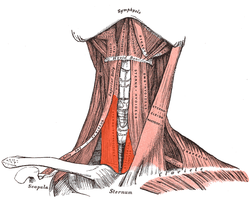
Sternothyroid visible center left
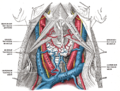
Section of the neck at about the level of the sixth cervical vertebra. Showing the arrangement of the fascia coli. (Sternothyroideus labeled at right, third from top.)
Details
OriginManubrium
InsertionThyroid cartilage
ArterySuperior thyroid artery
NerveAnsa cervicalis
ActionsDepresses thyroid cartilage
Identifiers
Latinmusculus sternothyroideus
TA98A04.2.04.006
TA22173
FMA13343
Anatomical terms of muscle

The sternothyroid muscle (or sternothyroideus) is an infrahyoid muscle of the neck.[1] It acts to depress the hyoid bone.

Structure

[edit]

The two muscles are in contact with each other proximally (close to their origin), but diverge distally (towards their insertions).[1]

Origin

[edit]

The sternothyroid arises from the posterior surface of the manubrium of the sternum from the midline to the notch for the first rib (inferior to the origin of the sternohyoid muscle), and the posterior margin of the first costal cartilage.[1]

Insertion

[edit]

It inserts onto the oblique line of the lamina of thyroid cartilage.[1]

Innervation

[edit]

The sternothyroid muscle receives motor innervation from branches of the ansa cervicalis (ultimately derived from cervical spinal nerves C1-C3).[1]

Relations

[edit]

The sternothyroid muscle is shorter and wider than the sternohyoid muscle and is situated deep to and partially medial to it.[1]

Variations

[edit]

The muscle may be absent or doubled. It may issue accessory slips to the thyrohyoid muscle, inferior pharyngeal constrictor muscle, or the carotid sheath.

Actions/movements

[edit]

The sternothyroid muscle indirectly depresses the hyoid bone by means of pulling the thyroid. When the hyoid bone is fixed, it instead elevates the larynx (producing an increased voice pitch).[1]

Clinical significance

[edit]

The upward extension of a thyroid swelling (goitre) is prevented by the attachment of the sternothyroid to the thyroid cartilage. A goitre can therefore only grow to the front, back or middle but no higher.

Additional images

[edit]

References

[edit]
[edit]
Revisions and contributorsEdit on WikipediaRead on Wikipedia
from Grokipedia
The sternothyroid muscle is a narrow, strap-like muscle located in the anterior aspect of the neck, forming part of the deep layer of the infrahyoid muscle group, which collectively aids in stabilizing and moving the and . It originates from the posterior surface of the manubrium of the , just inferior to the origin of the overlying sternohyoid muscle, and extends superiorly to insert along the oblique line on the anterior surface of the . The muscle's primary function is to depress the and , contributing to , , and overall neck flexion by stabilizing the laryngeal framework during these processes. Innervated by branches of the (arising from spinal nerves C1–C3 via the ), the sternothyroid muscle receives motor fibers that enable its contractile actions without direct contribution from . Its arterial blood supply is provided by branches of the superior and inferior thyroid arteries (the former from the and the latter from the of the ), ensuring robust vascularization in the thyroid region; venous drainage parallels the superior and inferior veins into the internal jugular and brachiocephalic veins, respectively. The muscle lies deep to the sternohyoid and superficial to the gland, forming a key landmark in anterior neck dissections, where it is often reflected during or procedures to access underlying structures like the . Anatomical variations of the sternothyroid muscle are relatively uncommon but documented, including additional bellies or anomalous insertions that may alter its relation to nearby vessels such as the or , potentially impacting surgical approaches in the anterior cervical . These variations underscore the muscle's role in the complex neurovascular architecture of the , where it helps partition the anterior and supports the fascial layers enclosing the and parathyroid glands. Clinically, or dysfunction of the sternothyroid can lead to or voice changes due to impaired laryngeal depression, highlighting its importance in head and .

Structure

Origin

The sternothyroid muscle originates from the posterior surface of the manubrium sterni, particularly its upper portion, immediately inferior to the attachment of the sternohyoid muscle. This attachment provides a broad base for the muscle's proximal fibers, which arise as a thin, flat sheet directly against the sternal bone. An additional origin extends from the sternal end of the first rib's , specifically its posterior edge, blending seamlessly with the manubrial attachment to form a continuous tendinous origin. The muscle occupies a relatively superficial position on the posterior aspect of the compared to deeper structures, though it lies beneath the overlying sternohyoid; its fibers course superolaterally in a diverging manner toward the . Embryologically, the sternothyroid muscle, like other infrahyoid strap muscles, derives from the associated with the third and fourth pharyngeal arches.

Insertion

The sternothyroid muscle inserts onto the oblique line of the , a prominent ridge on the external surface of the lamina that extends anteroinferiorly between the superior and inferior tubercles, posterior to the superior notch. This attachment point lies on the anterolateral aspect of the , facilitating the muscle's role in laryngeal depression. The muscle fibers, arising from a broad base on the posterior manubrium, progressively converge into a narrower aponeurotic insertion along this oblique line, spanning a significant portion of its length to provide stable anchorage to the laryngeal framework. Variations in insertion height occur, with the attachment typically positioned midway along the cartilage's anterolateral surface, though it may extend toward the inferior or exhibit anomalous slips in rare cases.

Innervation

The sternothyroid muscle receives its primary motor innervation from the anterior rami of spinal nerves C1–C3 via the , a component of the . This neural supply enables precise control of the muscle's depressive actions on the during and . The pathway begins with C1–C3 fibers that hitchhike along the (cranial nerve XII) after exiting the , descending through the before separating from the hypoglossal trunk to form the ; this detachment typically occurs near the anterior aspect of the , allowing branches to provide innervation to the sternothyroid. Unlike muscles such as the geniohyoid or thyrohyoid, which receive direct contributions from C1 fibers embedded within the itself, the sternothyroid derives no intrinsic motor input from , highlighting its exclusive dependence on spinal segmental innervation for function. Variations in this innervation are infrequent but documented, including rare cases where supplementary branches arise independently from the C2 root, bypassing the full loop and traveling directly to the muscle after emerging between the C1 and C2 vertebrae. Such anomalies may alter surgical approaches in dissections but do not typically affect the primary pathway in the majority of individuals.

Blood supply

The sternothyroid muscle receives its arterial blood supply primarily from muscular branches of the inferior thyroid artery, a branch of the arising from the , with contributions from the , which originates from the . The muscle exhibits a segmental pattern, with its upper fibers predominantly vascularized by branches of the and the lower fibers supplied by the inferior thyroid artery. This dual supply ensures adequate oxygenation along the muscle's length, from its origin on the manubrium of the to its insertion on the . Anastomoses between the superior and inferior thyroid arteries facilitate collateral blood flow, enhancing the reliability of to the sternothyroid muscle in cases of vascular compromise. Venous drainage from the sternothyroid muscle follows a corresponding pattern, primarily via the superior and , which empty into the or . This drainage supports efficient removal of metabolic byproducts, maintaining the muscle's function in hyoid depression and laryngeal stabilization.

Relations

The sternothyroid muscle is positioned in the anterior aspect of the , forming part of the deep layer of the infrahyoid strap muscles. Superficially, it is covered by the sternohyoid muscle and the platysma, with the superior belly of the omohyoid also crossing anteriorly in its upper portion. Deep to the sternothyroid muscle lie the lobes of the and the , with the muscle overlying the anterior surface of the thyroid's lateral lobes as it ascends toward the . Laterally, the sternothyroid muscle relates to the and , which course within the positioned posterolaterally to the muscle. Medially, it adjoins the trachea and the , which ascends in the tracheoesophageal groove posterior to the gland and thus deep to the muscle. Within the infrahyoid muscle group, the sternothyroid forms the posterior boundary of the superficial layer (sternohyoid and omohyoid) and serves as the anterior boundary for deeper structures like the thyrohyoid muscle, contributing to the layered arrangement of these strap muscles along the anterior neck.

Variations

The sternothyroid muscle displays several anatomical variations, primarily identified through cadaveric dissections, including absence, duplication, fusion with neighboring infrahyoid muscles, and alterations in origin attachments. Absence or of the sternothyroid muscle is uncommon, with unilateral cases—predominantly on the right side—reported in isolated cadaveric observations across multiple studies, suggesting a below 1% in the general population. Duplication or the presence of an additional belly occurs in approximately 2.8% of cases based on reviews of 36 cadavers exhibiting muscular anomalies, where the extra slip often arises from the first or . Fusion with the sternohyoid muscle, manifesting as a connecting muscle bridge, has been documented in rare unilateral instances during routine dissections, potentially altering the typical separation between these strap muscles. Fusion with the is more frequent, with continuous muscular fibers linking the two observed in 68.2% of cadavers in a detailed study, often resulting in modified insertion points and showing a right-sided predominance. Variations in origin breadth include extensions beyond the manubrium sterni to the medial end of the first , with occasional reports of broader attachments approaching the second in anomalous configurations. Cadaveric studies indicate subtle side differences, with variations such as absence, additional slips, and fusions more commonly reported on the right side; gender-specific data suggest greater muscle thickness in males overall for infrahyoid groups, though specific metrics for sternothyroid remain limited.

Function

Actions

The sternothyroid muscle primarily acts to depress the of the , which facilitates movements such as and . This depression occurs as the muscle contracts to pull the inferiorly from its origin on the manubrium of the to its insertion on the oblique line of the . The sternothyroid coordinates with other , including the sternohyoid, omohyoid, and thyrohyoid, to ensure a balanced and controlled inferior pull on the and , preventing undue lateral deviation or excessive strain during coordinated movements. Biomechanically, the sternothyroid generates a primarily vertical downward force with a slight medial component, aligned along the oblique orientation of its origin-insertion line, which directs the pull toward the midline of the for efficient laryngeal depression.

Physiological role

The sternothyroid muscle plays a role in the process by depressing the to return it to its resting position after initial elevation, aiding in coordinated deglutition and airway protection. This depression occurs following the initial elevation of the by , allowing the sternothyroid to return the structure to its resting position and ensure coordinated deglutition. In this integrated mechanism, the muscle's action contributes to the precise timing required for safe bolus passage into the , preventing entry into the . In and , the sternothyroid muscle stabilizes the to support consistent vocal cord adduction and patterns. Contraction of the muscle lowers the , which can lengthen the vocal tract and influence during vocalization. This stabilization is essential for maintaining consistent vocal cord adduction and patterns, supporting clear articulation and voice modulation in speech. The sternothyroid muscle may serve a minor accessory role in respiration by depressing the during inspiration to help maintain upper airway patency, though this is primarily observed in . Its activation helps counteract potential collapse of the pharyngeal airway under negative pressure, contributing to efficient airflow in respiratory efforts. Through synergy with other neck muscles, the sternothyroid helps maintain stability of the laryngeal framework during head-neck movements, promoting equilibrium in upright posture and reducing strain on surrounding neck tissues.

Clinical significance

Surgical relevance

In , the sternothyroid muscle is routinely retracted laterally or divided to expose the superior pole and lobes, facilitating access to the gland while minimizing injury to adjacent structures such as the and vessels. This maneuver enhances visualization of the superior pedicle without causing significant long-term voice or swallowing impairments, as evidenced by patient-reported outcomes in prospective studies. Division is particularly useful in cases of enlarged goiters, where the muscle's attachment to the is transected to improve operative field clarity. During tracheostomy, the sternothyroid muscle is divided or retracted midline alongside the overlying sternohyoid to allow direct incision into the trachea, reducing the need for extensive lateral dissection and preserving vascular integrity. This technique is standard in both elective and emergent procedures, as the muscle's superficial position over the trachea provides a reliable anatomical guide for safe entry. Intraoperative identification of the sternothyroid relies on landmarks such as the overlying sternohyoid muscle, which aids precise and avoids inadvertent damage to underlying laryngeal structures.

Pathologies and injuries

In severe instances, such as or cut-throat injuries, rupture of the sternothyroid muscle may accompany disruption, leading to airway compromise and requiring urgent surgical intervention. These injuries are rated under musculoskeletal disability schedules, with severe involvement of the sternothyroid (as part of the anterior muscle group) assigned a 30% impairment level based on functional loss. Hypertonicity of the sternothyroid muscle has been implicated in rare cases of , manifesting as dysphonia with lowered voice pitch and laryngeal descent during , often without structural lesions on , and may disrupt coordinated hyoid depression essential for . Iatrogenic injury to the sternothyroid commonly arises during , where partial or complete muscle division is performed to access the superior pole, potentially causing transient voice alterations such as hoarseness or reduced pitch, even without recurrent laryngeal nerve damage. Studies indicate these voice changes are typically short-lived, resolving within 6 months, with no long-term aerodynamic or perceptual differences compared to cases without division; however, persistent symptoms may necessitate for assessment. Rare neoplastic pathologies include benign leiomyomas originating from the fibers of the sternothyroid, presenting as painless neck masses and confirmed histologically as the first reported case in this specific muscle. Malignant involvement often stems from occult invasion by differentiated , occurring in approximately 16% of cases with minimal extrathyroidal extension, where microscopic tumor infiltration necessitates en bloc excision for accurate staging and to reduce positive margin risk (from an estimated 27.5% to 7.5%). Diagnostic imaging such as MRI or CT is essential for delineating tumor extent in the muscle, particularly for metastases, though preoperative may miss subclinical invasion.

References

Add your contribution
Related Hubs
User Avatar
No comments yet.