Hubbry Logo
Steven HolcombSteven HolcombMain
Open search
Steven Holcomb
Community hub
Steven Holcomb
logo
8 pages, 0 posts
0 subscribers
Be the first to start a discussion here.
Steven Holcomb
Steven Holcomb
from Wikipedia

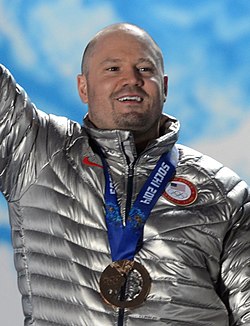
Steven Paul Holcomb (April 14, 1980 – May 6, 2017) was an American bobsledder who competed from 1998 until his death in 2017.[1][2] At the 2010 Winter Olympics in Vancouver, he won the four-man bobsled event for the United States, its first gold medal in that event since 1948.[3] At the 2014 Winter Olympics in Sochi, he finished second in both the four-man and two-man event.

Key Information

Early career

[edit]

Holcomb learned to ski when he was 2 years old. He was born in Park City, Utah, where his mother would take him skiing at every opportunity. He began ski racing when he was six at the main resort of Park City, and began ski racing for the Park City Ski Team for the following twelve years. During this time he was also an athlete in local sports, playing soccer, football, basketball, baseball, and running track. In 1998 he participated in a local USA bobsled team try-out and scored enough points to be invited to the National Team Camp, which included the National Push Championships. He finished in eighth place and was invited to stay for an additional week to train with the National Team. Despite his eighth-place finish, which qualified him for the national team, he was not selected because of his small stature and young age.

After placing 5th at the National Team Trials in early October 1998 at the Utah Olympic Park, he chose to attend the University of Utah. Shortly following the naming of the American 1998 IBSF Bobsleigh World Cup team, an injury caused the withdrawal of one member. On November 3, 1998, he was asked to join the World Cup team in Calgary, Alberta, for the first World Cup race, where he pushed for driver Brian Shimer. He then went on to have an above average career as a pusher for drivers Jim Herberich, Mike Dionne, Todd Hays, and Brian Shimer. Shortly before the 2002 Winter Olympics, Holcomb was cut from Brian Shimer's team, and replaced with Dan Steele, a veteran from the 1998 Winter Olympics. At the Utah Olympic Park for the 2002 Winter Olympics, he served as a bobsled forerunner, who tests the bobsled course prior to competition.

Starting with the 2004–2005 season, he achieved second and third ranked American driver. Holcomb left the military with an honorable discharge in June 2006, and focused on competition on the World Cup circuit. This led to immediate results in the 2006–07 season, where Holcomb (with team members Jovanovic and Kreitzburg) won the two-man World Cup Championship, while he finished second in the four-man competition (with Jovanovic, Kreitzburg, and Mesler), which earned Holcomb the overall Combined Championship.

As Holcomb rose through the ranks of American bobsledders, the degenerative eye disease Keratoconus, initially diagnosed in 2002, began to affect his daily life and competitive skills, which led to depression.[4] In 2007, a non-invasive surgical procedure, corneal collagen cross-linking (C3-R), was performed to stabilize the disease,[5] and in 2008 implantable corrective lenses were inserted,[6] providing a measure of correction during the 2007–08 Bobsleigh World Cup season; he led his teams to three gold, three silver, and one bronze medals over that season. After Holcomb won gold at the 2010 Winter Olympics in Vancouver, Brian Boxer Wachler renamed the procedure C3-R to Holcomb C3-R, marking the first time a medical procedure was named after an Olympic athlete.[7][8]

Career

[edit]
The crew of the four-man USA-1 at the 2010 Winter Olympics with their gold medals. From left to right: Holcomb, Justin Olsen, Steve Mesler, and Curtis Tomasevicz.

Over the course of his career, Holcomb piloted his two-man ("Night Hawk") and four-man ("Night Train") US teams to a total of 12 gold medals, 6 silver medals and 9 bronze medals across Bobsleigh at the Winter Olympics, IBSF World Championships and season-long IBSF Bobsleigh World Cup final standings. His results in individual Bobsleigh World Cup races, contributing to each season's final standings, include 29 gold, 23 silver and 9 bronze medals. As of the completion of his final (2016–17) season of all international competitions – and still true as of the completion of the 2021–22 sliding season – Steven Holcomb is the winningest American bobsled athlete in history.

Included in his success was the first US Four-man Olympic Championship title in 62 years, and the first US Four-man World Championship title in 50 years.

Olympics

[edit]
Steven Holcomb and Steve Langton, on 2014 Sochi Olympics podium with two-man bobsleigh bronze medals – later upgraded to silver.

It was announced on 17 January 2010 that Holcomb made the United States team in both the two-man and four-man events for the 2010 Winter Olympics. On February 17, Holcomb led the four-man US bobsled team to a gold-medal victory, ending a 62-year gold medal drought in United States Olympic four-man bobsled competition.

Holcomb qualified for the 2014 Winter Olympics in Sochi, in both the two-man and four-man bobsled. On February 16, Holcomb and brakeman Steve Langton won the bronze medal in the two-man competition, ending yet another 62-year medal drought in US Olympic two-man competition.[9] These medals were upgraded to Silver Medals on March 27, 2019, when the IOC vacated the golds that Russian pilot Alexander Zubkov won in both the two- and four-man events due to doping.[10] That means Holcomb, who crossed the line third in both of those races, now is a two-time silver winner in addition to the four-man gold he won at Vancouver in 2010.[11]

World Championships, World Cup

[edit]

At season-ending IBSF World Championships, Holcomb won four medals: a gold (2009 Four-man) and three bronzes (2008 Mixed team, 2009 Two-man, 2009 Mixed team).

Holcomb's successes at races during season-long IBSF Bobsleigh World Cup tournaments have resulted in numerous World Cup season titles. For the 2006–07 Bobsleigh World Cup, Holcomb won the overall 2006–07 Two-man,[12] and 2006–07 Combined World Cup titles;[13] the Combined title combines the results from both two-man and four-man competition, with Holcomb's second place in the 2006–07 Four-man standings contributing to his title win in the Combined standings.[14] The 2006–07 result also made him the first American man to win the Two-man World Cup title. With strong performances throughout the 2009–10 Bobsleigh World Cup and 2013–14 Bobsleigh World Cup seasons, Holcomb won the 2009–10 Combined (his second), 2009–10 Four-man (his first), 2013–14 Combined (his third) and 2013–14 Two-man (his second) World Cup season titles.

After his success on the 2013–14 World Cup circuit and at the 2014 Olympics, Holcomb fell back in the results for the World Cup and World Championship competitions of the 2014–15 and 2015–16 seasons. He roared back in the 2016–17 Bobsleigh World Cup season, which ended on 19 March 2017, just seven weeks before Holcomb's death. During that season, Holcomb piloted his sleds to second place in the year-end 2016–17 Two-man, and third place in the year-end 2016–17 Four-man and 2016–17 Overall Combined World Cup standings.

Holcomb receiving one of his three crystal trophies from his podium finishes in all three final standings (two-man, four-man, overall Combined) of the 2016–17 Bobsleigh World Cup season. (19 March 2017)

Military service

[edit]

Holcomb served as a soldier in the Utah Army National Guard for seven years,[15] from March 1999 until July 2006. During his Army National Guard service, he served as a combat engineer in the 1457th Engineering Battalion. He took part in the U.S. Army World Class Athlete Program (WCAP) for seven years. At the end of 2006, he received an Honorable Discharge from service. While in the National Guard, he earned an Army Achievement Medal, Army Commendation Medal, Good Conduct Medal, Army Presidential Unit Citation, Army Superior Unit Award and Army Service Ribbon.

Education

[edit]

Holcomb attended The Winter Sports School in Park City, graduating in 1997.

Boy Scouts

[edit]

As a youth, Holcomb attained the rank of Eagle Scout in the Boy Scouts of America.[16]

Death

[edit]

Holcomb was found dead in room 202 at the US Olympic Training Center in Lake Placid, New York, on May 6, 2017. He was 37.[17] The initial autopsy cited fluid in Holcomb's lungs as a significant factor, while a subsequent toxicology report indicated that Holcomb had a blood-alcohol level of 0.188, along with a level of the sleeping aid Lunesta.[18]

Holcomb had been found in his room by Katie Uhlaender, his close friend and US Olympic skeleton athlete.[19] Holcomb and Uhlaender were featured in The Weight of Gold (2020), an HBO Sports Documentary which "explor(es) the mental health challenges that Olympic athletes often face."[20][21]

References

[edit]

Further reading

[edit]
[edit]
Revisions and contributorsEdit on WikipediaRead on Wikipedia
from Grokipedia
Steven Holcomb (April 14, 1980 – May 6, 2017) was an American bobsledder renowned for his piloting skills, overcoming near-blindness to win three Olympic medals and five world championships, making him one of the most decorated competitors in U.S. bobsled history. Born in Park City, Utah, Holcomb began his athletic career in speed sports before transitioning to bobsledding as a push athlete in 1998, later becoming a driver in 2002 after serving in the Utah Army National Guard from 1999 to 2006. He competed in three Winter Olympics, earning a gold medal in the four-man event at the 2010 Vancouver Games—piloting the sled The Night Train to end a 62-year U.S. drought in the discipline—and silver medals in both the two-man and four-man events at the 2014 Sochi Games. At the FIBT/IBSF World Championships, he secured five gold medals across two-man (2012), four-man (2009, 2012), and team events (2012, 2013), alongside 10 total medals and six World Cup overall titles with 60 podium finishes. Holcomb's career was marked by personal adversity, including , an eye disorder that reduced his vision to 20/600 and contributed to severe depression; he underwent experimental C3-R corneal in 2007, restoring his sight to 20/20 and enabling his Olympic breakthrough, though he attempted amid ongoing struggles. He detailed his journey in the 2012 But Now I See: My Journey from Blindness to Olympic Gold, co-authored with Steve Eubanks, and his 2010 four-man bobsled team was posthumously inducted into the U.S. Olympic & Paralympic Committee Hall of Fame in the Class of 2025. Holcomb died at age 37 in , from pulmonary congestion exacerbated by alcohol and prescription medications, leaving a legacy as a pioneering figure in American bobsledding.

Early Life

Family and Childhood

Steven Holcomb was born on April 14, 1980, in Park City, . He was the son of Steve Holcomb Sr., a longtime resident of the area, and Jean Anne Schaefer. Holcomb had two older sisters, Megan Holcomb and Stephanie Petersen (née Holcomb), with whom he shared a close family bond growing up. His parents had relocated to Park City in 1976, establishing roots in the mountain community shortly before his arrival. Holcomb spent his childhood in Park City, a hub for nestled near renowned ski resorts like and . The town's vibrant outdoor culture, shaped by its Olympic heritage and proximity to world-class slopes, provided an ideal backdrop for young athletes. His family's integration into this environment exposed him early to the rhythms of seasonal , with winters dominated by snow-covered mountains and summers by alpine trails. From a young age, Holcomb showed a natural affinity for athletic activities, particularly those tied to Park City's winter landscape, such as . He also engaged in a variety of , including soccer, football, basketball, baseball, and running, reflecting the diverse physical pursuits encouraged in his hometown. The local sports scene, bolstered by community events and family support, nurtured his competitive spirit and love for the outdoors, setting the foundation for his future endeavors.

Education

Steven Holcomb attended The School in , a specialized designed for aspiring winter sports athletes, and graduated in 1997. The school's emphasizes a rigorous college preparatory program delivered on a compressed calendar spanning April to November, comprising approximately 144 instructional days across three semesters. This unique structure allows students to focus intensively on winter training and competition from December through March, integrating academics with disciplines such as , , , , , luge, and —many of which align with Olympic events. Accredited by AdvancED/, the program requires a minimum of 24 credits for graduation, including core subjects like English, , , and , with honors options available to challenge high-achieving students. During his high school years at the Winter Sports School, Holcomb honed his athletic skills through participation in local ski races as a member of the Park City Ski Team, where he competed in events for 12 years beginning at age six. This involvement helped shape his early development as a competitive racer, fostering the discipline and speed that would later define his career, while the school's balanced approach supported his transition from youth skiing to more structured athletic training.

Bobsleigh Career

Early Involvement and Challenges

Steven Holcomb began his bobsled career as a push athlete with the U.S. National Team in 1998, making his World Cup debut that November in Calgary as part of driver Brian Shimer's crew. After failing to qualify for the 2002 Winter Olympics as a brakeman, he transitioned to driving later that year, achieving immediate success by securing podium finishes in all eight races on the America's Cup circuit. This rapid rise marked his emergence as a promising pilot, though his career soon faced a severe setback. In 2002, Holcomb was diagnosed with keratoconus, a degenerative eye condition that causes the cornea to thin and bulge, leading to progressive vision distortion and loss. The disease severely impaired his ability to drive, as the high speeds of bobsledding—often exceeding 90 mph—required precise visual acuity to navigate icy tracks with minimal margins for error; by 2007, his vision had deteriorated to the point of legal blindness, with distorted central vision making it impossible to see the track clearly or read gauges. This led to profound despair, including a suicide attempt, and brought him perilously close to retirement from the sport. Desperate for solutions, Holcomb underwent an experimental corneal collagen cross-linking (C3-R) procedure in 2007, performed by Dr. Brian Boxer Wachler in , which used drops and UV light to strengthen the and halt the progression of . The treatment stabilized his condition without invasive surgery, providing initial relief. In 2008, he received implantable collamer lenses (ICL), biocompatible lenses surgically placed behind the iris to correct his extreme nearsightedness and restore clarity. These interventions returned his vision to 20/20, allowing him to resume training and competition at full capacity. Prior to his vision restoration, Holcomb gained his first significant international exposure as a driver at the 2004 FIBT World Championships in , , where he competed in the two-man event and began establishing himself on the global stage despite his emerging health challenges.

Olympic Achievements

Holcomb made his Olympic debut as a driver at the in , , competing in both the two-man and four-man events. In the four-man competition, he piloted the USA-2 sled to a sixth-place finish with a total time of 3 minutes 41.36 seconds across four runs, alongside push athletes Curtis Tomasevicz, Bill Schuffenhauer, and Lorenzo Smith III. In the two-man event, Holcomb and Bill Schuffenhauer placed 14th with a combined time of 3:44.72. At the in , , Holcomb achieved his breakthrough, leading the to its first in four-man since 1948. Driving the custom-designed sled nicknamed "The Night Train," he teamed with Justin Olsen, Steve Mesler, and Curtis Tomasevicz to record a four-run total of 3:24.46, setting track records in the first and third heats and edging out Germany's silver-medal team by 0.38 seconds. This victory ended a 62-year U.S. drought in the event and marked a pivotal moment in American history. In the two-man competition, Holcomb finished sixth with a total time of 3:27.94. Holcomb returned to the Olympics at the 2014 Games in Sochi, Russia, securing medals in both events, which were later upgraded due to doping disqualifications of Russian competitors. In the two-man bobsleigh, he and push athlete Steve Langton initially earned bronze with a four-run aggregate of 3:46.27, the first U.S. medal in the discipline since 1952; this was reallocated to silver in 2019 following the disqualification of Russia's Alexander Zubkov and Alexey Voevoda. In the four-man event, Holcomb drove a sled featuring Steve Langton, Curtis Tomasevicz, and Chris Fogt to an initial bronze medal with a total time of 3:40.99, finishing 0.09 seconds behind Russia's gold-winning team; this too was upgraded to silver in 2019 after further doping reviews. These results solidified Holcomb's status as one of the most successful U.S. bobsled drivers, contributing to three Olympic medals overall.

World Championships and World Cup

Holcomb's international career extended beyond the Olympics to the biennial IBSF World Championships, where he amassed 10 medals, including five golds, establishing him as one of the most decorated U.S. bobsledders in the event's history. His breakthrough came in 2007 with a silver medal in the four-man competition in St. Moritz, Switzerland, signaling the emergence of American bobsleigh on the global stage. In 2009, at the championships in Lake Placid, New York, Holcomb piloted the U.S. team to gold in the four-man event, the first such victory for the United States in 50 years, while also earning bronze in the two-man and mixed team events. He added bronze in the four-man at the 2010 Worlds in St. Moritz before achieving a historic triple in 2012 back in Lake Placid: gold in the two-man with pusher Steve Langton, gold in the four-man, and gold in the inaugural team event alongside skeleton and women's bobsleigh athletes, marking the first U.S. team title. Holcomb closed his Worlds medal collection with a bronze in the four-man at the 2013 championships in St. Moritz and a gold in the team event in 2013, contributing to his total of five championship titles. On the annual IBSF World Cup circuit, Holcomb's consistency propelled him to 60 medals overall—12 golds, 24 silvers, and 24 bronzes—making him the most successful American bobsled pilot in the competition's history from his debut in 2002 through his final season in 2016–17. He began his ascent on the Americas Cup in 2002, podiuming in eight of eight races, before transitioning to the elite World Cup level in 2004–05, where he quickly notched top-10 finishes. Holcomb captured six overall season titles: the two-man and combined in 2006–07, combined and four-man in 2009–10, and combined and two-man in 2013–14, often dominating with multiple victories per season. For instance, in the 2013–14 campaign, he secured seven gold medals across events, including a podium sweep for the U.S. in the two-man race at Lake Placid and a track-record start in the four-man at Calgary. His World Cup prowess featured record-breaking performances, such as the fastest start ever recorded at the Whistler track in 2010, and sustained top finishes that underscored his technical mastery and team synergy with crews like the "Night Train" four-man sled. Over 15 seasons, Holcomb's 60% podium rate in World Cup races highlighted his role in elevating U.S. bobsleigh from underdogs to perennial contenders.

Personal Life

Military Service

Steven Holcomb enlisted in the in 1999 as a assigned to the 1457th Engineer Battalion. His service lasted from 1999 until 2006, during which he balanced military obligations with his emerging athletic pursuits, having entered just a year prior in 1998. In 2003, his unit was mobilized for deployment, but Holcomb was exempted due to an administrative oversight related to his athlete status, allowing him to continue training without overseas service. As a , Holcomb's duties included specialized tasks in and explosives handling, contributing to his development of a disciplined approach to high-risk environments. He also participated in the U.S. Army World Class Athlete Program (WCAP), which integrated military fitness regimens and structured training to support elite competitors, enhancing his physical conditioning and mental resilience for demanding roles. During his tenure, he received several commendations, including the Army Achievement Medal, Army Commendation Medal, Good Conduct Medal, Army Presidential Unit Citation, and , culminating in an honorable discharge in 2006. The military's emphasis on , , and directly bolstered Holcomb's preparation for rigorous physical challenges, fostering the precision and focus essential to his and athletic endeavors.

Boy Scouts Involvement

Steven Holcomb began his involvement with the Boy Scouts of America as a youth in , where he joined Troop 72 and participated in frequent outdoor activities. Growing up in a mountainous region conducive to winter pursuits, Holcomb engaged in weekend outings that included winter camping and snowshoeing, fostering his comfort in harsh environments. These experiences, occurring nearly every weekend, immersed him in the practical aspects of outdoor exploration and group expeditions typical of in . Holcomb achieved the rank of at age 15, after nine years in the program, fulfilling the rigorous requirements that include earning at least 21 merit badges—with a focus on those emphasizing , , and outdoor proficiency—and completing a substantial project. He reflected that pursuing merit badges expanded his worldview, stating, "Earning all the merit badges really opens your eyes to more than just one thing in life. There’s so much to learn, so much you have to do." This accomplishment highlighted his dedication to hands-on learning and skill application, as he noted the need to "actually have to learn and use your skills" to succeed. Through , Holcomb developed core values such as perseverance, goal-setting, and teamwork, which he credited with shaping his resilient character and later athletic endeavors. The program's emphasis on consistent effort resonated with him, as he emphasized, "You always have to do your best; you really do have to perform." These principles, instilled during his youth, provided a foundational adventurous spirit that influenced his approach to challenges throughout life, including his bobsledding career.

Death and Legacy

Circumstances of Death

On May 6, 2017, Steven Holcomb was discovered deceased in his room at the U.S. Olympic Training Center in , by fellow athlete and close friend Katie Uhlaender, a U.S. skeleton racer. He was 37 years old at the time. An autopsy conducted by Essex County Coroner Francis Whitelaw revealed significant fluid accumulation in Holcomb's lungs, indicative of , which was determined to be a key factor in his death. results further indicated a blood-alcohol concentration of 0.188—more than twice the legal driving limit in New York—and the presence of , the active ingredient in the prescription sleep aid Lunesta, at excessive levels. The coroner ruled the death accidental, attributing it to exacerbated by the fatal combination of alcohol and , with no evidence of foul play or other suspicious circumstances. In the immediate aftermath, the U.S. Olympic Committee notified Holcomb's family and provided support, while activities at the training center were temporarily paused to allow athletes and staff time to process the loss; team camps resumed later in June 2017. Holcomb had continued to maintain a presence at the Lake Placid facility following his retirement from competition in 2016.

Impact and Remembrance

Steven Holcomb is widely regarded as the winningest U.S. bobsledder in history, amassing three Olympic medals, ten medals, and 60 medals across his career. His 2010 Olympic gold in the four-man event marked the first such victory for the since 1948, ending a 62-year and inspiring a new generation of American sliders to pursue excellence in the sport. This achievement, piloting the iconic "Night Train" sled with teammates Justin Olsen, Steve Mesler, and Curt Tomasevicz, not only elevated U.S. bobsleigh's global standing but also symbolized resilience, as Holcomb overcame significant vision challenges earlier in his career. Beyond the track, Holcomb's personal battle with —a degenerative eye condition—propelled him into advocacy that popularized the non-invasive Holcomb C3-R procedure worldwide. Undergoing the treatment in 2007, which halted the disease's progression and restored his vision without surgery, Holcomb shared his story through his 2012 memoir But Now I See and public appearances, raising awareness for an ailment affecting roughly one in 500 people and enabling other athletes to continue their careers. His efforts directly influenced treatment access, with the procedure—renamed in his honor—saving visions and avoiding corneal transplants for hundreds. Following his death, Holcomb received posthumous honors, including upgraded silver medals for the 2014 team events, awarded in 2019 after a doping disqualification of Russian competitors; his family accepted them on his behalf at a Team USA ceremony. In 2025, Holcomb and his 2010 four-man bobsled teammates were posthumously inducted into the U.S. Olympic & Paralympic Committee Hall of Fame as part of the Class of 2025. Memorial services celebrated his life and character: one in , in May 2017, attended by fellow athletes and Olympic officials, and a larger gathering in , in June 2017, where hundreds wore T-shirts in tribute to his heroic spirit. Family members reflected on his unwavering positivity and solution-oriented mindset; his mother, Jean Schaefer, noted, "I never heard him be negative," while his sister Megan discovered motivational notes underscoring his resilience. The Giving Vision – Steven Holcomb Legacy Foundation, established in his memory and led by his mother and Dr. Brian Boxer Wachler, continues his advocacy by providing grants to cover travel and lodging for patients seeking C3-R treatment, having assisted over 100 individuals as of 2018.

References

Add your contribution
Related Hubs
User Avatar
No comments yet.