Hubbry Logo
Orbit equationOrbit equationMain
Open search
Orbit equation
Community hub
Orbit equation
logo
7 pages, 0 posts
0 subscribers
Be the first to start a discussion here.
Orbit equation
Orbit equation
from Wikipedia

In astrodynamics, an orbit equation defines the path of orbiting body around central body relative to , without specifying position as a function of time. Under standard assumptions, a body moving under the influence of a force, directed to a central body, with a magnitude inversely proportional to the square of the distance (such as gravity), has an orbit that is a conic section (i.e. circular orbit, elliptic orbit, parabolic trajectory, hyperbolic trajectory, or radial trajectory) with the central body located at one of the two foci, or the focus (Kepler's first law).

If the conic section intersects the central body, then the actual trajectory can only be the part above the surface, but for that part the orbit equation and many related formulas still apply, as long as it is a freefall (situation of weightlessness).

Central, inverse-square law force

[edit]

Consider a two-body system consisting of a central body of mass M and a much smaller, orbiting body of mass , and suppose the two bodies interact via a central, inverse-square law force (such as gravitation). In polar coordinates, the orbit equation can be written as[1] where

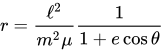
  • is the separation distance between the two bodies and
  • is the angle that makes with the axis of periapsis (also called the true anomaly).
  • The parameter is the angular momentum of the orbiting body about the central body, and is equal to , or the mass multiplied by the magnitude of the cross product of the relative position and velocity vectors of the two bodies.[note 1]
  • The parameter is the constant for which equals the acceleration of the smaller body (for gravitation, is the standard gravitational parameter, ). For a given orbit, the larger , the faster the orbiting body moves in it: twice as fast if the attraction is four times as strong.
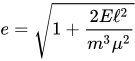
  • The parameter is the eccentricity of the orbit, and is given by[1]
    where is the energy of the orbit.

The above relation between and describes a conic section.[1] The value of controls what kind of conic section the orbit is:

  • when , the orbit is elliptic (circles are ellipses with );
  • when , the orbit is parabolic;
  • when , the orbit is hyperbolic.

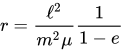
The minimum value of in the equation is: while, if , the maximum value is:
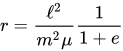
If the maximum is less than the radius of the central body, then the conic section is an ellipse which is fully inside the central body and no part of it is a possible trajectory. If the maximum is more, but the minimum is less than the radius, part of the trajectory is possible:

  • if the energy is non-negative (parabolic or hyperbolic orbit): the motion is either away from the central body, or towards it.
  • if the energy is negative: the motion can be first away from the central body, up to after which the object falls back.

If becomes such that the orbiting body enters an atmosphere, then the standard assumptions no longer apply, as in atmospheric reentry.

Low-energy trajectories

[edit]

If the central body is the Earth, and the energy is only slightly larger than the potential energy at the surface of the Earth, then the orbit is elliptic with eccentricity close to 1 and one end of the ellipse just beyond the center of the Earth, and the other end just above the surface. Only a small part of the ellipse is applicable.

If the horizontal speed is , then the periapsis distance is . The energy at the surface of the Earth corresponds to that of an elliptic orbit with (with the radius of the Earth), which can not actually exist because it is an ellipse fully below the surface. The energy increase with increase of is at a rate . The maximum height above the surface of the orbit is the length of the ellipse, minus , minus the part "below" the center of the Earth, hence twice the increase of minus the periapsis distance. At the top[of what?] the potential energy is times this height, and the kinetic energy is . This adds up to the energy increase just mentioned. The width of the ellipse is 19 minutes[why?] times .

The part of the ellipse above the surface can be approximated by a part of a parabola, which is obtained in a model where gravity is assumed constant. This should be distinguished from the parabolic orbit in the sense of astrodynamics, where the velocity is the escape velocity.

See also trajectory.

Categorization of orbits

[edit]

Consider orbits which are at one point horizontal, near the surface of the Earth. For increasing speeds at this point the orbits are subsequently:

  • part of an ellipse with vertical major axis, with the center of the Earth as the far focus (throwing a stone, sub-orbital spaceflight, ballistic missile)
  • a circle just above the surface of the Earth (Low Earth orbit)
  • an ellipse with vertical major axis, with the center of the Earth as the near focus
  • a parabola
  • a hyperbola

Note that in the sequence above[where?], , and increase monotonically, but first decreases from 1 to 0, then increases from 0 to infinity. The reversal is when the center of the Earth changes from being the far focus to being the near focus (the other focus starts near the surface and passes the center of the Earth). We have

Extending this to orbits which are horizontal at another height, and orbits of which the extrapolation is horizontal below the surface of the Earth, we get a categorization of all orbits, except the radial trajectories, for which, by the way, the orbit equation can not be used. In this categorization ellipses are considered twice, so for ellipses with both sides above the surface one can restrict oneself to taking the side which is lower as the reference side, while for ellipses of which only one side is above the surface, taking that side.

See also

[edit]

Notes

[edit]

References

[edit]
Revisions and contributorsEdit on WikipediaRead on Wikipedia
from Grokipedia
The orbit equation is a fundamental relation in astrodynamics and celestial mechanics that describes the path of a smaller body orbiting a much more massive central body under the influence of Newtonian gravity, representing the trajectory as a conic section—such as an ellipse, parabola, or hyperbola—relative to the central body's position. In polar coordinates, with the central body at the focus, the equation takes the form r=p1+ecosθr = \frac{p}{1 + e \cos \theta}, where rr is the radial distance from the focus, pp is the semilatus rectum (a measure related to the orbit's size), ee is the eccentricity (determining the conic type: e=0e = 0 for a circle, 0<e<10 < e < 1 for an ellipse, e=1e = 1 for a parabola, and e>1e > 1 for a hyperbola), and θ\theta is the true anomaly (the angle from the periapsis). This equation emerges from the two-body problem, where the motion is governed by the inverse-square law of universal gravitation, F=GMmr2F = -\frac{G M m}{r^2}, with GG as the gravitational constant, MM the central mass, and mm the orbiting mass. By substituting polar coordinates and using conservation of angular momentum h=r2θ˙h = r^2 \dot{\theta} (or LL in some notations), the radial acceleration equation simplifies to a differential equation in terms of u=1/ru = 1/r: d2udθ2+u=GMh2\frac{d^2 u}{d\theta^2} + u = \frac{G M}{h^2}, whose general solution yields the conic form after integration. Here, p=h2/(GM)p = h^2 / (G M) (or μ=GM\mu = G M, the standard gravitational parameter), linking the equation to conserved quantities like specific angular momentum and energy. Isaac Newton first derived the orbit equation in his Philosophiæ Naturalis Principia Mathematica (1687), building on Johannes Kepler's empirical laws of planetary motion (1609–1619) to prove that inverse-square gravitation produces elliptical orbits with the central body at one focus, thus unifying observation with theory. In modern applications, such as trajectory planning, the equation is extended to account for perturbations like 's oblateness (via the J2J_2 term in the ), enabling precise calculations of including semimajor axis aa, inclination ii, and argument of perigee ω\omega. For instance, near-circular orbits (e0e \approx 0, a7000a \approx 7000 km) are common for monitoring missions, with rates influenced by J2=1.08263×10³J_2 = 1.08263 \times 10^{-3} to achieve sun-synchronous configurations.

Central Force Orbits

General Orbit Equation

In classical mechanics, a central force is defined as a force acting on a particle that is always directed toward or away from a fixed central point, with its magnitude depending solely on the radial distance rr from that center. This radial dependence ensures that the force has no torque about the center, leading to the conservation of angular momentum. The specific angular momentum \ell is given by =mr2dθdt\ell = m r^2 \frac{d\theta}{dt}, where mm is the particle's mass and θ\theta is the polar angle, remaining constant throughout the motion. To describe the shape of the orbit, it is convenient to use the substitution u=1/ru = 1/r, transforming the problem from radial time dependence to angular dependence. This yields the general for the orbit, known as Binet's equation: d2udθ2+u=m2u2f(1u),\frac{d^2 u}{d\theta^2} + u = \frac{m}{\ell^2 u^2} f\left(\frac{1}{u}\right), where f(r)f(r) denotes the magnitude of the central force as a function of rr. This second-order equation relates the orbital trajectory directly to the form of the force law. Binet's transformation, developed by Jacques Philippe Marie Binet in the , facilitates solving for the orbit shape r(θ)r(\theta) without explicit time integration. For arbitrary central force laws, the solutions to Binet's equation do not generally produce conic section orbits, unlike the specific case of inverse-square s. For instance, an isotropic with force magnitude f(r)=krf(r) = k r (where k>0k > 0) results in bounded elliptical orbits centered precisely at the center, distinct from the off-center ellipses of gravitational motion. In contrast, a constant-magnitude central f(r)=αf(r) = \alpha (with α>0\alpha > 0 for attraction) yields spiral orbits, where the particle either approaches asymptotically or recedes outward in a spiraling path, depending on initial conditions. These examples illustrate how the force law dictates the qualitative geometry of the .

Derivation from Conservation Laws

The motion of a particle under a central force is governed by Newton's second law in polar coordinates, where the force is directed radially toward the center and depends only on the distance rr from the center. The radial component of the acceleration leads to the equation md2rdt2mr(dθdt)2=f(r)m \frac{d^2 r}{dt^2} - m r \left( \frac{d\theta}{dt} \right)^2 = -f(r), with f(r)>0f(r) > 0 denoting the magnitude of the attractive force. Since the central force produces no , angular momentum is conserved, given by =mr2dθdt=\ell = m r^2 \frac{d\theta}{dt} = constant. This allows the centrifugal term to be rewritten as mr(dθdt)2=2mr3m r \left( \frac{d\theta}{dt} \right)^2 = \frac{\ell^2}{m r^3}, substituting into the radial equation to yield md2rdt22mr3=f(r)m \frac{d^2 r}{dt^2} - \frac{\ell^2}{m r^3} = -f(r). Conservation of total energy provides another key relation: E=12m(drdt)2+12mr2(dθdt)2+V(r)E = \frac{1}{2} m \left( \frac{dr}{dt} \right)^2 + \frac{1}{2} m r^2 \left( \frac{d\theta}{dt} \right)^2 + V(r), where V(r)V(r) is the potential energy satisfying f(r)=dVdrf(r) = -\frac{dV}{dr}. Using 12mr2(dθdt)2=22mr2\frac{1}{2} m r^2 \left( \frac{d\theta}{dt} \right)^2 = \frac{\ell^2}{2 m r^2}, the energy equation simplifies to E=12m(drdt)2+Veff(r)E = \frac{1}{2} m \left( \frac{dr}{dt} \right)^2 + V_{\text{eff}}(r), with the effective potential Veff(r)=V(r)+22mr2V_{\text{eff}}(r) = V(r) + \frac{\ell^2}{2 m r^2}. This one-dimensional form describes radial motion in the effective potential, where bound states (E<0E < 0) may exist depending on VeffV_{\text{eff}}. To obtain the orbit equation relating rr and θ\theta, introduce the substitution u=1/ru = 1/r. Since dθdt=/(mr2)=(u2)/m\frac{d\theta}{dt} = \ell / (m r^2) = (\ell u^2)/m, the radial velocity becomes drdt=drdθdθdt=1u2dudθu2m=mdudθ\frac{dr}{dt} = \frac{dr}{d\theta} \frac{d\theta}{dt} = -\frac{1}{u^2} \frac{du}{d\theta} \cdot \frac{\ell u^2}{m} = -\frac{\ell}{m} \frac{du}{d\theta}. Differentiating again gives d2rdt2=2u2m2d2udθ2\frac{d^2 r}{dt^2} = -\frac{\ell^2 u^2}{m^2} \frac{d^2 u}{d\theta^2}. Substituting into the radial force equation and simplifying yields the general orbit equation: d2udθ2+u=m2u2f(1u).\frac{d^2 u}{d\theta^2} + u = \frac{m}{\ell^2 u^2} f\left( \frac{1}{u} \right). This second-order differential equation describes the shape of the orbit in terms of the polar angle θ\theta. The solutions to this equation determine whether orbits are closed (periodic in θ\theta) or open (non-periodic, filling a region densely). For bound orbits (E<0E < 0), closure occurs only for specific force laws, as established by Bertrand's theorem, which proves that all bound orbits are closed solely for the inverse-square force and the harmonic oscillator force; other central forces generally produce open rosette-like orbits.

Inverse-Square Law Orbits

Keplerian Orbit Equation

The Keplerian orbit equation specifies the trajectory of a smaller mass mm orbiting a much more massive central mass MM under an attractive inverse-square central force, such as Newtonian gravity. The magnitude of this force is given by f(r)=μmr2f(r) = \frac{\mu m}{r^2}, where μ=GM\mu = G M is the standard gravitational parameter, GG is the gravitational constant, and rr is the radial distance from the central mass. Substituting the inverse-square force into the general polar orbit equation (derived earlier from conservation of angular momentum and energy) yields a simplified second-order differential equation in terms of the substitution u=1/ru = 1/r and the polar angle θ\theta: d2udθ2+u=μm22,\frac{d^2 u}{d\theta^2} + u = \frac{\mu m^2}{\ell^2}, where \ell is the constant total angular momentum of the orbiting body. This equation is linear with a constant inhomogeneous term, and its general solution is u(θ)=μm22+Ccos(θθ0),u(\theta) = \frac{\mu m^2}{\ell^2} + C \cos(\theta - \theta_0), where CC and θ0\theta_0 are integration constants determined by initial conditions. By aligning the coordinate system such that θ0=0\theta_0 = 0 (measuring θ\theta from the direction of closest approach), and defining the eccentricity e=C2/(μm2)e = C \ell^2 / (\mu m^2), the solution simplifies to u(θ)=1p(1+ecosθ),u(\theta) = \frac{1}{p} (1 + e \cos \theta), with the semi-latus rectum p=2/(μm2)p = \ell^2 / (\mu m^2). Inverting for rr gives the standard polar form of the Keplerian orbit equation: r=p1+ecosθ.r = \frac{p}{1 + e \cos \theta}. This equation describes a conic section (ellipse, parabola, or hyperbola) with the central mass MM located at one focus. The angle θ\theta is the true anomaly, measured from the periapsis (point of closest approach) to the current position of the orbiting body. The parameter pp sets the scale of the orbit, while ee (ranging from 0 to \infty) determines its shape: e<1e < 1 for bound elliptic paths, e=1e = 1 for parabolic escape trajectories, and e>1e > 1 for hyperbolic scattering.

Eccentricity and Energy Relations

In the context of the Keplerian orbit equation, the eccentricity ee quantifies the deviation of the orbit from , serving as a direct indicator of the orbit's shape and the underlying conditions of the two-body . For inverse-square central forces, such as gravitational attraction, ee emerges from the interplay between the total EE and the \ell, reflecting whether the motion is bound or unbound. The explicit relation between eccentricity and energy is given by e=1+2E2m3μ2,e = \sqrt{1 + \frac{2 E \ell^2}{m^3 \mu^2}},
Add your contribution
Related Hubs
User Avatar
No comments yet.