
Submediant
View on Wikipedia

In music, the submediant is the sixth degree ( ) of a diatonic scale. The submediant ("lower mediant") is named thus because it is halfway between the tonic and the subdominant ("lower dominant")[1] or because its position below the tonic is symmetrical to that of the mediant above.[2] (See the figure in the Degree (music) article.)
In the movable do solfège system, the submediant is sung as la in a major mode, le or lo in do-based minor and fa in la-based minor. It is occasionally called superdominant,[3] as the degree above the dominant. This is its normal name (sus-dominante) in French.
In Roman numeral analysis, the triad formed on the submediant is typically symbolized by "VI" if it is a major triad (the default in a minor mode) and by "vi" if it is a minor triad (the default in a major mode).
The term submediant may also refer to a relationship of musical keys. For example, relative to the key of C major, the key of A minor is the submediant. In a major key, the submediant key is the relative minor. Modulation (change of key) to the submediant is relatively rare, compared with modulation to the dominant in a major key or modulation to the mediant (relative major) in a minor key.
Chord
[edit]Amongst the primary roles played by the submediant chord is that in the deceptive cadence, V(7)–vi in major or V(7)–VI in minor.[4][5] In a submediant chord, the third may be doubled.[6]
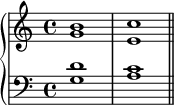

In major, the submediant chord also often appears as the starting point of a series of perfect descending fifths and ascending fourths leading to the dominant, vi–ii–V. This is because the relationship between vi and ii and between ii and V is the same as that between V and I. If all chords were major (I–VI–II–V–I), the succession would be one of secondary dominants.[7] This submediant role is as common in popular and classical music as it is in jazz, or any other musical language related to Western European tonality. A more complete version starts the series of fifths on the chord of iii, iii–vi–ii–V–I, as in measures 11 and 12 of Charlie Parker's "Blues for Alice". In minor, the progression from VI to ii° (e.g. A♭ to D diminished in C minor) involves a diminished fifth, as does the ii° chord itself; it may nevertheless be used in VI–ii°–V–I by analogy with the major. Similarly, a scale's full counterclockwise circle of 5ths progression I–IV–vii°–iii–vi–ii–V–I can be used by analogy with the usual descending fifth progression, even though IV–vii° involves a diminished fifth.

Another frequent progression is the sequence of descending thirds (I–vi–IV–ii–|–V in root position or first inversion), alternating major and minor chords.[7] This progression is also frequent in jazz, where it is used in a shortened version ||: I vi | ii V7 :|| in what is nicknamed the "I Got Rhythm" progression by George Gershwin. This chord progression moves from tonic I, to the submediant (vi), to the supertonic ii, to the dominant V7.
Chromatic submediants, like chromatic mediants, are chords whose roots are related by a major third or minor third, contain one common tone, and share the same quality, i.e. major or minor. They may be altered chords.
Submediant chords may also appear as seventh chords: in major, as vi7, or in minor as VIM7 or ♯viø7:[8]

In rock and popular music, VI in minor often uses the chromatically lowered fifth scale degree as its seventh, VI7, for example as in Bob Marley's clearly minor mode "I Shot The Sheriff".[9]
Name
[edit]The term mediant appeared in English in 1753 to refer to the note "midway between the tonic and the dominant".[10] The term submediant must have appeared soon after to similarly denote the note midway between the tonic and the subdominant.[11] The German word Untermediante is found in 1771.[12] In France, on the other hand, the sixth degree of the scale was more often called the sus-dominante, as the degree above the dominant. This reflects a different conception of the diatonic scale and its degrees:[13]
- In English as in German, the tonic is flanked on both sides by subtonic / supertonic, submediant / mediant and dominant / subdominant – the 7th degree being more usually known as the leading tone (or leading note) if it is a semitone under the tonic. (See the figure in Degree (music)#Major and minor scales);
- In French and Italian, a conception with two centres, subtonic (sous-tonique, sotto-tonica) and supertonic (sustonique, sopra-tonica) on both sides of the tonic, subdominant (sous-dominante, sotto-dominante) and "superdominant" (sus-dominante, sopra-dominante) on both sides of the dominant – and the mediant left alone between the two.
In the German theory derived from Hugo Riemann, the minor submediant in a major key is considered the Tonikaparallele (minor relative of the major tonic), labeled Tp, and the major submediant in a minor key is the Subdominantparallele (major relative of the minor subdominant), labeled sP.
See also
[edit]References
[edit]- ^ Benward & Saker (2003). Music: In Theory and Practice, Vol. I, p. 33. 7th edition. ISBN 978-0-07-294262-0. "The lower mediant halfway between tonic and lower dominant (subdominant)."
- ^ Forte, Allen (1979). Tonal Harmony, p. 120. 3rd edition. Holt, Rinehart, and Wilson. ISBN 0-03-020756-8. "The triad on VI is called the submediant because it occupies a position below the tonic triad analogous to that occupied by the mediant above the tonic triad.
- ^ Ebenezer Prout, Harmony: its theory and practice, 09/09/2010
- ^ Foote, Arthur (2007). Modern Harmony in its Theory and Practice, p. 93. ISBN 1-4067-3814-X.
- ^ Owen, Harold (2000). Music Theory Resource Book, p. 132. ISBN 0-19-511539-2.
- ^ Chadwick, G. H. (2009). Harmony – A Course Of Study, p. 36. ISBN 1-4446-4428-9.
- ^ a b c d Andrews, William G.; Sclater, Molly (2000). Materials of Western Music Part 1, p. 226. ISBN 1-55122-034-2.
- ^ Kostka, Stefan; Payne, Dorothy (2004). Tonal Harmony (5th ed.). Boston: McGraw-Hill. pp. 231. ISBN 0072852607. OCLC 51613969.
- ^ Stephenson, Ken (2002). What to Listen for in Rock: A Stylistic Analysis, p. 89. ISBN 978-0-300-09239-4.
- ^ Etymology Dictionary, s.v. "Mediant".
- ^ The term can be found in John W. Calcott, A Musical Grammar in Four Parts, London, 3d edition, 1817, p. 137. (1st edition 1806.)
- ^ Johann Georg Sulzer, Allgemeine Theorie der schönen Künste, 1771, s.v. "Sexte".
- ^ See Nicolas Meeùs, "Scale, polifomia, armonia", in J. J. Nattiez (ed), Enciclopedia della musica, vol. II, Il sapere musicale, Torino, Einaudi, 2002, p. 84.
Submediant
View on GrokipediaDefinition and Scale Position
Scale Degree
The submediant is the sixth scale degree in the diatonic scale, positioned between the dominant (fifth degree) and the leading tone (seventh degree).[2] In the key of C major, with no sharps or flats in its key signature, the submediant is A natural, forming the ascending scale as C–D–E–F–G–A–B–C.[7] This degree creates a major sixth interval above the tonic or, equivalently, a major third below the tonic's octave displacement.[7] It also lies a minor third above the subdominant (fourth degree); for instance, in C major, the subdominant F ascends a minor third to the submediant A.[2] In solfège notation, the submediant is sung as la in major keys.[8] In natural minor keys, it is le, reflecting the lowered sixth degree relative to the parallel major; for example, in A minor (sharing C major's key signature of no sharps or flats), the ascending scale is A–B–C–D–E–F–G–A, with F as the submediant (le).[9] The submediant thus contrasts positionally with the mediant, the third scale degree located a minor third above the tonic.[7]Relation to Other Degrees
The submediant, as the sixth scale degree, occupies a central position in the diatonic scale, situated halfway between the subdominant (degree 4) and the upper tonic (degree 8) when considering the linear arrangement of the scale extending to the upper octave. This intermediary placement justifies its nomenclature, positioning it equidistant in terms of scale steps from the subdominant below and the upper tonic above, thus bridging the lower and upper halves of the octave.[1][10] In relation to other degrees, the submediant mirrors the mediant (degree 3) through scale symmetry: just as the mediant lies a major third above the tonic, the submediant lies a major third below the upper tonic, creating a balanced reflection around the octave's central axis. This symmetry highlights the submediant's role in the overall proportional structure of the diatonic scale. Compared to the supertonic (degree 2), which serves as the immediate upper neighbor to the tonic, the submediant functions analogously as an upper neighbor within the upper tetrachord, adjacent above the dominant (degree 5). Similarly, while the leading tone (degree 7) provides an upper approach to the tonic from below in the upper tetrachord, the submediant offers a parallel relational approach in its proximity to surrounding degrees, emphasizing stepwise connections in scalar motion.[6][11] To illustrate these relationships, consider a basic diatonic scale diagram in C major, where the submediant (A) acts as a pivot between the lower tetrachord (C-D-E-F) and the upper tetrachord (G-A-B-C):| Degree | Note | Name | Relation to Submediant |
|---|---|---|---|
| 1 | C | Tonic | Five steps below |
| 2 | D | Supertonic | Four steps below |
| 3 | E | Mediant | Mirrors submediant symmetrically |
| 4 | F | Subdominant | Two steps below |
| 5 | G | Dominant | Stepwise lower neighbor |
| 6 | A | Submediant | Central pivot |
| 7 | B | Leading Tone | Stepwise upper neighbor |
| 8 | C | Upper Tonic | Two steps above |
Chord Construction
Triad Formation
The submediant triad is constructed by stacking thirds starting from the sixth scale degree of the diatonic scale, with the root on degree 6, the third on degree 1 (an octave above the root), and the fifth on degree 3.[13] This forms a basic three-note chord in root position.[13] In major keys, the submediant triad is a minor triad due to the minor third interval between the root (degree 6) and the third (degree 1). For example, in C major, the scale degrees yield the notes A (root), C (third), and E (fifth), creating the A minor triad.[13] It is denoted in Roman numeral analysis as vi (lowercase indicating minor quality).[13] In minor keys, the submediant triad is a major triad, typically built using the natural minor scale, where the interval from root (degree 6) to third (degree 1) is a major third. For example, in A minor, the notes are F (root), A (third), and C (fifth), forming the F major triad.[4] It is denoted as VI (uppercase indicating major quality).[4] A basic close-position voicing places the root in the bass, with the third and fifth immediately above it in the closest possible stacking. In C major (vi: A-C-E), this appears as:Bass: A (root)
Middle: C (third)
Treble: E (fifth)
Seventh Chords
The submediant seventh chord extends the submediant triad by adding a note a seventh above the root, using the diatonic scale degrees. In major keys, this produces the vi7 chord, built on the sixth scale degree with a minor triad plus a minor seventh, resulting in the intervals of a minor third, perfect fifth, and minor seventh from the root. For instance, in C major, the vi7 chord comprises the notes A–C–E–G, forming a minor seventh chord quality.[14][15] In minor keys, the submediant seventh chord is notated as VI7 and features a major triad with a major seventh (scale degrees 6, 1, 3, 5), yielding a major seventh chord quality. In A minor (natural minor), for example, VI7 consists of F–A–C–E.[16] Common voicings for the submediant seventh emphasize smooth voice leading and balance. In root position for vi7 in C major, a close voicing might stack as A (bass)–C–E–G, providing a compact minor seventh sonority. The first inversion, denoted vi6/5, places the third (C) in the bass, often voiced as C–E–G–A to facilitate connections in progressions; a sample spacing could feature A over C bass in an open voicing for added resonance, such as C (bass)–E–G–A. Second inversion (vi4/3) uses the fifth (E) in the bass, like E–G–A–C, while third inversion (vi4/2) has the seventh (G) in the bass, as in G–A–C–E. Similar inversion principles apply to VI7, with root-position F–A–C–E in A minor, and first inversion VI6/5 voiced as A–C–E–F.[14][15] The vi7 in major keys differs from other diatonic seventh chords, such as the ii7, which shares the half-diminished quality misconception but actually features a diminished fifth; for example, ii7 in C major is D–F–A–C (minor third, diminished fifth, minor seventh), contrasting the vi7's perfect fifth that lends a more stable, less tense character.[14][15]Harmonic Function
In Major Keys
In major keys, the submediant chord, roman numeral vi, functions as a weak pre-dominant, typically extending the tonic area or transitioning to stronger pre-dominants like IV or ii by sharing scale degrees that facilitate smooth voice leading.[4] This role arises from its minor quality, which contrasts with the surrounding major harmonies while avoiding strong resolution tendencies.[4] The vi chord commonly resolves to IV or ii, forming descending-third sequences such as I–vi–IV–ii, or it may lead indirectly to V through these intermediaries; direct motion from vi to V is possible but requires careful contrary motion to avoid parallel fifths.[4] In deceptive cadences, vi substitutes for the tonic after V, evading the expected authentic resolution (V–I) and surprising the listener through common tones like the tonic and third scale degrees.[17][4] As the tonic chord of the relative minor key, vi embodies a modal shift within the same key signature; for example, in C major, the vi chord (A–C–E) serves as the i chord in A minor, enabling subtle tonal ambiguity without introducing accidentals.[18] Representative progressions highlight vi's versatility, such as the canonical I–vi–IV–V cycle, which circulates through tonic, submediant, subdominant, and dominant functions to create cyclical harmonic drive, as in countless hymns and popular songs (e.g., in C major: C–Am–F–G).[19] Another example is the descending-fifths chain vi–ii–V–I, where vi initiates pre-dominant motion toward resolution, often doubled on the root for stability.[4]| Key | Progression | Roman Numerals | Notes |
|---|---|---|---|
| C major | C – Am – F – G | I – vi – IV – V | Balances stability (I, IV) with tension (vi, V); vi adds plaintive color. |
| G major | G – Em – C – D | I – vi – IV – V | vi (Em) prolongs tonic before subdominant arrival. |