



Community hub
Recent from talks
Knowledge base stats:
Talk channels stats:
Members stats:
Sumac
Sumac or sumach (/ˈsuːmæk, ˈʃuː-/ S(H)OO-mak, UK also /ˈsjuː-/)—not to be confused with poison sumac—is any of the roughly 35 species of flowering plants in the genus Rhus (and related genera) of the cashew and mango tree family, Anacardiaceae. However, it is Rhus coriaria that is most commonly used for culinary purposes. Sumac is prized as a spice—especially in Iranian cuisine, and other Eastern cuisines—and used as a dye and holistic remedy. The plants grow in subtropical and temperate regions, on nearly every continent except Antarctica and South America. Native to Persia[citation needed], it holds cultural significance as a symbolic item on the Haft-sin table during Nowruz, the Persian New Year.
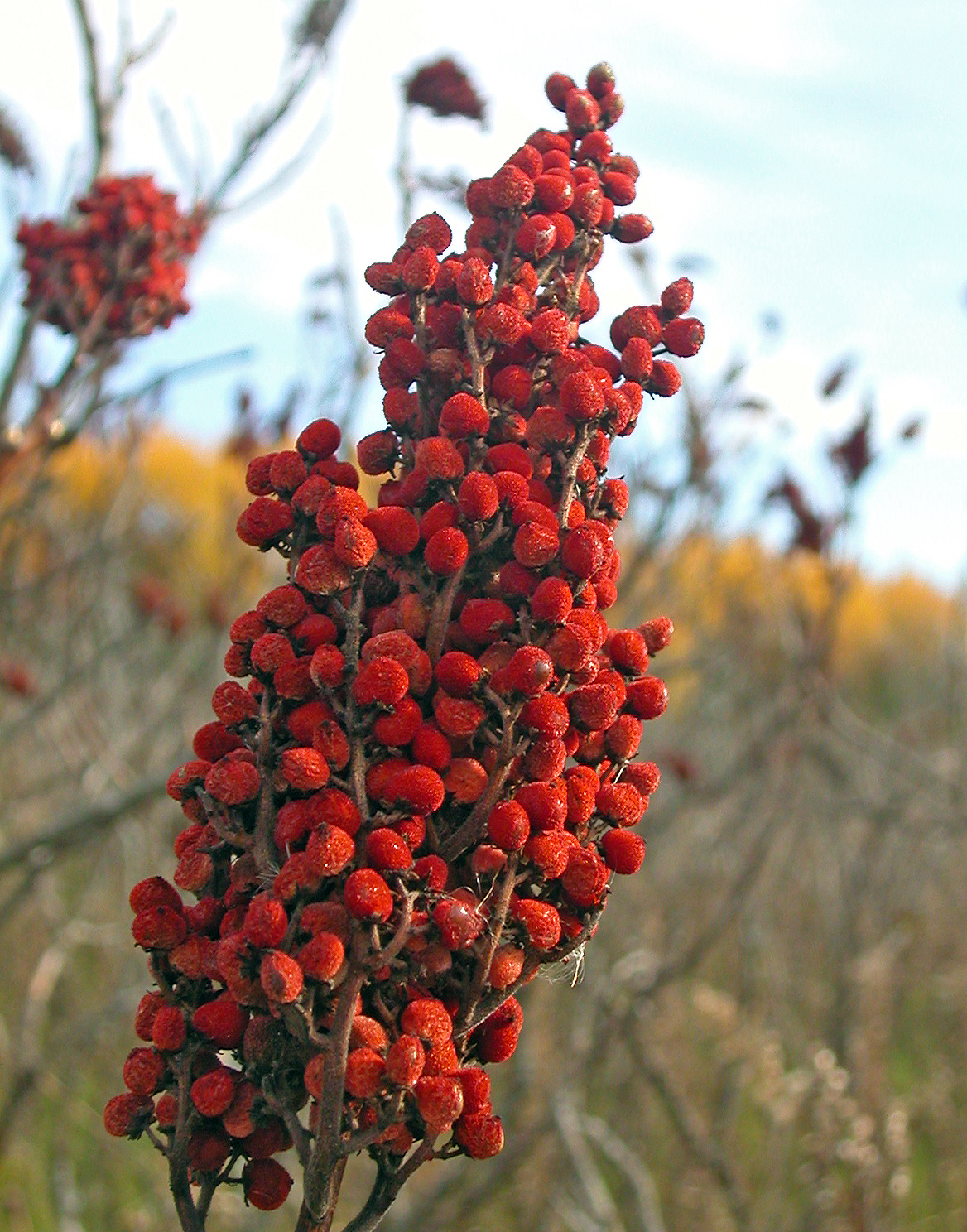
Sumacs are dioecious shrubs and small trees that can reach a height of one to ten metres (3–33 ft). The leaves of its type species are pinnately compound, though some species have trifoliate or simple leaves. The flowers are in dense panicles or spikes 5–30 cm (2–12 in) long, each flower very small, greenish, creamy white or red, with five petals. The fruits are reddish, thin-fleshed drupes covered in varying levels of hairs at maturity and form dense clusters at branch tips, sometimes called sumac bobs.
Sumacs propagate both by seed (spread by birds and other animals through their droppings), and by new shoots from rhizomes, forming large clonal colonies.[citation needed]
The word sumac traces its etymology from Old French sumac (13th century), from Mediaeval Latin sumach, from Arabic سماق summāq, from Syriac ܣܘܡܩܐ summāqa meaning "red".
The generic name Rhus derives from Ancient Greek ῥοῦς rhous referring to the type species R. coriaria, of unknown etymology; the suggestion that it is connected with the verb ῥέω rheō "to flow" is now rejected by scholars.[citation needed] The taxonomy of Rhus has a long history, with de Candolle proposing a subgeneric classification with 5 sections in 1825. At its largest circumscription, Rhus, with over 250 species, has been the largest genus in the family Anacardiaceae.
Other authors used subgenera and placed some species in separate genera, hence the use of Rhus sensu lato and Rhus sensu stricto (s.s.). One classification uses two subgenera, Rhus (about 10 spp.) and Lobadium (about 25 spp.), while at the same time Cotinus, Duckera, Malosma, Metopium, Searsia and Toxicodendron segregated to create Rhus s.s.. Other genera that have been segregated include Actinocheita and Baronia. As defined, Rhus s.s. appears monophyletic by molecular phylogeny research. However, the subgenera do not appear to be monophyletic. The larger subgenus, Lobadium, has been divided further into sections, Lobadium, Terebinthifolia, and Styphonia (two subsections).
As of November 2024, Plants of the World Online accepts 54 species.
Asia, North Africa and southern Europe
Hub AI
Sumac AI simulator
(@Sumac_simulator)
Sumac
Sumac or sumach (/ˈsuːmæk, ˈʃuː-/ S(H)OO-mak, UK also /ˈsjuː-/)—not to be confused with poison sumac—is any of the roughly 35 species of flowering plants in the genus Rhus (and related genera) of the cashew and mango tree family, Anacardiaceae. However, it is Rhus coriaria that is most commonly used for culinary purposes. Sumac is prized as a spice—especially in Iranian cuisine, and other Eastern cuisines—and used as a dye and holistic remedy. The plants grow in subtropical and temperate regions, on nearly every continent except Antarctica and South America. Native to Persia[citation needed], it holds cultural significance as a symbolic item on the Haft-sin table during Nowruz, the Persian New Year.
Sumacs are dioecious shrubs and small trees that can reach a height of one to ten metres (3–33 ft). The leaves of its type species are pinnately compound, though some species have trifoliate or simple leaves. The flowers are in dense panicles or spikes 5–30 cm (2–12 in) long, each flower very small, greenish, creamy white or red, with five petals. The fruits are reddish, thin-fleshed drupes covered in varying levels of hairs at maturity and form dense clusters at branch tips, sometimes called sumac bobs.
Sumacs propagate both by seed (spread by birds and other animals through their droppings), and by new shoots from rhizomes, forming large clonal colonies.[citation needed]
The word sumac traces its etymology from Old French sumac (13th century), from Mediaeval Latin sumach, from Arabic سماق summāq, from Syriac ܣܘܡܩܐ summāqa meaning "red".
The generic name Rhus derives from Ancient Greek ῥοῦς rhous referring to the type species R. coriaria, of unknown etymology; the suggestion that it is connected with the verb ῥέω rheō "to flow" is now rejected by scholars.[citation needed] The taxonomy of Rhus has a long history, with de Candolle proposing a subgeneric classification with 5 sections in 1825. At its largest circumscription, Rhus, with over 250 species, has been the largest genus in the family Anacardiaceae.
Other authors used subgenera and placed some species in separate genera, hence the use of Rhus sensu lato and Rhus sensu stricto (s.s.). One classification uses two subgenera, Rhus (about 10 spp.) and Lobadium (about 25 spp.), while at the same time Cotinus, Duckera, Malosma, Metopium, Searsia and Toxicodendron segregated to create Rhus s.s.. Other genera that have been segregated include Actinocheita and Baronia. As defined, Rhus s.s. appears monophyletic by molecular phylogeny research. However, the subgenera do not appear to be monophyletic. The larger subgenus, Lobadium, has been divided further into sections, Lobadium, Terebinthifolia, and Styphonia (two subsections).
As of November 2024, Plants of the World Online accepts 54 species.
Asia, North Africa and southern Europe