


Community hub
Recent from talks
Contribute something
Nothing was collected or created yet.
Haft-sin
View on WikipediaHaft Seen or Haft sin (Persian: هفتسین, lit. 'Seven S's') is an arrangement of seven symbolic items whose names start with the letter "س" (pronounced as "seen"), the 15th letter in the Persian alphabet; "haft" (هفت) is Persian for "seven".[1][2] It is traditionally displayed at Nowruz, the Iranian New Year, which is celebrated on the day of the vernal equinox, marking the beginning of spring in the Northern Hemisphere.
Items of Haft-seen
[edit]
The following are the primary items of Haft-seen, whose Persian names begin with the letter S in the Persian alphabet.[1][2]
- Sabzeh (سبزه) – wheat, barley, mung bean, or lentil sprouts grown in a dish.
- Samanu (سمنو) – wheat germ sweet pudding.
- Senjed (سنجد) – oleaster.
- Serkeh (سرکه) – vinegar.
- Seeb (سیب) – apple.
- Seer (سیر) – garlic.
- Somagh (سماق) – sumac.


Coins (سکه sekke), hyacinth (سنبل sonbol), and clock (ساعت saa'at) are sometimes included too. Other symbolic items that are typically used to accompany Haft-sin include a mirror, candles, painted eggs, goldfish, and traditional Persian confections.
A "book of wisdom" is also commonly included, which might be, Avesta, the Shahnameh, the Quran or the Divān of Hafez.[1]
One of the most well-known traditions celebrated at the start of the new solar year is "haft sin". Items that begin with the letter (S), such as apples, garlic, coins, and so on, are organized on the Sofre Haft-Sin.
Seven was regarded as a sacred number in the Sasanian faith, and at this time, individuals planted seven seeds on seven distinct pillars.
Iranians offer Haft-Sin for either the twelve sacred tower numbers or the number seven Amshaspand. For the first day of spring, they placed items like greenery and water signifying growth and light, milk signifying rebirth, resurrection, and rebirth, a fire pit signifying the sustainability of heat and light, a mirror signifying purity and transparency, a freshly struck coin symbolizing possession and blessing, an egg signifying race and sperm, an oleaster signifying endearment and fertility and birth, an apple signifying the mystery of love, a pomegranate signifying sanctity, an orange representing the Earth sphere, a specific Esfand flower signifying Amshaspand Sepandarms on their tables and a fish signifying the end of the Esfand month.
In addition to the Holy Book, other items in the Sofreh Haft Sin were bread baked from seven grains, cheese, sugar, dates, rose water, olives, branches from the holy pomegranate tree, willow, and figs in bunches of seven, twelve, or three.
According to legend, the Haft Shin table was used by Persians before being given a new name. The Haft Shin table's components were candles (Sham), wine (Sharab), nectar (Shahd), syrup (Sharbat), sweets (Shirini), boxwood (Shamshad), and anemones (Shaqayegh) or plant branches (Shakh-e-Nabat).
When Haft Shin first gained popularity among Iranians during the Sassanid era, Shamshad was set out on the table alongside the other Shins on Nowruz as a representation of longevity and greenness.
Persians used to prepare the "Seven Candles" table during the Sassanid era and before the advent of Islam, which contained wine, candles, sharbat, boxwood, nectar, and anemones. The Persian alphabet "Shin" changed into "Sin" when Islam was introduced to Iran and their "wine" was declared to be unlawful. At this point, its twin, vinegar, was put on the table.
Gallery
[edit]-
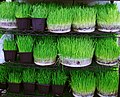 Wheatgrass, one of the items of Haft-sin.
 -
 A bowl of samanu, one of the items of Haft-sin.
 -
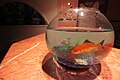 Goldfish, one of the items of Haft-sin.
 -
 A Haft-sin table at the White House.
 -
 A Haft-sin table at a hotel in Bijar, Kurdistan.
 -
 A Haft-sin table at Sharif University of Technology.
 -
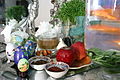 A Haft-sin table.
 -
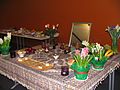 A Haft-sin table.
 -
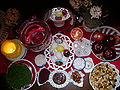 A Haft-sin table.
 -
 A Haft-sin table.
 -
 A Haft-sin table.
 -
 Haft Mewa
 -
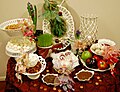 A Haft-sin table.
 -
 A Haft-sin table.
 -
 A Haft-sin table.
 -
 Haft Mewa


.jpg)


References
[edit]- ^ a b c Campo, Juan Eduardo (2009). "Nawruz". Encyclopedia of Islam. Infobase Publishing. pp. 524–525. ISBN 978-1-4381-2696-8. Archived from the original on 2017-10-14. Retrieved 2018-04-17.
- ^ a b "Noruz, manifestation of culture of peace, friendship among societies". Tehran Times. April 7, 2018. Archived from the original on April 18, 2018. Retrieved April 17, 2018.
External links
[edit]
- Shahbazi, A. Shapur (March 1, 2012). "HAFT SIN". Encyclopaedia Iranica. Vol. XI. pp. 524–526.
Haft-sin
View on GrokipediaOrigins and History
Ancient Roots
The roots of Nowruz celebrations, to which the Haft-sin tradition is connected, trace back to ancient Persian practices with Zoroastrian influences, emphasizing renewal and harmony with nature. While the specific Haft-sin arrangement is of more recent origin, pre-Islamic rituals during the Sassanid era (224–651 CE) included elements that may have inspired it, such as the sacred significance of the number seven in Zoroastrianism.[7] In Zoroastrianism, the number seven held profound sacred significance, representing the seven Amesha Spentas (holy immortals or bounteous immortals), who embody divine attributes such as good thought, truth, and immortality, emanating from Ahura Mazda. These entities are central to Avestan texts, where they symbolize the seven stages of creation—sky, water, earth, plants, animals, humans, and fire—aligning with Nowruz as a festival of renewal and the triumph of good over evil.[8] Evidence from the Sassanid period illustrates elaborate Nowruz preparations that incorporated sets of seven, including the planting of seven types of seeds—such as wheat, barley, lentils, and beans—on top of twelve mud-brick pillars in the royal palace, each pillar dedicated to a month of the year. These pillars, known as haft-ābdār ("seven seeds"), were erected about 25 days before Nowruz, allowing the seeds to sprout into green symbols of fertility and growth by the festival, which were then displayed during equinox observances. Items were often arranged in groups of seven, twelve, or three to evoke cosmic completeness, with rituals emphasizing communal feasting and renewal.[9] According to popular tradition, a precursor arrangement known as Haft-Shin, featuring items beginning with the letter "shin" (ش), existed in pre-Islamic times, but historical evidence for this is limited and considered speculative by scholars.[7][10]Evolution Over Time
According to popular tradition, following the Arab conquest of Persia in the 7th century CE, an arrangement featuring items beginning with the letter "shin" (ش), such as wine (sharab), may have been adapted to Haft-Sin with items starting with "sin" (س) to align with Islamic norms, such as substituting vinegar (serkeh) for wine; however, the exact origins of Haft-Sin remain obscure, with scholarly sources suggesting it is a more modern practice that gained prominence in the 20th century.[7][11][12] During the Safavid era (1501–1736 CE), the Haft-Sin table featured in royal Nowruz observances, with various symbolic items including fruits, sweets, and eggs, reflecting the dynasty's emphasis on Persian cultural revival under Twelver Shi'ism.[13][7] The tradition deepened its integration into Persian literary culture through the inclusion of divans—collections of poetry—on the Haft-Sin table, particularly that of the poet Hafez (d. 1390 CE), used for bibliomancy (fal) to seek guidance for the new year.[14] In the 20th century, Haft-Sin persisted and revived amid political changes; under the Pahlavi dynasty (1925–1979), it symbolized a return to pre-Islamic Persian identity, promoted through state-sponsored celebrations that expanded Nowruz rituals. After the 1979 Islamic Revolution, despite initial tensions with the new regime's focus on Islamic observances, the tradition endured as a marker of cultural resilience and subtle resistance, with families continuing private Haft-Sin setups even as public expressions adapted to official oversight. This continuity culminated in UNESCO's 2010 inscription of Nowruz, including Haft-Sin, on the Representative List of the Intangible Cultural Heritage of Humanity, recognizing its role in fostering community bonds across regions.[13][15][16]Cultural Significance
Connection to Nowruz
Nowruz, the Persian New Year, commences on the vernal equinox, typically falling between March 20 and 21 in the Gregorian calendar, signifying the arrival of spring and themes of renewal and rejuvenation. This ancient festival aligns precisely with the Iranian solar calendar, also known as the Solar Hijri or Jalali calendar, which is based on astronomical calculations to mark the exact moment when day and night are equal, symbolizing the triumph of light over darkness. At the heart of Nowruz celebrations is the Haft-sin, a ceremonial table setting known as sofreh-ye Haft-sin, which serves as the central focal point for families to gather, reflect, and usher in the new year with prayers and well-wishes for prosperity and harmony.[17][18][19] The Haft-sin table is meticulously prepared in the days leading up to the equinox, to ensure it is ready at the precise astronomical instant of Nowruz's onset, allowing families to convene around it for rituals of gratitude and renewal. This setup integrates seamlessly with broader Nowruz observances, including Chaharshanbe Suri, the fire-jumping festival held on the eve of the last Wednesday before the equinox, where participants leap over bonfires to ward off misfortune and purify themselves for the year ahead. Following the equinox, the table remains a enduring symbol throughout the 13-day holiday period, facilitating daily family gatherings for shared meals, storytelling, and contemplative prayers that emphasize unity and hope.[20][17][19] The festivities culminate on the 13th day with Sizdah Bedar, an outdoor excursion to nature where families picnic and release symbolic items from the Haft-sin table, such as sprouted greens, into running water to carry away misfortunes and complete the cycle of renewal. This extended timeline underscores Nowruz's deep connection to seasonal and cosmic rhythms in the Iranian solar calendar, reinforcing communal bonds through rituals that blend ancient astronomical precision with cultural practices of reflection and joy.[21][19][22]Symbolism of the Number Seven
In Zoroastrianism, the number seven is revered as a sacred emblem of divine order and creation, most prominently through the seven Amesha Spentas, the immortal benefactors or archangels who represent core principles such as good thought, truth, and immortality, assisting Ahura Mazda in maintaining cosmic harmony.[23] This numerological motif extends to the faith's cosmogony, where the material world emerges in seven sequential stages: the sky, water, earth, plants, the primordial ox, humanity, and fire, each stage underscoring progressive manifestation from the spiritual to the physical realm.[24] Additionally, ancient Zoroastrian texts acknowledge seven planets—Mercury, Venus, Mars, Jupiter, Saturn, the Sun, and the Moon—as celestial forces governed by divine chieftains, influencing earthly events and reinforcing the interconnectedness of the macrocosm and microcosm.[25] These Zoroastrian foundations draw from broader Indo-Iranian traditions, where seven symbolizes vitality and equilibrium, as seen in rituals involving the planting of seven seeds to invoke agricultural growth and prosperity, reflecting the cyclical renewal of nature.[10] Similarly, the seven colors of the rainbow are interpreted as emblems of harmony and divine covenant in ancient Iranian lore, bridging earthly observation with spiritual wholeness and evoking the spectrum of life's transitions.[26] Following the Islamic conquest, the symbolism of seven integrated with Quranic numerology, particularly the concept of seven heavens layered in ascending order, which parallels pre-Islamic Persian views of stratified cosmic realms and enhances the number's aura of transcendence and unity.[27] In Persian mysticism, such as Sufi interpretations, seven denotes completeness and balance, often linked to the seven valleys of the soul's journey toward enlightenment, as outlined in classical texts like Attar's Conference of the Birds.[28] This layered significance manifests culturally in Haft-sin, where the selection of seven items encapsulates renewal, fertility, and the human life's phases—from birth to spiritual fulfillment—positioning the table as a symbolic microcosm of universal order.[4] The tradition's adherence to seven elements thus perpetuates these motifs, invoking holistic prosperity without delving into individual item meanings.The Haft-Sin Table
The Seven Essential Items
The Haft-sin table features seven essential items, each beginning with the Persian letter "س" (sin), selected for their cultural significance in Nowruz celebrations. These items are traditionally arranged on a cloth-covered table and represent core elements of renewal and prosperity in Persian tradition.[16]- Sabzeh: Sprouts grown from wheat, barley, mung beans, or lentils in a shallow dish, representing fresh growth.[29]
- Samanu: A sweet, thick pudding prepared by slowly cooking wheat germ with flour until it thickens, with sweetness derived from the natural sugars in the wheat.[30]
- Senjed: Dried fruits from the oleaster tree (Elaeagnus angustifolia), also known as Russian olives, placed whole or in small piles.[16]
- Serkeh: Vinegar, typically poured into a small bowl, derived from fermented fruits or grains.[29]
- Seeb: Apples, usually red varieties, arranged in a dish for their vibrant color and crisp texture.[30]
- Seer: Garlic bulbs, peeled or whole, valued for their pungent aroma and medicinal properties in traditional use.[16]
- Somagh: Sumac berries, ground into a coarse red powder or left as dried berries, sourced from the Rhus coriaria plant.[29]