Hubbry Logo
ToxicodendronToxicodendronMain
Open search
Toxicodendron
Community hub
Toxicodendron
logo
8 pages, 0 posts
0 subscribers
Be the first to start a discussion here.
Toxicodendron
Toxicodendron
from Wikipedia

Toxicodendron
Toxicodendron radicans
Scientific classification Edit this classification
Kingdom: Plantae
Clade: Tracheophytes
Clade: Angiosperms
Clade: Eudicots
Clade: Rosids
Order: Sapindales
Family: Anacardiaceae
Subfamily: Anacardioideae
Genus: Toxicodendron
Mill.[1]
Type species
Toxicodendron pubescens Mill.[3]
Species[2]

29; see text

Synonyms[2]
  • Albonia Buc'hoz, nom. nud.
  • Augia Lour., nom. rej.
  • Philostemon Raf.
  • Vernix Adans.

Toxicodendron is a genus of flowering plants in the sumac family, Anacardiaceae. It contains trees, shrubs and woody vines, including poison ivy, poison oak, and the lacquer tree. The best-known members of the genus in North America are eastern poison ivy (T. radicans) and western poison oak (T. diversilobum), both ubiquitous throughout much of their respective region.

All members of the genus produce the skin-irritating oil urushiol, which can cause a severe allergic reaction known as urushiol-induced contact dermatitis. The resins of certain species native to Japan, China and other Asian countries, such as lacquer tree (T. vernicifluum) and wax tree (T. succedaneum), are used to make lacquer, and, as a byproduct of lacquer manufacture, their berries are used to make japan wax.

Description

[edit]

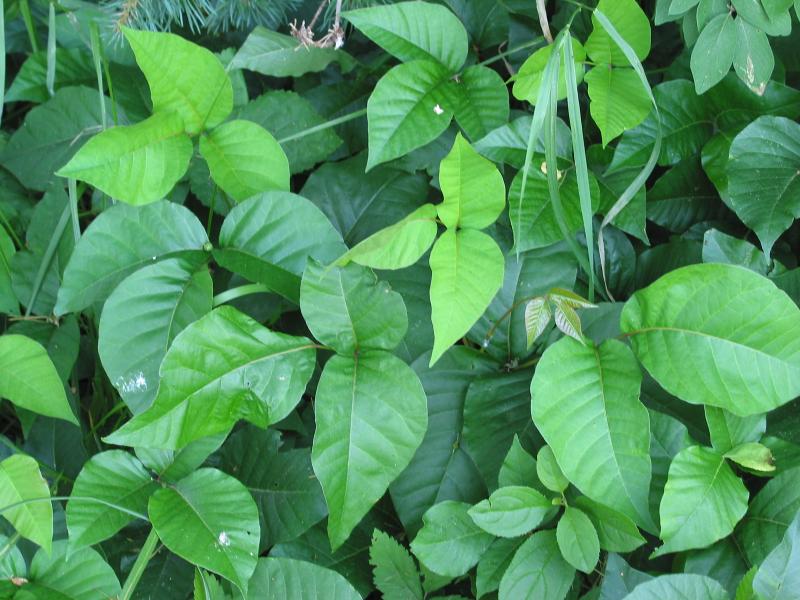
Plants in the genus have pinnately compound, alternate leaves and whitish or grayish drupes. They are quite variable in appearance. The leaves may have smooth, toothed, or lobed edges, and all three types of leaf edges may be present in a single plant. The plants grow as creeping vines, climbing vines, shrubs, or, in the case of lacquer tree (T. vernicifluum) and poison sumac (T. vernix), as trees. While leaves of poison ivy and poison oaks usually have three leaflets, sometimes there are five or, occasionally, even seven leaflets. Leaves of poison sumac have 7–13 leaflets, and of Lacquer Tree, 7–19 leaflets.

Taxonomy

[edit]

It was published by Philip Miller in 1754. The lectotype species is Toxicodendron pubescens Mill.[3][4] The genus is a member of the Rhus complex, and has at various times been categorized as being either its own genus or a sub-genus of Rhus.[5] There is evidence which points to keeping Toxicodendron as a separate monophyletic genus, but researchers have stated that the Toxicodendron and Rhus groups are complex and require more study to be fully understood.[6]

The common names come from similar appearances to other species that are not closely related and to the allergic response to the urushiol. Poison oak is not an oak (Quercus, family Fagaceae), but this common name comes from the leaves' resemblance to white oak (Quercus alba) leaves, while poison ivy is not an ivy (Hedera, family Araliaceae), but has a superficially similar growth form. Technically, the plants do not contain a poison; they contain a potent allergen.

Species

[edit]

29 species are accepted (as of November 2024).[2]

  • Toxicodendron acuminatum (DC.) C.Y.Wu & T.L.Ming (synonym Rhus acuminata) – China, Bhutan, India and Nepal.
  • Toxicodendron bimannii Barbhuiya – Assam
  • Toxicodendron borneense (Stapf) Gillis – Borneo
  • Toxicodendron calcicola C.Y.Wu – endemic to China
  • Toxicodendron delavayi (Franch.) F.A.Barkley – southwestern Sichuan and northwestern and central Yunnan in south-central China
  • Toxicodendron diversilobum (Torr. & A.Gray) Greene (synonym Rhus diversiloba) – Western poison oak is found throughout much of western North America, ranging from the Pacific coast into the Sierra Nevada and Cascade mountain ranges between southern British Columbia and southward into Baja California. It is extremely common in that region, where it is the predominant species of the genus. Indeed, it is California's most prevalent woody shrub.[7] Extremely variable, it grows as a dense shrub in open sunlight, or as a climbing vine in shaded areas. It propagates by creeping rhizomes or by seed.[8] The compound leaves are divided into three leaflets, 35–100 mm long, with scalloped, toothed, or lobed edges. The leaves may be red, yellow, green, or some combination of those colors, depending on various factors, such as the time of year.
  • Toxicodendron fulvum (Craib) C.Y.Wu & T.L.Ming – southern Yunnan and northern Thailand
  • Toxicodendron grandiflorum C.Y.Wu & T.L.Ming – Yunnan and southwestern Sichuan in south-central China
  • Toxicodendron griffithii (Hook.f.) Kuntze – eastern Himalayas to Yunnan and southwestern Guizhou in south-central China
  • Toxicodendron hirtellum C.Y.Wu – southern Sichuan
  • Toxicodendron hookeri (K.C.Sahni & Bahadur) C.Y.Wu & T.L.Ming – eastern Nepal to Assam
  • Toxicodendron khasianum (Hook.f.) Kuntze – Assam and Bangladesh
  • Toxicodendron × lobadioides Greene (T. diversilobum × T. rydbergii) – Washington in the northwestern United States
  • Toxicodendron nodosum (Blume) Kuntze – western Malesia and southwestern Sulawesi
  • Toxicodendron oligophyllum S.L.Tang, Liang Ma & S.P.ChenFujian in southeastern China
  • Toxicodendron orientale Greene (synonyms Rhus orientale and R. ambigua) – Asian poison ivy is very similar to the American poison ivy, and replaces it throughout east Asia (so similar that some texts treat it as just a variety of the American species).
  • Toxicodendron pubescens Mill. (synonym Rhus toxicarium) – Atlantic poison oak grows mostly in sandy soils in eastern parts of the United States. Growing as a shrub, its leaves are in groups of three. Leaves are typically rounded or lobed and are densely haired. Although it is often confused with the more common poison ivy, even in the scientific literature,[9] Atlantic poison oak has small clumps of hair on the veins on the underside of the leaves, while poison ivy does not.
  • Toxicodendron quinquefoliolatum Q.H.Chen – Guizhou in south-central China
  • Toxicodendron radicans (L.) Kuntze (synonym Rhus radicans) – Poison ivy is extremely common in some areas of North America. In the United States, it grows in all states east of the Rockies. It also grows in Central America. Appearing as a creeping vine, a climbing vine, or a shrub, it reproduces both by creeping rootstocks and by seeds. The appearance varies. Leaves, arranged in an alternate pattern, usually in groups of three, are from 20 to 50 mm long, pointed at the tip, and can be toothed, smooth, or lobed, but never serrated. Leaves may be shiny or dull, and the color varies with the season. Vines grow almost straight up rather than wrapping around their support and can grow to 8–10 m in height. In some cases, Poison ivy may entirely engulf the supporting structure, and vines may extend outward like limbs so that it appears to be a Poison ivy "tree".
  • Toxicodendron rhetsoides (Craib) Tardieu – Thailand, Laos, and Vietnam
  • Toxicodendron rostratum T.L.Ming & Z.F.Chen – southern Yunnan
  • Toxicodendron rydbergii (Small ex Rydb.) Greene (synonym Rhus rydbergii) – Western poison ivy is found in northern parts of the eastern United States. It also exists in the western United States and Canada but is much less common than poison oak. It may grow as a vine or a shrub. It was once considered a subspecies of poison ivy. It does sometimes hybridize with the climbing species. Western poison ivy is found in much of western and central United States and Canada, although not on the West Coast. In the eastern United States, it is rarely found south of New England.
  • Toxicodendron striatum (Ruiz & Pav.) Kuntze (synonym Rhus striata) – Manzanillo is a South American poisonous tree growing in the tropical rain forests on low elevation slopes. The name should not be confused with the unrelated Manchineel, a poisonous tree that is not a member of the Anacardiaceae.
  • Toxicodendron succedaneum (L.) Kuntze (synonym Rhus succedanea) – Wax tree is native of Asia, although it has been planted elsewhere, most notably in Australia and New Zealand. It is a large shrub or tree, up to 8 m tall, somewhat similar to a sumac tree. Because of its beautiful autumn foliage, it has been planted outside of Asia as an ornamental plant, often by gardeners who were apparently unaware of the dangers of allergic reactions. It is now officially classified as a noxious weed in Australia and New Zealand. The fatty-acid methyl ester of the kernel oil meets all of the major biodiesel requirements in the USA (ASTM D 6751-02, ASTM PS 121-99), Germany (DIN V 51606) and European Union (EN 14214).[10]
  • Toxicodendron sylvestre (Siebold & Zucc.) Kuntze (synonym Rhus sylvestris) – native to China, Japan, Korea and Taiwan.
  • Toxicodendron trichocarpum (Miq.) Kuntze – southern China, Korea, Japan, and Kuril Islands
  • Toxicodendron vernicifluum (Stokes) F.A.Barkley (synonym Rhus verniciflua) – Lacquer tree or varnish tree grows in Asia, especially China and Japan. Growing up to 20 m tall, its sap produces an extremely durable lacquer. The leaves have 7–19 leaflets (most often 11–13). The sap contains the allergenic oil, urushiol. Urushiol gets its name from this species which in Japanese is called Urushi. Other names for this species include Japanese lacquer tree, Japanese Varnish Tree, and Japanese Sumac (Note: the term "varnish tree" is also occasionally applied to the Candlenut, Aleurites moluccana, a southeast Asian tree unrelated to Toxicodendron).
  • Toxicodendron vernix (L.) Kuntze (synonym Rhus vernix) – Poison sumac is a tall shrub or a small tree, from 2–7 m tall. It is found in swampy, open areas and reproduces by seeds. The leaves have between 7–13 untoothed leaflets, in a feather-compound arrangement.[11] In terms of its potential to cause urushiol-induced contact dermatitis, poison sumac is far more virulent than other Toxicodendron species, even more virulent than poison ivy and poison oak. According to some botanists, T. vernix is the most toxic plant species in the United States (Frankel, 1991).
  • Toxicodendron wallichii (Hook.f.) Kuntze – Himalayas, southern Tibet, southern China, Vietnam, and northern Thailand
  • Toxicodendron yunnanense C.Y.Wu – Yunnan

Formerly placed here

[edit]
  • Searsia parviflora (Roxb.) F.A.Barkley (as Toxicodendron parviflorum (Roxb.) Kuntze) – Small-flowered poison sumac grows in the Himalayas between Kumaun, India and Bhutan

Etymology

[edit]

The generic name is derived from the Greek words τοξικόν (toxikón), meaning 'poison', and δένδρον (déndron), meaning 'tree'.[12]

Toxicity

[edit]

All members of the genus produce the skin-irritating oil urushiol, which can cause a severe allergic reaction known as urushiol-induced contact dermatitis.[13]

Uses

[edit]

In East Asia, in particular in Japan, traditional candle fuel was produced from Toxicodendron vernicifluum and Toxicodendron succedaneum, among other sumac plants in the genus Toxicodendron, rather than beeswax or animal fats. The sumac wax was a byproduct of traditional Japanese lacquer manufacture. The conical rousoku candles produced from sumac wax burn with smokeless flame and were favored in many respects over candles made from lard or beeswax during the Tokugawa shogunate. Japan wax is not a true wax but a solid fat that contains 10-15% palmitin, stearin, and olein with about 1% japanic acid (1,21-heneicosanedioic acid). It is still used in many tropical and subtropical countries in the production of wax match sticks.[citation needed]

[edit]

Notes

[edit]

References

[edit]
[edit]
Revisions and contributorsEdit on WikipediaRead on Wikipedia
from Grokipedia
Toxicodendron Mill. is a of approximately 29 species of flowering in the family, , consisting of woody vines, s, and small trees that are primarily distributed in temperate and subtropical regions of eastern and . These are characterized by compound leaves typically with three to thirteen leaflets, dioecious flowers arranged in panicles, and drupaceous fruits, often adapting to a wide range of habitats from disturbed forests and roadsides to wetlands and coastal areas. The is best known for producing , a clear oily in all parts that causes severe in about 50-75% of humans upon direct contact or through smoke from burning . Notable species include Toxicodendron radicans (eastern poison ivy), a climbing vine widespread across much of North America except the far west and Alaska; T. diversilobum (western poison oak), a shrub common in California and Oregon chaparral and oak woodlands; T. pubescens (Atlantic poison oak), found in the southeastern United States; and T. vernix (poison sumac), a shrub restricted to eastern North American wetlands. Ecologically, Toxicodendron species play roles in wildlife habitats, providing berries for birds and cover for small mammals, though they are considered invasive or weedy in some disturbed areas due to their vigorous growth and tolerance of varied soil and light conditions. Historically classified within the broader genus Rhus, Toxicodendron was segregated based on the presence of urushiol and phylogenetic differences, highlighting its distinction from non-toxic sumacs. While some Asian species like T. vernicifluum have been used for lacquer production, the North American taxa pose significant health risks, prompting extensive research into dermatitis prevention and treatment.

General Characteristics

Morphological Features

Toxicodendron species exhibit diverse growth forms, ranging from shrubs and small trees to woody vines. Shrubs and small trees, such as T. vernix, typically reach heights of up to 7.6 meters with an erect habit and open crown, often producing basal sprouts. Vines, exemplified by T. radicans, function as rhizomatous lianas that climb via aerial rootlets along stems, attaining lengths exceeding 15 meters and stem diameters up to 15 cm in mature individuals. These lack thorns, distinguishing them from certain Rhus species that may bear spines, such as R. microphylla. Leaves in the are alternate, , and compound, with leaflet number varying by : typically trifoliate (three leaflets) in T. radicans and T. rydbergii, but pinnately compound with 7-13 leaflets in T. vernix. Leaflets are generally ovate to lanceolate or elliptic, measuring 3-15 cm in length and 1-10 cm in width, with glossy surfaces that often turn vibrant red or orange in autumn. Stems and leaves contain a milky sap that oxidizes to black upon exposure to air. Flowers are small and inconspicuous, greenish-white to yellowish, with five petals, arranged in axillary panicles measuring 5-20 cm long. Fruits are drupes, 3-10 mm in diameter, initially greenish but ripening to white or grayish hues, often persisting through winter in hanging clusters. Morphological variability is pronounced, particularly in leaf shape within species like T. radicans, where leaflets display polymorphism including entire, serrated, crenate, or lobed margins, and occasional penta- or hepta-foliate forms due to developmental processes. This plasticity, documented in a 2023 of observations, complicates identification but underscores adaptive traits across habitats. The sap's content contributes to the genus's notoriety, though its chemical details are elaborated elsewhere.

Etymology

The genus name Toxicodendron derives from the Greek words toxikon (poison) and dendron (tree), reflecting the poisonous properties of its members, and was first published by the English botanist in his 1754 edition of The Gardeners Dictionary. This nomenclature was introduced to distinguish these plants from non-toxic sumacs in the related genus Rhus, highlighting their hazardous sap containing . Common names for Toxicodendron species often stem from their superficial resemblances to other plants combined with their toxic effects. For instance, "" (T. radicans) arose from its climbing, ivy-like growth habit and the severe skin irritation caused by its sap, a term first recorded by English explorer Captain John Smith in 1624 during his accounts of North American flora. Similarly, "" (T. pubescens and T. diversilobum) derives from the lobed leaves that mimic those of oaks (Quercus spp.), emphasizing the deceptive familiarity paired with danger. In Asian contexts, regional names like "varnish tree" or "lacquer tree" (T. vernicifluum) reflect traditional uses of the for production, despite the associated , contrasting with the cautionary Western appellations. Historically, many species were classified under Rhus (e.g., Rhus toxicodendron), leading to lingering binomial names that underscore the taxonomic separation driven by their unique allergenic traits.

Taxonomy

Classification History

The genus Toxicodendron traces its taxonomic origins to the mid-18th century, when Carl Linnaeus included its species within the broader genus Rhus in his seminal work Species Plantarum (1753), treating toxic plants like poison ivy as Rhus toxicodendron alongside non-toxic sumacs without distinguishing based on toxicity or chemistry. This lumping reflected the limited morphological resolution available at the time, as Rhus sensu lato encompassed a diverse array of shrubs, trees, and vines in the Anacardiaceae family. Shortly thereafter, proposed the separate genus Toxicodendron in the fourth edition of The Gardeners Dictionary (1754), initially based on the distinctive toxic properties and subtle morphological traits of certain Rhus species, such as resinous sap and trifoliolate leaves, though adoption was slow due to inconsistent application. The separation gained traction in the early , formalized around , when botanists recognized the presence of —a potent allergenic —as a key chemical synapomorphy distinguishing Toxicodendron from non-toxic Rhus, alongside differences in fruit structure and growth habits. Molecular phylogenetics in the late 1990s and 2000s provided robust support for Toxicodendron as a monophyletic genus distinct from Rhus sensu stricto, using nuclear ITS sequences and chloroplast markers to resolve the Rhus complex and confirm its placement within Anacardiaceae. Recent analyses, including chloroplast genome sequencing of species like T. diversilobum in 2023, have further affirmed this monophyly without proposing major reclassifications through 2025. Currently, 28 species are accepted in Toxicodendron, with ongoing refinements documented in databases like Plants of the World Online (as of November 2025).

Accepted Species

The genus Toxicodendron includes 28 accepted species, predominantly found in the temperate zones of the Northern Hemisphere. These species are typically woody vines, shrubs, or small trees characterized by compound leaves and the presence of urushiol, an oleoresin that causes contact dermatitis in sensitive individuals. In North America, several species are prominent. Toxicodendron radicans, known as eastern poison ivy, is a versatile vine or shrub that climbs up to 30 meters or grows as a low shrub, featuring trifoliate leaves that vary widely in shape and are native to woodlands, fields, and disturbed areas across the eastern and central United States and southern Canada. Toxicodendron rydbergii, or western poison ivy, is a more herbaceous, low-growing vine or subshrub with similar trifoliate leaves, adapted to drier habitats in the western United States and Canada. Toxicodendron pubescens, the Atlantic poison oak, forms dense shrubs up to 3 meters tall with pubescent leaves, occurring in sandy soils and coastal plains of the southeastern United States. Toxicodendron diversilobum, Pacific poison oak, grows as a shrub reaching 2 meters or a climbing vine up to 15 meters, with lobed, oak-like leaves, and is native to chaparral and woodland edges in California and Oregon. Toxicodendron vernix, poison sumac, is a small tree or shrub up to 9 meters high with pinnate leaves of 7-13 leaflets, restricted to wetlands and swamps in the eastern United States. Asian species include , the lacquer tree, a up to 10 meters tall valued for its used in traditional urushi production, native to , , and Korea. , the wax tree, is a or small up to 8 meters with pinnate leaves, native to the and eastern , but noted for its invasive potential in regions like and where it has naturalized and outcompetes native vegetation. Another notable species is , Asian , a climbing or with trifoliate leaves, distributed across eastern from to . No new species have been described in Toxicodendron between 2023 and 2025, though recent studies have highlighted intraspecific variability, such as in leaf morphology of T. radicans, which complicates identification but underscores its adaptability. In 2025, four species previously classified in Rhus from were transferred to Toxicodendron, expanding its known distribution eastward, though these changes are pending full incorporation into major databases.

Formerly Placed Taxa

Several species formerly included in the broader Rhus complex alongside Toxicodendron were excluded from the genus due to the absence of urushiol, the oleoresin responsible for allergic contact dermatitis. Common examples include , a non-toxic Mediterranean valued for its edible fruits and tangy flavor in culinary uses such as spice blends. Another is , the staghorn sumac native to , characterized by its velvety red fruit clusters that are also non-toxic and used in traditional beverages. Reclassifications were driven by key distinctions: the lack of toxic sap, differences in fruit morphology such as non-resinous drupes, and phylogenetic evidence from DNA analyses in studies post-2000 that confirmed Toxicodendron as a monophyletic separate from non-toxic relatives. These taxa were transferred to Rhus sensu stricto or other segregate genera like for those with smoketree-like inflorescences. Notable cases involve African species, such as Rhus capense, now recognized as Searsia capensis following phylogenetic revisions of Rhus that separated non-toxic lineages based on molecular and morphological data. Historical taxonomic confusion arose from lumping non-allergenic sumacs with toxic species under Rhus, leading to misidentifications in early floras and persistent common name overlaps that endangered safe practices. These changes have refined Toxicodendron to 28 species strictly defined by their content and related traits, as updated in modern regional such as the (2024 edition). Excluded taxa generally lack the climbing habit and aerial rootlets typical of many current Toxicodendron species.

Distribution and Ecology

Global Range

The genus Toxicodendron is primarily distributed across the , with native ranges concentrated in temperate and subtropical regions of and . In , species such as T. radicans (eastern poison ivy) occur widely from southern (including , , and the Maritime provinces) southward through the eastern and to , encompassing areas from to and west to and . Similarly, T. vernix () is native to wetlands across the eastern United States and southeastern , ranging from extreme southern and to , west to eastern , and north to southeastern . In , T. vernicifluum (lacquer tree) is found from northern Pakistan through , , Korea, and the , while T. succedaneum (wax tree) extends from the across temperate eastern to northern , including , , , , , , , and . Introduced ranges have expanded beyond native areas due to ornamental planting and accidental dispersal. T. radicans has become invasive in parts of , , , and , where it establishes in non-native ecosystems. T. succedaneum, introduced as an ornamental for its autumn foliage, has naturalized in parts of the and shows invasive potential there. Biogeographically, Toxicodendron species favor temperate to subtropical climates and native species are notably absent from south of the equator and most of , though isolated native occurrences exist in northern such as and , and introduced populations are present in . Recent observations indicate climate-driven northward expansion of T. radicans in , with increased abundance in northern regions like post-2020, attributed to warmer temperatures and elevated CO2 levels enhancing growth and range limits. This shift often associates the species with disturbed habitats, amplifying its presence in altered landscapes.

Habitat Preferences and Interactions

Species of the genus Toxicodendron exhibit versatile habitat preferences, thriving in a variety of environmental conditions across their ranges. They commonly occupy disturbed areas such as edges, roadsides, and clearings, where they tolerate partial shade to full sun, as well as fluctuations in from dry uplands to saturated soils. These demonstrate resilience to , poor soil quality, and nutrient variability, often favoring soils with higher calcium and content. For instance, T. radicans (eastern ) is frequently found in floodplains and a broad spectrum of habitats including woodlands and open fields, while T. vernix (poison sumac) prefers swampy, environments with standing water. In ecological interactions, Toxicodendron species play multifaceted roles within their communities. Their fruits serve as a vital source for numerous bird , with over 60 documented consumers including songbirds and game birds, facilitating and . Leaves are browsed by and other herbivores, contributing to nutrient cycling without apparent to these animals. As in , they colonize disturbed sites post-fire or , aiding through extensive root systems and addition, which paves the way for later-successional vegetation. Morphological adaptations, such as climbing vines or erect shrubs, enhance their establishment in these dynamic habitats. Certain Toxicodendron species exhibit invasive tendencies in non-native regions, altering local ecosystems. T. succedaneum (wax tree), introduced as an ornamental, has naturalized and displaces native vegetation in riparian zones and disturbed woodlands, particularly in , where recent assessments highlight its spread along water margins and bushlands. Similarly, T. radicans shows increased growth and abundance under elevated atmospheric CO₂ levels, with studies indicating up to 77% higher and 149% greater , potentially exacerbating forest understory dominance and reducing through competitive exclusion. Most Toxicodendron species are ecologically common and widespread, facing no significant IUCN threats due to their adaptability and abundance. However, some Asian taxa, such as T. vernicifluum (lacquer tree), experience pressure from harvesting for used in traditional production, though cultivation mitigates widespread decline.

Toxicity

Chemical Basis of Toxicity

The toxicity of plants in the genus Toxicodendron is primarily attributed to urushiol, a mixture of catecholic olefins consisting of alkylcatechol derivatives with long hydrocarbon side chains, typically 15 or 17 carbons in length (e.g., 3-pentadecylcatechol for the C15 variant predominant in species like T. radicans and T. vernix). Urushiol is present throughout the plant, including in the sap, leaves, stems, fruits, and roots, where it resides in resin canals and serves as a key defensive compound. Chemically, is highly lipophilic due to its nonpolar alkyl side chains, enabling rapid penetration through the skin's . Upon exposure to air or light, it undergoes oxidative , forming a durable, black lacquer-like residue that hardens and prevents moisture loss in the plant. Concentrations of vary across Toxicodendron species and plant parts, with poison sumac (T. vernix) having notably higher content than , estimated to be 10-15 times more potent. Urushiol is biosynthesized via the phenylpropanoid pathway, starting from and involving key enzymes such as (PAL) and subsequent hydroxylations to form the core, followed by to attach the side chain; this process is enriched in specialized tissues like resin canals. Evolutionarily, represents an adaptation for , deterring herbivores and microbial pathogens through its irritant and properties, as evidenced by its role in preformed resistance mechanisms against insect and fungal attack. Detection of urushiol relies on its characteristic oxidative , which produces the observable black residue on damaged plant tissues or contaminated surfaces. For quantitative analysis, techniques such as gas chromatography-mass spectrometry (GC-MS) are employed to separate and identify the mixture's components based on side-chain variations and .

Biological Effects

Exposure to Toxicodendron species elicits a reaction in humans, resulting in delayed mediated by , the plant's allergenic . Approximately 50-75% of adults are sensitized, with an estimated 25-40 million cases occurring annually in , predominantly among outdoor workers and affecting all ages and ethnicities. Studies as of 2024 show that rising CO2 levels increase content and plant growth, potentially exacerbating cases. Symptoms typically emerge 24-72 hours after re-exposure in sensitized individuals, manifesting as linear streaks of , papules, vesicles, and bullae accompanied by intense pruritus, , and pain; mild cases resolve in 1-2 weeks, while severe ones persist for 2-3 weeks without intervention. Severity of reactions varies by species and exposure route; for instance, T. diversilobum (Pacific poison oak) often induces more intense cutaneous due to higher concentrations. Inhalation of smoke from burning plants aerosolizes particles, leading to irritation, , and potentially life-threatening airway obstruction in susceptible individuals. Among animals, avian species exhibit immunity to , consuming berries and foliage to facilitate without adverse effects. Mammalian responses are generally milder; dogs may develop localized from indirect contact but rarely show systemic symptoms, while livestock such as deer and cattle browse the plants as without toxicity. Repeated human exposures can foster chronic sensitization, heightening future reaction intensity, though remains rare.

Prevention and Management

Preventing contact with Toxicodendron species is the primary strategy for avoiding , beginning with accurate identification. The "leaves of three, let it be" rule helps recognize many species, such as (T. radicans), which typically features compound leaves with three leaflets, though variations occur seasonally or regionally. Individuals should avoid brushing against suspected plants and learn local variants through reliable field guides or extension services. Post-exposure, washing affected skin with soap and water as soon as possible, ideally within 10-15 minutes, can remove a significant portion of the before it is absorbed into the skin. After 30 minutes, most of the oil has been absorbed, reducing the effectiveness of washing, while also laundering contaminated clothing immediately. Protective measures include wearing long sleeves, pants, gloves, and closed-toe shoes in areas where Toxicodendron grows, particularly during activities like or . Barrier creams containing bentoquatam form a physical shield against the plant's oil, applied before exposure and reapplied after sweating or water contact; studies show they reduce incidence when used correctly. For high-risk professions, such as , vinyl or PVC gloves are recommended over , as they better prevent oil penetration. Removing Toxicodendron plants from personal property involves mechanical or chemical methods, always with protective gear to avoid skin contact. Mechanical removal, such as digging out roots when soil is moist, is effective for small infestations but requires complete root extraction to prevent regrowth; cut stems should be bagged and disposed of properly. Herbicides like glyphosate, applied as a foliar spray in late summer or early fall, target actively growing plants and can control larger patches, though multiple applications may be needed and non-target vegetation must be considered. Treatment for Toxicodendron dermatitis focuses on symptom relief and inflammation reduction, typically resolving in 2-3 weeks without scarring. For mild cases covering less than 10% of the body, over-the-counter topical corticosteroids like , applied 2-4 times daily, alleviate redness and itching. Severe or widespread rashes warrant oral at 40-60 mg daily for 5-7 days, followed by a taper over 2-3 weeks to prevent rebound; this regimen reduces swelling and blistering effectively in most patients. Oral antihistamines, such as diphenhydramine, provide additional relief from itching, especially at night, though they do not address the underlying allergic response. Environmental management of Toxicodendron in ecosystems emphasizes integrated approaches to control spread, particularly for like T. succedaneum (Japanese lacquer tree) in regions such as , where 2025 invasive plant guidelines recommend early detection and prioritized removal using mechanical cutting combined with herbicides to protect native . Prescribed burns can suppress T. radicans in fire-adapted habitats by top-killing vines, though roots often resprout, requiring follow-up treatments and precautions like smoke monitoring to minimize health risks. Desensitization efforts remain experimental and non-standard. PDC-urushiol conjugates, administered via injection, have shown promise in phase I trials by inducing tolerance to the , potentially reducing reactions in 70-90% of participants, but further studies are needed for approval. Oral extracts have demonstrated partial desensitization in small cohorts, with mild side effects, though they are not recommended outside research settings.

Uses

Industrial Applications

The sap of , commonly known as urushi, serves as the primary material for industrial production, yielding a highly durable and waterproof prized for its resistance to corrosion, abrasion, and moisture. Harvested by tapping the trunks during the summer months, this sap has been central to Asian craftsmanship, notably in (shikki), with archaeological evidence indicating its use since the late around 3000 BCE. The polymerization of in the sap upon exposure to oxygen and humidity forms a hard, protective film, enabling applications in art objects, furniture, and decorative items. In systems in western , , mature T. vernicifluum trees yield about 200 grams of raw per tree annually, translating to roughly 150 kg per at typical planting densities of 600–900 trees. Trees are tapped twice per year for 6–7 days each, with production sustainable over 7–10 years following an initial 6–8 year growth phase, often interplanted with crops to optimize . The fruits of provide another key industrial resource through the extraction of (also called ), a fat used in candles, polishes, varnishes, and soaps. This wax, comprising about 17% of the fruit's dry weight, offers a natural, glossy finish similar to and has been commercially harvested in for these purposes. Historically, from T. vernicifluum has also functioned as a strong in and , including applications in traditional Asian to seal joints and enhance . The global market for lacquer tree processing, driven largely by natural urushi demand, was valued at approximately $125 million in 2023, with projections reaching $238 million by 2032, supported by sustainable harvesting in and to meet artisanal and industrial needs.

Traditional and Medicinal Applications

Various species within the genus Toxicodendron have been employed in traditional folk medicine across Asia, with a 2024 comprehensive review identifying 13 species used to address blood disorders, abnormal bleeding, skin ailments, and hemostasis. For instance, Toxicodendron vernicifluum has been traditionally applied in Chinese, Japanese, and Korean herbal practices to treat rheumatism and various skin conditions, leveraging its anti-inflammatory properties derived from processed extracts that mitigate the plant's inherent toxicity. In homeopathic medicine, Rhus toxicodendron, prepared from (poison ivy), is a widely used remedy in dilutions ranging from 6C to 200C to alleviate symptoms of , , and flu-like illnesses characterized by restlessness and joint stiffness improved by motion. Recent studies from 2024 have demonstrated its immunostimulatory effects in immunocompromised mice treated with , where dilutions of 6C, 30C, and 200C enhanced immune parameters such as levels and counts. Extracts from Toxicodendron species exhibit potential, with urushiol-free preparations showing promise in preclinical models for reducing in conditions like . A 2025 case series in a homeopathic journal reported positive outcomes in managing symptoms using Rhus toxicodendron 30C alongside , highlighting symptom relief in joint pain and stiffness. However, these applications necessitate strict precautions due to the plants' allergenic content, which can provoke severe even in processed forms. Globally, Native American communities have historically utilized species of Toxicodendron, including T. radicans, for medicinal purposes such as treating swelling and skin conditions through poultices, though such practices carry risks of allergic reactions. Contemporary development of Toxicodendron-based supplements remains constrained by their high allergenicity, limiting widespread adoption despite potential therapeutic benefits in detoxified extracts.

References

Add your contribution
Related Hubs
User Avatar
No comments yet.