Hubbry Logo
Sella turcicaSella turcicaMain
Open search
Sella turcica
Community hub
Sella turcica
logo
8 pages, 0 posts
0 subscribers
Be the first to start a discussion here.
Sella turcica
Sella turcica
from Wikipedia
Sella turcica
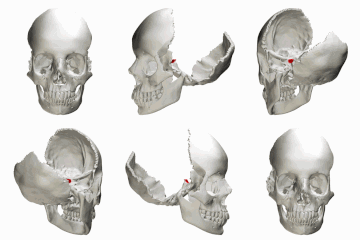
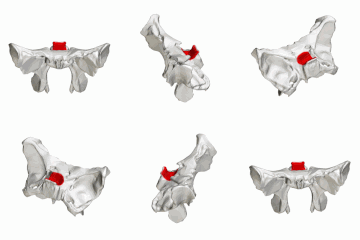
Human skull seen from side (parietal bones and temporal bones have been removed). Sella turcica shown in red.
Sella turcica and pituitary gland.
Details
Identifiers
Latinsella turcica
MeSHD012658
TA98A02.1.05.006
TA2589
FMA54709
Anatomical terms of bone

The sella turcica (Latin for 'Turkish saddle') is a saddle-shaped depression in the body of the sphenoid bone of the human skull and of the skulls of other hominids including chimpanzees, gorillas and orangutans. It serves as a cephalometric landmark. The pituitary gland or hypophysis is located within the most inferior aspect of the sella turcica, the hypophyseal fossa.

Structure

[edit]

The sella turcica is located in the sphenoid bone behind the chiasmatic groove and the tuberculum sellae. It belongs to the middle cranial fossa.[1]

The sella turcica's most inferior portion is known as the hypophyseal fossa (the "seat of the saddle"), and contains the pituitary gland (hypophysis). In front of the hypophyseal fossa is the tuberculum sellae.

Completing the formation of the saddle posteriorly is the dorsum sellae, which is continuous with the clivus, inferoposteriorly. The dorsum sellae is terminated laterally by the posterior clinoid processes.

Development

[edit]

It is widely believed that the development of the diaphragma sellae is a factor which determines the morphology of the sella turcica and its contents.[2]

Function

[edit]

The sella turcica forms a bony seat for the pituitary gland.

Clinical significance

[edit]

Empty sella syndrome is the condition of a shrunken or flattened pituitary gland.

Since the sella turcica forms a bony caudal border for the pituitary gland, a pituitary tumor usually extends upward in the rostral direction into the suprasellar region. This can result in compression of the optic chiasm, which lies on top of the pituitary, enveloping the pituitary stalk. Compression of the optic chiasm can lead to bitemporal hemianopsia, and, when there is no relevant trauma, this clinical finding is pathognomonic for a pituitary tumor.

Some pituitary adenomas can extend inferiorly, growing downward and invading the sphenoid bone and cavernous sinus.[3] Large adenomas can cause remodeling of the underlying sphenoid bone altering the shape of the sella turcica.[citation needed]

Sella turcica is also usually used as a reference point with nasion to establish the base of the skull in cephalometric analysis. This is commonly done prior to orthodontic treatment.[4]

Etymology

[edit]

Sella turcica is from the Latin words sella, meaning seat or saddle, and turcica, meaning Turkish.

See also

[edit]

Additional images

[edit]

References

[edit]
[edit]
Revisions and contributorsEdit on WikipediaRead on Wikipedia
from Grokipedia
The sella turcica (Latin for "Turkish saddle") is a saddle-shaped, saddle-like depression in the body of the sphenoid bone at the base of the skull, serving as a protective bony enclosure for the pituitary gland. Located in the midline of the cranial base, behind the bridge of the nose and inferior to the hypothalamus, it forms a fibro-osseous compartment that anchors the pituitary gland while facilitating its connection to the brain via the infundibulum. This structure is essential for the pituitary's endocrine functions, as it positions the gland in close proximity to the hypothalamic-hypophyseal vascular system for hormone regulation. Anatomically, the sella turcica features distinct boundaries: its anterior wall is formed by the tuberculum sellae, the posterior wall by the dorsum sellae with dorsum sellae clinoid processes, and the inferior margin abuts the sphenoid sinus, while the roof consists of the diaphragma sellae—a thin dural fold with a central aperture allowing passage of the pituitary stalk and vessels. Laterally, it is bordered by the cavernous sinuses, separated by a single layer of meningeal dura, and its typical dimensions include a length of less than 15 mm and a depth of less than 12 mm, though variations exist that can influence surgical approaches. The structure's dural components, including intercavernous venous sinuses below the pituitary, contribute to its vascular integration within the cranial base. Clinically, the sella turcica is significant due to its role in housing the pituitary, making it a common site for pathologies such as adenomas, which can expand and compress adjacent structures like the optic chiasm, leading to visual deficits or hormonal imbalances. Empty sella syndrome, where cerebrospinal fluid herniates into the fossa and flattens the gland, often results from increased intracranial pressure or prior surgery, potentially causing hypopituitarism. Its pneumatization by the sphenoid sinus also enables transsphenoidal surgical access for tumor resection, a standard procedure that leverages the sella's central location.

Anatomy

Location and gross structure

The sella turcica is a saddle-shaped depression located on the superior surface of the body of the , forming the hypophyseal fossa that accommodates the . This structure contributes to the floor of the middle cranial fossa, positioned posterior to the chiasmatic sulcus and anterior to the basilar part of the , where the merges to form the clivus. In adults, the sella turcica typically measures approximately 9-10 mm in anteroposterior length, 10-14 mm in width, and 6-7 mm in depth, based on pooled data from radiographic and cadaveric studies across populations. These dimensions provide a stable bony enclosure, with slight variations influenced by age, sex, and ethnicity, but maintaining a consistent saddle-like contour defined by anterior and posterior elevations. The center of the sella turcica serves as a key cephalometric landmark, denoted as point S in lateral cephalograms, essential for orthodontic and maxillofacial assessments of craniofacial growth and alignment. This structure is conserved across primates, present in humans as well as non-human species such as chimpanzees and gorillas, though comparative morphology reveals differences in depth and angulation related to cranial base flexion and facial projection.

Bony components and boundaries

The sella turcica is primarily formed by the superior surface of the sphenoid bone's body, creating a saddle-shaped depression known as the hypophyseal fossa that accommodates the pituitary gland. This bony structure provides structural containment, with its walls derived from specific projections and plates of the sphenoid. The anterior boundary is defined by the tuberculum sellae, a transverse ridge that protrudes slightly upward and separates the sella from the anterosuperior chiasmatic sulcus, which accommodates the optic chiasm. Posteriorly, the boundary is formed by the dorsum sellae, a quadrilateral bony plate that slopes backward and upward, terminating at the posterior clinoid processes on either side. These posterior clinoid processes serve as attachment points for dural structures. Laterally, the sella is delimited by the anterior and posterior clinoid processes; the anterior clinoid processes project medially from the lesser wings of the sphenoid bone, while the posterior ones arise from the superolateral aspects of the dorsum sellae. These paired processes contribute to the partial enclosure of the sella's roof, which remains incomplete superiorly and is spanned by the diaphragma sellae, a dural fold with a central aperture allowing passage of the pituitary stalk. The floor consists of the central portion of the sphenoid body's superior surface, forming the hypophyseal fossa and overlying the sphenoid sinus. In terms of articulations, the sella turcica integrates seamlessly with the sphenoid body inferiorly, while its lateral aspects relate to the temporal bones through the carotid sulci, shallow grooves on the sphenoid body that house the internal carotid arteries within the cavernous sinuses. This configuration ensures the structural integrity of the region while facilitating neurovascular passage.

Development and variations

Embryonic and fetal development

The sella turcica originates from the cartilaginous precursors of the , specifically through the chondrification of the presphenoid and basisphenoid centers during the 4th to 6th weeks of . Mesenchymal condensations form the presphenoid around the 4th week, contributing to the anterior aspects, while the basisphenoid chondrifies by the 5th week, forming the posterior body that includes the initial depression of the sella turcica. These centers fuse progressively, establishing the saddle-shaped fossa that will house the . Concurrent with sphenoid chondrogenesis, Rathke's pouch plays a key role in shaping the sella turcica by indenting the forming hypophyseal fossa. This ectodermal evagination arises in the 4th week from the roof of the stomodeum, extending toward the neural ectoderm of the diencephalon, and separates from the oral epithelium by weeks 6 to 8, with its anterior wall proliferating to form the adenohypophysis. The pouch's upward growth influences the deepening of the sellar floor, integrating pituitary development with the surrounding cartilaginous framework. The , forming the incomplete roof of the sella turcica, develops from meningeal folds of the around weeks 8 to 10 of gestation. These folds arise from mesenchymal differentiations around the pituitary capsule, which by 12 weeks fully enclose the gland and fuse with the dura to create a partial barrier over the fossa, leaving a central for the infundibulum. This formation helps define the sellar boundaries and protects the developing pituitary from intracranial pressures. During the fetal period, the sella turcica integrates morphologically with facial bones, as evidenced by geometric morphometrics studies showing strong correlations between sellar shape and cranial base growth patterns. Analysis of fetal crania reveals that variations in sella dimensions covary with midfacial development, influenced by shared developmental modules from weeks 12 onward. Early variations, such as incomplete ossification leading to congenital asymmetries, can be observed in fetal imaging and are often linked to genetic disruptions. For instance, in cases of trisomy 18 with holoprosencephaly, asymmetrical lesser wings of the sphenoid result in an incomplete anterior sellar boundary and persistent cartilaginous regions at 28 weeks gestation. Such asymmetries highlight the sensitivity of sellar formation to midline patterning defects during prenatal stages.

Postnatal changes and morphological variations

Following birth, the sella turcica undergoes substantial growth, with its volume increasing significantly during infancy and childhood to 800–1000 mm³ in adults. This expansion occurs gradually during childhood and accelerates during , driven by hormonal influences from the enlarging . In later life, the sella turcica may exhibit age-related morphological flattening, with pituitary atrophy often leading to an empty sella appearance within the stable bony volume. Surgical approaches to the pituitary reveal narrower dimensions in children compared to adults, influencing procedural planning. Morphological variations in the sella turcica include diverse shapes such as oval, round, and flat, with anteroposterior lengths typically ranging from 6 to 13 mm. Bony bridging, characterized by partial or complete osseous connections across the sella, occurs in 2–5% of individuals and may impact adjacent neural structures. Population-based differences are evident, with the sella generally larger in males than females. Ethnic variations exist, such as longer dimensions observed in Caucasian populations compared to others, according to recent meta-analyses. Additionally, correlations have been noted between sella morphology and craniofacial patterns, including calcification, in studies from 2024. These morphological variations hold clinical relevance, as flattened sella forms predispose individuals to conditions like empty sella syndrome.

Function

Mechanical support for the pituitary gland

The sella turcica serves as a bony enclosure for the pituitary gland, specifically housing the adenohypophysis (anterior lobe) and neurohypophysis (posterior lobe) within the hypophyseal fossa of the sphenoid bone. This saddle-shaped depression, bounded anteriorly by the tuberculum sellae, posteriorly by the dorsum sellae, and laterally by dural reflections, prevents displacement of the gland during physiological stresses by providing a fixed, fibro-osseous compartment approximately 8-12 mm in transverse dimension. The pituitary is further protected by the diaphragma sellae, a thin dural fold that forms the roof of the fossa with a central aperture for the infundibulum, separating the gland from the subarachnoid space while allowing cerebrospinal fluid (CSF) circulation nearby. This arrangement, combined with the surrounding dura mater, separates the gland from the subarachnoid space and thereby protects it from direct exposure to cerebrospinal fluid (CSF) and associated pressure fluctuations, while allowing passage of the infundibulum through the central aperture. The surrounding dura mater further reinforces this enclosure. Bony fixation via the sphenoid bone's rigid structure and dural attachments to the anterior and posterior clinoid processes contribute to the pituitary's stability during head movements, anchoring the gland and minimizing shear or translational forces that could disrupt its vascular supply or neural connections. In comparative anatomy, the sella turcica fulfills a similar supportive role in primates, enclosing and stabilizing the pituitary amid evolutionary adaptations such as basicranial flexion, which repositions the gland centrally to accommodate larger brain volumes and enhanced neuroendocrine integration without compromising mechanical protection.

Relations to adjacent neurovascular structures

The sella turcica is situated in close proximity to critical neurovascular structures, influencing its clinical relevance in pathologies involving expansion or invasion. Superiorly, the lies above the , a dural fold that incompletely roofs the sella and permits passage of the ; this arrangement renders the vulnerable to compression from upward expansion of the , such as in macroadenomas. Inferiorly, the floor of the sella turcica directly overlies the sphenoid sinus, facilitating potential transsphenoidal spread of infections or tumors from the sinus into the sellar region, as observed in cases of invasive fungal sinusitis like aspergillosis. Laterally, the sella is bordered by the cavernous sinuses, which house the internal carotid arteries and cranial nerves III (oculomotor), IV (trochlear), V1 (ophthalmic branch of trigeminal), V2 (maxillary branch of trigeminal), and VI (abducens); the anterior and posterior clinoid processes, bony projections of the sphenoid, serve as dural attachments that help define the sinus boundaries and stabilize the surrounding dura mater. Posteriorly, the forms the rear wall of the sella, adjacent to the and the , positioning these structures at risk from posterior sellar expansions. Anteriorly, the tuberculum sellae marks the front of the sella, in relation to the optic nerves and the supraclinoid segments of the internal carotid arteries, which course nearby and can be affected by anterior sellar lesions. Regarding vascular supply, branches from the intracavernous portion of the internal carotid artery contribute to the hypophyseal arteries, which form the pituitary portal system delivering blood to the gland within the sella.

Clinical significance

Associated disorders and pathologies

The sella turcica is implicated in several disorders that directly affect its structure and function, often leading to compression or displacement of the pituitary gland. Empty sella syndrome (ESS) is characterized by partial or complete flattening of the pituitary gland within the sella, resulting in an apparent "empty" appearance on imaging due to herniation of cerebrospinal fluid. This condition is frequently idiopathic in primary ESS, though secondary forms can arise postpartum or following trauma, surgery, or radiation. Common symptoms include chronic headaches from increased intracranial pressure and hormonal deficiencies such as hypopituitarism, affecting growth hormone, thyroid, or gonadotropin secretion. A 2025 cadaveric analysis highlighted the prevalence of endocrine dysfunction in primary ESS cases, with up to 40% showing pituitary hormone deficiencies upon histological examination. Pituitary adenomas represent the most common pathology involving the sella turcica, with macroadenomas (tumors greater than 1 cm) often eroding the sella floor and expanding into adjacent structures, leading to bony remodeling. These macroadenomas can compress the optic chiasm, resulting in bitemporal hemianopsia, a hallmark visual field defect characterized by loss of peripheral vision in both eyes. In contrast, microadenomas (less than 1 cm) typically distort the pituitary shape without causing significant bony changes, often presenting with endocrine hypersecretion rather than mass effect. Macroadenomas often require surgical intervention due to their size and mass effects, and bony remodeling or invasion can occur in invasive cases. Other tumors such as craniopharyngiomas and meningiomas can invade the sella turcica, particularly the dorsum sellae, disrupting pituitary function and nearby neurovascular elements. Craniopharyngiomas, benign epithelial neoplasms arising from Rathke's pouch remnants, frequently extend into the sellar and suprasellar regions, causing calcification and cystic changes that erode bony boundaries. Meningiomas originating from the diaphragma sellae or tuberculum sellae may invade the dorsum sellae, leading to hyperostosis and compression symptoms like headaches or cranial nerve deficits. Rathke's cleft cysts, remnants of embryonic tissue, are another common non-neoplastic sellar lesion that can cause compression symptoms. Infectious processes, including erosions from sphenoid sinusitis, can also degrade the sellar floor through osteomyelitis or abscess formation, often presenting with acute headaches, fever, and visual disturbances. Non-adenomatous tumors account for approximately 10% of sellar region pathologies. Calcification patterns within the sella turcica are associated with craniofacial anomalies, such as skeletal dysplasias, and increase the risk for malocclusion by altering mandibular positioning and dental alignment. A 2024 cross-sectional study of cephalometric radiographs demonstrated that irregular or bridged sella morphologies correlate with Class II and III malocclusions, with calcification prevalence up to 25% higher in affected individuals compared to controls. These patterns may reflect underlying developmental disruptions in the sphenoid bone. Bone remodeling in the sella turcica due to pituitary adenomas involves both hyperostosis and direct invasion, particularly into the clinoid processes, which can complicate surgical access. Adenomas promote osteoclastic activity leading to erosion of the sellar floor and anterior clinoids, while reactive hyperostosis may thicken the dorsum sellae in chronic cases. A 2023 study on invasive pituitary adenomas identified molecular pathways like PKCθ activation as drivers of bony invasion, observed in 15-20% of macroadenomas extending to the clivus or cavernous sinus. Recent imaging analyses post-2011 confirm that such remodeling occurs progressively, with invasion rates increasing with tumor size beyond 2 cm.

Imaging techniques and surgical considerations

Magnetic resonance imaging (MRI) is the gold standard for imaging the sella turcica, providing excellent soft tissue contrast to visualize the pituitary gland's volume, morphology, and relations to surrounding structures. Non-contrast and gadolinium-enhanced sequences, particularly T1-weighted imaging, allow differentiation of the anterior and posterior pituitary lobes, with the anterior lobe appearing isointense on both T1 and T2 sequences. In cases of empty sella syndrome, MRI reveals a flattened or partially absent pituitary appearance within the sella, often confirmed on sagittal views. For pituitary adenomas, dynamic contrast-enhanced MRI using thin-slice T1-weighted sequences post-gadolinium administration highlights hypoenhancing microadenomas, achieving detection rates around 70% for lesions as small as 3 mm. Computed tomography (CT) complements MRI by focusing on bony anatomy, effectively detecting erosion, calcification, and deformities of the sella turcica floor and dorsum sellae, which are critical for preoperative evaluation. High-resolution CT scans delineate the anterior and posterior clinoid processes and sphenoid sinus pneumatization, aiding in surgical trajectory planning. Recent 2025 analyses using CT metrics have quantified sella volume changes, reporting mean volumes of approximately 259 mm³ in children aged 1-18 years, with narrower dimensions in pediatric patients influencing access routes. These measurements support precise assessment of bony remodeling in pathologies like macroadenomas, where erosion may extend to the cavernous sinus. Cephalometry, involving lateral skull X-rays, plays a key role in orthodontic and craniofacial assessments by identifying the sella point—the geometric center of the sella turcica—as a stable cranial landmark for superimposing serial images. This technique evaluates sella morphology variations, such as bridging or elongation, which correlate with dentofacial anomalies like Class III malocclusions, with bridging prevalence up to 10.71% in orthognathic cases. Sella dimensions typically range from 4-12 mm vertically and 5-16 mm anteroposteriorly, aiding diagnosis of growth discrepancies without radiation exposure beyond routine cephalometrics. The transsphenoidal approach remains the preferred surgical route for accessing sella turcica lesions, such as pituitary adenomas, by traversing the sphenoid sinus to avoid brain manipulation, with procedures lasting 2-4 hours under general anesthesia. Endoscopic variants, using a rigid endoscope through one or both nostrils, provide panoramic visualization and reduce nasal complications compared to microscopic techniques, achieving gross total resection in over 80% of cases. Age-related considerations are vital, as 2025 CT studies indicate narrower sella volumes in children (under 300 mm³ pre-puberty), necessitating adjusted instrumentation to mitigate risks like cerebrospinal fluid leaks. Post-2020 advancements enhance precision in sella turcica interventions, including of patient-specific models from CT/MRI data to simulate variations like bridging, reducing operative time and blood loss by up to 20% in pituitary surgeries. Intraoperative navigation integrates neuronavigation with overlays, fusing preoperative images for real-time guidance in distorted , particularly beneficial for bridging cases where bony landmarks are obscured. These tools, validated in endoscopic transsphenoidal procedures, improve outcomes by minimizing vascular risks in the .

History and nomenclature

Etymology

The term sella turcica derives from Latin, where sella means "saddle" or "seat," reflecting the saddle-like depression in the sphenoid bone that accommodates the pituitary gland. The descriptor turcica, meaning "Turkish," alludes to the structure's resemblance to a traditional Turkish saddle, characterized by a high front pommel (corresponding to the tuberculum sellae) and rear cantle (corresponding to the dorsum sellae), which provided secure seating for riders during the Ottoman era. This nomenclature was formalized in the 17th century by the Flemish anatomist Adrianus Spigelius (1578–1625) in his work De humani corporis fabrica libri decem (published posthumously in 1627), amid efforts to standardize anatomical terminology based on descriptive morphology. Earlier descriptions of the structure appeared in Andreas Vesalius's De humani corporis fabrica (1543), but without the specific "sella turcica" designation. Historically, alternative terms emphasized the region's functional role in housing the pituitary gland, such as pituitary fossa or hypophyseal fossa, which highlight its enclosure of the hypophysis rather than its shape. Other early variants included sella ephippi, sphenoidis sella, and sella equine, drawing on general saddle analogies without the Turkish specificity.

Historical anatomical descriptions

The earliest known anatomical references to the region of the sella turcica date back to the ancient physician Galen in the 2nd century AD, who vaguely described the sphenoid bone area as housing glandular structures involved in the drainage of cerebral residues, likening the pituitary to a receptacle for "phlegm of the brain" without precise delineation of the saddle-like depression. Galen's observations, based on animal dissections, portrayed the sella turcica as a perforated structure through which blood vessels allegedly transported pituitary secretions, a concept that influenced medical thought for centuries. During the Renaissance, Andreas Vesalius provided a more accurate illustration and description of the sphenoid saddle in his seminal 1543 work De humani corporis fabrica, depicting it as a saddle-shaped cavity suitable for enclosing the pituitary gland. The term "sella" was introduced by Realdo Colombo in 1559, and "sella turcica" was later coined by Spigelius in 1627 to reflect its resemblance to a Turkish saddle. This representation marked a shift toward human-based anatomy, correcting Galenic errors and emphasizing the structure's role in supporting glandular elements, though Vesalius still adhered to humoral theories regarding its function. In the 19th century, clinicians like Pierre Marie advanced recognition of the sella turcica's clinical relevance by linking its enlargement to pituitary pathology in acromegaly, as detailed in his 1886 publications where he described cases with expanded sella due to pituitary tumors, proposing the condition as a distinct disorder involving glandular hypertrophy secondary to osseous changes. Marie's observations, drawn from autopsies, highlighted the sella's enclosure of the pituitary as central to endocrine disturbances, paving the way for surgical interest in the region. The 20th century brought transformative visualization techniques with Wilhelm Conrad Roentgen's discovery of X-rays in 1895, which enabled non-invasive imaging of the sella turcica and revealed enlargements or erosions associated with pituitary tumors for the first time. Building on this, early endocrine studies in the , led by figures like Harvey Cushing, emphasized the sella's functional enclosure of the pituitary as a master regulator of hormonal secretion, integrating anatomical findings with emerging to underscore its role in systemic disorders. Historical reviews have noted limited attention to morphological variations of the sella turcica prior to 2020, with pre-2020 literature focusing primarily on adult pathology rather than developmental aspects; however, 2024 studies have highlighted previously overlooked fetal integration patterns, revealing coordinated growth between the sella and facial bones through geometric morphometric analysis.

References

Add your contribution
Related Hubs
User Avatar
No comments yet.