


Community hub
0 subscribers8 pages, 0 posts
Recent from talks
All channels
Be the first to start a discussion here.
Be the first to start a discussion here.
Be the first to start a discussion here.
Be the first to start a discussion here.
Contribute something
Welcome to the community hub built to collect knowledge and have discussions related to Surface ectoderm.
Nothing was collected or created yet.
Surface ectoderm
View on Wikipediafrom Wikipedia
 | This article may be too technical for most readers to understand. (February 2024) |
| Surface ectoderm | |
|---|---|
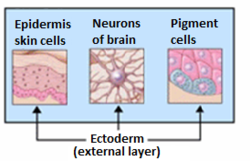
 Organs derived from ectoderm. | |
| Details | |
| Precursor | Ectoderm |
| Identifiers | |
| FMA | 87656 |
| Anatomical terminology | |
The surface ectoderm, AKA external ectoderm, is one of the two early embryonic divisions of the ectoderm. The other early division of the ectoderm is the neuroectoderm.
The surface ectoderm develops into the following structures:
- Skin (only the epidermis; the dermis is derived from the mesoderm) (along with glands, hair, and nails)
- The epithelium of the mouth and nasal cavity
- The glands of the mouth and nasal cavity, namely the saliva glands and the mucosal glands
- Tooth enamel (as a side note, dentin and dental pulp are formed from the ectomesenchyme, which is derived from the neuroectoderm (specifically neural crest cells, and it travels with mesenchymal cells)
- The epithelium of the anterior pituitary gland
- The lens, cornea, lacrimal gland, tarsal glands, and the conjunctiva of the eye
- The apical ectodermal ridge, which induces the development of the limb buds of the embryo
See also
[edit]References
[edit] This article incorporates text in the public domain from the 20th edition of Gray's Anatomy (1918)
External links
[edit]- https://web.archive.org/web/20071213145329/http://cwx.prenhall.com/bookbind/pubbooks/martini10/chapter18/custom3/deluxe-content.html
- Coad, Jane; Dunstall, Melvyn (2001). Anatomy and physiology for midwives. Edinburgh; New York: Mosby. ISBN 0723429790.

 | This anatomy article is a stub. You can help Wikipedia by expanding it. |