
Hubbry Logo
Thermal ionizationThermal ionizationMain
Open search
Thermal ionization
Community hub
Thermal ionization
logo
7 pages, 0 posts
0 subscribers
Be the first to start a discussion here.
Thermal ionization
Thermal ionization
from Wikipedia

Thermal ionization, also known as surface ionization or contact ionization, is a physical process whereby the atoms are desorbed from a hot surface, and in the process are ionized.

Thermal ionization is used to make simple ion sources, for mass spectrometry and for generating ion beams.[1] Thermal ionization has seen extensive use in determining atomic weights, in addition to being used in many geological/nuclear applications.[2]

Physics

[edit]
Surface ionization effect in a vaporized cesium atom at 1500 K, calculated using a grand canonical ensemble. Y-axis: average number of electrons on the atom; the atom is neutral when it has 55 electrons. X-axis: energy variable (equal to the surface work function) dependent on electron chemical potential μ and electrostatic potential ϕ.

The likelihood of ionization is a function of the filament temperature, the work function of the filament substrate and the ionization energy of the element.

This is summarised in the Saha–Langmuir equation:[3]
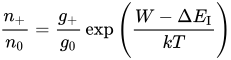
where

= ratio of ion number density to neutral number density
= ratio of statistical weights (degeneracy) of ionic (g+) and neutral (g0) states
= work function of surface
= ionization energy of desorbed element
= Boltzmann constant
= surface temperature

Negative ionization can also occur for elements with a large electron affinity against a surface of low work function.

Thermal ionization mass spectrometry

[edit]

One application of thermal ionization is thermal ionization mass spectrometry (TIMS). In thermal ionization mass spectrometry, a chemically purified material is placed onto a filament which is then heated to high temperatures to cause some of the material to be ionized as it is thermally desorbed (boiled off) the hot filament. Filaments are generally flat pieces of metal around 1–2 mm (0.039–0.079 in) wide, 0.1 mm (0.0039 in) thick, bent into an upside-down U shape and attached to two contacts that supply a current.

This method is widely used in radiometric dating, where the sample is ionized under vacuum. The ions being produced at the filament are focused into an ion beam and then passed through a magnetic field to separate them by mass. The relative abundances of different isotopes can then be measured, yielding isotope ratios.

When these isotope ratios are measured by TIMS, mass-dependent fractionation occurs as species are emitted by the hot filament. Fractionation occurs due to the excitation of the sample and therefore must be corrected for accurate measurement of the isotope ratio.[4]

There are several advantages of the TIMS method. It has a simple design, is less expensive than other mass spectrometers, and produces stable ion emissions. It requires a stable power supply, and is suitable for species with a low ionization energy, such as strontium and lead.

The disadvantages of this method stem from the maximum temperature achieved in thermal ionization. The hot filament reaches a temperature of less than 2,500 °C (2,770 K; 4,530 °F), leading to the inability to create atomic ions of species with a high ionization energy, such as osmium and tungsten. Although the TIMS method can create molecular ions instead in this case, species with high ionization energy can be analyzed more effectively with MC-ICP-MS.[citation needed]

See also

[edit]

References

[edit]
Revisions and contributorsEdit on WikipediaRead on Wikipedia
from Grokipedia
Thermal ionization is a physical process whereby atoms or molecules acquire sufficient to lose one or more electrons, forming positively charged ions and free electrons, typically occurring in high-temperature environments such as gases, plasmas, or on heated surfaces. In gaseous media under local , this process is governed by the Saha equation, which quantifies the ionization balance as ni+1neni=2gi+1gi(2πmekTh2)3/2eχi/kT\frac{n_{i+1} n_e}{n_i} = \frac{2 g_{i+1}}{g_i} \left( \frac{2\pi m_e k T}{h^2} \right)^{3/2} e^{-\chi_i / kT}, where nin_i and ni+1n_{i+1} are the number densities of the ith and (i+1)th states, nen_e is the , gg represents statistical weights, mem_e is the , kk is Boltzmann's constant, TT is , hh is Planck's constant, and χi\chi_i is the . This equilibrium is crucial in for modeling stellar atmospheres, where temperatures above approximately 10,000 K lead to significant of elements like ( 13.6 eV). A distinct form, known as surface or contact thermal ionization, involves the desorption and ionization of atoms from a hot metal surface, such as a tungsten or rhenium filament, where atoms with low ionization potentials (e.g., alkali metals) are selectively ionized if the surface's work function exceeds the atom's ionization energy, following the Langmuir-Saha relation. This method achieves high ionization efficiencies for elements like rubidium, strontium, and neodymium, often exceeding 1% for favorable cases. It is widely applied in thermal ionization mass spectrometry (TIMS), enabling precise isotopic ratio measurements for geochronology and trace element analysis, with instruments capable of detecting femtogram-level samples. Key aspects of thermal ionization include its dependence on , which determines the Boltzmann factor eχ/kTe^{-\chi / kT} driving the exponential increase in ionization fraction, and density effects that influence collision rates and equilibrium shifts. In non-equilibrium conditions, such as in partially ionized plasmas, additional processes like collisional or may dominate, but thermal mechanisms remain foundational for understanding high-energy density physics in stars, laboratory plasmas, and analytical instruments.

History

Early Observations

In the early-to-mid-19th century, experiments on in flames and heated gases revealed the presence of charged particles produced by . Scientists such as Jean-Charles de la Rive, conducting studies in the and , observed that flames containing salts exhibited electrical conductivity, suggesting the dissociation of neutral molecules into ions under thermal conditions. These observations were extended in the late through investigations of electrical effects near hot bodies, where insulated plates exposed to heated wires in gases acquired charges whose polarity depended on and . During the 1890s, J.J. Thomson's work with cathode ray tubes demonstrated electrical conductivity in hot vapors, attributing it to the production of ions by the passage of rays through rarefied gases at elevated temperatures. Thomson noted that the conductivity increased with heat, as the rays ionized the gas, allowing current to flow more readily. These findings highlighted the role of in generating charge carriers within vapors. In the early 1900s, studies on vapors confirmed a direct correlation between temperature and production. Experiments showed that vapors of elements like sodium and exhibited enhanced ionization as temperatures rose, with hot filaments in these vapors emitting electrons that increased conductivity. A key advancement came in 1903 when J.J. Thomson performed the first quantitative measurements of ionization in vapors such as sodium, determining the degree of dissociation into ions as a function of temperature and pressure, which provided empirical data on thermal effects in low-ionization-potential metals. These empirical discoveries were later rationalized by the as a theoretical framework for equilibrium ionization.

Development of Theory

The development of the theoretical framework for thermal ionization emerged in the early 20th century, building on empirical observations of spectral lines in stellar atmospheres that suggested varying degrees of gas ionization with temperature. These early findings provided the impetus for theorists to seek a quantitative explanation, shifting from classical thermodynamic models to those incorporating emerging quantum principles. Max Planck's foundational work on quantum theory, particularly his 1900 derivation of the blackbody radiation law, initiated the quantum revolution and provided indirect underpinnings through the concept of discrete energy quanta, which later enabled quantum statistical mechanics for atomic systems. This approach, building on Ludwig Boltzmann's statistical mechanics, allowed for the calculation of partition functions and probability distributions in thermal systems, replacing earlier classical approximations that failed to account for atomic excitation and ionization accurately. In 1920, published his seminal paper "Ionisation in the Solar Chromosphere" in the , applying quantum statistics to derive a relation between temperature, pressure, and the state of elements in stellar atmospheres. Saha's work, followed by two additional papers in the same journal through February 1921, integrated ionization potentials from experiments like those of Franck and Hertz with the Sackur-Tetrode equation for quantum , marking a pivotal transition to quantum mechanical explanations of thermal . This framework explained the observed strengths and gradients in , revolutionizing . Although initially underappreciated in Western scientific circles, Saha's contributions gained prominence through subsequent refinements. Refinements to Saha's theory appeared in 1923, notably through Edward Milne's collaboration with Ralph Fowler, who provided a more rigorous statistical mechanical derivation and addressed applications to stellar reversing layers in their Monthly Notices of the Royal Astronomical Society papers. These works clarified the role of pressures and partition functions in equilibria, enhancing the of the model for high-temperature gaseous environments and helping to popularize the theory in .

Fundamentals

Definition and Principles

Thermal ionization refers to the process in which neutral atoms or molecules acquire sufficient to lose one or more electrons, forming ions and free electrons. This can occur in high-temperature gaseous or plasma environments through collisional excitation driven solely by , without the involvement of external , , or other non-thermal mechanisms. In such media, fast-moving particles—predominantly electrons—collide with neutral , transferring sufficient to eject bound electrons if the energy exceeds the ionization potential of the atom or molecule. This results in the formation of a partially or fully ionized gas, often termed a thermal plasma, where the arises from the thermal agitation of the particles. A complementary mechanism, surface thermal ionization, occurs when atoms or molecules adsorb onto a hot metal surface (e.g., or filament) and, upon desorption, ionize if the surface exceeds the atom's , as described by the Langmuir-Saha relation. This selectively ionizes elements with low ionization potentials, such as alkali metals. The underlying principles for gaseous thermal ionization stem from the statistical distribution of particle energies in the system, governed by the Maxwell-Boltzmann distribution, which describes the probability of particles possessing energies high enough to overcome the ionization energy barrier. At elevated temperatures, the high-energy tail of this distribution enables a fraction of s to achieve velocities corresponding to energies greater than the ionization potential (typically several volts), facilitating electron-impact ionization collisions. The , defined as the fraction of neutral particles that have been ionized (often denoted as α), increases with temperature and depends on the specific atomic species; for example, alkali metals like sodium or , with low ionization potentials around 4–5 eV, exhibit significant ionization at temperatures exceeding 2000 K. This process establishes between ions, electrons, and neutrals. Key concepts in thermal ionization include single-stage ionization, where only one electron is removed to form singly charged ions, and multiple ionization stages, involving sequential removal of additional electrons to produce higher charge states (e.g., M → M⁺ → M²⁺), which require progressively higher temperatures to achieve appreciable fractions. The overall ionization level remains a dynamic balance influenced by recombination processes, but the net effect is a quasineutral plasma where positive ions and electrons coexist in equal numbers, enabling collective behaviors characteristic of plasmas.

Ionization Mechanisms

Thermal ionization occurs through microscopic processes where facilitates the removal of electrons from atoms or ions, primarily via collisional and excitation pathways. In collisional , a free electron collides with a neutral atom, transferring sufficient in an to exceed the atom's potential, thereby ejecting a bound and creating an ion- pair. For instance, the potential of sodium is 5.139 eV, meaning the incident must impart at least this energy for to occur. The detailed steps in collisional ionization involve the approaching free electron interacting with the target's outer electrons via forces, leading to energy redistribution where the bound gains enough to escape the atomic potential. This process is more efficient in plasmas with sufficient electron temperatures, as higher thermal velocities increase collision rates. Another key mechanism is thermal excitation to Rydberg states—highly excited states with large principal quantum numbers—followed by autoionization, where the atom spontaneously decays into an ion and due to configuration interaction. Rydberg states are populated through thermal collisions or radiative processes, and their proximity to the ionization continuum (with energies just below the ionization potential) enables rapid autoionization lifetimes on the order of nanoseconds. Ionization can proceed via direct or stepwise paths: direct ionization removes an electron from the in a single collision exceeding the full ionization potential, while stepwise ionization involves initial excitation to an intermediate state (lowering the effective potential for the second step) before further collision or autoionization. Stepwise processes dominate in environments with abundant excited states, such as moderately dense thermal plasmas. In rarefied gases, where particle densities are low, direct collisional ionization prevails due to infrequent interactions, leading to slower overall ionization rates. Conversely, in dense plasmas, stepwise mechanisms and enhanced collisions amplify , though high electron densities promote three-body recombination, where an ion-electron pair captures a third body to stabilize, countering net . These mechanisms collectively determine the , which can be quantified using tools like the Saha equation.

Theoretical Framework

Saha Ionization Equation

The provides a fundamental relation for determining the in a gas or plasma under local (LTE), linking the number densities of successive stages to temperature and . Derived from principles of , it equates the chemical potentials of neutral and ionized species, assuming Maxwell-Boltzmann statistics for the particles involved. The equation is particularly useful for systems where thermal collisions dominate the process, such as in stellar atmospheres or laboratory plasmas. The standard form of the Saha equation for the transition from the ii-th ionization stage to the (i+1)(i+1)-th stage is ni+1neni=2gi+1gi(2πmekTh2)3/2exp(IikT),\frac{n_{i+1} n_e}{n_i} = \frac{2 g_{i+1}}{g_i} \left( \frac{2\pi m_e k T}{h^2} \right)^{3/2} \exp\left(-\frac{I_i}{k T}\right), where ni+1n_{i+1} and nin_i are the number densities of ions in the (i+1)(i+1)-th and ii-th stages, respectively; nen_e is the electron number density; gi+1g_{i+1} and gig_i are the statistical weights (or ground-state degeneracies) of the respective ions; mem_e is the electron mass; kk is Boltzmann's constant; TT is the temperature; hh is Planck's constant; and IiI_i (or χi\chi_i) is the ionization energy from the ii-th to the (i+1)(i+1)-th stage. In cases where full partition functions Ui+1U_{i+1} and UiU_i are used instead of degeneracies gg, the factor 2gi+1/gi2 g_{i+1}/g_i generalizes to 2Ui+1/Ui2 U_{i+1}/U_i, accounting for all accessible quantum states. The derivation begins by considering the ionization reaction Xi+eXi+1X_i + e^- \rightleftharpoons X_{i+1}, where and reverse rates balance in equilibrium. Using the , the population ratio between states is proportional to exp(ϵ/kT)\exp(-\epsilon / kT), with ϵ\epsilon as the energy difference. For the ionized state, the electron contributes a translational partition function derived from the volume, yielding the quantum concentration (2πmekT/h2)3/2(2\pi m_e k T / h^2)^{3/2}, while the factor of 2 accounts for the electron's spin degeneracy. The exponential term exp(Ii/kT)\exp(-I_i / k T) arises from the energy cost of ionization, dominating the temperature dependence. This approach assumes the ions behave as ideal gases, with the total partition function separating into internal and translational parts. Key assumptions underlying the equation include LTE, where the ionization temperature equals the electron temperature; negligible interactions between particles ( approximation); and neglect of radiative processes or external fields that could disrupt equilibrium. These hold well for dilute, thermally isolated systems but require modifications in denser environments. The original formulation was introduced by in 1920 to explain strengths in stellar spectra. In high-density plasmas, where Coulomb interactions become significant, corrections to the Saha equation account for non-ideal effects, such as lowering the effective ionization potential through screening or ionization. These modifications, often incorporated via terms like exp(Δ/kT)\exp(\Delta / kT) where Δ\Delta is the potential depression, extend the equation's validity to regimes like inertial confinement fusion plasmas.

Equilibrium and Influencing Factors

In thermal plasmas, ionization equilibrium is established when the rate of collisional balances the rate of recombination processes, particularly three-body recombination where two electrons and an ion collide to form a neutral atom and a free electron. This balance ensures a steady-state ionization fraction, governed by the principle of under local (LTE). The serves as the foundational relation for quantifying this equilibrium in terms of particle densities and temperatures. Key factors influencing the equilibrium include , which drives an exponential increase in the fraction due to the Boltzmann factor in rates, making higher temperatures favor ionized states even at moderate densities. affects the balance through the , where higher electron densities enhance recombination rates, thereby reducing the overall fraction for a given . influences density ratios, with lower pressures in low-density gases promoting higher fractions by diminishing three-body recombination , as fewer collisions occur per unit volume. The fraction is commonly defined as α=nene+nn\alpha = \frac{n_e}{n_e + n_n}, where nen_e is the and nnn_n is the neutral density, providing a measure of the plasma's state. In non-equilibrium plasmas, deviations from LTE arise when ionization and recombination timescales differ, often due to rapid expansions or external perturbations, leading to over- or under-ionization relative to predictions. For instance, lowering pressure in low-density gases, such as in rarefied atmospheric layers, can shift the equilibrium toward higher α\alpha by reducing collisional de-excitation.

Experimental Techniques

Ionization Sources

Thermal ionization sources in laboratory settings primarily consist of resistively heated filaments and oven-style vaporizers designed to volatilize and ionize samples under controlled high-temperature conditions. Resistively heated filaments, typically constructed from high-melting-point metals such as or wires formed into coils or ribbons, operate at temperatures ranging from 1000 to 2500 K to facilitate the desorption and ionization of atomic species. These filaments are favored for their properties and ability to withstand prolonged heating without deformation. Operational protocols for these sources emphasize precise sample preparation and environmental control to optimize ionization. Samples are typically loaded onto filaments as purified salt solutions, which are pipetted directly onto the heated surface after solvent evaporation, or mixed with activators like silica gel to enhance ion emission by lowering the effective work function of the surface. Vacuum conditions, usually below 10^{-7} Torr, are maintained to prevent ion recombination with electrons and to ensure a collision-free path for the generated ions toward the analyzer. Temperature is regulated via resistive current to achieve ionization efficiencies typically ranging from 0.1% to several percent, depending on the element's ionization potential and surface conditions, as predicted by the Langmuir-Saha equation for thermal equilibrium. Filament burnout remains a practical challenge, with rhenium filaments often lasting only a few hours of continuous operation at peak temperatures due to oxidation or mechanical stress, necessitating frequent replacement. Design considerations for these sources prioritize stability and integration with downstream . Electron emission from the filaments, which aids positive formation, generates currents in the range of 10^{-12} to 10^{-9} A, ensuring low-noise s suitable for high-precision . Safety protocols include shielding to manage radiative and electrical isolation to prevent arcing in the , while the sources are engineered for seamless coupling to mass spectrometers via electrostatic lenses that focus the without introducing aberrations.

Thermal Ionization Mass Spectrometry

Thermal ionization (TIMS) is an analytical technique that combines thermal ionization as a sample source with magnetic sector to achieve high-precision measurements of ratios. In this method, samples are vaporized and ionized by heating a thin metal filament, typically or , under high conditions, producing positively or negatively charged ions depending on the element. These ions are then extracted, accelerated to energies around 10 kV, formed into a focused beam, and separated based on their in a magnetic sector analyzer before detection, often using a multicollector system for simultaneous monitoring. The technique was developed in the 1940s by physicist A.O.C. Nier at the , who designed key sector field mass spectrometers incorporating thermal ionization sources for precise isotope abundance measurements, including critical work on isotopes during the . The procedure begins with meticulous sample preparation to ensure purity, such as dissolving geological or environmental samples and using liquid chromatography in a Class 100-1000 clean laboratory to chemically separate target elements like , lead, or . Isotopic tracers are often added during this stage to quantify concentrations and correct for . The purified elements are then loaded as microliter volumes of acid solution onto pre-cleaned filaments, which are assembled into an and heated stepwise—first to dry the sample, then to 1000–2000°C for gradual and —producing a stable for analysis. Ion extraction and focusing occur via electrostatic lenses, enabling near 100% transmission efficiency to the detector. TIMS offers exceptional advantages for isotope ratio analysis, including precision as low as 0.001% for ratios like ^{87}Sr/^{86}Sr in the Rb-Sr method, and detection limits down to 10^{-12} g for elements with favorable ionization efficiencies, such as and alkaline earth metals. Its stable, low-emission minimizes background noise, supports multi-filament configurations for sequential of multiple elements on a single sample (e.g., Rb and Sr), and allows for high-throughput measurements. However, limitations include isobaric interferences from ions of similar mass-to-charge ratios, which necessitate highly pure samples to avoid overlap, and low overall efficiencies typically below 1%, restricting its use to elements with low first ionization potentials. Additionally, continuous mass-dependent during evaporation requires correction, often limited to elements with at least three isotopes for accurate normalization.

Applications

In Analytical Chemistry

Thermal ionization plays a central role in through thermal ionization (TIMS), which enables high-precision isotopic analysis for quantification and age determination, particularly in and . This technique measures isotope ratios of elements like U, Pb, Re, Os, and Sr with accuracies of 0.01-0.001%, allowing researchers to resolve subtle variations in natural samples for and tracer studies. In environmental monitoring, TIMS quantifies such as Pu in to assess exposure levels. Key applications include U-Pb dating of crystals, which provides precise ages for igneous and metamorphic events spanning to timescales, often achieving sub-per mil precision via TIMS (ID-TIMS). For ore deposits, Re-Os isotope analysis of molybdenite dates mineralization events and traces geochemical reservoirs, as and isotopes accumulate in minerals over geological time. In forensics, lead isotope ratios measured by TIMS link bullet fragments to sources or victims by matching signatures from environmental or manufacturing origins, serving as the standard for high-precision ratio determination. Compared to (ICP-MS), TIMS offers superior precision and lower mass fractionation for isotopic ratios, though ICP-MS is faster with simpler sample preparation. methods, such as (U-Th)/He , complement TIMS by providing insights into kinetics and closure temperatures, enabling integrated studies of histories. Precision in TIMS advanced significantly in the with the introduction of multi-collector systems, which allowed simultaneous ion detection and reduced errors to levels enabling millennial-scale resolution in . As of 2025, new developments like double-focusing TIMS further enhance system stability and precision for isotopic measurements. Sample requirements are typically on the order of micrograms to milligrams of purified material, loaded as ~10 μL aqueous solutions onto heated filaments for .

In Astrophysics and Plasma Physics

In astrophysical environments, thermal ionization is crucial in hot, dense regions under local , such as stellar atmospheres and the solar corona, where it determines the ionization balance via the Saha equation. Saha-Boltzmann plots, combining ionization and excitation equilibria, serve as diagnostic tools for temperature estimation in these astrophysical plasmas by plotting logarithmic ratios of line intensities against energy levels, yielding slopes inversely proportional to temperature. In the solar corona, thermal ionization results in fully ionized at temperatures exceeding 10^6 K, with also largely stripped of electrons, facilitating efficient radiation transport through low opacity dominated by . This high ionization state enhances coronal transparency to X-rays, allowing observations of solar flares and coronal mass ejections. Recent applications include modeling thermal ionization in ultra-hot atmospheres, aiding interpretation of JWST spectra. However, modeling partially ionized zones in atmospheres presents challenges, as rapid variations in ionization fractions lead to steep gradients in equations of state and opacities, complicating simulations of convective layers and pulsation modes. In plasma physics, particularly in controlled fusion devices, thermal ionization governs the behavior of edge plasmas in tokamaks, where temperatures near 10^6 K produce partially ionized regions critical for particle and heat transport. In these scrape-off layers, neutral atoms from wall interactions undergo thermal ionization, influencing plasma stability and edge-localized modes that can damage reactor components. For inertial confinement fusion diagnostics, ionization balances in hohlraum plasmas are probed via X-ray spectra from highly ionized species, providing insights into temperature and density profiles during implosions. Thermal ionization also affects opacity in these systems, modulating radiation transport and energy deposition, with higher ionization reducing bound-free absorption and enhancing overall plasma efficiency.

References

Add your contribution
Related Hubs
User Avatar
No comments yet.