Hubbry Logo
Susan FenigerSusan FenigerMain
Open search
Susan Feniger
Community hub
Susan Feniger
logo
8 pages, 0 posts
0 subscribers
Be the first to start a discussion here.
Susan Feniger
Susan Feniger
from Wikipedia

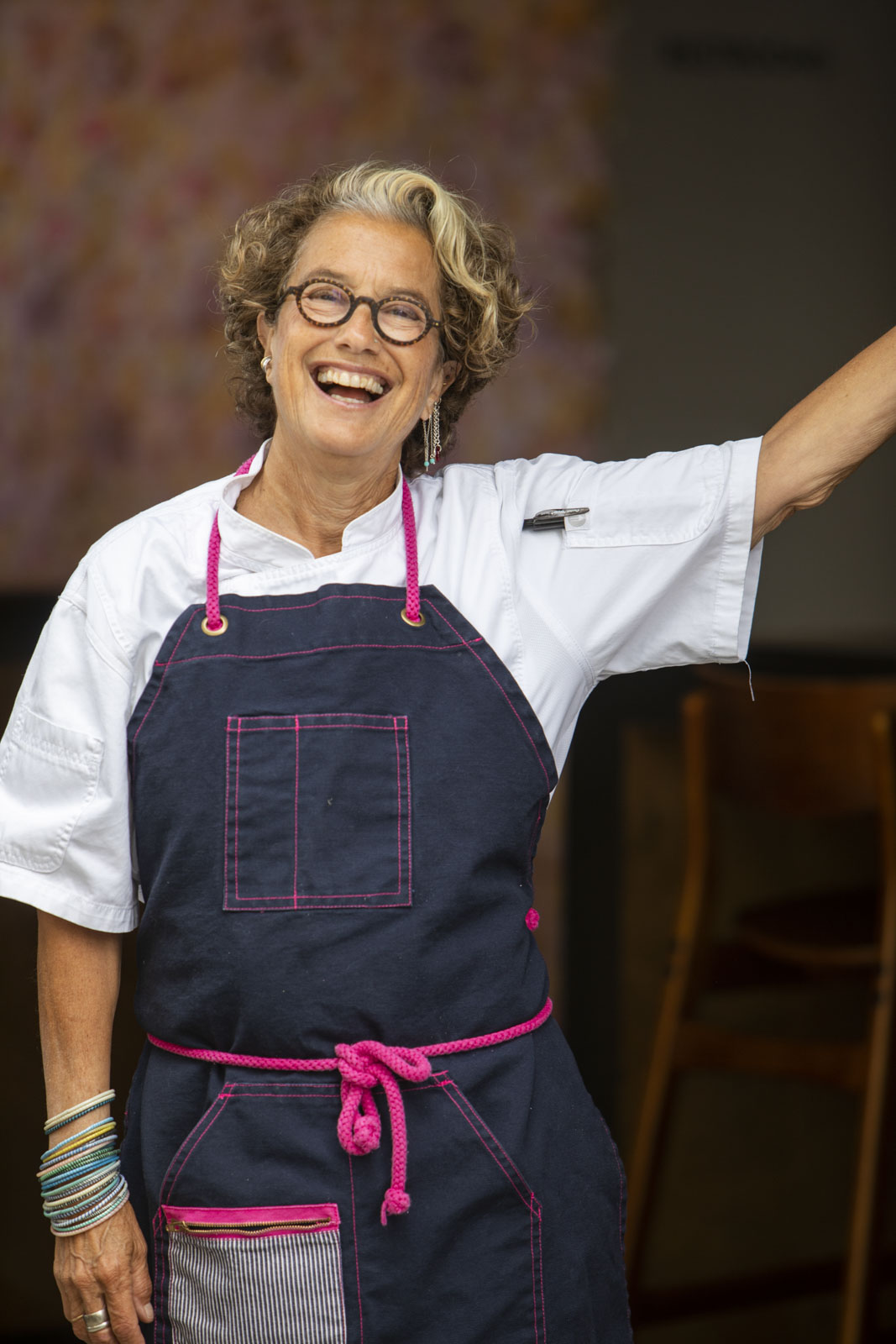
Susan Feniger is an American chef, restaurateur, cookbook author, and radio and TV personality. She is known for starring in the cooking show Too Hot Tamales on the Food Network and opening several influential restaurants in Los Angeles. She has been awarded a Lifetime Achievement Award by the California Restaurant Association.

Key Information

Early life and education

[edit]

Feniger is from Toledo, Ohio, and is the daughter of Ruth Alice and Yale Feniger.[1] She was raised in a Jewish home.[2] Feniger graduated from Pitzer College in 1976.

Career

[edit]

Restaurants

[edit]

After working together in Chicago and Paris, Feniger and her longtime collaborator, Mary Sue Milliken, settled in Los Angeles where they founded City Cafe in 1981. They eventually expanded to a larger space on La Brea Blvd. and renamed the establishment City Restaurant. In 1985, they opened the Mexican restaurant Border Grill in the original City Cafe space, before moving it to Santa Monica in 1990. The restaurant later expanded to Pasadena (closed) and the Mandalay Bay Resort in Las Vegas. Broadening their culinary horizons Feniger and her partner opened the Latin flavor restaurant Ciudad (now a Border Grill) in Los Angeles in 1998. The success of the three restaurants led Feniger and Milliken to be recognized for changing Los Angeles's culinary landscape.[3] Feniger has been influenced by the food and culture of various nations, such as India, France, and Mexico.[4]

In April 2009, Feniger opened her first solo project: Street, a multi-ethnic eatery of "street food" in Hollywood. Sample dishes included millet puffs, paani puri, Massaman chicken curry, dumplings, Egyptian-style baked fish and peanut butter cookies for dessert.[5][6] Street closed in November 2013.

In December 2013, Feniger, with Executive Chef and Partner Kajsa Alger, opened Mud Hen Tavern at the former location of Street. A neighborhood bar and restaurant, it offered seasonal, gourmet pub and comfort food in a warm and relaxed setting. The bar team in partnership with mixology consultant Tricia Carr (formerly Alley), curated a beverage program that offered a vibrant and accessible selection of international wines, local craft beers and artisanal cocktails to complement Mud Hen Tavern's cuisine. Mud Hen Tavern closed on October 11, 2016.[7]

In December 2019, Feniger and Milliken opened the Mexican restaurant Socalo in Santa Monica. The name is derived from the words "SoCal" and zócalo, or “town square” in Spanish.[8]

In December 2023, Feniger and Milliken opened the restaurant Alice B. in Palm Springs, which has a focus on seasonal bounty, French, and Mediterranean influences.[9] The restaurant is named after Alice B. Toklas, partner of Gertrude Stein, and is part of Living Out, a luxury apartment complex for LGBTQIA+ adults.[10]

Publishing, television, and film

[edit]

In collaboration with Milliken and others, Feniger has published five cookbooks: City Cuisine (1989), Mesa Mexicana (1994), Cantina: The Best of Casual Mexican Cooking (Casual Cuisines of the World) (1996), Cooking with Too Hot Tamales (1997) and Mexican Cooking for Dummies (1999/2002).[11]

Feniger is also a TV personality, starring with Milliken in 396 episodes of the popular Too Hot Tamales and Tamales World Tour on the Food Network in the 1990s. Prior to the shows on the Food Network, in 1993 Feniger and Milliken appeared with Julia Child in her PBS series Cooking with Master Chefs.[12] Feniger has also appeared on Sabrina, the Teenage Witch[13] and prepared with Milliken the food that was served in the 2001 movie, Tortilla Soup.[14]

Most recently, Feniger appeared on the second season of Top Chef Masters that aired in 2010. She was the last female chef in the competition, eliminated following a challenge to create a dish fit for the gods. Feniger's creation for Aphrodite was Kaya toast served with a soy-glazed egg and coconut jam.[15] She raised $32,500 for The Scleroderma Research Foundation. "It's an honor to be on that show and have Schleroderma [sic] Research Foundation out there in the public eye," she said in an interview with SlashFood. "I've gotten so many email messages and Facebook messages from all over the country. So for me, I'm totally the winner in this."[16]

In 2011, ABC bought the rights to develop a sitcom based on the lives of Feniger and Milliken,[17] but it never aired.

In April 2013, she appeared as herself in the Bones episode "The Maiden in the Mushrooms".[18]

In October 2014, Feniger appeared as a contestant in the "Superstar Sabotage" tournament of Cutthroat Kitchen.[19] She also appeared as a guest judge in Episode 15 of Hell's Kitchen (Season 19) which was aired in April 2021.[20][21]

Awards and honors

[edit]

The Smithsonian's National Museum of American History houses small dishes from Feniger and Milliken's City Café in Los Angeles, California, their first restaurant that opened in 1981.[22] In 2013, Feniger was awarded the Elizabeth Burns Lifetime Achievement Award by the California Restaurant Association.[23] She was the co-recipient of the 2018 Julia Child Award from The Julia Child Foundation for Gastronomy and the Culinary Arts.[24][25]

Personal life

[edit]

Feniger was a founding board member of the Scleroderma Research Foundation and has served on the organization's board since 1988.[26]

Feniger serves on the board of the Los Angeles LGBT Center.[27] She is a lesbian and her partner is Liz Lachman.[13][28] Feniger's ex-husband, Josh Schweitzer, is married to her business partner Mary Sue Milliken.[29]

Her nephew is actor Ben Feldman, who is the step-son of her sister.[30]

References

[edit]
[edit]
Revisions and contributorsEdit on WikipediaRead on Wikipedia
from Grokipedia
Susan Feniger is an American chef, restaurateur, cookbook author, and television personality renowned for advancing global and Mexican-inspired cuisines in . She graduated from in 1977 and began her career working at notable establishments including Le Perroquet in and Ma Maison under in . In partnership with Mary Sue Milliken, Feniger co-founded City Café in 1981 and CITY restaurant in 1985, establishing their reputation for innovative, border-crossing flavors. The duo later launched Border Grill, a flagship Modern Mexican concept with locations in Los Angeles and Las Vegas, alongside ventures like Socalo, Alice B. Toklas Bakery, BBQ Mexicana, and Pacha Mamas. They co-authored six cookbooks, including Susan Feniger’s Street Food, emphasizing street-inspired and sustainable dishes. Feniger and Milliken rose to national prominence co-hosting nearly 400 episodes of the Food Network series Too Hot Tamales in the 1990s, along with appearances on Top Chef Masters, PBS's Cooking with Master Chefs, and other programs. Their contributions earned the James Beard Award in 1985, the Julia Child Award in 2018, the Los Angeles Times Gold Award in 2018, and the California Restaurant Association's Lifetime Achievement Award in 2013. Feniger also serves on boards for organizations promoting sustainable aquaculture and scleroderma research, reflecting her commitment to culinary advocacy beyond restaurants.

Early Life and Education

Childhood and Initial Interests

Susan Feniger was born and raised in Ottawa Hills, a suburb of Toledo, Ohio, in a largely Russian Jewish family. Her mother's extensive home cooking, including dishes such as brisket, noodle pudding, kugel, and homemade fudge, profoundly inspired her early affinity for food preparation, with the family freezer often stocked for impromptu gatherings. Both parents maintained gardens, exposing her to fresh ingredients from a young age, while her father's ownership of a small flower shop introduced her to the fundamentals of hospitality and customer service. Feniger's initial encounters with ethnic cuisine within her family included her Aunt Faye's chicken liver-and-onion egg scramble and her Grandma Morgan's potato pierogis, marking her first steps beyond standard American fare. During high school, she secured a position at a local cafeteria, where the dynamics of food service began to captivate her, fostering an appreciation for the camaraderie and intensity of restaurant environments. Family outings, such as attending Toledo Mud Hens baseball games with her father followed by stops for fried bologna sandwiches, further embedded casual food enjoyment in her formative experiences. These early influences laid the groundwork for her transition from academic pursuits in business and economics to a dedicated interest in culinary arts.

Formal Training

Susan Feniger pursued formal culinary education at (CIA) in , graduating in 1977 with an in . Prior to this, she had been studying at in , but shifted focus after working in the college cafeteria under a former Army cook, which sparked her interest in cooking; she arranged an through a Pitzer economics professor to enroll at CIA. The CIA program provided Feniger with classical training in French culinary techniques, emphasizing foundational skills in technique, precision, and operations. During her time at the institute, she supplemented her coursework with hands-on experience at a local and in several French restaurants, bridging theoretical knowledge with practical application. This structured education distinguished Feniger from many peers who learned primarily , equipping her with a rigorous, standardized foundation that propelled her early professional opportunities in high-profile kitchens.

Professional Career

Early Culinary Roles

Feniger's initial foray into professional cooking began during high school with a job at Smith's Cafeteria in , where she handled basic food preparation tasks. Following this, while attending and studying economics and business, she worked in campus dining halls and part-time for a former army cook who encouraged her to pursue culinary training professionally. After graduating from the Culinary Institute of America in 1977, Feniger secured her first high-profile kitchen position at Le Perroquet, a renowned French restaurant in Chicago, entering a predominantly male environment as one of the earliest women hired there. At Le Perroquet, she honed skills in classic French techniques under intense conditions, marking her transition from entry-level roles to fine-dining operations; this period also introduced her to Mary Sue Milliken, who had preceded her as one of the few female hires. These early experiences at Le Perroquet laid foundational expertise in rigorous kitchen discipline, which Feniger later credited for building resilience amid the era's gender barriers in professional cooking. By late , she relocated to , taking preparatory roles that preceded collaborative ventures, though specifics on interim positions remain limited in documented accounts.

Partnership Formation and Key Collaborations

Feniger and Milliken met in the late 1970s while working as the first female line cooks at the acclaimed French restaurant Le Perroquet in , where Feniger had joined after graduating from . Their shared experiences in a male-dominated kitchen fostered a professional bond, leading them to relocate to together. In 1981, they formalized their partnership by opening City Cafe, a compact 35-seat venue on that showcased global influences drawn from their travels and training. This debut collaboration emphasized fresh, ingredient-driven dishes and marked one of the earliest instances of women chefs launching an independent restaurant in . The duo's partnership gained momentum with the 1985 launch of Border Grill, initially a modest 40-seat "taco stand" on dedicated to authentic yet innovative inspired by their research trips to . This venture shifted their focus toward regional Mexican flavors, earning critical praise and a for the concept, while establishing them as pioneers in elevating food beyond stereotypes in American dining. They later relocated City Cafe to a larger space, rebranding it as CITY, which operated from the early 1980s until its closure in 1994 and featured pan-international menus blending Asian, Latin, and European elements. Key collaborations extended beyond restaurants to media and publishing, including their co-hosting of the Food Network series Too Hot Tamales in the 1990s, which aired nearly 400 episodes demystifying Mexican cooking techniques and ingredients for a broad audience. Together, they authored multiple cookbooks, such as City Cuisine (1989) and Fruits of the Grill (1990), which documented their fusion approaches and research-driven recipes. Their enduring alliance, spanning over 40 years, culminated in the formation of Mundo Hospitality Group, overseeing ventures like Socalo (opened 2019) and Alice B. in Palm Springs (2023), alongside catering and food truck operations that adapted to market shifts. This partnership has been attributed to mutual respect, complementary skills—Feniger's creativity paired with Milliken's precision—and a commitment to ethical sourcing and sustainability.

Restaurant Developments

Feniger partnered with to open City Café in in 1981, marking their entry into the city's restaurant scene with a focus on Southwestern and Latin-inspired dishes that emphasized fresh ingredients and bold flavors. The venture evolved into the larger CITY Restaurant by 1985, expanding their influence in fine dining while introducing innovative techniques drawn from their travels. In 1985, the duo launched Border Grill on as a compact 40-seat operation styled as a , prioritizing light, healthful modern with an emphasis on regional authenticity and vibrant seasonings. This concept proved foundational, leading to expansions including a outpost at Resort in 1999, which brought their approach to a broader audience on the Strip. Further growth included the 2009 introduction of the Border Grill for mobile service and Border Grill Stop kiosks in 2010, adapting their menu for casual, on-the-go consumption. The partnership continued with Ciudad's debut in in 1998, a space dedicated to Latin fusion that integrated diverse culinary traditions from , , and . In 2010, this location transitioned into Border Grill Downtown LA, refining the Mexican focus while maintaining the site's role in urban dining. Feniger's independent project, , opened in Hollywood in March 2009, showcasing global street foods inspired by her international research trips, such as Indian vada pav and Moldovan placinte, presented in a casual format. By December 2013, she repurposed the site as Mud Hen Tavern, shifting to seasonal American pub fare with gourmet twists like elevated bar snacks and hearth-roasted dishes. Recent developments under their Mundo Hospitality Group include Socalo in Santa Monica, opened in December 2019 as a Mexican pub blending and regional Mexican elements. In December 2023, Alice B. debuted in Palm Springs, offering New American Californian menus centered on seasonal produce with French and Mediterranean accents. These ventures reflect ongoing adaptation to local markets and evolving tastes.

Media and Publishing Contributions

Feniger has co-authored six cookbooks, primarily in collaboration with , focusing on Mexican and global cuisines. These include City Cuisine (1989), Mesa Mexicana (1994), and Cantina: The Best of Casual Mexican Cooking, which emphasize accessible interpretations of regional flavors. Her solo-authored Susan Feniger's : Irresistibly Crispy, Creamy, Crunchy, Spicy, Sticky, Sweet Recipes (2011) draws from international travels, featuring dishes like Indonesian and Thai street snacks adapted for home cooks. In television, Feniger gained prominence co-hosting Too Hot Tamales on Food Network from 1995 to 1998, producing 396 episodes that showcased bold, fusion cooking techniques alongside Milliken. The series extended to Tamales World Tour, exploring global cuisines on location. She appeared in Julia Child's Cooking with Master Chefs (1993–1996), demonstrating Thai and Indian influences, and competed as a finalist on Bravo's Top Chef Masters in 2010, where her inventive dishes earned praise from judges. Additional guest roles include judging on Worst Cooks in America (2010) and appearing on Family Feud (2010). On radio, Feniger and Milliken served as original co-hosts of KCRW's in , pioneering food-centric broadcasting by discussing culinary trends, recipes, and interviews with industry figures during the 1990s and early 2000s. These platforms established Feniger as an early influencer in food media, predating the explosion of programming, and contributed to popularizing multicultural street foods in American households.

Awards and Professional Recognition

Feniger and her longtime collaborator have received multiple joint honors for pioneering Mexican and global flavors in . In 2013, they were awarded the California Restaurant Association's Lifetime Achievement Award, recognizing their enduring influence on the industry. In 2014, the pair was inducted into the MenuMasters Hall of Fame during ceremonies in , acknowledged for elevating through innovative menu development and broad cultural impact. The year 2018 marked significant recognition, as Feniger and Milliken became the first duo and the first women to receive the from the and the , honoring their transformative contributions to culinary education, entrepreneurship, and diverse influences. That same year, they earned the Gold Award for excellence and innovation in cuisine. Feniger is frequently described in professional profiles as a James Beard Award-winning chef, with the accolade tied to the broader validation of her and Milliken's national culinary footprint following key restaurant openings.

Business Challenges and Adaptations

Restaurant Setbacks and Closures

In 1994, Feniger and her longtime collaborator Mary Sue Milliken closed their flagship City Restaurant on La Brea Avenue in Los Angeles after 13 years of operation, amid challenging economic conditions for the city's restaurant industry. The venue, which had pioneered pan-global cuisine, was sold to restaurateur Ron Salisbury, who relocated his Sonora Cafe to the space; no exact closure date was set, but operations were expected to continue for at least six weeks following the March 27 announcement. Feniger expressed regret over the end, stating, "I wish I could say we are going to be around for 25 years, but that just wasn’t meant to be," while highlighting the strength of their newer Border Grill outpost in Santa Monica. Feniger faced further closures in 2016, including the shuttering of Mud Hen Tavern in Hollywood, which she had rebranded from her earlier concept in 2013. The gastropub-style venue at 742 N. Highland Avenue ceased operations on October 11, 2016, with staff notified shortly beforehand; had originally debuted in 2009 as a global street-food showcase but underwent the transformation to appeal to neighborhood diners with American comfort fare. That same year, Feniger and Milliken announced the closure of the original Border Grill in Santa Monica after 26 years, with the Fourth Street location ending service in mid-October. The decision followed a period of reflection, during which the owners hosted farewell events featuring throwback menu items and expressed appreciation for patrons and staff; they indicated plans to retool the space for a new, unspecified concept while maintaining other Border Grill outposts. Specific factors such as lease terms or market shifts were not detailed publicly, though the timing aligned with broader pressures on legacy restaurants in high-rent coastal areas.

Responses to Criticisms

Feniger has responded to critiques of her Street restaurant (2009–2014), which drew complaints for charging upscale prices—often $10–20 per dish—for food inspired by global street vendors, diverging from low-cost authenticity expectations. In a 2009 Los Angeles Times profile, this pricing mismatch was highlighted as a key detractor amid otherwise positive reception for its bold flavors and execution. Feniger countered by framing the concept as an intentional elevation of street food traditions using premium ingredients and refined techniques, arguing it brought underrepresented cuisines like Hungarian lángos or Filipino kwek-kwek to American diners in a sustainable restaurant format rather than literal replication. After Street's closure due to financial pressures including high operational costs in Los Angeles' competitive market, Feniger rejected labeling it a total failure, noting in 2023 interviews that "lots of restaurants open and close" and emphasizing enduring customer loyalty, with patrons later approaching her to call it their "favorite restaurant experience ever." She positioned the venture's end as a pivotal lesson in resilience, stating the true measure of success lies in "how you deal with failure" by scraping oneself "off the sidewalk" to innovate further, as explored in the 2024 documentary Forked, which documents her subsequent pop-up experiments and underscores ambition's costs without defeatism. Regarding Border Grill closures, such as the Santa Monica location after 26 years in 2016 amid rising rents and shifting dining trends, Feniger and partner attributed setbacks to external economic factors rather than conceptual flaws, pivoting to airport licensing deals and new formats like Socalo to sustain their Mexican-inspired empire. Feniger has addressed implied partnership strains—occasionally speculated in media—by crediting regular for their longevity since 1985, quipping it as the "secret" to navigating disputes without romanticizing or denying tensions. This pragmatic adaptation counters narratives of decline, with Feniger affirming in 2025 reflections that business evolution demands flexibility over clinging to originals.

Personal Life

Family Background and Relationships

Feniger was born in , to parents Ruth Alice Feniger and Yale Feniger, and raised in the suburb of Ottawa Hills, where she attended high school. Her mother provided early culinary inspiration through extensive home cooking and meal preparation, while family connections to Toledo persisted, with her father and brother residing there into adulthood. She maintains family ties, including with her nephew, actor , whom she has publicly featured in collaborative cooking segments and social media posts. Feniger was married to Josh Schweitzer for eight or nine years, with the union officiated by a as a Father's Day gift to her father; the couple separated in the early 1990s. Schweitzer subsequently married Feniger's longtime business partner , with whom he has two sons. Identifying as a , Feniger entered a committed relationship with filmmaker in the mid-1990s, referring to her as her wife; the couple marked 25 years together by 2020 and over 30 years as of 2025, collaborating professionally including on the 2023 documentary Susan Feniger. FORKED.

Identity and Advocacy

Susan Feniger identifies as a and has been openly so throughout much of her professional career in the culinary industry. She previously married Josh Schweitzer in the early years of her career, but later came out as , with Schweitzer subsequently marrying her longtime business partner . Feniger's current partner is . As one of the few openly celebrity chefs, she has emphasized the importance of visibility in a male-dominated field, noting that her gender presented greater barriers than her sexual orientation. Feniger actively advocates for LGBTQ causes, serving as co-chair of the board of the Los Angeles LGBT Center, where she contributes to efforts supporting the community amid challenges like the COVID-19 pandemic. She has participated in fundraisers, such as auctioning cooking classes to raise $30,000 for the Center in 2009, and hosts events like culinary fundraisers to advance LGBTQ initiatives. Feniger describes LGBTQ issues as "near and dear to her heart," leveraging her platform to promote inclusivity and support through her involvement in the Center's programs.

Philanthropy and Community Involvement

Culinary and Social Initiatives

Feniger has leveraged her culinary expertise to support social causes, particularly through , programs, and fundraising events that address , , and health research. In partnership with , she co-launched the Feed Folks initiative during the , delivering over 12,000 meals weekly to first responders, healthcare workers, food-insecure seniors, and unhoused individuals in . A key focus has been her leadership in the LGBT Center's culinary efforts, where as a board member she has driven expansions including a professional-grade at the Anita May Rosenstein , opened in early 2019. This facility supports the center's annual provision of over 74,000 meals to clients, with Feniger advocating for programs that pair meal service with skill-building. In 2019, she helped launch the Culinary Arts Program, a three-month course for LGBTQ+ youth and seniors aimed at preparing participants for jobs in restaurants and hospitality. Feniger also contributes to anti-hunger organizations via advisory roles, serving on the Culinary Council of Three Square, a Las Vegas-area dedicated to ending through food rescue and distribution. Additionally, as a founding board member of the , she co-chairs the annual Cool Comedy • Hot Cuisine benefit, where she and Milliken prepare multi-course meals for attendees; the 2024 event raised over $1.3 million for research. These efforts underscore her use of cooking as a tool for community support and fundraising, often integrating global flavors from her restaurant background.

Board Roles and Causes

Feniger joined the as a founding board member in 1988, motivated by her close friendship with founder Sharon Monsky, who succumbed to the disease. In this capacity, she has driven culinary aspects of the organization's flagship fundraising event, Cool Comedy • Hot Cuisine, to support research aimed at curing , a chronic autoimmune condition affecting connective tissues. She serves as co-chair of the LGBT Center's board of directors and co-chairs its Culinary Arts Program, initiated in 2019 as a 12-week vocational course equipping LGBTQ+ and seniors with hospitality and restaurant skills for employment opportunities. This involvement advances causes of community empowerment and economic inclusion for sexual minorities through practical workforce development. Feniger also holds a position on the [L.A.](/page/L(a) Tourism & Convention Board, contributing to efforts that promote ' culinary scene and hospitality infrastructure to attract visitors and bolster local business. These board commitments underscore her dedication to targeted in innovation, social equity for LGBTQ+ individuals, and regional economic vitality via .

References

Add your contribution
Related Hubs
User Avatar
No comments yet.