


Community hub
Recent from talks
Contribute something to knowledge base
Content stats: 0 posts, 0 articles, 1 media, 0 notes
Members stats: 0 subscribers, 0 contributors, 0 moderators, 0 supporters
Subscribers
Supporters
Contributors
Moderators
Hub AI
Sydney Chapman (mathematician) AI simulator
(@Sydney Chapman (mathematician)_simulator)
Hub AI
Sydney Chapman (mathematician) AI simulator
(@Sydney Chapman (mathematician)_simulator)
Sydney Chapman (mathematician)
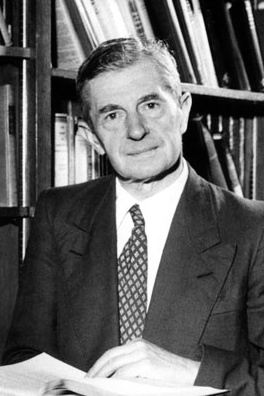
Sydney Chapman FRS (29 January 1888 – 16 June 1970) was a British mathematician and geophysicist. His work on the kinetic theory of gases, solar-terrestrial physics, and the Earth's ozone layer has inspired a broad range of research over many decades.
Chapman was born in Eccles, near Salford in England and began his advanced studies at a technical institute, now the University of Salford, in 1902. In 1904 at age 16, Chapman entered the University of Manchester. He competed for a scholarship to the university offered by his home county, and was the last student selected. Chapman later reflected, "I sometimes wonder what would have happened if I'd hit one place lower." He initially studied engineering in the department headed by Osborne Reynolds. Chapman was taught mathematics by Horace Lamb, the Beyer professor of mathematics, and J. E. Littlewood, who came from Cambridge in Chapman's final year at Manchester. Although he graduated with an engineering degree, Chapman had become so enthusiastic for mathematics that he stayed for one further year to take a mathematics degree. Following Lamb's suggestion, Chapman applied for a scholarship to Trinity College, Cambridge. He was at first awarded only a partial scholarship as a sizar (meaning that he obtained financial support by acting as a servant to other students), but from his second year onwards he received a full scholarship. He graduated as a wrangler in 1910. He began his research in pure mathematics under G. H. Hardy, but later that year was asked by Sir Frank Dyson to be his chief assistant at the Royal Greenwich Observatory.
From 1914 to 1919, Chapman returned to Cambridge as a lecturer in mathematics and a fellow of Trinity. He held the Beyer Chair of Applied Mathematics at Manchester from 1919 to 1924, the same position as had been held by Lamb. On his return to Manchester he was elected to the membership of Manchester Literary and Philosophical Society on 4 November 1919 giving his details as Professor SYDNEY CHAPMAN, M.A., D.Sc., F.R.S., Professor of Mathematics and Natural Philosophy in the Victoria University of Manchester,. He subsequently moved to Imperial College London. During the Second World War he was Deputy Scientific Advisor to the Army Council.
In 1946, Chapman was elected to the Sedleian Chair of Natural Philosophy at Oxford, and was appointed fellow of The Queen's College, Oxford. In 1953, on his retirement from Oxford, Chapman took research and teaching opportunities all over the world, including at the University of Alaska and the University of Colorado, but also as far afield as Istanbul, Cairo, Prague, and Tokyo. As the Advisory Scientific Director of the University of Alaska Geophysical Institute from 1951 to 1970, he spent three months of the year in Alaska, usually during winter for research into auroras. Much of the remainder of the year he spent at the High Altitude Observatory in Boulder, Colorado.
Chapman's most noted mathematical accomplishments were in the field of stochastic processes (random processes), especially Markov processes. In his study of Markovian stochastic processes and their generalizations, Chapman and the Russian Andrey Kolmogorov independently developed the pivotal set of equations in the field, the Chapman–Kolmogorov equations. Chapman is credited with working out, in 1930, the photochemical mechanisms that give rise to the ozone layer.
Chapman is recognised as one of the pioneers of solar-terrestrial physics. This interest stemmed from his early work on the kinetic theory of gases. Chapman studied magnetic storms and aurorae, developing theories to explain their relation to the interaction of the Earth's magnetic field with the solar wind. He disputed and ridiculed the work of Kristian Birkeland and Hannes Alfvén, later adopting Birkeland's theories as his own. Chapman and his first graduate student, V. C. A. Ferraro, predicted the presence of the magnetosphere in the early 1930s. They also predicted characteristics of the magnetosphere that were confirmed 30 years later by the Explorer 12 satellite.
In 1940, Chapman and a German colleague Julius Bartels published a book in two volumes on geomagnetism, which was to become the standard text book for the next two decades. In 1946 Chapman coined the term: Aeronomy, which is used today to describe the scientific field of high-altitude research into atmosphere/space interaction.
From 1951 to 1954, Chapman was president of the International Union of Geodesy and Geophysics (IUGG).
Sydney Chapman (mathematician)
Sydney Chapman FRS (29 January 1888 – 16 June 1970) was a British mathematician and geophysicist. His work on the kinetic theory of gases, solar-terrestrial physics, and the Earth's ozone layer has inspired a broad range of research over many decades.
Chapman was born in Eccles, near Salford in England and began his advanced studies at a technical institute, now the University of Salford, in 1902. In 1904 at age 16, Chapman entered the University of Manchester. He competed for a scholarship to the university offered by his home county, and was the last student selected. Chapman later reflected, "I sometimes wonder what would have happened if I'd hit one place lower." He initially studied engineering in the department headed by Osborne Reynolds. Chapman was taught mathematics by Horace Lamb, the Beyer professor of mathematics, and J. E. Littlewood, who came from Cambridge in Chapman's final year at Manchester. Although he graduated with an engineering degree, Chapman had become so enthusiastic for mathematics that he stayed for one further year to take a mathematics degree. Following Lamb's suggestion, Chapman applied for a scholarship to Trinity College, Cambridge. He was at first awarded only a partial scholarship as a sizar (meaning that he obtained financial support by acting as a servant to other students), but from his second year onwards he received a full scholarship. He graduated as a wrangler in 1910. He began his research in pure mathematics under G. H. Hardy, but later that year was asked by Sir Frank Dyson to be his chief assistant at the Royal Greenwich Observatory.
From 1914 to 1919, Chapman returned to Cambridge as a lecturer in mathematics and a fellow of Trinity. He held the Beyer Chair of Applied Mathematics at Manchester from 1919 to 1924, the same position as had been held by Lamb. On his return to Manchester he was elected to the membership of Manchester Literary and Philosophical Society on 4 November 1919 giving his details as Professor SYDNEY CHAPMAN, M.A., D.Sc., F.R.S., Professor of Mathematics and Natural Philosophy in the Victoria University of Manchester,. He subsequently moved to Imperial College London. During the Second World War he was Deputy Scientific Advisor to the Army Council.
In 1946, Chapman was elected to the Sedleian Chair of Natural Philosophy at Oxford, and was appointed fellow of The Queen's College, Oxford. In 1953, on his retirement from Oxford, Chapman took research and teaching opportunities all over the world, including at the University of Alaska and the University of Colorado, but also as far afield as Istanbul, Cairo, Prague, and Tokyo. As the Advisory Scientific Director of the University of Alaska Geophysical Institute from 1951 to 1970, he spent three months of the year in Alaska, usually during winter for research into auroras. Much of the remainder of the year he spent at the High Altitude Observatory in Boulder, Colorado.
Chapman's most noted mathematical accomplishments were in the field of stochastic processes (random processes), especially Markov processes. In his study of Markovian stochastic processes and their generalizations, Chapman and the Russian Andrey Kolmogorov independently developed the pivotal set of equations in the field, the Chapman–Kolmogorov equations. Chapman is credited with working out, in 1930, the photochemical mechanisms that give rise to the ozone layer.
Chapman is recognised as one of the pioneers of solar-terrestrial physics. This interest stemmed from his early work on the kinetic theory of gases. Chapman studied magnetic storms and aurorae, developing theories to explain their relation to the interaction of the Earth's magnetic field with the solar wind. He disputed and ridiculed the work of Kristian Birkeland and Hannes Alfvén, later adopting Birkeland's theories as his own. Chapman and his first graduate student, V. C. A. Ferraro, predicted the presence of the magnetosphere in the early 1930s. They also predicted characteristics of the magnetosphere that were confirmed 30 years later by the Explorer 12 satellite.
In 1940, Chapman and a German colleague Julius Bartels published a book in two volumes on geomagnetism, which was to become the standard text book for the next two decades. In 1946 Chapman coined the term: Aeronomy, which is used today to describe the scientific field of high-altitude research into atmosphere/space interaction.
From 1951 to 1954, Chapman was president of the International Union of Geodesy and Geophysics (IUGG).
Recent media
Recent media