Hubbry Logo
Talbot TagoraTalbot TagoraMain
Open search
Talbot Tagora
Community hub
Talbot Tagora
logo
8 pages, 0 posts
0 subscribers
Be the first to start a discussion here.
Talbot Tagora
Talbot Tagora
from Wikipedia

Talbot Tagora
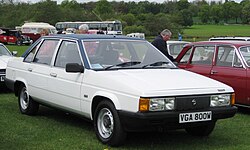
Talbot Tagora 2.2 saloon
Overview
ManufacturerPSA
Production1980–1983
AssemblyPoissy, France
DesignerRoy Axe[1]
Body and chassis
ClassExecutive car
Body style4-door saloon
LayoutFR layout
Powertrain
Engine
Transmission4-speed manual
5-speed manual
3-speed automatic
Dimensions
Wheelbase2,808 mm (110.6 in)[2]
Length4,828 mm (190.1 in)[2]
Width1,810 mm (71.3 in)[2]
Height1,444 mm (56.9 in)[2]
Kerb weight1255–1345 kg (2767–2965 lb)[2]
Chronology
PredecessorChrysler 180/2 litre
Dodge 3700 (Spain)
SuccessorPeugeot 605

The Talbot Tagora is an executive car developed by Chrysler Europe and produced by Peugeot Société Anonyme (PSA). The Tagora was marketed under the Talbot marque after PSA took over Chrysler's European operations in 1979. PSA presented the first production vehicle in 1980 and launched it commercially in 1981. The Tagora fell short of sales expectations, described as a "showroom flop" just a year after its launch,[3] and PSA cancelled the model two years later. Fewer than 20,000 Tagora models were built, all of them at the former Simca factory in Poissy, near Paris, France.[4]

Development

[edit]

Chrysler Europe began development of the Tagora in 1976, under the code name C9, with the goal of replacing the unsuccessful Chrysler 180 series. Following the same development pattern as with the Horizon and Alpine models, the responsibility for the Tagora's technical development remained in France, while the styling was devised at Chrysler's design centre in the United Kingdom.[5] An early proposal for the name of the car was "Simca 2000".[6]

Design

[edit]

The original C9 prototype was a modern-styled saloon with a low beltline and large interior dimensions made possible by the long-wheelbase. The British design team initially proposed some stylistic features inspired by the Citroën SM, including a front glass panel between the headlights to accommodate the number plate, round front wheelarches and rear spats. However, Chrysler management in the United States deemed these features too extravagant, so the design of the C9 became more conventional: front and rear wheelarches were squared off and the spats lost, and the license plate was placed on the front bumper as on most cars. To better balance the tall silhouette, the beltline was raised. Over the course of development, the C9 also lost its vertical taillights in favour of more "fashionable" horizontal ones.[5][7]

Engine dilemma

[edit]

The main competitors in the executive vehicle market offered engines bigger than the biggest 2.0-litre inline-four engine used by Chrysler Europe, and a six-cylinder engine was generally expected. Consequently, the company had to seek a new engine for the Tagora. One candidate was a straight-six manufactured by Mitsubishi, but it proved unsuitable for a car of this class. The other proposal was the Douvrin V6 engine (the "PRV"), a joint development of PSA, Renault and Volvo. Since the Tagora would be in direct competition with PSA models that used the PRV, it seemed unlikely that Chrysler would be able to procure that engine.[5]

Sales projections

[edit]
The Tagora SX was the line-up's flagship, featuring the 2.6-litre engine and alloy wheels.

Chrysler Corporation approved the development of the model on the assumption that Chrysler Europe would sell 60,000 C9 models per year, which translated into a projected 5 percent share of the executive car market. This estimate seemed achievable because Chrysler had a 7 percent market share in Europe overall. The projected sales would have covered the car's tooling costs, with the development costs accounted for separately, as part of an independent annual budget.[5]

PSA takeover

[edit]

During the development of the C9, the management of the bankruptcy-threatened Chrysler Corporation decided to divest itself of its debt-ridden European operations. The buyer was the French PSA Group, formed in 1976 after Peugeot took over Citroën. The deal was finalised in 1978, in which the buyer paid US$1.00 for the entirety of Chrysler Europe and its obligations. The take-over was effective as of 1 January 1979.[8]

While the C9 project was well advanced, PSA already had a crowded lineup in the large vehicle segment, including the renowned Citroën CX, the slow-selling Peugeot 604 and the newly launched Peugeot 505. But with so much having already been invested in the project, PSA decided to press ahead and complete the development of C9, albeit with modifications to allow the use of shared parts with other PSA models. The Simca double wishbone front suspension gave way to MacPherson struts adopted from the Peugeot 505 and 604, and the rear axle was replaced with that of the 505, much narrower than the one originally planned, as it was designed with respect to the 505 body width, and thus compromised the C9's stance as the rear wheels were now badly inset within their arches. The C9 front end was extended to accommodate the optional PRV engine: now that the model belonged to PSA, using the PRV presented no problems.[5][9]

Short market life

[edit]

Following the renaming of Chrysler Europe's models to the Talbot marque, the C9 was christened the Talbot Tagora, and the first batch of cars rolled out of the former Simca plant in Poissy in 1980. The same year, PSA presented the Tagora at the Salon de l'Automobile in Paris. Following a hands-on demonstration of the model to the press in Morocco in March 1981, the car went on sale in France in April and in the United Kingdom in May.[5][10] The British billboard advertising campaign boasted "The new Talbot Tagora. Luxury and performance redefined."[9]

The Tagora was priced to overlap with high-end Peugeot 505 and low-end Citroën CX models, while slotting in beneath the Peugeot 604. Its pricing was also comparable to the Renault 20/30 and Ford Granada. The Tagora was in the 20,000–30,000 Deutsch Mark bracket in Germany.[11] During the first fifteen months of the car's existence, in 1980/81, a mere 16,169 Tagoras were produced[12] which was only one quarter of Chrysler's initial projections. Sales proved insufficient even for this production level, and volumes plummeted by more than 80 percent in 1982.[12] In 1983 the sales figures prompted PSA to cancel the model altogether.[12] By the time the Tagora was discontinued, only about 19,500 had been built; by comparison, over 116,000 Peugeot 505s and 74,000 Citroën CXs were made in 1981 alone.[5][9][13][14]

In December 2010, Practical Classics reported that 99.09 percent of all UK-registered Tagoras were no longer on the roads. The last UK-registered Tagora on the road, has been declared on a SORN (statutory off-road notice) since 2016.[15] The last UK-registered Tagora has been put back on the road as of September 2022 [16]

Powertrains and models

[edit]
Talbot Tagora interior.
Interior of a Tagora SX 2.6

As with most large cars of its time, the Tagora was a rear-wheel drive vehicle, with a longitudinally mounted engine. There were three engine choices, mated to four- and five-speed manual transmissions or an optional three-speed automatic in the case of the four-cylinder engines.[2][17]

The available models were:

  • 2.2-litre (2155 cc) Type 180 OHC I4, double-barrel Solex carburettor, 115 metric horsepower (85 kW), 184 newton-metres (136 lbf⋅ft).
The base engine was a version of the older Simca Type 180 2.0-litre with increased displacement, as also featured in the Matra Murena. It was unrelated to either the American Chrysler K or PSA Douvrin 2.2-litre engines.[5] Available trim levels were designated GL and GLS. The GL was the only model to feature the four-speed manual transmission, and have power steering as an option as opposed to standard. It was first to be dropped, for the 1983 model year.
  • 2.3-litre (2304 cc) XD2S OHV turbodiesel I4, 80 metric horsepower (59 kW), 188 newton-metres (139 lbf⋅ft).
This Peugeot-developed turbodiesel was primarily used in the Peugeot 505 and 604. The diesel-powered version of the Tagora was designated DT.
  • 2.7-litre (2664 cc) PRV OHC V6, two triple-barrel Weber carburettors, 166 metric horsepower (122 kW), 234 newton-metres (173 lbf⋅ft).
The V6 model, which was actually badged "2.6", came in the top SX trim level, loaded with extras, but was not available with automatic transmission.[17] The PRV engine used in the Tagora was different from the one used in contemporary Peugeot vehicles in that it was fitted with triple-barrel Weber carburettors rather than fuel injection, resulting in a higher power-rating. This made it the most powerful French car of its time.[2] Nevertheless, only 1,083 V6 Tagora models were made.[18]

Tagora Présidence

[edit]

The Tagora Présidence was a concept car designed by stylist Sunny Atri at the Talbot design studio in Whitley, Coventry. The concept was created to generate interest in employing high-end Tagoras as chauffeur-driven limousines by users such as business executives and government officials. The donor model for the Présidence was the 2.6 SX, which had an interior appointed with Connolly Leather upholstery and brass highlights, plus a host of electronics including a telephone, dictaphone, text-message receiver, and television with VCR. Originally valued at £25,000, the Présidence now resides at a car museum in Poissy.[19][20]

Critical appraisal

[edit]

The Tagora was not greeted with much acclaim by the British motoring press. Autocar reviewed the Tagora in its 2.2 litre GLS iteration, and summed it up as "excellent, if not a great advance".[21] L. J. K. Setright of Car magazine asked who could want one given the crowded market into which it came.[22] Concluding a group test in Car, the Tagora was described as a "problematic newcomer"[3] that did not exceed the standard set by the winner of the group test, the Volvo 244 GLE. However, Motor Sport[23] considered the Tagora a "usefully effortless, uncomplicated, simple-to-drive and very comfortable car".

The recurring theme of published tests was the Tagora's lack of clear advantages or of a competitive edge. In comparing the car to its likely competitors, Autocar's verdict was that "the new Talbot is highly comparable with the others, and deserves to sell as any of them, although it does not come out with any startling advantages which you might expect of the latest appearance on the scene". Those cars against which the Tagora 2.2 GLS was compared were the Ford Granada 2.3 GL, Opel Rekord 2.0S, Renault 20TX, Rover 2300 and Volvo 244 GL. Of these cars, the Tagora was the second most expensive but did not have a superiority among the significant attributes of speed, acceleration, interior room or chassis design. Out of the comparison group the Tagora had the second highest top speed, was the third fastest to 60 mph though it had the best overall mpg (by 0.7 mpg). In terms of interior room, it had the fourth best legroom (front/rear). Motor Sport also noted the car's modest competence in comparison with the Rover 2300 (launched 1976), saying that the Tagora had more leisurely acceleration.[23] LJK Setright noted the cars's overall "adequacy" going on to say that if fitted with the correct type of tyre he would still opt for a Peugeot 604 instead.[22] Car judged the chassis design to be one area "where [the Tagora] does not show the comparative youth of its design".[3]

The Tagora's handling was deemed "on the good side", wrote Autocar, and performance was described as "good but not outstanding". As such the car lay "uneasily close to being listed as under-engined" though the authors conceded that generally the Tagora did not feel under-engined when in use.[21] LJK Setright dissented saying the Tagora was as "refined in its ride as should be expected of it" and that "the car also has a good deal more road-holding and cornering than might be expected".[22] However, in December 1981 Car magazine judged the car (2.2 GLS model) to be prone to "untidy" handling, tending to under-steer first followed by excessive over-steer.[3] The magazine made a particular note of the advantage in handling and grip enjoyed by the older live-axled Volvo 244, underlining the point about the Tagora's lack of advantage in terms of road manners.

Regarding the interior, the seats drew praise for their comfort and detail design.[21] However, again, Car provided a counterpoint to the effect that the Volvo was as roomy, despite its shorter wheelbase.[3] The steering wheel was criticized in the same review for being too close to the driver's legs. The ventilation temperature control was "not satisfactory" due to an unprogressive response at the cool end of the dial. There was no fan-blown cold air (cold air was by ram-effect) nor an option for cool air to be directed to the face at the same time as warmth being directed into the footwells.[21] According to Car [3] the ventilation "fell down badly" on account of its awkward controls. Oddment accommodation was "disappointment".[21] Lacking a self-setting stay, opening the bonnet was "heavy work" and the boot, while large, had the demerit of an "unusual" locking method: "[the boot] is locked before being shut by pushing in a red handle set in the inside of the lid".[21]

In summary, the main competencies of the Tagora were its spacious cabin (though it was not class-leading), its comfortable seating, its fuel economy (in 2.2 GLS form) and the size of its luggage compartment (572 litres).[3] But the fact that a car launched in 1974, the Volvo 244 GLE, could offer better seats, disc brakes all round, better headlights, better ventilation and better handling for only slightly more than Talbot was charging for their car indicated that the Tagora had come to market with a vehicle that was uncompetitive in too many major respects.

Nearly a decade after the Tagora had ceased production, the view of the car in the automotive press was that it was merely average though there was little actively wrong with the car.[24] The view was that the Tagora had the advantage of refinement, good manners and, in V6 form, good performance. Rust was identified as the single biggest problem for the surviving cars, usually around the rear suspension mountings. Buckley suggested that the car might attain collectible status by 2003.

Reasons for commercial failure

[edit]

Market situation and image

[edit]
Rear view of 1981 2.2 GLS Tagora

In terms of engineering, the Tagora had no major flaws (except perhaps for the poor cabin ventilation). The 1979 energy crisis, however, dealt a blow to the European automotive market: the large car segment contracted significantly,[3] making Chrysler's initial sales projections unrealistic. The Tagora was ultimately launched under the Talbot brand, which was not established in the marketplace and had a confused pedigree, putting the car at an immediate disadvantage in an executive car market dominated by well established offerings such as the Ford Granada.[5][9] In the view of Martin Buckley[24] Talbot did not advertise the car effectively so "people did not know about the car".

Design

[edit]

As the British magazine What Car? opined, the Tagora "has such a complete blandness of style as to disqualify it instantly in a market where character and status count for so much."[5] The design of the Tagora was focused on practicality, providing exceptional cabin space at the expense of style. The steep windscreen formed a quite strange angle with the relatively short, wedge-shaped bonnet. The car was wider and taller than most of its competitors, and buyers were unaccustomed to such proportions. The PSA-sourced axles had very narrow tracks relative to the width of the body, which provided an awkward look, especially at the rear. Nor did the plain, plastic dashboard stir enthusiasm among reviewers and prospective customers.[5][9]

References

[edit]
[edit]
Revisions and contributorsEdit on WikipediaRead on Wikipedia
from Grokipedia
The Talbot Tagora was a large produced by the French automaker from 1980 to 1983. It was originally developed by as the C9 project starting in 1976, with styling handled in the UK and engineering in , but the program was taken over by PSA after their 1978 acquisition of Chrysler's European operations. Unveiled at the in October 1980 and entering sales in March 1981, the Tagora was built at the Poissy plant in and positioned as a successor to earlier Chrysler models like the 180 series. The Tagora featured a boxy, modern design with a spacious interior influenced by contemporary trends, including a reminiscent of the Rover SD1. It was offered in trim levels such as GL, GLS, and SX, with the top SX variant providing luxury appointments to rival models like the Ford Granada. Engine options included a 2.2-liter inline-four petrol unit producing around 115 horsepower, a 2.3-liter Peugeot-sourced , and a 2.7-liter PRV delivering up to 165 horsepower in the SX model for a top speed of approximately 122 mph. Despite its roomy cabin, comfortable ride, and competitive pricing, the Tagora struggled with sales due to market saturation from established rivals like the and , as well as perceptions of badge engineering under the marque. Total production reached only about 19,389 units before the model was discontinued in , marking it as one of PSA's commercial disappointments and contributing to the eventual phase-out of the brand. Today, surviving examples are rare, but the Tagora has garnered a among enthusiasts for its blend of and engineering and its role as the last original design under the name.

Background and Development

Project Origins

In 1976, initiated Project C9, a development effort aimed at creating a new large saloon to replace the commercially unsuccessful series, which had failed to gain traction in the European market since its 1970 launch. The 180, derived from platforms but rebadged under , suffered from low sales volumes—typically under 30,000 units annually—due to its uncompetitive positioning and the broader economic pressures of the mid-1970s. This project represented 's strategic push to consolidate its European operations, which included the acquired in the UK and in France, by introducing a more appealing model to the executive segment. The C9 was conceived as a designed specifically for European buyers, with the goal of capturing a share of the expanding market for premium saloons. It targeted direct competition against established rivals such as the Ford Granada, , and , positioning as a viable alternative in the mid-to-upper executive class. To secure internal approval and investment, the project team forecasted annual sales of 60,000 to 70,000 units, which would represent approximately 5% of the European large-car market and double the volume of the outgoing 180. These ambitions unfolded against the backdrop of Europe's mounting financial challenges throughout the , as the parent company grappled with U.S.-based losses exceeding $1 billion by 1979, compounded by the that depressed demand for larger vehicles. The European division, burdened by outdated model lineups and insufficient investment, required a high-impact successor to the 180 to stem ongoing losses and justify further rationalization efforts. Early planning thus emphasized a pan-European approach, with engineering led from and styling contributions from the team.

Design Process

The exterior styling of the Talbot Tagora was led by designer Roy Axe at Chrysler's Whitley studio in , , where the team developed a boxy, angular aesthetic intended to appeal to executive buyers in the European market. Early concepts under Art Blakeslee's direction at Whitley featured innovative elements like recessed frontal treatments, but these were simplified in the final design to emphasize a modern, glassy three-box saloon profile with aerodynamic considerations for improved efficiency and road presence. The styling drew influences from competitors such as the Ford Granada and , aiming for a spacious yet pragmatic form that balanced visual boldness with manufacturability. Mechanical engineering aspects were handled by a French team at Chrysler's Carrières-sur-Seine technical center, focusing on a clean-sheet platform to position the Tagora as a premium offering above the 1308. To enhance cost efficiency, the platform incorporated select components from the Horizon, such as suspension elements, while developing new for the chassis and body structure to support executive-class dimensions and handling. The finalized measurements included a length of 4,628 mm and a of 2,808 mm, providing a stable footprint suited to long-distance travel and family use. The interior layout prioritized practicality, with a design accommodating five passengers in a configuration that maximized rear legroom and luggage capacity, reflecting the project's emphasis on versatile executive transport over opulent materials. Key personnel like product development executive Burton Bouwkamp oversaw the integration of these elements, ensuring the Tagora's cabin supported everyday usability with features like ample headroom and straightforward ergonomics. This approach stemmed from Chrysler's goal to create a competitive mid-size saloon, though the process was influenced by the 1978 PSA takeover, which shifted priorities without fundamentally altering the core .

Engine Selection Challenges

The development of the Talbot Tagora, codenamed Project C9, initially envisioned a six-cylinder engine, with options like a unit under consideration to provide the refinement and performance needed for an executive saloon competing with the Ford Granada. However, extensive testing revealed shortcomings in power output, delivery, and overall smoothness, leading to abandon it amid rising development costs and concerns over long-term reliability. The 1979 energy crisis exacerbated engine selection dilemmas, as fluctuating fuel prices and shifting consumer preferences toward efficiency prompted a reevaluation of propulsion options. Engineers faced a choice between petrol engines for and diesel for , resulting in a hybrid approach that incorporated both Chrysler-sourced petrol units and Peugeot diesels to broaden market appeal without overcommitting to one fuel type. This compromise reflected broader industry trends but introduced integration complexities for the Tagora's rear-wheel-drive platform. By the late , the shortlist narrowed to three engines: a 2.2-liter inline-four petrol from producing 115 horsepower, a 2.7-liter PRV V6 petrol developing 166 horsepower, and a 2.3-liter turbodiesel offering 80 horsepower. The PRV V6, a joint Peugeot-Renault-Volvo design, was prioritized for the top-tier models but encountered significant hurdles during testing, including excessive vibration at certain RPMs and uneven power delivery that required custom modifications like triple . These issues not only delayed refinement but also shaped the model's hierarchy, positioning the V6 as a premium yet challenging option. Peugeot's 1978 takeover of Chrysler Europe ultimately resolved access to the PRV V6, despite initial resistance over potential competition with the Peugeot 604, allowing the mixed engine lineup to proceed to production.

Impact of PSA Takeover

In 1978, PSA Peugeot Citroën acquired 's operations, including the brand and the assembly plant, for a nominal $1 while assuming significant debts associated with the division. The , effective from January 1, 1979, integrated Chrysler's ongoing s into PSA's portfolio, with the Talbot Tagora (project C9) proceeding despite overlapping with established PSA models like the and . To align the Tagora with PSA's manufacturing standards and cut costs, engineers substituted several Chrysler-specific components with off-the-shelf PSA parts, notably adopting the 505's rear axles and brake system. This re-engineering also involved revising the vehicle's electronics for compatibility with PSA's electrical architecture, further standardizing production across the group. These modifications contributed to a one-year delay in the Tagora's launch, pushing it from an initial 1979 target to its debut at the October 1980 Paris Motor Show. Despite PSA's primary emphasis on its Peugeot and Citroën marques, the company strategically retained the Talbot branding for the Tagora to attempt a revival of the historic name, positioning it as a premium executive saloon in markets like the UK and France. As part of this integration, the powertrain saw adaptations including the adoption of PSA-compatible PRV V6 petrol engines and Peugeot-sourced turbodiesel units.

Design and Specifications

Exterior and Interior Features

The Talbot Tagora exhibited a boxy, upright exterior design typical of early executive saloons, featuring a three-box shape with smooth flanks, a deep six-light glasshouse, and a low waistline for a modern yet conservative appearance. Its frontal treatment included flush-mounted dual oblong headlights and a minimal grille with limited chrome accents, while the rear incorporated large horizontal lamp clusters and partly enclosed wheel arches that contributed to a bland, unadventurous stance. Measuring 1,810 mm in width, the Tagora projected a substantial but restrained executive presence, prioritizing practicality over flair. Inside, the cabin emphasized spaciousness with a 2,808 mm (110.6-inch) enabling ample rear legroom and an airy atmosphere suitable for family use. Upholstery consisted of cloth in pleated on upper trims or vinyl on base models, paired with an analogue in a plain, horizontal layout featuring a black instrument pod and rectangular vents, evoking a minimalist style akin to the Rover SD1. Despite the roomy design, critics noted the interior's dated plastics and lack of premium touches, such as or , rendering it featureless and van-like in quality. Higher trims like the GLS included standard for easier handling, while options such as a and were available to enhance comfort, though the latter was inconsistently fitted following PSA's cost-cutting. The offered a luggage capacity of 572 liters, reinforcing the Tagora's focus on utilitarian family transport over sporty appeal.

Chassis and Suspension

The Talbot Tagora employed a conventional front-engine, rear-wheel-drive layout, which facilitated balanced weight distribution and straightforward power delivery to the rear wheels. Its suspension setup prioritized executive-car refinement, featuring independent front suspension with MacPherson struts adapted from the and 604 models for precise steering response and isolation from road imperfections. The rear utilized a live with coil springs, also borrowed from the , providing stable handling under load while maintaining simplicity in maintenance. This configuration, combined with rack-and-pinion steering, delivered competent roadholding suitable for long-distance touring, though the narrower rear track—resulting from the PSA components—slightly compromised cornering agility compared to the original design intent. Braking was handled by ventilated disc brakes at the front and drum brakes at the rear (discs on higher SX trim), offering progressive stopping power without the (ABS), which was not yet standard in production vehicles of the early . The overall curb weight fell between 1,255 and 1,345 kg, contributing to a planted feel on highways. The ride quality emphasized comfort through soft spring rates and heavy damping, absorbing bumps effectively for a serene cabin experience, while enabling 0-100 km/h acceleration in 12-17 seconds for inline-four and diesel variants or ~9-10 seconds for the V6. Safety provisions were era-typical, relying on front and rear to dissipate impact energy and three-point seat belts for occupant restraint, with no airbags or electronic stability aids incorporated.

Powertrain Options

The Talbot Tagora featured three primary engine options, comprising two petrol variants and one diesel, all front-mounted and driving the rear wheels to provide a and efficiency for its executive saloon positioning. The base petrol utilized a 2.2-litre inline-four producing 82 kW (115 hp) at 5,400 rpm and 181 Nm of torque at 3,200 rpm, derived from Simca's Type 180 unit with a single twin-choke carburettor for reliable everyday use. For higher performance, the top-spec model employed a 2.7-litre PRV , co-developed by Peugeot-Renault-Volvo, delivering 122 kW (166 hp) at 6,000 rpm and 230 Nm of torque at 3,500 rpm via two triple-barrel Weber carburettors, offering smoother operation and greater refinement. Complementing these was a 2.3-litre Sofim inline-four aimed at economy-conscious buyers, generating 59 kW (80 hp) at 4,000 rpm and 188 Nm of at 2,000 rpm, which provided strong low-end pull suitable for long-distance cruising despite modest peak power. Transmission choices included a standard four-speed manual gearbox for the inline-four engines, with a five-speed manual available on the V6 for enhanced highway flexibility, while a three-speed ZF was optional across the lineup for easier urban driving. Fuel economy varied by engine and configuration, typically ranging from 8 to 12 L/100 km in mixed conditions, with the diesel achieving the best figures around 8-9 L/100 km. Performance metrics reflected the engines' capabilities, with top speeds between 180 and 200 km/h—the V6 reaching approximately 200 km/h—and acceleration from 0-100 km/h in about 9.5 seconds for the V6, compared to 12-17 seconds for the others, emphasizing the six-cylinder's superior responsiveness.

Models and Variants

Standard Models

The Talbot Tagora's standard models encompassed four core variants—GL, GLS, SX, and DT—designed to appeal to a range of buyers with varying priorities for performance, equipment, and economy. These saloon models shared a common rear-wheel-drive platform with a 2,808 mm , emphasizing spacious interiors and competitive pricing in the European market. The entry-level GL served as the base model, powered by a 2.2-litre inline-four delivering 115 PS from a Simca-derived unit with a single twin-choke carburettor. It came standard with a four-speed , steel wheels, and vinyl upholstery, positioning it as an affordable option for budget-conscious buyers. was listed as an option, though many examples appear to have included it as standard. Building on the GL, the mid-range GLS retained the same 2.2-litre engine and 115 PS output but upgraded to a five-speed , with an automatic option available. Key enhancements included alloy wheels, velour upholstery, tinted glass, a , central locking, and standard , offering improved comfort and refinement for private owners seeking value. The SX represented the top petrol variant in the standard lineup, featuring a 2.66-litre PRV producing 165 PS for smoother performance and higher output. It included full instrumentation, alloy wheels, power windows front and rear, height-adjustable driver's seat, all-round disc brakes, a wash-wipe system, and chrome-accented bumpers as standard equipment. The DT was the diesel-oriented model, equipped with a 2.3-litre turbocharged inline-four yielding 79 hp, derived from Peugeot's offerings and focused on for cost-sensitive applications. It prioritized low running costs through its economical diesel powertrain, making it suitable for high-mileage professional use, though specific trim details were more basic compared to petrol siblings.

Tagora Présidence

The Tagora Présidence was a one-off luxury developed by as a styling exercise to highlight the brand's capabilities in the premium executive segment. Unveiled in May 1981, it was based on the Tagora SX model and intended to appeal to affluent business professionals while demonstrating potential for government fleet adoption in the and . Equipped with the 2.66-litre PRV V6 engine delivering 165 horsepower, the Présidence featured an extravagant interior finished in Connolly leather with woollen cloth seat inserts and brass inlays on the centre console and gear lever. High-tech amenities catered to executive needs, including a colour television, video recorder, 100-watt stereo system, telephone, dictaphone, CEEFAX/Oracle teletext services, and an electric shaver in the glovebox. The package was completed with a custom matching leather-and-brass briefcase. Although the Présidence exemplified Talbot's ambition for upscale variants, it never progressed beyond this prototype stage, with the single example reportedly preserved in France.

Production and Market Performance

Manufacturing Details

The Talbot Tagora was assembled exclusively at PSA's Poissy plant in France, a facility originally established for Simca production and retained following the 1978 takeover of Chrysler Europe by PSA. Production commenced in September 1980, with the first vehicles rolling off the line ahead of the model's commercial launch in early 1981. The plant was equipped to handle an initial planned output of 60,000 to 70,000 units annually, equating to roughly 200 to 280 vehicles per day assuming standard operational schedules, though actual volumes fell far short due to market challenges. The assembly process utilized stamped steel body panels, welded together in a line setup typical of PSA's mid-1980s manufacturing standards, incorporating both legacy tooling and new PSA integrations for efficiency. Following the PSA acquisition, components were sourced from within the group, including the rear axle and suspension elements from the , the PRV shared with other PSA models, and gearbox options adapted from designs, which streamlined supply chains but required modifications to the original C9 project specifications. Final assembly stages emphasized rigorous quality inspections, particularly for variants destined for export markets in Europe and beyond, to meet varying regulatory and durability standards. In total, 19,389 Tagora units were produced at across the model's short lifespan, with yearly breakdowns as follows: 145 in 1980, 15,368 in 1981, 2,566 in 1982, and 1,310 in 1983. Discontinuation was effectively announced in late 1982 amid declining demand and internal PSA rationalization, with production winding down and ceasing in June 1983, and remaining stock cleared from inventories by mid-year to avoid further financial losses.

Sales and Distribution

The Talbot Tagora was unveiled to the public at the in October 1980, marking the debut of PSA's ambitious executive sedan under the badge. Commercial sales began in the following February, with initial pricing set at 58,700 French francs for the base GL model, 66,000 francs for the mid-range GLS, and 88,300 francs for the top SX variant introduced later that year. These prices positioned the Tagora as a competitive option in the large saloon segment, targeting buyers seeking luxury features at a relatively accessible cost. Sales were concentrated overwhelmingly in the French domestic market, accounting for approximately 70% of total production. Exports were limited, primarily to neighboring European countries such as the —where availability started in May 1981 at prices from £6,916 for the GL—and , alongside smaller volumes in . Later, in the post-1989 period following the fall of the , a handful of units reached Eastern European markets, including , often as used imports. Distribution relied on the existing dealer network, which PSA gradually integrated with outlets to streamline operations and support the model's rollout. The Tagora achieved its sales peak during the 1980-1981 period, with 15,513 units delivered, driven by initial enthusiasm for its spacious design and . Promotional campaigns emphasized the car's generous interior room and competitive pricing against rivals like the Ford Granada, portraying it as an ideal family executive. However, sales plummeted by over 80% to 2,566 units in 1982, amid the deepening European economic that curtailed demand for premium vehicles. Further declines to 1,310 units in 1983 underscored the model's struggle to maintain momentum.

Reception and Legacy

Critical Reviews

Contemporary reviews of the Talbot Tagora in 1981 generally acknowledged its strengths in comfort and practicality while highlighting shortcomings in excitement and refinement compared to established rivals like the 20 and Ford . The car's spacious interior and smooth V6 ride were frequent points of praise, with LJK Setright in magazine's 1981 review of the V6 SX variant lauding its eager acceleration—"climbs up the speedometer with an eagerness that must put all of its class rivals in the shade"—and safe, secure handling that remained "always competent, never at a loss for the right gear or the necessary grip." Autocar's 1981 test of the 2.2 GLS model commended the comfortable seat design and overall spaciousness, including generous legroom and a large , positioning it as a value-oriented option in a crowded executive segment. Similarly, Motor Sport Magazine in October 1981 highlighted the Tagora's effortless control, untiring touring capability, and commanding driving position, describing it as "very comfortable" for family use with commendably thrifty fuel consumption at 29.6 mpg. Critics, however, often faulted the Tagora for bland styling, vague handling, and a lack of innovation that failed to differentiate it from competitors like the or 20. What Car? magazine's 1982 appraisal dismissed the exterior as exhibiting "complete blandness of style" and criticized the interior's cheap feel, alongside inexcusably poor ventilation. Autocar echoed this, finding the design "successful if not standing out" with no "startling advantages," performance "good but not outstanding," and handling merely "on the good side," while noting minor issues like indecisive steering around straight-ahead and an unsatisfactory ventilation system. Motor Sport Magazine concurred on handling limitations, describing acceleration as leisurely at 11.5 seconds to 60 mph and the steering as indecisive, though it remained sure-footed overall. The diesel variant, powered by a 2.3-litre turbocharged unit, was noted for strong —aligning with the petrol models' thrifty —but drew for its noisy operation under load, a common trait of the era's indirect-injection diesels. Period road tests typically awarded the Tagora average scores, around 3 out of 5 stars, reflecting its solid but unremarkable execution. Following PSA's 1978 acquisition of , reviewers praised the Tagora's improved build quality, with Autocar describing the cabin as "well finished" and carefully thought out, though the car was ultimately viewed as "competent rather than exciting."

Reasons for Commercial Failure

The Talbot Tagora suffered from a tarnished brand image rooted in the Chrysler era's reputation for unreliability, including rust-prone bodies and noisy Simca-derived engines that lingered in consumer perceptions despite the 1978 PSA acquisition. Within the PSA lineup, the Tagora was overshadowed by the established , which dominated the executive segment and rendered the Talbot as an unnecessary interloper lacking prestige or clear identity. This weak positioning alienated potential buyers seeking trusted badges in the upper-medium saloon market. Its 1980 launch coincided with the 1979 Second Oil Crisis and ensuing recession, which sharply curtailed demand for large, petrol-engined saloons as fuel prices soared and economic uncertainty favored smaller, more efficient vehicles. The sector was already contracting, with consumers shifting toward imports like the amid broader market shrinkage. Ineffective marketing further doomed the Tagora, as campaigns failed to emphasize its rare or positioning as a "budget ," while a sparse dealer network hindered visibility. It faced fierce competition from entrenched rivals such as the Ford Granada and , which boasted superior brand recognition and interiors. compromises, including bland aesthetics derived from a mish-mash of , , and components—such as a narrow rear track from the axle—resulted in dated looks and unrefined handling that disappointed expectations for an executive car. Pricing, though initially competitive, proved high relative to the sparse features (e.g., no automatic transmission on the V6 SX variant), offering little value over peers. These factors contributed to dismal , with only 19,389 units produced before discontinuation in 1983.

Modern Appraisal

In the decades following its discontinuation, the Talbot Tagora has become exceedingly rare, with few examples surviving worldwide out of the original production run of 19,389 units. Many succumbed to , particularly around the rear suspension, while others were scrapped due to low demand for parts. In the , only one was reported roadworthy as of 2022, with recent accounts confirming at least one survivor as of 2025. Among collectors, interest has grown modestly, driven by the car's obscurity and quirky . Restored V6 models, especially the SX variants, now command values between €10,000 and €20,000, reflecting rising appreciation for well-preserved examples. As of 2025, surviving examples continue to attract interest at car shows. Occasional restorations have been documented in enthusiast media, such as a 2022 YouTube video showcasing a drive of a fully restored survivor, which highlights the Tagora's unconventional charm and mechanical reliability despite its flaws. The Tagora is often regarded as an "iconic failure" in automotive history, emblematic of Chrysler Europe's turbulent transition under PSA ownership, as detailed in specialized publications and online archives. It played a transitional role as Talbot's final flagship. However, it left no notable legacy, remaining confined to road use.

References

Add your contribution
Related Hubs
User Avatar
No comments yet.