
Recent from talks
Tatenectes
Knowledge base stats:
Talk channels stats:
Members stats:
Tatenectes
Tatenectes is a genus of cryptoclidid plesiosaur known from the Upper Jurassic of Wyoming. Its remains were recovered from the Redwater Shale Member of the Sundance Formation, and initially described as a new species of Cimoliosaurus by Wilbur Clinton Knight in 1900. It was reassigned to Tricleidus by Maurice G. Mehl in 1912 before being given its own genus by O'Keefe and Wahl in 2003. Tatenectes laramiensis is the type and only species of Tatenectes. While the original specimen was lost, subsequent discoveries have revealed that Tatenectes was a very unusual plesiosaur. Its torso had a flattened, boxy cross-section and its gastralia (belly ribs) exhibit pachyostosis (thickening). The total length of Tatenectes has been estimated at 2–3 meters (6.6–9.8 ft).
Tatenectes is related to Kimmerosaurus, although their taxonomic placement has varied. They were once considered to be close relatives of Aristonectes in the family Cimoliasauridae or Aristonectidae, but later assigned to Cryptoclididae. The unusual body shape and pachyostotic gastralia of Tatenectes would have helped to make it more stable and resistant to turbulence. Based on stomach contents, Tatenectes fed on cephalopods and fish. It would have lived in the shallow waters of the Sundance Sea, an epicontinental sea covering much of North America during part of the Jurassic. Tatenectes shared its habitat with invertebrates, fish, ichthyosaurs, and other plesiosaurs, including another cryptoclidid, Pantosaurus, and the large pliosaurid Megalneusaurus.
All known specimens of Tatenectes come from the Redwater Shale Member in the upper part of the Sundance Formation. This formation is located in Wyoming, in the Eastern Rocky Mountains. An incomplete plesiosaur skeleton preserving multitudinous vertebrae and a nearly complete forelimb from the Sundance Formation was described by Wilbur C. Knight in 1900. With this specimen as a holotype, which was never assigned a specimen number, he named a new species of Cimoliosaurus, C. laramiensis. In 1912, Maurice G. Mehl questioned the assignment of C. laramiensis to Cimoliosaurus, noting that Cimoliosaurus was a catch-all, and that since this genus was named based on vertebrae, the vertebrae of C. laramiensis would have to be similar to those of the type species, C. magnus. He was unable to find such similarities, and provisionally reclassified C. laramiensis as a species of Tricleidus, due to the anatomy of its forelimbs.
Although the holotype specimen of T. laramiensis has since been lost, Knight's description of the specimen was sufficient to determine that T. laramiensis is a valid species. In 2003, F. Robin O'Keefe and William Wahl, JR. referred another specimen housed at the Tate Geological Museum to this species. This specimen, listed under the specimen numbers UW 15943 and UW 24801, consists of vertebrae, ribs, a shoulder girdle, a partial forelimb, and a fragmentary skull and was assigned as a neotype. Additionally, O'Keefe and Wahl noted that the shoulder girdle of this species was quite different from that of Tricleidus, so they named a new genus, Tatenectes, to include T. laramiensis. The name Tatenectes honours Marion and Inez Tate, founders of the Tate Museum in Casper, Wyoming in 1980 and combines this with the Greek word nektes, meaning "diver." O'Keefe and Hallie P. Street assigned more material to Tatenectes laramiensis in 2009, including UW 24215, a partial skeleton including further cranial, vertebral, pectoral, and phalangeal elements. Another skeleton, USNM 536976, was assigned to this species by O'Keefe and colleagues in 2011. This specimen preserved 22 vertebrae, ribs, gastralia, and complete pelves.
Tatenectes is a small plesiosaur, a group of marine reptiles well adapted to aquatic life. Tatenectes is a "plesiosauromorph", meaning that it would have had an elongated neck, small head, and longer humeri than femora, as opposed to the short necks and large skulls and femora of "pliosauromorphs". In 1900, Knight estimated that Tatenectes was probably less than 3.7 meters (12 ft). O'Keefe and Street later estimated a smaller total length of around 2 meters (6.6 ft) in 2009, although O'Keefe and colleagues gave a maximum length of 3 meters (9.8 ft) two years later. The overall shape of Tatenectes is very unusual among plesiosaurs, with the body being flattened and rather short back-to-front. The squamosals, bones located at the rear of the skull, are tall, three-pronged elements which form an arch over the back face of the skull. This structure, the squamosal arch, is an identifying plesiosaurian trait. There is an opening between the pterygoids (bones that form part of the palate) known as the anterior interpterygoid vacuity. Posterior to this opening, the pterygoids thicken and project downwards. When the skull is viewed from below, the parasphenoid (a bone located between the palate and braincase) is obscured by other bones. This palatal configuration is a distinctive characteristic of Tatenectes. Another such trait is the shape of its teeth, which were small and thin, bearing elongated roots and low enamel ridges.
The total number of cervical (neck) vertebrae in Tatenectes is unknown. The neural spines of these vertebrae are short and angled posteriorly. Many features of the cervical vertebrae can be used to identify this genus: the cervical centra (vertebral bodies) are considerably shorter (in length) than wide, and are not constricted in the middle; the articulations for the cervical ribs are short but pronounced; the articular faces of the cervical vertebrae are round and weakly defined; the subcentral foramina (two small openings on the underside of the centrum) of the cervical vertebrae are positioned further apart than typical in related plesiosaurs. The form of the torso in Tatenectes is very distinctive. Flattened and spheroid in shape, the torso has a somewhat boxy cross-section. There are sixteen dorsal (back) vertebrae in Tatenectes, which, when articulated, form a considerably flatter arch than seen in related taxa. The dorsal neural spines are inclined anteriorly. The dorsal ribs articulate with the vertebrae horizontally and are deflected backwards, contributing to the flatness of the body. The gastralia (belly ribs) Tatenectes are unusually large for its size that exhibit pachyostosis (thickening). The medial (midline) gastralia are relatively straight, while the lateral (outer) gastralia are strongly J-shaped. Tatenectes bears four sacral (hip) vertebrae, which are smaller than the dorsal vertebrae. The centra of the caudal (tail) vertebrae are anteroposteriorly short. All of the vertebrae have amphicoelous centra (bearing concave articular faces).
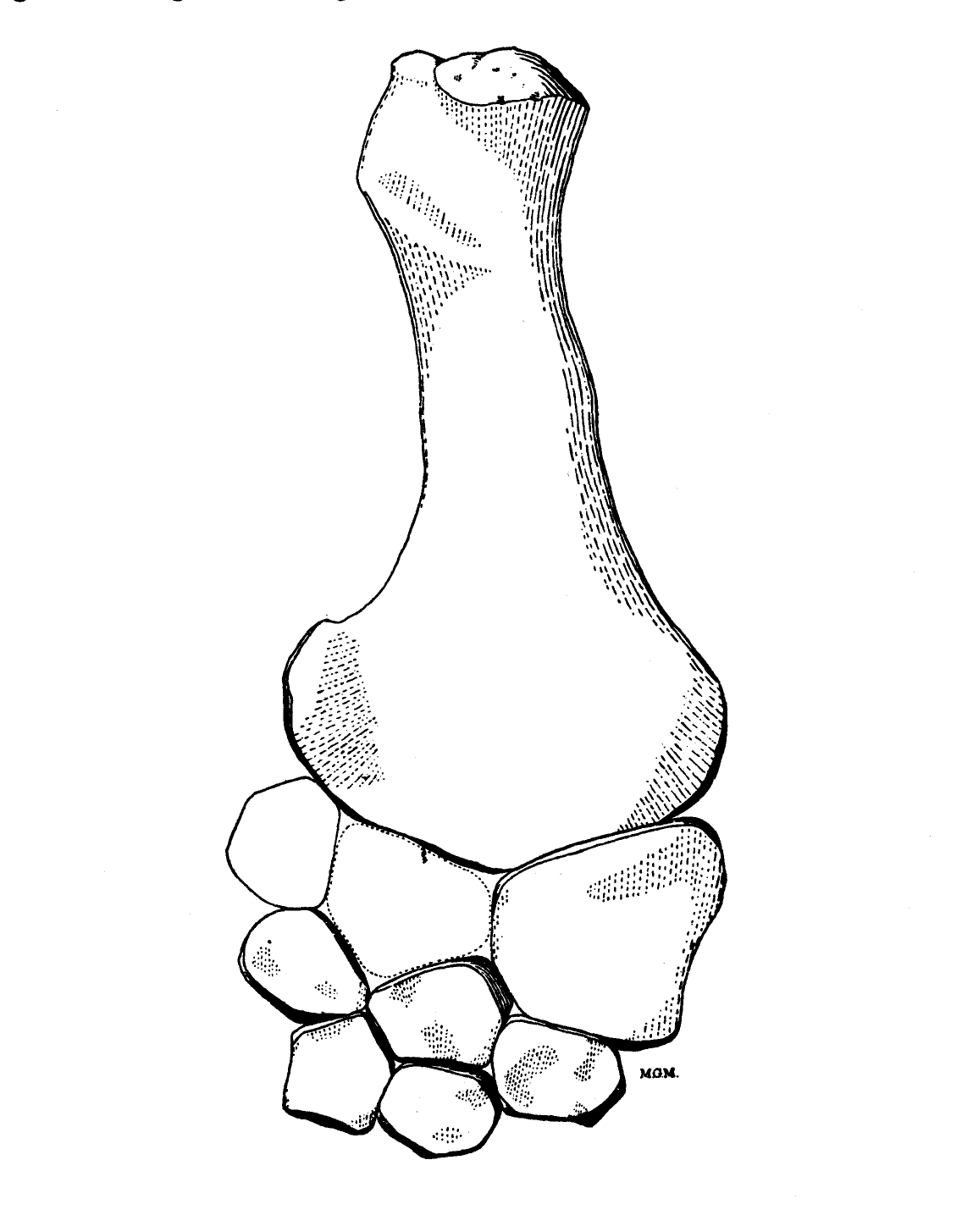
The morphology of the medial process of the scapula of Tatenectes is diagnostic of this genus. These processes are anteroposteriorly short, with the posterior ends of each process contacting the other along the midline and a notch separating their anterior ends. The top of this notch is overlain by a distinctive clavicle, which is flat and simple in morphology. The pectoral fenestra (an opening enclosed by the scapula and coracoid) is rounded and enlarged. The posterior region of the coracoid is much thinner than the rest of the pectoral girdle. The humerus has a slender, elongated shaft and is another bone with a distinctive shape. The surfaces of the humerus that articulated with the lower arm bones (radius and ulna) have roughly equal lengths. The humerus also bears articulations that indicate there were two additional bones in the lower arm. Tatenectes had six carpals (wrist bones). The metacarpals and proximal phalanges are mildly flattened, with a groove on each side of their top surfaces, while the distal phalanges are flattened more strongly. The pelvic girdle of Tatenectes is wider than long and has a flatter bottom surface than typical among plesiosaurs, making it short top-to-bottom. Each pubic bone is flat and plate-like, with a notch on its front rim forming a projection known as an anterolateral horn. The ischium is more robust where it forms the acetabulum, thinning posteriorly. The straight, gracile ilium forms an acute angle with the ischium when viewed from the side, yet another identifying characteristic.
Tatenectes has had a complicated taxonomic history. While it had previously been considered a species of Cimoliasaurus or Tricleidus, O'Keefe and Wahl found it to be the sister taxon of Kimmerosaurus in 2001. These two genera, as well as Aristonectes, were considered to be part of Cimoliasauridae, with Kaiwhekea being either a member of this family or its closest known relative. In 2009, O'Keefe and Street considered that utilizing the name "Cimoliasauridae" for this group was a poor choice since they found Cimoliasaurus to actually belong to a different group, Elasmosauridae. The group containing Tatenectes, Kimmerosaurus, Aristonectes, and Kaiwhekea was subsequently named Aristonectidae. However, in 2011, O'Keefe and colleagues noted the problematic nature of Aristonectes and Kaiwhekea. Due to their unusual morphology, these two genera are difficult to classify, making their relation to Tatenectes ambiguous. Further studies have recovered Tatenectes as a member of Cryptoclididae, where it is still found to be a close relative of Kimmerosaurus, in addition to Cryptoclidus. Aristonectes and Kaiwhekea, however, are now thought to be derived elasmosaurids known as aristonectines.
Hub AI
Tatenectes AI simulator
(@Tatenectes_simulator)
Tatenectes
Tatenectes is a genus of cryptoclidid plesiosaur known from the Upper Jurassic of Wyoming. Its remains were recovered from the Redwater Shale Member of the Sundance Formation, and initially described as a new species of Cimoliosaurus by Wilbur Clinton Knight in 1900. It was reassigned to Tricleidus by Maurice G. Mehl in 1912 before being given its own genus by O'Keefe and Wahl in 2003. Tatenectes laramiensis is the type and only species of Tatenectes. While the original specimen was lost, subsequent discoveries have revealed that Tatenectes was a very unusual plesiosaur. Its torso had a flattened, boxy cross-section and its gastralia (belly ribs) exhibit pachyostosis (thickening). The total length of Tatenectes has been estimated at 2–3 meters (6.6–9.8 ft).
Tatenectes is related to Kimmerosaurus, although their taxonomic placement has varied. They were once considered to be close relatives of Aristonectes in the family Cimoliasauridae or Aristonectidae, but later assigned to Cryptoclididae. The unusual body shape and pachyostotic gastralia of Tatenectes would have helped to make it more stable and resistant to turbulence. Based on stomach contents, Tatenectes fed on cephalopods and fish. It would have lived in the shallow waters of the Sundance Sea, an epicontinental sea covering much of North America during part of the Jurassic. Tatenectes shared its habitat with invertebrates, fish, ichthyosaurs, and other plesiosaurs, including another cryptoclidid, Pantosaurus, and the large pliosaurid Megalneusaurus.
All known specimens of Tatenectes come from the Redwater Shale Member in the upper part of the Sundance Formation. This formation is located in Wyoming, in the Eastern Rocky Mountains. An incomplete plesiosaur skeleton preserving multitudinous vertebrae and a nearly complete forelimb from the Sundance Formation was described by Wilbur C. Knight in 1900. With this specimen as a holotype, which was never assigned a specimen number, he named a new species of Cimoliosaurus, C. laramiensis. In 1912, Maurice G. Mehl questioned the assignment of C. laramiensis to Cimoliosaurus, noting that Cimoliosaurus was a catch-all, and that since this genus was named based on vertebrae, the vertebrae of C. laramiensis would have to be similar to those of the type species, C. magnus. He was unable to find such similarities, and provisionally reclassified C. laramiensis as a species of Tricleidus, due to the anatomy of its forelimbs.
Although the holotype specimen of T. laramiensis has since been lost, Knight's description of the specimen was sufficient to determine that T. laramiensis is a valid species. In 2003, F. Robin O'Keefe and William Wahl, JR. referred another specimen housed at the Tate Geological Museum to this species. This specimen, listed under the specimen numbers UW 15943 and UW 24801, consists of vertebrae, ribs, a shoulder girdle, a partial forelimb, and a fragmentary skull and was assigned as a neotype. Additionally, O'Keefe and Wahl noted that the shoulder girdle of this species was quite different from that of Tricleidus, so they named a new genus, Tatenectes, to include T. laramiensis. The name Tatenectes honours Marion and Inez Tate, founders of the Tate Museum in Casper, Wyoming in 1980 and combines this with the Greek word nektes, meaning "diver." O'Keefe and Hallie P. Street assigned more material to Tatenectes laramiensis in 2009, including UW 24215, a partial skeleton including further cranial, vertebral, pectoral, and phalangeal elements. Another skeleton, USNM 536976, was assigned to this species by O'Keefe and colleagues in 2011. This specimen preserved 22 vertebrae, ribs, gastralia, and complete pelves.
Tatenectes is a small plesiosaur, a group of marine reptiles well adapted to aquatic life. Tatenectes is a "plesiosauromorph", meaning that it would have had an elongated neck, small head, and longer humeri than femora, as opposed to the short necks and large skulls and femora of "pliosauromorphs". In 1900, Knight estimated that Tatenectes was probably less than 3.7 meters (12 ft). O'Keefe and Street later estimated a smaller total length of around 2 meters (6.6 ft) in 2009, although O'Keefe and colleagues gave a maximum length of 3 meters (9.8 ft) two years later. The overall shape of Tatenectes is very unusual among plesiosaurs, with the body being flattened and rather short back-to-front. The squamosals, bones located at the rear of the skull, are tall, three-pronged elements which form an arch over the back face of the skull. This structure, the squamosal arch, is an identifying plesiosaurian trait. There is an opening between the pterygoids (bones that form part of the palate) known as the anterior interpterygoid vacuity. Posterior to this opening, the pterygoids thicken and project downwards. When the skull is viewed from below, the parasphenoid (a bone located between the palate and braincase) is obscured by other bones. This palatal configuration is a distinctive characteristic of Tatenectes. Another such trait is the shape of its teeth, which were small and thin, bearing elongated roots and low enamel ridges.
The total number of cervical (neck) vertebrae in Tatenectes is unknown. The neural spines of these vertebrae are short and angled posteriorly. Many features of the cervical vertebrae can be used to identify this genus: the cervical centra (vertebral bodies) are considerably shorter (in length) than wide, and are not constricted in the middle; the articulations for the cervical ribs are short but pronounced; the articular faces of the cervical vertebrae are round and weakly defined; the subcentral foramina (two small openings on the underside of the centrum) of the cervical vertebrae are positioned further apart than typical in related plesiosaurs. The form of the torso in Tatenectes is very distinctive. Flattened and spheroid in shape, the torso has a somewhat boxy cross-section. There are sixteen dorsal (back) vertebrae in Tatenectes, which, when articulated, form a considerably flatter arch than seen in related taxa. The dorsal neural spines are inclined anteriorly. The dorsal ribs articulate with the vertebrae horizontally and are deflected backwards, contributing to the flatness of the body. The gastralia (belly ribs) Tatenectes are unusually large for its size that exhibit pachyostosis (thickening). The medial (midline) gastralia are relatively straight, while the lateral (outer) gastralia are strongly J-shaped. Tatenectes bears four sacral (hip) vertebrae, which are smaller than the dorsal vertebrae. The centra of the caudal (tail) vertebrae are anteroposteriorly short. All of the vertebrae have amphicoelous centra (bearing concave articular faces).
The morphology of the medial process of the scapula of Tatenectes is diagnostic of this genus. These processes are anteroposteriorly short, with the posterior ends of each process contacting the other along the midline and a notch separating their anterior ends. The top of this notch is overlain by a distinctive clavicle, which is flat and simple in morphology. The pectoral fenestra (an opening enclosed by the scapula and coracoid) is rounded and enlarged. The posterior region of the coracoid is much thinner than the rest of the pectoral girdle. The humerus has a slender, elongated shaft and is another bone with a distinctive shape. The surfaces of the humerus that articulated with the lower arm bones (radius and ulna) have roughly equal lengths. The humerus also bears articulations that indicate there were two additional bones in the lower arm. Tatenectes had six carpals (wrist bones). The metacarpals and proximal phalanges are mildly flattened, with a groove on each side of their top surfaces, while the distal phalanges are flattened more strongly. The pelvic girdle of Tatenectes is wider than long and has a flatter bottom surface than typical among plesiosaurs, making it short top-to-bottom. Each pubic bone is flat and plate-like, with a notch on its front rim forming a projection known as an anterolateral horn. The ischium is more robust where it forms the acetabulum, thinning posteriorly. The straight, gracile ilium forms an acute angle with the ischium when viewed from the side, yet another identifying characteristic.
Tatenectes has had a complicated taxonomic history. While it had previously been considered a species of Cimoliasaurus or Tricleidus, O'Keefe and Wahl found it to be the sister taxon of Kimmerosaurus in 2001. These two genera, as well as Aristonectes, were considered to be part of Cimoliasauridae, with Kaiwhekea being either a member of this family or its closest known relative. In 2009, O'Keefe and Street considered that utilizing the name "Cimoliasauridae" for this group was a poor choice since they found Cimoliasaurus to actually belong to a different group, Elasmosauridae. The group containing Tatenectes, Kimmerosaurus, Aristonectes, and Kaiwhekea was subsequently named Aristonectidae. However, in 2011, O'Keefe and colleagues noted the problematic nature of Aristonectes and Kaiwhekea. Due to their unusual morphology, these two genera are difficult to classify, making their relation to Tatenectes ambiguous. Further studies have recovered Tatenectes as a member of Cryptoclididae, where it is still found to be a close relative of Kimmerosaurus, in addition to Cryptoclidus. Aristonectes and Kaiwhekea, however, are now thought to be derived elasmosaurids known as aristonectines.
Recent media