Hubbry Logo
NeurocraniumNeurocraniumMain
Open search
Neurocranium
Community hub
Neurocranium
logo
8 pages, 0 posts
0 subscribers
Be the first to start a discussion here.
Neurocranium
Neurocranium
from Wikipedia
Neurocranium
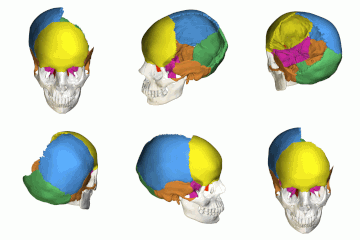
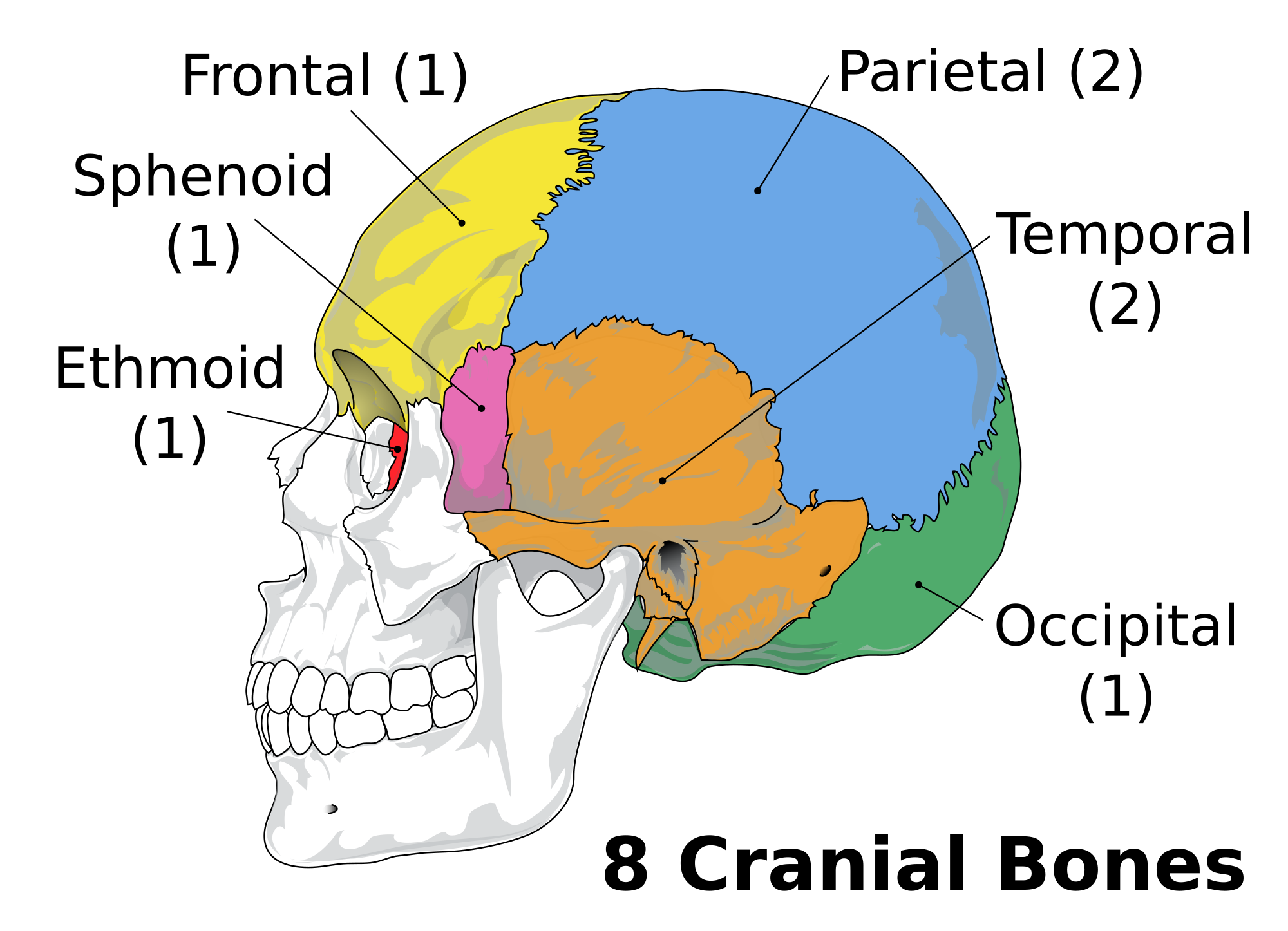
The eight bones that form the human neurocranium.
The eight cranial bones. (Facial bones are shown in transparent.)
  Yellow: Frontal bone (1)
  Blue: Parietal bone (2)
  Purple: Sphenoid bone (1)
  Brown: Temporal bone (2)
  Green: Occipital bone (1)
  Red: Ethmoid bone (1)
Details
Identifiers
Latinneurocranium
TA98A02.1.00.007
TA2354
FMA53672
Anatomical terms of bone

In human anatomy, the neurocranium, also known as the braincase, brainpan, brain-pan,[1][2] or brainbox, is the upper and back part of the skull, which forms a protective case around the brain.[3] In the human skull, the neurocranium includes the calvaria or skullcap. The remainder of the skull is the facial skeleton.

In comparative anatomy, neurocranium is sometimes used synonymously with endocranium or chondrocranium.[4]

Structure

[edit]

The neurocranium is divided into two portions:

In humans, the neurocranium is usually considered to include the following eight bones:

The ossicles (three on each side) are usually not included as bones of the neurocranium.[6] There may variably also be extra sutural bones present.

Below the neurocranium is a complex of openings (foramina) and bones, including the foramen magnum which houses the neural spine. The auditory bullae, located in the same region, aid in hearing.[7]

The size of the neurocranium is variable among mammals. The roof may contain ridges such as the temporal crests.

Development

[edit]

The neurocranium arises from paraxial mesoderm. There is also some contribution of ectomesenchyme. In Chondrichthyes and other cartilaginous vertebrates this portion of the cranium does not ossify; it is not replaced via endochondral ossification.

Other animals

[edit]

The neurocranium is formed by the combination of the endocranium, the lower portions of the cranial vault, and the skull roof. Through the course of evolution, the human neurocranium has expanded from comprising the back part of the mammalian skull to being also the upper part: during the evolutionary expansion of the brain, the neurocranium has overgrown the splanchnocranium. The upper-frontmost part of the cranium also houses the evolutionarily newest part of the mammal brain, the frontal lobes.

The braincase of Dilophosaurus, an extinct theropod dinosaur

In other vertebrates, the foramen magnum is oriented towards the back, rather than downwards. The braincase contains a greater number of bones, most of which are endochondral rather than dermal:[8]

  • The singular basioccipital is the rear lower part of the braincase, below the foramen magnum. It is homologous to the basilar part of the occipital bone. In the ancestral tetrapod, the basioccipital makes up most of a large central knob-like surface, the occipital condyle, which articulates with the vertebrae as a ball-and-socket joint. This plesiomorphic ("primitive") state is retained by modern reptiles and birds. The underside of the basioccipital may have a pair of large projections which act as neck muscle attachments: the basitubera (also known as basioccipital tubera or basal tubera)
  • The paired exoccipitals (singular: exoccipital) are visible at the rear of the braincase, adjacent to the foramen magnum and above the basioccipital. They are homologous to the lateral parts of the occipital bone. Modern amphibians and mammals have independently acquired inflated exoccipitals, acting as paired occipital condyles while the basioccipital is reduced and loses its connection to the vertebrae.
  • The singular supraoccipital is the rear upper part of the braincase, above the foramen magnum and below or behind the parietals or postparietals. It is homologous to the squamous part of the occipital bone, which is greatly enlarged in humans.
  • The paired opisthotics (singular: opisthotic) form most of the rear lateral part of the braincase, in front of the exoccipitals and above the foramen ovale. They also contribute to the paroccipital process, a lateral projection which acts as a buttress between the braincase and the outer skull bones. In many tetrapods, the opisthotic is fused to its corresponding exoccipital. The jugular foramen is usually found near the point of fusion.
  • The paired prootics (singular: prootic) form the lateral part of the braincase, in front of the opisthotics. The front edge of the prootic is typically deeply notched by the exit hole for the trigeminal nerve (V). Many other nerve exits are scattered among the prootic, opisthotic, and exoccipital. The prootic is homologous to the petrous part of the temporal bone (in humans) or the petrosal bone (in other mammals).
  • Some reptiles have a laterosphenoid in front of the prootic. This bone is present in archosaurs and a few other archosauromorphs, as well as the stem-turtle Proganochelys.
  • The singular basisphenoid forms the front lower part of the braincase, in front of the basioccipital and below the prootics. Each side of the basisphenoid hosts a basipterygoid process, a lateral rod which bends down and out to link to the pterygoid bones of the bony palate. The basisphenoid may also act as a component of the basitubera.
  • The singular parasphenoid is one of the few dermal components of the braincase, a flat plate below the basisphenoid. The parasphenoid acts as a component of the bony palate, wedging between the pterygoid bones and often ornamented with small tooth-like denticles. In many vertebrates the parasphenoid and basisphenoid are fused into a single bone, the parabasisphenoid. The front part of the parabasisphenoid is a blade-like structure, the cultriform process, which extends much further forward than the rest of the braincase.

Additional images

[edit]

See also

[edit]

References

[edit]
[edit]
[edit]
Revisions and contributorsEdit on WikipediaRead on Wikipedia
from Grokipedia
The neurocranium, also referred to as the braincase, is the portion of the that forms a bony protecting the and associated structures, distinguishing it from the viscerocranium that forms the . It consists of eight primary bones in adults: the anteriorly, two parietal bones superiorly, two temporal bones laterally, the posteriorly, the at the base, and the centrally. These bones articulate via fibrous sutures to create a rigid vault divided into the calvaria (dome-like superior portion) and the cranial base (inferior platform). The primary function of the neurocranium is to safeguard the , , , and sensory organs like the eyes within the orbits, while also providing attachment sites for and . It houses in bones such as the frontal, sphenoid, and ethmoid, which lighten the structure and humidify inhaled air. The cranial base subdivides into anterior, middle, and posterior fossae, accommodating the brain's lobes and vascular structures. Developmentally, the neurocranium arises from both (for the calvaria) and (for the base), with fontanelles present in infants allowing brain growth before suture fusion around age two.

Anatomy

Components and Bones

The neurocranium, also known as the braincase, consists of eight primary bones that collectively enclose and protect the within the . These bones are the single anteriorly, the paired parietal bones superiorly, the paired temporal bones laterally, the single posteriorly, the single centrally at the base, and the single anteriorly at the base. This arrangement forms a rigid vault that accommodates the adult , which has an average volume of 1,300–1,400 cm³. The neurocranium is structurally divided into the calvaria (skull cap), comprising the vault-like superior portion formed by the frontal, parietals, occipital, and squamous parts of the temporals, and the cranial base, the inferior floor including the sphenoid, ethmoid, petrous portions of the temporals, and basilar regions of the occipital and frontal bones. This distinction allows the calvaria to provide expansive coverage over the cerebral hemispheres while the base supports the and integrates with facial structures. The is a robust, unpaired bone that constitutes the anterior aspect of the neurocranium, forming the smooth convexity of the forehead and the superior roof of both orbits. Its external surface features prominent supraorbital ridges (or arches), which are thickened bony margins above the eyes providing protection and serving as attachment sites for the and corrugator supercilii; medially, these ridges meet at the , a midline elevation. Internally, the bone contributes to the , and it contains frontal sinuses that lighten the structure while aiding in voice resonance. The parietal bones, a pair of flat, quadrilateral plates, form the largest portion of the cranial vault's superior and lateral walls, creating the broad, curved roof over the parietal . Each parietal is trapezoid-shaped with convex external and concave internal surfaces, and they articulate with each other along the midline , a that extends from the coronal to the . Key features include the superior temporal lines, which arc across the external surface for attachment of the fascia, and the inferior temporal lines that mark the boundary with the ; these lines enhance structural reinforcement and muscle support. The temporal bones, a pair of complex, irregular bones positioned at the inferior lateral aspects of the neurocranium, each comprise three main regions: the thin, squamous portion superiorly blending into the calvaria; the dense, pyramid-shaped petrous portion housing the middle and structures; and the mastoid region posteriorly with its air-filled cells. Notable features include the external auditory meatus, a curved canal opening on the inferior squamous part that conducts to the tympanic , and the slender styloid process, a downward-projecting spike derived from that anchors muscles of the , , and , as well as ligaments stabilizing the . The petrous apex also contains the for the and the for IX–XI and the . The , an unpaired trapezoidal plate, forms the posterior wall and a significant portion of the cranial base, enclosing the occipital lobes and . Its external surface bears the —superior, highest, and lowest ridges that provide attachments for neck muscles like the and splenius capitis, facilitating head movement—and the , a midline bony projection for ligamentous anchorage. Inferiorly, two large, kidney-shaped project from the base, articulating with the atlas (C1 vertebra) via synovial joints to support the on the vertebral column; centrally, the bone features the , the largest opening through which the passes. The , an unpaired, irregular bone resembling a butterfly or bat in shape, occupies the central anterior portion of the cranial base, linking the neurocranium to the viscerocranium and forming parts of the middle , orbits, and . It consists of a cuboidal body containing the hypophyseal fossa (or ), a saddle-shaped depression that cradles the ; paired greater wings extending laterally to form the floor of the middle and parts of the temporal and orbital walls; paired lesser wings projecting anteriorly to contribute to the and orbital roofs; and paired pterygoid processes descending from the body, each with lateral and medial plates that anchor masticatory muscles and form the pterygopalatine and infratemporal fossae. The body also houses sphenoidal sinuses that communicate with the . The , an unpaired, lightweight cubic structure located anteriorly between the orbits, contributes to the , medial orbital walls, and roof. It comprises a horizontal superiorly, perforated by numerous foramina that transmit filaments (cranial nerve I) from the to the olfactory bulbs, enabling the ; a midline perpendicular plate that forms the superior ; and paired ethmoidal labyrinths (or lateral masses) containing ethmoidal air cells (sinuses) that form the superior and middle nasal conchae, which project into the to warm, humidify, and filter inhaled air while lightening the bone. The labyrinths' thin lamina papyracea forms the medial orbital walls, providing a fragile barrier vulnerable to orbital infections.

Articulations and Features

The neurocranium's bones are primarily integrated through immovable fibrous joints known as sutures, which provide stability while allowing limited growth during development. These include the , which articulates the with the two parietal bones; the , joining the two parietal bones along the midline; the , connecting the parietal bones to the posteriorly; and the , linking the parietal and temporal bones laterally. Sutures are a type of syndesmosis, characterized by dense fibrous that binds the bone edges without intervening . Additionally, the spheno-occipital serves as a temporary between the sphenoid and occipital bones, facilitating early base elongation before eventual ossification. Prominent surface features mark the intersections of these sutures, aiding in anatomical orientation and clinical assessment. The is the point where the coronal and sagittal sutures meet anteriorly, corresponding to the former site of the in infants. The represents a critical H-shaped junction involving the frontal, parietal, greater wing of the sphenoid, and squamous temporal bones, overlying the and serving as a thin, vulnerable region. Several foramina perforate the neurocranium to accommodate neurovascular structures. The , located in the , permits passage of the , , vertebral arteries, and the spinal roots of cranial nerve XI. The , formed between the temporal and s, transmits cranial nerves IX, X, and XI, along with the internal jugular vein and posterior meningeal artery. The , within the lesser wing of the , conveys the (cranial nerve II) and the . The internal acoustic meatus, on the petrous , houses the (cranial nerve VII) and (cranial nerve VIII), along with associated labyrinthine vessels. On its intracranial surfaces, the neurocranium supports dural folds and vascular channels that compartmentalize the . The , a sickle-shaped dural partition, attaches anteriorly to the of the and posteriorly to the internal occipital protuberance, extending downward between the cerebral hemispheres; its superior free edge houses the within a meningeal groove on the inner tables of the frontal and parietal bones. The tentorium cerebelli, a tent-like dural shelf, attaches along the posterior clinoid processes, superior petrous ridges of the temporal bones, and grooves for the , separating the occipital lobes from the and incorporating sinuses such as the straight and transverse for venous drainage. These inner surfaces also feature shallow grooves, or sulci, that accommodate the , including the running midsagittally along the vault.

Development

Embryological Formation

The embryological formation of the neurocranium begins during the third week of gestation with the induction of the neural plate from the ectoderm, followed by its folding and fusion to form the neural tube by the end of the fourth week. This process establishes the foundational axis for cranial development, with mesenchymal cells arising via epithelial-mesenchymal transformation from paraxial mesoderm and cranial neural crest cells by the end of week 3. Somites, derived from paraxial mesoderm, emerge in the occipital region during week 3 and differentiate into sclerotomes that contribute to the occipital bone's formation. Concurrently, neural crest cells delaminate from the dorsal neural tube during neural fold elevation and closure, migrating to populate the cranial mesenchyme and give rise to most neurocranial bones, with the exception of the parietal bones, which originate primarily from paraxial mesoderm. By weeks 6 to 7, the chondrocranium develops as a cartilaginous precursor to the neurocranium, with mesenchymal condensations forming around the to create key structures such as the presphenoid, basisphenoid, and parachordal cartilages. These elements arise from a combination of neural crest-derived cells for the anterior portions (e.g., presphenoid and basisphenoid) and mesodermal contributions for the posterior aspects, providing a supportive framework ventral to the developing . The chondrocranium's formation involves multiple chondrification centers that coalesce, setting the stage for subsequent while encasing the and early . The neurocranium undergoes ossification through two primary mechanisms: , which replaces in the ethmoid, sphenoid, and occipital base, and membranous (, which occurs directly from mesenchymal condensations in the frontal, parietal, and squamous portion of the temporal bones. The first ossification centers appear during week 8, initiating in the frontal and parietal bones at their eminences and spreading centrifugally, while endochondral centers in the cranial base emerge slightly later around week 12. Fusion patterns of these elements are regulated by signaling pathways, including , which establish anterior-posterior patterning along the and influence migration, and BMP signaling, which promotes mesenchymal condensation, chondrogenesis, and differentiation to guide fusion and growth.

Growth and Ossification

The postnatal growth of the neurocranium is characterized by rapid expansion to accommodate the tripling of volume in the first year of life, primarily through the flexible fontanelles and unfused sutures that allow for molding and enlargement. The , located at the junction of the frontal and parietal bones, typically measures about 2.1 cm at birth and closes between 13 and 26 months of age, while the closes much earlier, by 1 to 2 months. These membranous gaps enable the to adapt during delivery and subsequent growth, with head circumference increasing approximately 12 cm in the first year (from ~35 cm at birth to ~47 cm), then slowing to about 1-2 cm per year until age 5. Sutures, such as the metopic (frontal), begin fusing early, with complete closure by the second year, whereas the fuses around age 24, the sagittal around 22, and the lambdoid around 26-28 years, ensuring progressive stabilization as growth decelerates. Mechanisms of neurocranium growth involve appositional formation at the sutures, where osteoblasts deposit new layers on the external periosteal surface while osteoclasts resorb internally, driven by the expanding volume that exerts mechanical forces on the and sutures. This process adds perpendicular to the suture edges, contributing to the calvarial vault's increase in width, , and height, with the most rapid phase occurring in the first 2 years when 80% of adult is achieved. At the cranial base, predominates via , such as the spheno-occipital (SOS), which remains active for longitudinal growth until fusion between ages 18 and 20 (earlier in females at ~18 years), allowing the base to elongate and support facial development. These processes ensure coordinated expansion, with the vault growing faster initially than the base. Hormonal factors, including (GH) and thyroid hormone, regulate and overall cranial expansion, with GH promoting activity and bone deposition at sutures, while thyroid hormone influences maturation in the base's synchondroses. Deficiencies in these hormones can impair postnatal cranial growth, leading to reduced vault size. emerges prominently post-puberty, with male neurocrania becoming 10-15% larger than females due to higher GH and levels enhancing bone apposition, though minimal differences are evident before . By early adulthood, around age 25, the neurocranium achieves full , with all major sutures and synchondroses fused, marking the end of significant growth; however, minor remodeling persists lifelong through balanced and activity, adapting to mechanical stresses. This completion aligns with maturation, preventing further expansion while maintaining structural integrity.

Function

Protective Role

The neurocranium serves as the primary mechanical barrier safeguarding the from external impacts, with its rigid bony vault—particularly the calvaria—designed to absorb and dissipate forces. Biomechanical studies indicate that the calvaria can endure substantial loads before , with mean fracture forces ranging from 3.5 to 5.8 kN depending on the region, such as the temporoparietal area (3.5–3.6 kN) and (4.8–5.8 kN). The skull base contributes to this protection through its irregular, angled architecture, which distributes incoming forces laterally and inferiorly, thereby minimizing direct transmission to the vulnerable . Layered structural elements within the neurocranium enhance this defensive capacity. The calvarial bones feature an outer compact table, a central spongy diploë layer that acts as a shock absorber due to its trabecular architecture, and an inner compact table that contours closely to the brain surface. Complementing these bony layers, the meninges—comprising the tough dura mater adherent to the inner skull, the web-like arachnoid mater, and the delicate pia mater—encase the brain, while cerebrospinal fluid (CSF) in the subarachnoid space provides hydraulic cushioning against sudden movements or jolts. The neurocranium balances enclosure with functional access, incorporating foramina such as the , , and internal acoustic meatus that permit cranial nerve passage for sensory input while preserving overall structural integrity against intrusion. Quantitatively, average calvarial thickness measures 5–8 mm, conferring flexibility in force distribution, whereas the reaches 10–20 mm thick, optimizing protection around the structures involved in sound transmission.

Structural Support

The neurocranium encloses and supports the through its inner cranial fossae, which are depressions in the floor of the designed to conform to the shape of specific brain regions for enhanced stability. The , formed primarily by the and parts of the ethmoid and sphenoid bones, accommodates the frontal lobes of the . The middle cranial fossa, contributed to by the sphenoid and temporal bones, houses the temporal lobes. The , involving the occipital, temporal, and sphenoid bones, contains the and . Additionally, the inner surface of the neurocranium features convolutional markings, or impressions from the cerebral gyri and sulci, which provide a snug fit that minimizes brain movement within the . The neurocranium also facilitates vascular support for the brain by housing key venous and arterial structures. , such as the transverse and sigmoid sinuses, are embedded in grooves along the inner aspects of the bones, particularly within the tentorium cerebelli and along the occipital and temporal regions; these grooves protect the sinuses from external compression while allowing efficient drainage of from the into the internal jugular veins. Arterial supply to the is provided by the internal carotid arteries, which enter the via the carotid canals in the , and the vertebral arteries, which pass through the in the before forming the . Dural folds attach to specific bony projections within the neurocranium to further stabilize brain position. The , a midline dural separating the cerebral hemispheres, anchors anteriorly to the of the . The tentorium cerebelli, which divides the from the , attaches along the superior borders of the petrous ridges of the temporal bones. are supported through basal foramina and associated structures, such as the cavernous sinuses located lateral to the body of the , which transmit nerves III, IV, V1, V2, and VI alongside the . Biomechanically, the neurocranium, weighing approximately 1.5 kg in adults, distributes its weight onto the primarily through the of the , which articulate with the atlas (C1) vertebra. This condylar articulation enables flexion and extension of the head while maintaining balance and support for the enclosed .

Clinical Significance

Associated Disorders

refers to the premature fusion of one or more cranial sutures in the neurocranium, disrupting normal skull growth and leading to abnormal head shapes. The most common form is sagittal synostosis, accounting for approximately 50% of cases and resulting in , a long, narrow . The overall incidence is about 1 in 2,500 live births, with many cases linked to genetic mutations, particularly in the FGFR2 gene, which is implicated in syndromes such as Apert and Crouzon. These mutations cause excessive signaling in pathways, accelerating activity and suture closure. Paget's disease of bone involves disordered , leading to enlarged, weakened neurocranial bones that become thickened and brittle. It affects 1% to 3% of individuals over age 55 , with skull involvement occurring in 25% to 65% of cases. When the skull is affected, the disease often causes due to ossicle involvement or cochlear distortion, impacting up to 60% of patients with cranial lesions. The condition arises from overactive osteoclasts followed by compensatory activity, potentially increasing risk and secondary complications like . Cranial fractures compromise the neurocranium's protective integrity, commonly resulting from high-impact trauma and often associated with traumatic brain injury (TBI). Linear fractures, which constitute about 80% of skull fractures, appear as nondisplaced breaks without significant bone displacement. Depressed fractures involve inward buckling of the bone, potentially compressing underlying brain tissue, while basilar fractures traverse the skull base and carry risks of vascular or neural injury. Petrous temporal bone fractures, a subset of basilar types, are particularly prone to cerebrospinal fluid (CSF) leaks through the middle ear or mastoid air cells, occurring in up to 20% of basilar cases and heightening infection risk. Tumors affecting the neurocranium include meningiomas, which originate from dural arachnoid cells and account for roughly 30% of primary intracranial neoplasms, with about 70% classified as benign WHO grade I lesions. These tumors may erode or hyperostose the overlying , presenting with headaches, seizures, or focal neurological deficits depending on location and size. Primary bone tumors such as osteomas, benign slow-growing lesions of the , are less common but can cause localized swelling or pain if they impinge on adjacent structures. Symptoms for both types often include progressive headaches and cranial nerve palsies, underscoring the need for imaging to assess dural or osseous involvement.

Diagnostic and Therapeutic Approaches

Computed tomography (CT) scans are the gold standard for evaluating neurocranium bone abnormalities, offering high with slice thicknesses as low as 0.5-1 mm to precisely detect fractures, assess suture patency, and delineate bony architecture. This modality excels in trauma settings, where it identifies linear fractures and diastatic separations with sensitivity exceeding 95% when combined with 3D reconstructions. (MRI), particularly zero-echo-time sequences, complements CT by providing superior contrast for soft tissue-bone interfaces, such as dural involvement or marrow edema adjacent to the neurocranium. Plain radiographs serve as an accessible initial screening tool for suspected neurocranium fractures or gross deformities, though they have largely been supplanted by cross-sectional imaging for detailed assessment. Surgical interventions for neurocranium pathologies include in acute trauma, where a flap is removed to reduce and prevent herniation; the flap is typically preserved and replaced via 3-6 months post-procedure to allow brain recovery and minimize infection risk. For , endoscopic strip craniectomy is a minimally invasive option performed in infants, involving removal of the fused suture strip under endoscopic guidance followed by helmet therapy; when conducted before 6 months of age, it yields low complication rates of approximately 2% and reoperation rates under 5%, indicating high efficacy in achieving normalized cranial growth. Non-surgical approaches target specific neurocranium-involving conditions, such as bisphosphonates for Paget's disease, which suppress excessive activity and reduce bone turnover markers like by 50% or greater, thereby stabilizing calvarial deformities. , including stereotactic , is employed for meningiomas encroaching on the neurocranium, achieving 5-year local control rates of 85-90% with minimal morbidity. Ongoing monitoring in trauma cases often involves for real-time measurement, with therapeutic interventions triggered at thresholds exceeding 20 mmHg to avert secondary brain injury.

Comparative Anatomy

In Non-Human Mammals

The neurocranium in non-human mammals exhibits significant variations adapted to diverse lifestyles, body sizes, and sensory demands, reflecting evolutionary pressures on brain protection, sensory processing, and structural integrity. In rodents, the neurocranium often features a relatively thin cranial vault, which accommodates rapid growth and lightweight construction suited to small body sizes and agile foraging, while expanded regions associated with the olfactory system, such as enlarged nasal and ethmoid areas, support acute olfaction critical for survival in complex environments. In carnivores, the neurocranium is typically more robust, with reinforced occipital regions providing attachment sites for powerful neck muscles that enhance bite force during predation; for instance, species like wolves and lynx display prominent sagittal crests and mastoid processes that contribute to this structural strength. Primates show notable expansions in the neurocranium to house larger , particularly in the frontal and parietal regions, correlating with enhanced cognitive abilities; chimpanzees, for example, have brain volumes ranging from 275 to 500 cm³, substantially smaller than the average of approximately 1,300 cm³, yet this expansion still results in a more rounded compared to many other mammals. In cetaceans, the neurocranium undergoes telescoping, with overlapping bones and asymmetric temporal regions facilitating echolocation; this , more pronounced in odontocetes, directs sound production and reception, adapting the structure to aquatic and . Key structural differences further highlight these adaptations, such as reduced or incompletely fused sutures in some groups for flexibility during growth or locomotion. In cetaceans, many cranial sutures remain patent throughout life, allowing accommodation of the expanding telencephalon while maintaining for sensory functions. Ungulates often possess elongated snouts that position the more anteriorly, enhancing olfactory capabilities in grazing species like , where the overall elongation supports a long rostrum for environmental sensing. Burrowing mammals, such as moles, exhibit thickened cranial bases and robust construction to withstand soil pressures, with extensive suture fusion providing durability during activities. In basal mammals like monotremes, the neurocranium is reduced and simplified, with hard-to-discern sutures and a leathery sheath covering the elongate, beak-like rostrum, reflecting their primitive egg-laying reproductive strategy and semi-aquatic or terrestrial lifestyles; for example, in platypuses and echidnas, the absence of auditory bullae and reduced jugal bones contribute to this lightweight, flexible design. These variations underscore how neurocranial morphology balances brain enclosure with ecological demands across mammalian diversity.

Evolutionary Development

The neurocranium originated in early jawless vertebrates, known as agnathans, as a simple cartilaginous capsule enclosing the and sensory organs, primarily composed of mesodermal tissues without extensive . evidence from the period, approximately 455 million years ago (MYA), reveals the earliest three-dimensionally preserved neurocranium in stem-group gnathostomes like Eriptychius americanus, featuring modular cartilages that supported the and orbits but lacked fusion with the splanchnocranium. This basic structure persisted in cyclostomes (modern agnathans like lampreys), where the neurocranium consists of cellular cartilage including otic capsules for protection, reflecting an ancestral condition before the evolution of jaws. Ossification of the neurocranium began in placoderms, the earliest jawed vertebrates, around 420 MYA during the Silurian-Devonian transition, incorporating both dermal s for external armor and initial endochondral elements within the chondrocranium. By the period (~419–359 MYA), became dominant, replacing with in the neurocranium, as seen in early placoderms like Minjinia turgenensis, which exhibited extensive endochondral formation alongside perichondral . This shift enabled a more rigid for the expanding and sensory capsules, marking a key milestone in vertebrate head . In transitions, the chondrocranium retained otic capsules derived from and mesodermal cells, providing continuity from ancestors while adapting to in amphibians and reptiles. Amphibians and reptiles developed a more unified chondrocranium with expanded otic regions for balance and hearing, as evidenced by and developmental studies showing parachordal cartilage integration with otic capsules. Therapsid ancestors of mammals, emerging in the Permian (~299–252 MYA), introduced innovations like the secondary palate—a bony shelf separating nasal and oral cavities—and neomorphic bones such as the squamosal, which contributed to the temporal region and facilitated muscle reorganization. These changes supported increased masticatory efficiency and brain protection in synapsid lineages. Along the primate lineage, encephalization—the relative brain size increase measured by the encephalization quotient (EQ)—rose dramatically, from approximately 1 in early mammals to about 7.5 in humans, driving morphological adaptations like a rounded cranial vault and pronounced basicranial flexion. This EQ escalation, linked to expanded cerebral cortices, reduced basicranial angulation from nearly 180° in reptiles to around 90° in humans, allowing the brain to sit atop a flexed base without excessive skull elongation. Cranial sutures evolved in endothermic mammals to accommodate this postnatal brain growth, remaining patent longer than in ectotherms to enable expansive bone apposition via intramembranous ossification at suture edges. In primates, suture complexity and delayed fusion further supported vault expansion, reflecting heterochronic shifts tied to elevated metabolic rates and neural demands.

References

Add your contribution
Related Hubs
User Avatar
No comments yet.