Hubbry Logo
Taylor dispersionTaylor dispersionMain
Open search
Taylor dispersion
Community hub
Taylor dispersion
logo
7 pages, 0 posts
0 subscribers
Be the first to start a discussion here.
Contribute something
Taylor dispersion
Taylor dispersion
from Wikipedia

Taylor dispersion or Taylor diffusion is an apparent or effective diffusion of some scalar field arising on the large scale due to the presence of a strong, confined, zero-mean shear flow on the small scale. Essentially, the shear acts to smear out the concentration distribution in the direction of the flow, enhancing the rate at which it spreads in that direction.[1][2][3] The effect is named after the British fluid dynamicist G. I. Taylor, who described the shear-induced dispersion for large Peclet numbers. The analysis was later generalized by Rutherford Aris for arbitrary values of the Peclet number, and hence the process is sometimes also referred to as Taylor-Aris dispersion.

The canonical example is that of a simple diffusing species in uniform Poiseuille flow through a uniform circular pipe with no-flux boundary conditions, but is relevant in many other contexts, including the spread of pollutants in rivers and of drugs in blood flow[4] and rivulet flow.[5]

Description

[edit]

We use z as an axial coordinate and r as the radial coordinate, and assume axisymmetry. The pipe has radius a, and the fluid velocity is:

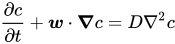
The concentration of the diffusing species is denoted c and its diffusivity is D. The concentration is assumed to be governed by the linear advection–diffusion equation:
The concentration and velocity are written as the sum of a cross-sectional average (indicated by an overbar) and a deviation (indicated by a prime), thus:


Under some assumptions (see below), it is possible to derive an equation just involving the average quantities:

Observe how the effective diffusivity multiplying the derivative on the right hand side is greater than the original value of diffusion coefficient, D. The effective diffusivity is often written as:
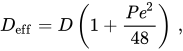
where is the Péclet number, based on the channel radius . The interesting result is that for large values of the Péclet number, the effective diffusivity is inversely proportional to the molecular diffusivity. The effect of Taylor dispersion is therefore more pronounced at higher Péclet numbers.

In a frame moving with the mean velocity, i.e., by introducing , the dispersion process becomes a purely diffusion process,

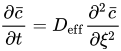
with diffusivity given by the effective diffusivity.

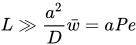
The assumption is that for given , which is the case if the length scale in the direction is long enough to smooth the gradient in the direction. This can be translated into the requirement that the length scale in the direction satisfies:

.

Dispersion is also a function of channel geometry. An interesting phenomenon for example is that the dispersion of a flow between two infinite flat plates and a rectangular channel, which is infinitely thin, differs approximately 8.75 times. Here the very small side walls of the rectangular channel have an enormous influence on the dispersion.

While the exact formula will not hold in more general circumstances, the mechanism still applies, and the effect is stronger at higher Péclet numbers. Taylor dispersion is of particular relevance for flows in porous media modelled by Darcy's law.[6]

Derivation

[edit]

One may derive the Taylor equation using method of averages, first introduced by Aris. The result can also be derived from large-time asymptotics, which is more intuitively clear. In the dimensional coordinate system , consider the fully-developed Poiseuille flow flowing inside a pipe of radius , where is the average velocity of the fluid. A species of concentration with some arbitrary distribution is to be released at somewhere inside the pipe at time . As long as this initial distribution is compact, for instance the species/solute is not released everywhere with finite concentration level, the species will be convected along the pipe with the mean velocity . In a frame moving with the mean velocity and scaled with following non-dimensional scales

where is the time required for the species to diffuse in the radial direction, is the diffusion coefficient of the species and is the Peclet number, the governing equations are given by

Thus in this moving frame, at times (in dimensional variables, ), the species will diffuse radially. It is clear then that when (in dimensional variables, ), diffusion in the radial direction will make the concentration uniform across the pipe, although however the species is still diffusing in the direction. Taylor dispersion quantifies this axial diffusion process for large .

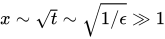
Suppose (i.e., times large in comparison with the radial diffusion time ), where is a small number. Then at these times, the concentration would spread to an axial extent . To quantify large-time behavior, the following rescalings[7]

can be introduced. The equation then becomes

If pipe walls do not absorb or react with the species, then the boundary condition must be satisfied at . Due to symmetry, at .

Since , the solution can be expanded in an asymptotic series, Substituting this series into the governing equation and collecting terms of different orders will lead to series of equations. At leading order, the equation obtained is

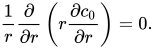
Integrating this equation with boundary conditions defined before, one finds . At this order, is still an unknown function. This fact that is independent of is an expected result since as already said, at times , the radial diffusion will dominate first and make the concentration uniform across the pipe.

Terms of order leads to the equation

Integrating this equation with respect to using the boundary conditions leads to

where is the value of at , an unknown function at this order.

Terms of order leads to the equation

This equation can also be integrated with respect to , but what is required is the solvability condition of the above equation. The solvability condition is obtained by multiplying the above equation by and integrating the whole equation from to . This is also the same as averaging the above equation over the radial direction. Using the boundary conditions and results obtained in the previous two orders, the solvability condition leads to


This is the required diffusion equation. Going back to the laboratory frame and dimensional variables, the equation becomes

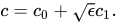
By the way in which this equation is derived, it can be seen that this is valid for in which changes significantly over a length scale (or more precisely on a scale . At the same time scale , at any small length scale about some location that moves with the mean flow, say , i.e., on the length scale , the concentration is no longer independent of , but is given by

Higher order asymptotics

[edit]

Integrating the equations obtained at the second order, we find

where is an unknown at this order.

Now collecting terms of order , we find


The solvability condition of the above equation yields the governing equation for as follows

See also

[edit]

References

[edit]

Other sources

[edit]
Revisions and contributorsEdit on WikipediaRead on Wikipedia
from Grokipedia
Taylor dispersion is a fundamental phenomenon in describing the enhanced longitudinal spreading of a passive scalar, such as a solute or , in a shear flow within a conduit, arising from the interplay between differential due to velocity variations across the cross-section and transverse that mixes the scalar between streamlines. This results in an effective dispersion that far exceeds alone, allowing the long-time behavior to be modeled as one-dimensional with an augmented . The concept was pioneered by British physicist Geoffrey Ingram Taylor in his 1953 analysis of solute transport in laminar Poiseuille flow through a circular tube, where he showed that after a characteristic time for radial equilibration (ta2/Dt \gg a^2 / D, with aa the tube radius and DD the molecular ), the variance of the solute distribution grows linearly with time, equivalent to with effective K=D+a2Um248DK = D + \frac{a^2 U_m^2}{48 D}, where UmU_m is the mean axial velocity. Taylor's work highlighted how the parabolic velocity profile causes faster-moving fluid near the center to carry solute ahead, while slower near-wall fluid lags it, with radial enabling this shear-induced spreading. In a follow-up 1954 study, Taylor extended the analysis to turbulent pipe flows, demonstrating similar enhancement but dominated by . In 1956, Ronald Aris provided a rigorous generalization using a method of moments, deriving the dispersion tensor for arbitrary duct cross-sections and velocity fields without assuming specific timescales, yielding K=D+1ADA(uU)TB(uU)dAK = D + \frac{1}{A D} \int_A (\mathbf{u} - \mathbf{U})^T \mathbf{B} (\mathbf{u} - \mathbf{U}) \, dA, where AA is the cross-sectional area, u\mathbf{u} the local , U\mathbf{U} the , and B\mathbf{B} the solution to a cell problem involving the transverse Laplacian. This framework, often called Taylor-Aris dispersion, applies to non-circular geometries and has been further extended to curved channels, porous media, and unsteady flows. Taylor dispersion plays a crucial role in numerous fields, including for modeling solute transport in rivers, estuaries, and where it explains observed anomalous spreading of pollutants or salts; applications like and reactor design; and physiological processes such as nutrient delivery in blood vessels or sap flow in plant . It also underpins analytical techniques like Taylor dispersion analysis for measuring coefficients of biomolecules. Despite its asymptotic nature—valid only after transverse mixing—the theory remains a cornerstone for understanding macroscale transport in microstructured flows.

Overview and History

Definition and Basic Principles

Taylor dispersion refers to the enhanced longitudinal spreading of a solute in a through a cylindrical tube, where the apparent dispersion exceeds that due to alone, arising from the interplay between the parabolic profile and radial . In steady, pressure-driven Poiseuille flow, the varies parabolically across the tube's cross-section, with fluid near the center moving faster than near the walls. Qualitatively, when a solute is introduced into the flow, particles near the tube's axis are advected downstream more rapidly than those near the boundaries, generating radial concentration gradients. Over time, molecular diffusion acts transversely to homogenize these gradients, allowing solute elements to sample different axial velocities and resulting in net longitudinal dispersion that scales with the square of the flow velocity. This process effectively couples advection and diffusion, leading to a Gaussian-like plume centered on the mean flow velocity. The phenomenon, first analyzed by G.I. Taylor in 1953, is named after him. The effective dispersion coefficient DeffD_\text{eff} captures this enhancement and is given by Deff=D+a2U248D,D_\text{eff} = D + \frac{a^2 U^2}{48 D}, where DD is the molecular diffusivity, aa is the tube radius, and UU is the mean flow velocity. Intuitively, the first term represents pure molecular diffusion, while the second term arises from the velocity shear, becoming dominant at high flow rates or large tube radii where radial mixing is slower relative to axial advection. For visualization, consider an initial narrow solute band injected into a straight tube: initially, it elongates unevenly due to the velocity profile, but after sufficient time for radial diffusion (on the order of a2/Da^2/D), the band broadens symmetrically into a dispersed plume traveling at mean speed UU.

Historical Development

The concept of Taylor dispersion emerged from investigations into the enhanced spreading of solutes in fluid flows due to the coupling of and . In 1953, Geoffrey Ingram Taylor published a seminal deriving the effective dispersion in laminar flow for miscible fluids introduced into a stream, demonstrating how radial across a parabolic profile leads to an apparent longitudinal that scales with the square of the tube and inversely with molecular . Taylor's work focused specifically on slow, steady flows in circular tubes, providing the foundational asymptotic approximation valid for long times after injection. Building directly on Taylor's framework, Rutherford Aris extended the theory in 1956 to arbitrary cross-sectional geometries using a method of moments, which systematically generates higher-order corrections to the dispersion coefficient without relying on specific velocity profiles. This generalization, often termed Taylor-Aris dispersion, broadened applicability beyond capillaries to ducts of varying shapes while preserving the core insight into flow-diffusion interactions. In the 1960s, the theory found practical traction in chromatographic contexts, where it was adapted to quantify coefficients from peak broadening in setups. A key early application came from J.C. Giddings and S.L. Seager, who in 1960 employed Taylor's dispersion principles to develop a rapid method for measuring using chromatographic apparatus, linking solute spreading to flow conditions in columns. By the 1970s, recognition grew for Taylor dispersion's role in environmental flows, such as solute in rivers and estuaries, where shear across profiles amplifies mixing over large scales. Pivotal advancements included applications to open-channel , as detailed in H.B. Fischer's monograph on mixing in inland and coastal waters, which integrated Taylor-Aris concepts to model longitudinal dispersion coefficients in natural streams. This era solidified the theory's utility beyond laboratory tubes to geophysical contexts. A comprehensive review by H. Brenner in 1982 further generalized dispersion phenomena to periodic porous media, influencing subsequent environmental modeling by addressing in flow paths.

Physical Mechanisms

Laminar Flow Velocity Profile

In steady through a cylindrical tube, the velocity profile is derived under the assumptions of low , incompressible , , no-slip boundary condition at the wall, and fully developed flow where entrance effects are negligible. These conditions ensure that inertial terms in the Navier-Stokes equations are small compared to viscous terms, allowing simplification to a balance between and viscous shear. The derivation begins with the steady-state Navier-Stokes momentum equation for an incompressible fluid in cylindrical coordinates (r,θ,z)(r, \theta, z), where the flow is unidirectional along the tube axis zz: ρ(vv)=p+μ2v+ρg.\rho \left( \mathbf{v} \cdot \nabla \mathbf{v} \right) = -\nabla p + \mu \nabla^2 \mathbf{v} + \rho \mathbf{g}. Assuming no body forces, steady state, and fully developed flow (vz=vz(r)v_z = v_z(r), vr=vθ=0v_r = v_\theta = 0), the inertial term vanishes, and the equation simplifies to 0=pz+μ1rr(rvzr),0 = -\frac{\partial p}{\partial z} + \mu \frac{1}{r} \frac{\partial}{\partial r} \left( r \frac{\partial v_z}{\partial r} \right), with constant pressure gradient p/z=ΔP/L\partial p / \partial z = -\Delta P / L, where ΔP\Delta P is the pressure drop over tube length LL. Integrating twice with boundary conditions vz(a)=0v_z(a) = 0 (no-slip at radius aa) and vz/r=0\partial v_z / \partial r = 0 at r=0r = 0 (symmetry) yields the parabolic velocity profile u(r)=ΔP4μL(a2r2),u(r) = \frac{\Delta P}{4 \mu L} (a^2 - r^2), where μ\mu is the fluid viscosity. The mean axial UU is obtained by integrating the profile over the cross-section and dividing by the area: U=a2ΔP8μL.U = \frac{a^2 \Delta P}{8 \mu L}. The maximum occurs at the centerline (r=0r = 0) and equals 2U2U. This parabolic profile results in shear across the tube, with varying from zero at the wall to 2U2U at the center, causing solute particles to experience differential depending on their radial position. In the context of Taylor dispersion, this variation is a prerequisite, as the steady, fully developed profile leads to initial radial segregation of solutes before diffusive mixing occurs.

Molecular Diffusion Effects

Molecular diffusion plays a central role in Taylor dispersion by enabling the mixing of solute particles across streamlines in , counteracting the effects of varying velocities. The process is governed by Fick's first law, which describes the diffusive flux J\mathbf{J} of a solute as J=Dc\mathbf{J} = -D \nabla c, where DD is the molecular diffusivity and cc is the concentration; in simple fluids, DD is isotropic, assuming no preferred direction for . This law underpins the transport equation for solute concentration, combining with due to flow. Transverse (radial) is particularly crucial, as it homogenizes solute concentration across the tube's cross-section, where velocity gradients—such as those from the parabolic profile—initially create radial variations in concentration. Over a characteristic timescale τd=a2/D\tau_d = a^2 / D, with aa the tube , radial allows solute molecules to sample different axial velocities, leading to enhanced longitudinal spreading. In contrast, longitudinal becomes negligible compared to the effective dispersion when the Pe=Ua/D>1\mathrm{Pe} = U a / D > 1, where UU is the mean flow velocity; here, convective effects dominate over pure axial . Without any , solute would remain stratified along streamlines indefinitely under pure , preventing cross-sectional mixing. For the full Taylor dispersion regime to develop, the radial diffusion timescale τd\tau_d must be comparable to or shorter than the flow L/UL / U, with LL the tube length, ensuring sufficient radial equilibration during transit.

Mathematical Formulation

Governing Equations

The transport of a solute in laminar tube flow is described by the advection-diffusion equation in cylindrical coordinates, with the axial direction denoted by zz and time by tt: ct+u(r)cz=D(2cz2+1rr(rcr)),\frac{\partial c}{\partial t} + u(r) \frac{\partial c}{\partial z} = D \left( \frac{\partial^2 c}{\partial z^2} + \frac{1}{r} \frac{\partial}{\partial r} \left( r \frac{\partial c}{\partial r} \right) \right), where c(r,z,t)c(r, z, t) is the solute concentration, u(r)u(r) is the radial-dependent axial velocity, DD is the constant coefficient, and rr is the radial coordinate. This formulation assumes an incompressible with steady and constant properties, including DD. In the high regime, where convective transport dominates over axial , the 2c/z2\partial^2 c / \partial z^2 term is often negligible, emphasizing the role of radial in coupling with the parabolic profile. The velocity u(r)u(r) follows the Poiseuille profile for pressure-driven flow in a circular tube of radius aa. Appropriate boundary conditions include no-flux at the impermeable tube wall, c/r=0\partial c / \partial r = 0 at r=ar = a, and symmetry at the centerline, c/r=0\partial c / \partial r = 0 at r=0r = 0. The initial condition typically models a uniform solute injection across the tube cross-section at t=0t = 0, such as a delta-function slug in zz. The equation is linear, permitting in principle, but the analytical solution remains complex owing to the strong coupling between the radial-dependent and diffusive terms.

Asymptotic Derivation

The asymptotic derivation of the effective one-dimensional model for Taylor dispersion relies on a perturbation analysis in the regime of long observation times ta2/Dt \gg a^2 / D and axial distances zaz \gg a, where aa is the tube radius and DD is the coefficient. This separation of scales permits treating the radial variations as fast-equilibrating compared to the slow axial evolution of the cross-sectionally averaged concentration. The starting point is the two-dimensional -diffusion equation in cylindrical coordinates for axisymmetric flow, c/t+u(r)c/z=D(2c/r2+(1/r)c/r+2c/z2)\partial c / \partial t + u(r) \partial c / \partial z = D \left( \partial^2 c / \partial r^2 + (1/r) \partial c / \partial r + \partial^2 c / \partial z^2 \right), where c(r,z,t)c(r,z,t) is the solute concentration and u(r)u(r) is the radial-dependent axial velocity. Under these conditions, the concentration is expanded asymptotically as c(r,z,t)c0(z,t)+χ(r)c0/z+c(r,z,t) \approx c_0(z,t) + \chi(r) \partial c_0 / \partial z + \cdots, where U=uU = \langle u \rangle is the mean velocity and higher-order terms are neglected. The function χ(r)\chi(r) captures the radial deviation due to velocity shear and satisfies the auxiliary Poisson equation for radial equilibrium, D(d2χ/dr2+(1/r)dχ/dr)=u(r)UD \left( d^2 \chi / dr^2 + (1/r) d \chi / dr \right) = u(r) - U, subject to boundary conditions dχ/drr=0=0d\chi/dr|_{r=0} = 0 () and χ(a)=0\chi(a) = 0 (no flux at the wall). This equation balances the transverse against the shear-induced radial concentration gradients. Averaging the expanded concentration over the tube cross-section, defined as c=(2/a2)0ac(r,z,t)rdr\langle c \rangle = (2/a^2) \int_0^a c(r,z,t) r \, dr, enforces χ=0\langle \chi \rangle = 0 to ensure the correction does not contribute to the leading-order . Substituting the expansion into the governing , neglecting the small axial term 2c/z2\partial^2 c / \partial z^2 relative to radial at leading order, and performing the cross-sectional average (which eliminates radial contributions by the no-flux boundary) yields the effective one-dimensional advection- , ct+Ucz=Deff2cz2,\frac{\partial \langle c \rangle}{\partial t} + U \frac{\partial \langle c \rangle}{\partial z} = D_{\rm eff} \frac{\partial^2 \langle c \rangle}{\partial z^2}, where the effective dispersion is Deff=Duχ=D+(uU)(χ)D_{\rm eff} = D - \langle u \chi \rangle = D + \langle (u - U) (-\chi) \rangle. For laminar Poiseuille flow in a circular tube, u(r)=2U(1r2/a2)u(r) = 2U (1 - r^2/a^2), explicit solution of the auxiliary gives χ(r)=Ua2D[14(ra)218(ra)418]\chi(r) = \frac{U a^2}{D} \left[ \frac{1}{4} \left( \frac{r}{a} \right)^2 - \frac{1}{8} \left( \frac{r}{a} \right)^4 - \frac{1}{8} \right], and evaluating the yields the classic result Deff=D+a2U2/(48D)D_{\rm eff} = D + a^2 U^2 / (48 D). This enhancement arises from the variance in the velocity profile, (uU)2=U2/3\langle (u - U)^2 \rangle = U^2 / 3, convolved with the diffusive equilibration time a2/Da^2 / D. The derivation holds under the condition of high Pe=Ua/D1\mathrm{Pe} = U a / D \gg 1, ensuring radial equilibrates much faster than axial , and a nondimensional axial development length (L/a)(D/(Ua))1(L / a) (D / (U a)) \gg 1, where LL is the characteristic axial scale over which c0c_0 varies, allowing the radial profile to fully adjust before significant axial changes occur.

Applications and Extensions

Practical Uses in Separation Techniques

In , Taylor dispersion arises from the coupling of and the velocity profile, leading to axial band broadening that limits separation resolution by increasing peak widths. This effect is minimized through the use of small diameters, which reduce the contribution proportional to the square of the , and by employing electroosmotic flow, whose nearly plug-like velocity profile significantly flattens the flow compared to parabolic pressure-driven profiles, thereby suppressing dispersion. In gas and liquid chromatography, particularly within open-tubular columns, the effective diffusion coefficient derived from Taylor dispersion predicts solute band broadening, enabling accurate modeling of separation efficiency. Height equivalent to a theoretical plate (HETP) models incorporate the Taylor-Aris term a2U248D\frac{a^2 U^2}{48 D}, where aa is the tube radius, UU is the average flow velocity, and DD is the molecular diffusion coefficient, to quantify the dispersion-induced contribution to plate height. The Golay equation integrates the Taylor dispersion term, with the contribution to HETP from dispersion given by r2u24Dm\frac{r^2 u}{24 D_m}, yielding a minimum HETP of approximately r3\frac{r}{\sqrt{3}}
Add your contribution
Related Hubs
Contribute something
User Avatar
No comments yet.