


Community hub
Recent from talks
Contribute something
Nothing was collected or created yet.
Tel Aviv Promenade
View on Wikipedia | This article includes a list of references, related reading, or external links, but its sources remain unclear because it lacks inline citations. (October 2014) |

Key Information


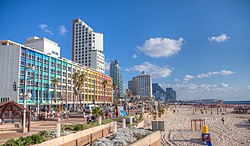
Tel Aviv Promenade (Hebrew: טיילת תל אביב-יפו, commonly referred to in Hebrew simply as the Tayelet, הטיילת - "The Promenade") runs along the Mediterranean seashore in Tel Aviv, Israel.
History
[edit]In the late 1930s, the city council decided to build a promenade for separation between bathing areas and hiking or promenading paths. It extended from Bograshov Beach to where Jerusalem (formerly Geula) Beach is located now. The introduction of the promenade was a turning point in common perception of the city's coastline.
At the same time, World War II started in September 1939, and the British Mandate Regime prohibited bathing in the beach. As a result of that, the city's beaches were abandoned and neglected. In addition, the developing new city was pouring its sewage to the sea and the beaches were banned for bathing for sanitary reasons. Seaside hotels and cafés were turning into questionable bars, gambling joints and brothels. The public abstained from the area, and the city's recreational centers were transferred to the city center, to areas such as Dizengoff Street.
In 1942, London Square was founded in the northern part of the promenade. In 1953, Gan-haAtsmaut (Independence Garden) was founded on the gravel hill above Hilton Beach. In 1965, at the time of the opening of the port of Ashdod, the ports of Tel Aviv and Jaffa were closed.
In the 1980s Shafdan, the Dan District sewage treatment facility, was founded, and the sewage was transferred to the plant and not to the sea. That enabled the cleansing of the beaches and preparations to be made in order to open them again to the public for bathing. During that period, tombolo breakwaters were placed, causing significant expansion of the beaches allowing a greater number of people to enter. In the scope of the project, beach facilities were restored and reopened.

In 2011, the municipality of Tel Aviv restored and renovated the promenade, and today it runs from the port of Tel Aviv to the port of Jaffa.
Sections
[edit]
- Tel Baruch Promenade - Tel Baruch Promenade runs between Tel Baruch Beach in the north and the Yarkon River in the south. It opened in 2009 in an area previously belonging to Reading Power Station and Sde Dov Airfield. The construction of the promenade required a long pedestrian bridge over the power station's docks. It is paved with concrete, with separate trails for pedestrians and bicyclists. The eastern side, adjacent to Sde Dov, is lined with shore vegetation, while the western side allows access to the undeclared beach along it. This section of the promenade is mostly secluded from the city, although there are plans for significant construction along it, should the airfield be relocated.
- Port Promenade - The Port Promenade runs along the restored Tel Aviv Port, between the mouth of the Yarkon River and Metzizim Beach. It opened in 2005, and it is made up of a wooden deck built along the Port's old sea wall. It is mostly commercial in nature, with many coffee houses, restaurants and shops, but without any bathing beaches.
- Metzizim/Hilton Promenade - This promenade runs between Metzizim Beach in the north and Gordon Beach in the south. This promenade has two distinct sections: an older one between Metzizim and Hilton Beaches and a newer one between Hilton and Gordon. It is somewhat narrower than Lahat Promenade because of its location between the kurkar (lithified sea sand) bluffs and the beach.
- Lahat Promenade (Herbert Samuel St.) - The main promenade in Tel Aviv, leading from Gordon beach to Aviv beach. The promenade was built in 1939 as a narrow promenade, elevated above sea level. In the 1980s it was demolished in preparation for reconstruction. In 1982, the first section was opened for public. The new promenade is broad and paved with pebbles. It is separated from the beach by a narrow strip of shore vegetation. On the promenade are several artistic sculptures and memorial plaques. In 1998, the promenade was renamed in honor of former mayor Shlomo Lahat, who was in office during the construction years and promoted the process.
- Sha'ar Le'Yafo Promenade (Gate to Jaffa promenade) - The section that links Charles Clore Park and Jaffa.
- Khomot ha'Yam Promenade (Sea barriers promenade) The section that links Sha'ar Le'Yafo Promenade and the Jaffa Port. The outline of the demolished ancient walls of Jaffa are marked out on the promenade pavement.
See also
[edit]References
[edit]External links
[edit]
- Beaches, a Tel Aviv Municipality webpage
- Promenade of Tel-Aviv Israel 60, Tel-Aviv 100 - Photo by Lev Borodulin
- 10 places to visit around Tel aviv Promenade
Tel Aviv Promenade
View on GrokipediaHistory
Origins and Early Development
The origins of the Tel Aviv Promenade trace back to the early 1930s during the British Mandate period, when Tel Aviv's municipal leaders recognized the seashore's potential as a key asset for economic growth, tourism, and public recreation amid rapid population expansion. Influenced by European seaside models such as Nice and Brighton, Mayor Meir Dizengoff prioritized coastal development to position the city as a modern resort destination, emphasizing hygiene, leisure, and health benefits for residents and visitors.[6][7] In 1933, the municipality launched an architectural competition for a comprehensive seashore plan, but it produced no viable winner, prompting Dizengoff to commission Jewish-French engineer Claude Gruenblatt to develop an alternative.[8][7] Gruenblatt's 1936 proposal, approved that year, envisioned an ambitious foreshore reclamation project featuring sea walls, 4- to 5-story hotels and clubs, galleries, and a central public garden to create a "Tel Aviv Riviera," but it faced strong public opposition for potentially privatizing beach access and altering the natural shoreline.[9][7] In response, the city pivoted to a more modest design by municipal engineer Ya’akov Ben Sira, who advocated for public-oriented infrastructure to mediate between urban and natural spaces while maintaining open access.[8] This shift aligned with broader Mandate-era urban planning influences, including Patrick Geddes' 1925 Town Planning Report, which emphasized integrating green spaces and pedestrian pathways into Tel Aviv's layout to foster social cohesion and recreational use.[10] Funded through municipal resources and a British loan, construction began in the late 1930s, reflecting the city's semi-autonomous decision-making under British oversight to adopt European standards for seaside infrastructure.[7] Completed in 1939–1940, the initial promenade was a narrow, elevated concrete path raised above sea level, stretching approximately 1.5 kilometers from Bograshov Beach in the north to Jerusalem Beach (formerly Geula Beach) in the south along the Mediterranean coast.[8] Its primary purpose was to separate overcrowded bathing zones from dedicated promenading paths, thereby organizing pedestrian traffic, reducing congestion on the sand, and promoting orderly seaside leisure without encroaching on the beach itself.[8][7] Early features included basic concrete paving for durability against coastal conditions, simple benches for resting, and formal rows of trees providing shade and an urban aesthetic, all designed to enhance views of the sea while dividing the shoreline into distinct sections: southern sandy beaches for bathing, a central tourist strip, and northern areas for general public use.[8][7] This foundational structure established the promenade as a vital public amenity, embodying Tel Aviv-Yafo's emerging identity as a vibrant, pedestrian-friendly coastal metropolis.[10]Mid-20th Century Neglect and Changes
The outbreak of World War II in September 1939 led to significant disruptions for Tel Aviv's nascent seaside infrastructure, as the British Mandate authorities imposed a ban on beach bathing to mitigate security risks amid wartime tensions. This prohibition, enacted shortly after the promenade's early development in the 1930s, resulted in the abandonment and initial neglect of the city's beaches, with public access curtailed and maintenance efforts redirected toward more pressing defense needs.[11] Following Israel's independence in 1948, rapid urbanization exacerbated environmental challenges along the promenade, as untreated sewage from the growing Tel Aviv-Yafo area was discharged directly into the Mediterranean through multiple outfalls, causing severe beach pollution and closures throughout the 1950s to 1970s. This deterioration rendered much of the shoreline unusable for recreation, with bacterial contamination levels prompting repeated shutdowns and contributing to the physical decay of the promenade's walkways and adjacent facilities. Urban expansion pressures during this period prioritized inland infrastructure, such as housing and commercial developments, over coastal maintenance, further allowing erosion and underuse to afflict the seaside path.[12][13][14] Amid these challenges, minor adaptive developments occurred, including the 1942 establishment of London Square in the northern section of the promenade, dedicated by the Tel Aviv municipality to honor London's resilience during the Blitz bombings. In 1953, Gan HaAtsmaut (Independence Park) was created on a gravel mound overlooking the central beaches, providing a landscaped green space that offered limited respite from the polluted waterfront below. The 1965 closure of the Tel Aviv and Jaffa ports, following the opening of the larger Ashdod facility, reshaped southern access to the promenade by vacating industrial harbor areas but initially leaving them underutilized and disconnected from pedestrian pathways.[15][16][5]Reconstruction and Expansion
In the 1980s, the establishment of the Shafdan wastewater treatment plant in the Dan Region south of Tel Aviv marked a pivotal advancement in addressing long-standing sewage pollution that had rendered the city's beaches unusable during the mid-20th century.[17] By diverting municipal sewage away from direct discharge into the Mediterranean Sea through a completed city-wide sanitary sewer system in 1982, Shafdan enabled comprehensive beach cleanups and the subsequent rebuilding of the promenade infrastructure.[8] This environmental remediation also facilitated breakwater expansions along the coastline, which widened the beaches and supported the promenade's physical reconstruction.[8] The central section of the promenade underwent its initial major reconstruction in 1982 under the leadership of Mayor Shlomo Lahat, who championed the project to revitalize the neglected waterfront as a public leisure space.[18] The first segment opened to the public that August, featuring a broader, pebble-paved walkway elevated above sea level, with a second phase completed in 1984 to extend connectivity.[8] In recognition of Lahat's contributions during his tenure from 1974 to 1993, the central promenade was renamed the Shlomo Lahat Promenade in 1998.[8] Subsequent expansions in the early 2000s further integrated the promenade into Tel Aviv's urban fabric, with the Port Promenade opening in 2005 as a wooden-deck extension along the historic Tel Aviv Port's sea wall, emphasizing commercial development with cafes and leisure facilities.[8] The Tel Baruch Promenade followed in 2009, connecting the Yarkon River mouth northward to Tel Baruch Beach and incorporating naturalistic coastal elements near the Reading Power Plant.[19] By the early 2010s, municipal efforts had unified the promenade over its full approximately 14 km extent from Tel Baruch Beach in the north to Jaffa in the south, with major renovations culminating in 2018 to enhance accessibility and landscaping throughout.[18][4] These phased projects were driven by significant municipal investments through entities like Atarim, a state-municipal corporation, which allocated resources to construct high-rise hotels, upscale cafes, and supporting infrastructure along the waterfront to stimulate tourism and economic recovery in the post-neglect era.[8] The efforts transformed the promenade into a continuous pedestrian and cycling route, attracting millions of visitors annually and reinforcing Tel Aviv's identity as a vibrant coastal destination.[18]Overview and Design
Location and Extent
The Tel Aviv Promenade, also known as the Tayelet, extends approximately 11 kilometers along the Mediterranean Sea coastline of Tel Aviv-Yafo, tracing a continuous route from Tel Baruch Beach in the north—adjacent to the Yarkon River estuary—to Jaffa Port in the south.[1][2][3] This path follows the city's western edge, offering unobstructed views of the sea while paralleling the urban shoreline. The promenade integrates closely with Tel Aviv-Yafo's diverse urban fabric, bordering northern residential districts characterized by high-rise apartments and green spaces near the Yarkon River, the vibrant central beachfront lined with hotels, shops, and entertainment venues, and the ancient, culturally rich areas of southern Jaffa with its archaeological sites and mixed Arab-Jewish neighborhoods. Its coastal positioning places it within a densely populated metropolitan area of over 4 million as of 2025 in the greater region, where urban expansion meets the natural shoreline.[20][21] Environmentally, the walkway is elevated roughly 2.5 meters above the adjacent beaches and sea level, shielding it from tidal fluctuations and sand accumulation while exposing it to Mediterranean breezes and seasonal weather patterns that influence visitor patterns. This elevation facilitates a separation between pedestrian activity and beach recreation, enhancing safety amid the high urban density of approximately 8,000 residents per square kilometer in core areas.[22] Multiple access points ensure connectivity, with stairways and ramps linking to inland streets such as HaYarkon Street in the central section, and proximity to public transport including bus lines (e.g., routes 5 and 10) that stop near key beach entrances like Frishman and Gordon Beaches. These connections support seamless integration with the city's extensive transit network, including the nearby Tel Aviv Savidor Central railway station about 2 kilometers inland.[23][24] The promenade's extent originated in the 1930s as an initial seaside path and underwent significant expansion through renovations in the 2010s.[25][26]Architectural and Infrastructure Features
The Tel Aviv Promenade incorporates varied paving materials to ensure durability in the face of coastal erosion, including concrete bases for structural stability, bamboo wood decking in lower sections for ecological compatibility and aesthetic appeal, and pebble surfaces in select areas to facilitate natural drainage and resist wave impact.[22][27][4] Throughout its length, the promenade features distinct infrastructure elements, such as separate upper-level walkways dedicated to pedestrians, cyclists, and skaters, alongside lower terraced platforms that provide seamless beach access via stairs and ramps designed for accessibility, including wheelchair and stroller use.[27][22][4] Engineering adaptations emphasize resilience against environmental challenges, with the upper promenade elevated approximately 2.5 meters above sea level to mitigate flood risks from rising tides and storm surges, while integrated features like terraced benches, shaded recreational areas using eco-friendly materials, and strategic lighting enhance usability without compromising the coastal ecosystem.[22] In the late 1970s and 1980s, offshore breakwater projects, including a second phase of four detached structures completed in 1976, combined with subsequent beach nourishment efforts, significantly shaped the adjacent shoreline by forming tombolos that expanded beach widths and stabilized the coast, thereby supporting the promenade's foundational infrastructure against erosion.[28]Route and Sections
Northern Sections
The northern sections of the Tel Aviv Promenade begin at Tel Baruch Beach and extend southward to Metzizim Beach, forming the quieter, more expansive starting point of the overall 11-kilometer coastal pathway. These areas emphasize recreational green spaces and commercial integration, contrasting with the denser urban energy further south.[29] The Tel Baruch Promenade, which opened in 2009, stretches from the Yarkon River outlet to the Tel Aviv Port, providing wide pedestrian and cycling paths that connect residential neighborhoods to the shoreline.[30] Key features include a steel pedestrian bridge spanning the Yarkon River mouth, designed to facilitate safe access while preserving natural river flow, and integrated green areas with picnic spots and fitness stations suitable for families.[31] Its proximity to Yarkon Park enhances its appeal as a transitional zone between urban greenery and beachfront, with low-rise residential surroundings contributing to a serene atmosphere.[32] Adjacent to this, the Port Promenade, completed as part of the Tel Aviv Port's public space regeneration in 2008, runs from the port complex to Metzizim Beach, featuring a 14,000-square-meter wooden deck elevated along the historic sea wall.[29] This section incorporates commercial elements such as boutique shops, seafood restaurants, and cafes overlooking the marina, where visitors can observe yacht activity and enjoy sunset views over the Mediterranean.[33] The design by Mayslits Kassif Architects prioritizes fluid circulation with wave-inspired contours in the decking, blending functionality with aesthetic appeal to attract both locals and tourists.[34] Collectively, these northern portions foster a family-oriented environment with reduced urban density, ample open spaces for walking and relaxation, and easy access to natural amenities like the Yarkon River estuary, making them ideal for leisurely outings away from the city's core bustle.[35]Central Sections
The central sections of the Tel Aviv Promenade encompass the bustling urban core stretching from Metzizim Beach to Frishman Beach, forming a vital link between the city's northern port areas and southern cultural zones.[36] This segment is characterized by its high pedestrian traffic, drawing locals and tourists alike for its seamless integration of beachfront leisure with urban energy, particularly around landmark hotels like the Hilton Tel Aviv, which provides direct access to the promenade from Independence Park.[37] The area's narrower design in certain stretches enhances its intimate feel, fostering a vibrant atmosphere conducive to tourism and daily recreation.[5] The Metzizim/Hilton Promenade, spanning from Metzizim Beach to Gordon Beach, features a distinctive layout with two contrasting parts: an older southern portion reflecting earlier 20th-century construction and a newer northern section that aligns with post-1980s enhancements.[36] This narrower walkway, approximately 1 kilometer long, hugs the coastline closely, offering unobstructed views of the Mediterranean while accommodating heavy foot traffic from nearby residential and hospitality hubs.[38] Its proximity to family-oriented beaches like Metzizim, with calm shallow waters, contributes to the section's appeal as a transitional space blending relaxation and accessibility.[36] Adjoining this is the Lahat Promenade, extending from Gordon Beach to Frishman Beach, a lively 1.5-kilometer stretch rebuilt in 1982 under the leadership of Mayor Shlomo Lahat to revitalize the neglected shoreline.[5] Renamed the Shlomo Lahat Promenade in 1998 to honor the former mayor's contributions, it boasts wide, pebble-paved paths designed for pedestrians and cyclists, lined with energetic cafe strips that amplify the beachfront's dynamic vibe.[38][39] The 1980s reconstruction played a pivotal role in transforming this core area into a thriving hub, boosting tourism through improved infrastructure and seamless hotel integrations like the Hilton.[5] Frishman Beach at its southern end adds to the vibrancy with its fine sands and family-friendly facilities, sustaining the promenade's role as a central artery for urban beach life.[36]Southern Sections
The southern sections of the Tel Aviv Promenade transition from the urban vibrancy of central Tel Aviv into the historic embrace of Jaffa, emphasizing heritage and contemplative spaces. The Sha'ar Le'Yafo Promenade, serving as the primary link between Charles Clore Park and Jaffa, features winding paths that traverse lush gardens and elevated walkways, providing unobstructed views of the Mediterranean Sea and the remnants of ancient port infrastructure below.[5] This segment, developed in the late 20th century amid broader coastal revitalization efforts, invites pedestrians to experience a gradual shift from sandy beaches to rocky shorelines, with design elements that prioritize accessibility and scenic integration.[14] Further south, the Khomot ha'Yam Promenade marks the final stretch to Jaffa Port, where modern paved pathways blend seamlessly with archaeological features, including visible outlines of ancient sea walls and excavated remnants of Ottoman-era fortifications that once defended the old city.[40] This approximately 0.5-kilometer boardwalk hugs the coastline, offering close proximity to historical sites while allowing visitors to trace the evolution of Jaffa's maritime past through interpretive markers and preserved structures. The closure of Jaffa Port in 1965, following the opening of the larger Ashdod facility, significantly influenced this area's transformation, repurposing former industrial zones into pedestrian-friendly promenades that enhance public access to the sea.[5] These southern sections embody a distinctive cultural mosaic, intertwining Jewish and Arab influences through architectural echoes of Jaffa's multicultural history, from Ottoman mosques to ancient synagogues integrated into the old city fabric. Quieter than their northern counterparts, the paths foster serene exploration leading directly to Jaffa's winding alleys and flea market, culminating in prime sunset viewing spots where the sun dips behind the minarets and clock tower, casting a warm glow over the port.[14] This blend of tranquility and heritage makes the area a favored retreat for locals and visitors seeking reflection amid the promenade's overall dynamism.[41]Attractions and Amenities
Beaches and Parks
The Tel Aviv Promenade is bordered by several prominent beaches that form an integral part of its coastal appeal, including Gordon Beach, Frishman Beach, Hilton Beach, Metzizim Beach, Alma Beach, and Charles Clore Beach. These beaches stretch along the Mediterranean shoreline, providing wide sandy expanses for recreation. In the 1980s, the construction of tombolo breakwaters significantly expanded the beach widths by trapping sand and reducing erosion, allowing for broader usable areas that accommodate larger crowds during peak seasons.[42][26] Adjacent to the promenade, green spaces enhance the recreational environment with dedicated parks offering shaded areas and family-friendly facilities. Gan HaAtzmaut, established in 1953 as one of Tel Aviv's early coastal parks, overlooks Hilton Beach and features lawns suitable for relaxation and gatherings. Charles Clore Park, located at the southern end near Alma and Charles Clore Beaches, spans approximately 30 acres of reclaimed land with rolling hills, barbecue spots, and playgrounds that connect seamlessly to the promenade's pathways.[26][43][44] Further north, the promenade links to Yarkon Park along the Yarkon River, providing additional picnic areas, playgrounds, and cycling paths that extend the green corridor inland.[45] Beach management along the promenade emphasizes safety and environmental quality, with lifeguard stations operational at all major beaches during the swimming season from April to October. These stations, staffed by trained personnel, monitor water conditions and enforce safety protocols to prevent accidents. Cleanliness has improved markedly since the completion of the Shafdan wastewater treatment plant in 1987, which processes sewage from the Tel Aviv metropolitan area and prevents untreated discharge into the sea, resulting in cleaner waters suitable for swimming and sunbathing.[1][46] Seasonal usage peaks in summer for sunbathing and water activities, while off-season periods see reduced crowds focused on walking and jogging along the adjacent paths.[36]Sculptures, Memorials, and Installations
The Tel Aviv Promenade features several notable sculptures that enhance its coastal aesthetic, including the iconic headstand statue of David Ben-Gurion, created by artist Itzik Ben Malka and installed in 2015 near Gordon Beach. This unconventional bronze sculpture depicts Israel's first prime minister performing a headstand, referencing his interest in the Feldenkrais Method for physical therapy, and serves as a playful tribute to his legacy while promoting nearby historical sites.[47][48] Wave-themed installations are prominent along the promenade, particularly from the 2011 municipal restoration, where the pebble paving was designed in undulating patterns to mimic ocean waves, complemented by curved railings that evoke the sea's movement. These elements, integrated into the walkway's architecture, create a seamless visual connection between the urban path and the Mediterranean shoreline.[19][49] Abstract modern art pieces, such as Gideon Graetz's "Gordon's Knot" sculpture—a bronze and stainless steel structure inspired by the Gordian Knot legend—are positioned near the promenade's central sections, symbolizing resilience and historical ties. Installed as part of broader urban enhancements, it adds a contemplative dimension to the beachfront environment.[47] Memorials along the promenade commemorate significant historical events, including the Altalena Memorial, a modest stone monument marking the 1948 sinking of the Irgun arms ship Altalena off Tel Aviv's coast during the early days of Israel's independence. Located in the central section near Frishman Beach, it honors the 16 fighters killed in the incident and stands as a poignant reminder of the nation's founding conflicts.[50][51] Another key memorial is the Cafe Apropo commemoration, a subtle abstract sculpture resembling a stylized female form or tree trunk, erected near Ben-Gurion Boulevard to remember the three women killed in a 1997 suicide bombing at the nearby cafe. This understated installation reflects Tel Aviv's history of resilience amid security challenges.[47] The promenade, renamed in 1998 to honor former mayor Shlomo Lahat for his role in its 1980s expansion, includes memorial plaques acknowledging his contributions to the city's coastal development. These plaques, embedded along the path, highlight Lahat's vision for transforming the esplanade into a vibrant public space.[39] Temporary exhibits and installations periodically appear, such as the July 2025 memorial installation, where 893 chairs bearing photographs of fallen Israeli soldiers were placed along the promenade to commemorate those lost in conflicts since October 7, 2023, fostering public reflection and solidarity. Organized by the Ministry of Foreign Affairs and partners, this interactive display emphasized community mourning and unity.[52][53] Street furniture incorporates artistic elements, including sculptural benches and lighting fixtures designed during the 2011 restoration to blend functionality with modern design, such as contoured seating that echoes the wave motifs and LED installations that illuminate the path at night. These features enhance accessibility while contributing to the promenade's cultural ambiance.[19][25]Cultural and Recreational Significance
Daily Activities and Usage
The Tel Aviv Promenade, stretching along the Mediterranean coastline, is a hub for routine physical activities that integrate seamlessly into the daily lives of residents and visitors. Locals frequently use the separated paths for walking, jogging, and cycling, taking advantage of the fresh sea air and scenic views to maintain fitness routines.[54] These activities are particularly popular in the evenings, when cooler temperatures draw crowds for leisurely strolls and people-watching, as well as during summer months from May to October, which see peak usage with approximately 8.5 million bathers annually.[54] Sunset viewing along the promenade adds a social dimension, allowing individuals to unwind while observing the vibrant mix of passersby.[55] Demographic patterns reflect the promenade's role as a multifaceted urban space, attracting locals for regular exercise, tourists for relaxed exploration, and families especially on weekends for casual outings.[56] Early mornings appeal to dedicated joggers and cyclists seeking quieter conditions, while evenings and weekends intensify activity with diverse groups, including young people and families enjoying the open layout.[57] This broad appeal underscores its function as an accessible corridor in the bustling Tel Aviv-Yafo metropolis, where the infrastructure of wide, well-maintained paths supports spontaneous daily engagement without the need for organized events.[58] Supporting these routines are practical amenities like numerous benches for resting, water fountains for hydration, and pet-friendly zones adjacent to dog beaches such as Hilton Beach, making the space inclusive for pet owners.[59][60] These features enhance usability, encouraging prolonged stays and repeat visits. The promenade promotes health and social benefits by fostering an active lifestyle in an urban setting, contributing to Tel Aviv's reputation as one of the world's healthiest cities through accessible exercise and community interaction amid the Mediterranean environment.[61]Events and Public Gatherings
The Tel Aviv Promenade serves as a primary venue for the annual Tel Aviv Pride Parade, one of the largest LGBTQ+ events in the Middle East, which typically routes along the beachfront boardwalk from central streets like Ben Zion Boulevard and Bograshov Street to Charles Clore Park.[62][63] Typically held in June, the parade attracts approximately 250,000 to 300,000 participants, including locals and international visitors, featuring floats, live performances, and a concluding beach festival. The 2025 event, planned for June 13, was canceled due to security concerns arising from Iranian strikes.[62][63][64] Other recurring annual events include beach volleyball tournaments at Gordon Beach, such as the Tazuz Beach Volleyball League and the International Gay Beach Volleyball Tournament tied to Pride Week, drawing competitive teams and spectators to the promenade's northern sections.[65][66] New Year's Eve gatherings often spill onto the promenade's beaches, with informal celebrations featuring music and fireworks along the coastal path.[67] Cultural happenings along the promenade include street performances by buskers and musicians, contributing to its vibrant atmosphere, particularly in the evenings near popular beachfront areas.[55] At the northern Port Promenade, the Namal Tel Aviv hosts weekly markets, such as the Friday Farmers' Market with over 50 vendors offering fresh produce, artisanal cheeses, and gourmet items, alongside weekend events like food fairs and live music sessions.[68][69] Yoga and wellness sessions occasionally occur in adjacent parks like Charles Clore Park, fostering community engagement during organized outdoor classes.[70] The promenade plays a significant public role as a site for protests and national celebrations, exemplified by the 2023 "Red Line" demonstrations where thousands of women formed a human chain along the beachfront to oppose judicial overhaul plans.[71] On Independence Day (Yom Ha'atzmaut), it hosts fireworks displays, outdoor performances, and Israeli Air Force flyovers along the beaches, drawing crowds for patriotic gatherings.[72] Following the 2011 municipal renovation that extended and modernized the pathway from Tel Aviv Port to Jaffa Port, the promenade has emerged as a key space for community meetups, including social justice vigils and local festivals.[19] These events significantly boost the local economy by spiking tourism, with the Pride Parade alone generating an estimated NIS 162 million in 2019 through 25,000 to 30,000 international visitors who spend about 140% more per day than average tourists on accommodations, dining, and entertainment.[62][73] Similar influxes from markets, sports tournaments, and holiday celebrations enhance revenue for nearby businesses and reinforce the promenade's status as a tourism anchor.[74]References
- https://commons.wikimedia.org/wiki/Category:Altalena_memorial_%28Tel_Aviv_promenade%29