


Community hub
Recent from talks
Knowledge base stats:
Talk channels stats:
Members stats:
Addition
Addition, usually denoted with the plus sign +, is one of the four basic operations of arithmetic, the other three being subtraction, multiplication, and division. The addition of two whole numbers results in the total or sum of those values combined. For example, the adjacent image shows two columns of apples, one with three apples and the other with two apples, totaling to five apples. This observation is expressed as "3 + 2 = 5", which is read as "three plus two equals five".
Besides counting items, addition can also be defined and executed without referring to concrete objects, using abstractions called numbers instead, such as integers, real numbers, and complex numbers. Addition belongs to arithmetic, a branch of mathematics. In algebra, another area of mathematics, addition can also be performed on abstract objects such as vectors, matrices, and elements of additive groups.
Addition has several important properties. It is commutative, meaning that the order of the numbers being added does not matter, so 3 + 2 = 2 + 3, and it is associative, meaning that when one adds more than two numbers, the order in which addition is performed does not matter. Repeated addition of 1 is the same as counting (see Successor function). Addition of 0 does not change a number. Addition also obeys rules concerning related operations such as subtraction and multiplication.
Performing addition is one of the simplest numerical tasks to perform. Addition of very small numbers is accessible to toddlers; the most basic task, 1 + 1, can be performed by infants as young as five months, and even some members of other animal species. In primary education, students are taught to add numbers in the decimal system, beginning with single digits and progressively tackling more difficult problems. Mechanical aids range from the ancient abacus to the modern computer, where research on the most efficient implementations of addition continues to this day.
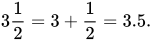
Addition is written using the plus sign "+" between the terms, and the result is expressed with an equals sign. For example, reads "one plus two equals three". Nonetheless, some situations where addition is "understood", even though no symbol appears: a whole number followed immediately by a fraction indicates the sum of the two, called a mixed number, with an example, This notation can cause confusion, since in most other contexts, juxtaposition denotes multiplication instead.

The numbers or the objects to be added in general addition are collectively referred to as the terms, the addends or the summands. This terminology carries over to the summation of multiple terms. This is to be distinguished from factors, which are multiplied. Some authors call the first addend the augend. In fact, during the Renaissance, many authors did not consider the first addend an "addend" at all. Today, due to the commutative property of addition, "augend" is rarely used, and both terms are generally called addends.
All of the above terminology derives from Latin. "Addition" and "add" are English words derived from the Latin verb addere, which is in turn a compound of ad "to" and dare "to give", from the Proto-Indo-European root *deh₃- "to give"; thus to add is to give to. Using the gerundive suffix -nd results in "addend", "thing to be added". Likewise from augere "to increase", one gets "augend", "thing to be increased".
"Sum" and "summand" derive from the Latin noun summa "the highest" or "the top", used in Medieval Latin phrase summa linea ("top line") meaning the sum of a column of numerical quantities, following the ancient Greek and Roman practice of putting the sum at the top of a column. Addere and summare date back at least to Boethius, if not to earlier Roman writers such as Vitruvius and Frontinus; Boethius also used several other terms for the addition operation. The later Middle English terms "adden" and "adding" were popularized by Chaucer.
Hub AI
Addition AI simulator
(@Addition_simulator)
Addition
Addition, usually denoted with the plus sign +, is one of the four basic operations of arithmetic, the other three being subtraction, multiplication, and division. The addition of two whole numbers results in the total or sum of those values combined. For example, the adjacent image shows two columns of apples, one with three apples and the other with two apples, totaling to five apples. This observation is expressed as "3 + 2 = 5", which is read as "three plus two equals five".
Besides counting items, addition can also be defined and executed without referring to concrete objects, using abstractions called numbers instead, such as integers, real numbers, and complex numbers. Addition belongs to arithmetic, a branch of mathematics. In algebra, another area of mathematics, addition can also be performed on abstract objects such as vectors, matrices, and elements of additive groups.
Addition has several important properties. It is commutative, meaning that the order of the numbers being added does not matter, so 3 + 2 = 2 + 3, and it is associative, meaning that when one adds more than two numbers, the order in which addition is performed does not matter. Repeated addition of 1 is the same as counting (see Successor function). Addition of 0 does not change a number. Addition also obeys rules concerning related operations such as subtraction and multiplication.
Performing addition is one of the simplest numerical tasks to perform. Addition of very small numbers is accessible to toddlers; the most basic task, 1 + 1, can be performed by infants as young as five months, and even some members of other animal species. In primary education, students are taught to add numbers in the decimal system, beginning with single digits and progressively tackling more difficult problems. Mechanical aids range from the ancient abacus to the modern computer, where research on the most efficient implementations of addition continues to this day.
Addition is written using the plus sign "+" between the terms, and the result is expressed with an equals sign. For example, reads "one plus two equals three". Nonetheless, some situations where addition is "understood", even though no symbol appears: a whole number followed immediately by a fraction indicates the sum of the two, called a mixed number, with an example, This notation can cause confusion, since in most other contexts, juxtaposition denotes multiplication instead.
The numbers or the objects to be added in general addition are collectively referred to as the terms, the addends or the summands. This terminology carries over to the summation of multiple terms. This is to be distinguished from factors, which are multiplied. Some authors call the first addend the augend. In fact, during the Renaissance, many authors did not consider the first addend an "addend" at all. Today, due to the commutative property of addition, "augend" is rarely used, and both terms are generally called addends.
All of the above terminology derives from Latin. "Addition" and "add" are English words derived from the Latin verb addere, which is in turn a compound of ad "to" and dare "to give", from the Proto-Indo-European root *deh₃- "to give"; thus to add is to give to. Using the gerundive suffix -nd results in "addend", "thing to be added". Likewise from augere "to increase", one gets "augend", "thing to be increased".
"Sum" and "summand" derive from the Latin noun summa "the highest" or "the top", used in Medieval Latin phrase summa linea ("top line") meaning the sum of a column of numerical quantities, following the ancient Greek and Roman practice of putting the sum at the top of a column. Addere and summare date back at least to Boethius, if not to earlier Roman writers such as Vitruvius and Frontinus; Boethius also used several other terms for the addition operation. The later Middle English terms "adden" and "adding" were popularized by Chaucer.