

Addition
View on Wikipedia

Addition, usually denoted with the plus sign +, is one of the four basic operations of arithmetic, the other three being subtraction, multiplication, and division. The addition of two whole numbers results in the total or sum of those values combined. For example, the adjacent image shows two columns of apples, one with three apples and the other with two apples, totaling to five apples. This observation is expressed as "3 + 2 = 5", which is read as "three plus two equals five".
Besides counting items, addition can also be defined and executed without referring to concrete objects, using abstractions called numbers instead, such as integers, real numbers, and complex numbers. Addition belongs to arithmetic, a branch of mathematics. In algebra, another area of mathematics, addition can also be performed on abstract objects such as vectors, matrices, and elements of additive groups.
Addition has several important properties. It is commutative, meaning that the order of the numbers being added does not matter, so 3 + 2 = 2 + 3, and it is associative, meaning that when one adds more than two numbers, the order in which addition is performed does not matter. Repeated addition of 1 is the same as counting (see Successor function). Addition of 0 does not change a number. Addition also obeys rules concerning related operations such as subtraction and multiplication.
Performing addition is one of the simplest numerical tasks to perform. Addition of very small numbers is accessible to toddlers; the most basic task, 1 + 1, can be performed by infants as young as five months, and even some members of other animal species. In primary education, students are taught to add numbers in the decimal system, beginning with single digits and progressively tackling more difficult problems. Mechanical aids range from the ancient abacus to the modern computer, where research on the most efficient implementations of addition continues to this day.
| Arithmetic operations | ||||||||||||||||||||||||||||||||||||||||||
|
||||||||||||||||||||||||||||||||||||||||||



![{\displaystyle \scriptstyle \left.{\begin{matrix}\scriptstyle {\frac {\scriptstyle {\text{dividend}}}{\scriptstyle {\text{divisor}}}}\\[1ex]\scriptstyle {\frac {\scriptstyle {\text{numerator}}}{\scriptstyle {\text{denominator}}}}\end{matrix}}\right\}\,=\,}](https://wikimedia.org/api/rest_v1/media/math/render/svg/5d5d22ff59234f0d437be740306e8dd905991e1e)


![{\displaystyle \scriptstyle {\sqrt[{\text{degree}}]{\scriptstyle {\text{radicand}}}}\,=\,}](https://wikimedia.org/api/rest_v1/media/math/render/svg/5582d567e7e7fbcdb728291770905e09beb0ea18)



Notation and terminology
[edit]
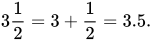
Addition is written using the plus sign "+" between the terms, and the result is expressed with an equals sign. For example, reads "one plus two equals three".[2] Nonetheless, some situations where addition is "understood", even though no symbol appears: a whole number followed immediately by a fraction indicates the sum of the two, called a mixed number, with an example,[3] This notation can cause confusion, since in most other contexts, juxtaposition denotes multiplication instead.[4]


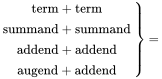
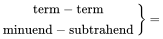
The numbers or the objects to be added in general addition are collectively referred to as the terms,[5] the addends or the summands.[2] This terminology carries over to the summation of multiple terms. This is to be distinguished from factors, which are multiplied. Some authors call the first addend the augend.[6] In fact, during the Renaissance, many authors did not consider the first addend an "addend" at all. Today, due to the commutative property of addition, "augend" is rarely used, and both terms are generally called addends.[7]
All of the above terminology derives from Latin. "Addition" and "add" are English words derived from the Latin verb addere, which is in turn a compound of ad "to" and dare "to give", from the Proto-Indo-European root *deh₃- "to give"; thus to add is to give to.[7] Using the gerundive suffix -nd results in "addend", "thing to be added".[a] Likewise from augere "to increase", one gets "augend", "thing to be increased".[8]

"Sum" and "summand" derive from the Latin noun summa "the highest" or "the top", used in Medieval Latin phrase summa linea ("top line") meaning the sum of a column of numerical quantities, following the ancient Greek and Roman practice of putting the sum at the top of a column.[10] Addere and summare date back at least to Boethius, if not to earlier Roman writers such as Vitruvius and Frontinus; Boethius also used several other terms for the addition operation. The later Middle English terms "adden" and "adding" were popularized by Chaucer.[11]
Definition and interpretations
[edit]Addition is one of the four basic operations of arithmetic, with the other three being subtraction, multiplication, and division. This operation works by adding two or more terms.[12] An arbitrary of many operation of additions is called the summation.[13] An infinite summation is a delicate procedure known as a series,[14] and it can be expressed through capital sigma notation , which compactly denotes iteration of the operation of addition based on the given indexes.[15] For example,


Addition is used to model many physical processes. Even for the simple case of adding natural numbers, there are many possible interpretations and even more visual representations.
Combining sets
[edit]

Possibly the most basic interpretation of addition lies in combining sets, that is:[2]
When two or more disjoint collections are combined into a single collection, the number of objects in the single collection is the sum of the numbers of objects in the original collections.
This interpretation is easy to visualize, with little danger of ambiguity. It is also useful in higher mathematics (for the rigorous definition it inspires, see § Natural numbers below). However, it is not obvious how one should extend this interpretation to include fractional or negative numbers.[16]
One possibility is to consider collections of objects that can be easily divided, such as pies or, still better, segmented rods. Rather than solely combining collections of segments, rods can be joined end-to-end, which illustrates another conception of addition: adding not the rods but the lengths of the rods.[17]
Extending a length
[edit]


A second interpretation of addition comes from extending an initial length by a given length:[18]
When an original length is extended by a given amount, the final length is the sum of the original length and the length of the extension.
The sum can be interpreted as a binary operation that combines and algebraically, or it can be interpreted as the addition of more units to . Under the latter interpretation, the parts of a sum play asymmetric roles, and the operation is viewed as applying the unary operation to .[19] Instead of calling both and addends, it is more appropriate to call the "augend" in this case, since plays a passive role. The unary view is also useful when discussing subtraction, because each unary addition operation has an inverse unary subtraction operation, and vice versa.


Properties
[edit]Commutativity
[edit]
Addition is commutative, meaning that one can change the order of the terms in a sum, but still get the same result. Symbolically, if and are any two numbers, then:[20] The fact that addition is commutative is known as the "commutative law of addition"[21] or "commutative property of addition".[22] Some other binary operations are commutative too as in multiplication,[23] but others are not as in subtraction and division.[24]

Associativity
[edit]
Addition is associative, which means that when three or more numbers are added together, the order of operations does not change the result. For any three numbers , , and , it is true that:[25] For example, .



When addition is used together with other operations, the order of operations becomes important. In the standard order of operations, addition is a lower priority than exponentiation, nth roots, multiplication and division, but is given equal priority to subtraction.[26]
Identity element
[edit]
Adding zero to any number does not change the number. In other words, zero is the identity element for addition, and is also known as the additive identity. In symbols, for every , one has:[25] This law was first identified in Brahmagupta's Brahmasphutasiddhanta in 628 AD, although he wrote it as three separate laws, depending on whether is negative, positive, or zero itself, and he used words rather than algebraic symbols. Later Indian mathematicians refined the concept; around the year 830, Mahavira wrote, "zero becomes the same as what is added to it", corresponding to the unary statement . In the 12th century, Bhaskara wrote, "In the addition of cipher, or subtraction of it, the quantity, positive or negative, remains the same", corresponding to the unary statement .[27]



Successor
[edit]Within the context of integers, addition of one also plays a special role: for any integer , the integer is the least integer greater than , also known as the successor of . For instance, 3 is the successor of 2, and 7 is the successor of 6. Because of this succession, the value of can also be seen as the -th successor of , making addition an iterated succession. For example, 6 + 2 is 8, because 8 is the successor of 7, which is the successor of 6, making 8 the second successor of 6.[28]

Units
[edit]To numerically add physical quantities with units, they must be expressed with common units.[29] For example, adding 50 milliliters to 150 milliliters gives 200 milliliters. However, if a measure of 5 feet is extended by 2 inches, the sum is 62 inches, since 60 inches is synonymous with 5 feet. On the other hand, it is usually meaningless to try to add 3 meters and 4 square meters, since those units are incomparable; this sort of consideration is fundamental in dimensional analysis.[30]
Performing addition
[edit]Innate ability
[edit]Studies on mathematical development starting around the 1980s have exploited the phenomenon of habituation: infants look longer at situations that are unexpected.[31] A seminal experiment by Karen Wynn in 1992 involving Mickey Mouse dolls manipulated behind a screen demonstrated that five-month-old infants expect 1 + 1 to be 2, and they are comparatively surprised when a physical situation seems to imply that 1 + 1 is either 1 or 3. This finding has since been affirmed by a variety of laboratories using different methodologies.[32] Another 1992 experiment with older toddlers, between 18 and 35 months, exploited their development of motor control by allowing them to retrieve ping-pong balls from a box; the youngest responded well for small numbers, while older subjects were able to compute sums up to 5.[33]
Even some nonhuman animals show a limited ability to add, particularly primates. In a 1995 experiment imitating Wynn's 1992 result (but using eggplants instead of dolls), rhesus macaque and cottontop tamarin monkeys performed similarly to human infants. More dramatically, after being taught the meanings of the Arabic numerals 0 through 4, one chimpanzee was able to compute the sum of two numerals without further training.[34] More recently, Asian elephants have demonstrated an ability to perform basic arithmetic.[35]
Addition by counting
[edit]Typically, children first master counting. When given a problem that requires that two items and three items be combined, young children model the situation with physical objects, often fingers or a drawing, and then count the total. As they gain experience, they learn or discover the strategy of "counting-on": asked to find two plus three, children count three past two, saying "three, four, five" (usually ticking off fingers), and arriving at five. This strategy seems almost universal; children can easily pick it up from peers or teachers.[36] Most discover it independently. With additional experience, children learn to add more quickly by exploiting the commutativity of addition by counting up from the larger number, in this case, starting with three and counting "four, five." Eventually children begin to recall certain addition facts ("number bonds"), either through experience or rote memorization. Once some facts are committed to memory, children begin to derive unknown facts from known ones. For example, a child asked to add six and seven may know that 6 + 6 = 12 and then reason that 6 + 7 is one more, or 13.[37] Such derived facts can be found very quickly and most elementary school students eventually rely on a mixture of memorized and derived facts to add fluently.[38]
Different nations introduce whole numbers and arithmetic at different ages, with many countries teaching addition in pre-school.[39] However, throughout the world, addition is taught by the end of the first year of elementary school.[40]
Single-digit addition
[edit]An ability to add a pair of single digits (numbers from 0 to 9) is a prerequisite for addition of arbitrary numbers in the decimal system. With 10 choices for each of the two digits to be added, this makes 100 single-digit "addition facts", which can be presented in an addition table.
| + | 0 | 1 | 2 | 3 | 4 | 5 | 6 | 7 | 8 | 9 |
|---|---|---|---|---|---|---|---|---|---|---|
| 0 | 0 | 1 | 2 | 3 | 4 | 5 | 6 | 7 | 8 | 9 |
| 1 | 1 | 2 | 3 | 4 | 5 | 6 | 7 | 8 | 9 | 10 |
| 2 | 2 | 3 | 4 | 5 | 6 | 7 | 8 | 9 | 10 | 11 |
| 3 | 3 | 4 | 5 | 6 | 7 | 8 | 9 | 10 | 11 | 12 |
| 4 | 4 | 5 | 6 | 7 | 8 | 9 | 10 | 11 | 12 | 13 |
| 5 | 5 | 6 | 7 | 8 | 9 | 10 | 11 | 12 | 13 | 14 |
| 6 | 6 | 7 | 8 | 9 | 10 | 11 | 12 | 13 | 14 | 15 |
| 7 | 7 | 8 | 9 | 10 | 11 | 12 | 13 | 14 | 15 | 16 |
| 8 | 8 | 9 | 10 | 11 | 12 | 13 | 14 | 15 | 16 | 17 |
| 9 | 9 | 10 | 11 | 12 | 13 | 14 | 15 | 16 | 17 | 18 |
Learning to fluently and accurately compute single-digit additions is a major focus of early schooling in arithmetic. Sometimes students are encouraged to memorize the full addition table by rote, but pattern-based strategies are typically more enlightening and, for most people, more efficient:[41]
- Commutative property: Mentioned above, using the pattern reduces the number of "addition facts" from 100 to 55.
- One or two more: Adding 1 or 2 is a basic task, and it can be accomplished through counting on or, ultimately, intuition.[41]
- Zero: Since zero is the additive identity, adding zero is trivial. Nonetheless, in the teaching of arithmetic, some students are introduced to addition as a process that always increases the addends; word problems may help rationalize the "exception" of zero.[41]
- Doubles: Adding a number to itself is related to counting by two and to multiplication. Doubles facts form a backbone for many related facts, and students find them relatively easy to grasp.[41]
- Near-doubles: Sums such as 6 + 7 = 13 can be quickly derived from the doubles fact 6 + 6 = 12 by adding one more, or from 7 + 7 = 14 but subtracting one.[41]
- Five and ten: Sums of the form 5 + x and 10 + x are usually memorized early and can be used for deriving other facts. For example, 6 + 7 = 13 can be derived from 5 + 7 = 12 by adding one more.[41]
- Making ten: An advanced strategy uses 10 as an intermediate for sums involving 8 or 9; for example, 8 + 6 = 8 + 2 + 4 = 10 + 4 = 14.[41]

As students grow older, they commit more facts to memory and learn to derive other facts rapidly and fluently. Many students never commit all the facts to memory, but can still find any basic fact quickly.[38]
Carry
[edit]
The standard algorithm for adding multidigit numbers is to align the addends vertically and add the columns by using the above addition table, starting from the ones column on the right. If the result of a column exceeds nine, the extra digit is "carried" into the next column. For example, in the following image, the ones in the addition of 59 + 27 is 9 + 7 = 16, and the digit 1 is the carry.[42] An alternate strategy starts adding from the most significant digit on the left; this route makes carrying a little clumsier, but it is faster at getting a rough estimate of the sum.[b]
Decimal fractions
[edit]Decimal fractions can be added by a simple modification of the above process. One aligns two decimal fractions above each other, with the decimal point in the same location. If necessary, one can add trailing zeros to a shorter decimal to make it the same length as the longer decimal. Finally, one performs the same addition process as above, except the decimal point is placed in the answer, exactly where it was placed in the summands.[44] As an example, 45.1 + 4.34 can be solved as follows:
   4 5 . 1 0
+  0 4 . 3 4
————————————
   4 9 . 4 4
Scientific notation
[edit]In scientific notation, numbers are written in the form , where is the significand and is the exponential part. To add numbers in scientific notation, they should be expressed with the same exponent, so that the two significands can simply be added.[45]


For example:

Non-decimal
[edit]Addition in other bases is very similar to decimal addition. As an example, one can consider addition in binary.[46] Adding two single-digit binary numbers is relatively simple, using a form of carrying:
- 0 + 0 → 0
- 0 + 1 → 1
- 1 + 0 → 1
- 1 + 1 → 0, carry 1 (since 1 + 1 = 2 = 0 + (1 × 21))
Adding two "1" digits produces a digit "0", while 1 must be added to the next column. This is similar to what happens in decimal when certain single-digit numbers are added together; if the result equals or exceeds the value of the radix (10), the digit to the left is incremented:
- 5 + 5 → 0, carry 1 (since 5 + 5 = 10 = 0 + (1 × 101))
- 7 + 9 → 6, carry 1 (since 7 + 9 = 16 = 6 + (1 × 101))
This is known as carrying.[47] When the result of an addition exceeds the value of a digit, the procedure is to "carry" the excess amount divided by the radix (that is, 10/10) to the left, adding it to the next positional value. This is correct since the next position has a weight that is higher by a factor equal to the radix. Carrying works the same way in binary:
  1 1 1 1 1    (carried digits)
    0 1 1 0 1
+   1 0 1 1 1
—————————————
  1 0 0 1 0 0 = 36
In this example, two numerals are being added together: 011012 (1310) and 101112 (2310). The top row shows the carry bits used. Starting in the rightmost column, 1 + 1 = 102. The 1 is carried to the left, and the 0 is written at the bottom of the rightmost column. The second column from the right is added: 1 + 0 + 1 = 102 again; the 1 is carried, and 0 is written at the bottom. The third column: 1 + 1 + 1 = 112. This time, a 1 is carried, and a 1 is written in the bottom row. Proceeding like this gives the final answer 1001002 (3610).
Computers
[edit]
Analog computers work directly with physical quantities, so their addition mechanisms depend on the form of the addends. A mechanical adder might represent two addends as the positions of sliding blocks, in which case they can be added with an averaging lever. If the addends are the rotation speeds of two shafts, they can be added with a differential. A hydraulic adder can add the pressures in two chambers by exploiting Newton's second law to balance forces on an assembly of pistons. The most common situation for a general-purpose analog computer is to add two voltages (referenced to ground); this can be accomplished roughly with a resistor network, but a better design exploits an operational amplifier.[48]
Addition is also fundamental to the operation of digital computers, where the efficiency of addition, in particular the carry mechanism, is an important limitation to overall performance.[49]

The abacus, also called a counting frame, is a calculating tool that was in use centuries before the adoption of the written modern numeral system and is still widely used by merchants, traders and clerks in Asia, Africa, and elsewhere; it dates back to at least 2700–2300 BC, when it was used in Sumer.[50]
Blaise Pascal invented the mechanical calculator in 1642;[51] it was the first operational adding machine. Pascal's calculator was limited by its gravity-assisted carry mechanism, which forced its wheels to only turn one way so it could add. To subtract, the operator had to use the Pascal's calculator's complement, which required as many steps as an addition.[52] Gottfried Leibniz built the stepped reckoner, another mechanical calculator, finished in 1694, and Giovanni Poleni improved on the design in 1709 with a calculating clock made of wood that could perform all four arithmetical operations. These early attempts were not commercially successful but inspired later mechanical calculators of the 19th century.[53]

Adders execute integer addition in electronic digital computers, usually using binary arithmetic. The simplest architecture is the ripple carry adder, which follows the standard multi-digit algorithm. One slight improvement is the carry skip design, again following human intuition; one does not perform all the carries in computing 999 + 1, but one bypasses the group of 9s and skips to the answer.[54]
In practice, computational addition may be achieved via XOR and AND bitwise logical operations in conjunction with bitshift operations. Both XOR and AND gates are straightforward to realize in digital logic, allowing the realization of full adder circuits, which in turn may be combined into more complex logical operations. In modern digital computers, integer addition is typically the fastest arithmetic instruction, yet it has the largest impact on performance since it underlies all floating-point operations as well as such basic tasks as address generation during memory access and fetching instructions during branching. To increase speed, modern designs calculate digits in parallel; these schemes go by such names as carry select, carry lookahead, and the Ling pseudocarry. Many implementations are, in fact, hybrids of these last three designs.[55]
Some decimal computers in the late 1950s and early 1960s used add tables instead of adders, e.g., RCA 301,[56] IBM 1620.[57]
Arithmetic implemented on a computer can deviate from the mathematical ideal in various ways. For example, if the result of an addition is too large for a computer to store, an arithmetic overflow occurs, resulting in an error message and/or an incorrect answer. Unanticipated arithmetic overflow is a fairly common cause of program errors. Such overflow bugs may be hard to discover and diagnose because they may manifest themselves only for very large input data sets, which are less likely to be used in validation tests.[58] The Year 2000 problem was a series of bugs where overflow errors occurred due to the use of a 2-digit format for years.[59]
Computers have another way of representing numbers, called floating-point arithmetic, which is similar to the scientific notation described above and which reduces the overflow problem. Each floating point number has two parts, an exponent and a mantissa. To add two floating-point numbers, the exponents must match, which typically means shifting the mantissa of the smaller number. If the disparity between the larger and smaller numbers is too great, a loss of precision may result. If many smaller numbers are to be added to a large number, it is best to add the smaller numbers together first and then add the total to the larger number, rather than adding small numbers to the large number one at a time. This makes floating-point addition non-associative in general.[60]
Addition of numbers
[edit]To prove the usual properties of addition, one must first define addition for the context in question. Addition is first defined on the natural numbers. In set theory, addition is then extended to progressively larger sets that include the natural numbers: the integers, the rational numbers, and the real numbers.[61] In mathematics education,[c] positive fractions are added before negative numbers are even considered; this is also the historical route.[63]
Natural numbers
[edit]There are two popular ways to define the sum of two natural numbers and . If one defines natural numbers to be the cardinalities of finite sets (the cardinality of a set is the number of elements in the set), then it is appropriate to define their sum as follows:[64]
Let be the cardinality of a set . Take two disjoint sets and , with and . Then is defined as .


Here means the union of and . An alternate version of this definition allows and to possibly overlap and then takes their disjoint union, a mechanism that allows common elements to be separated out and therefore counted twice.

The other popular definition is recursive:[65]
Let be the successor of , that is the number following in the natural numbers, so , . Define . Define the general sum recursively by . Hence .



Again, there are minor variations upon this definition in the literature. Taken literally, the above definition is an application of the recursion theorem on the partially ordered set .[66] On the other hand, some sources prefer to use a restricted recursion theorem that applies only to the set of natural numbers. One then considers to be temporarily "fixed", applies recursion on to define a function "", and pastes these unary operations for all together to form the full binary operation.[67]


This recursive formulation of addition was developed by Dedekind as early as 1854, and he would expand upon it in the following decades. He proved the associative and commutative properties, among others, through mathematical induction.[68]
Integers
[edit]The simplest conception of an integer is that it consists of an absolute value (which is a natural number) and a sign (generally either positive or negative). The integer zero is a special third case, being neither positive nor negative. The corresponding definition of addition must proceed by cases:[69]
For an integer , let be its absolute value. Let and be integers. If either or is zero, treat it as an identity. If and are both positive, define . If and are both negative, define . If and have different signs, define to be the difference between and , with the sign of the term whose absolute value is larger.





As an example, −6 + 4 = −2; because −6 and 4 have different signs, their absolute values are subtracted, and since the absolute value of the negative term is larger, the answer is negative.
Although this definition can be useful for concrete problems, the number of cases to consider complicates proofs unnecessarily. So the following method is commonly used for defining integers. It is based on the remark that every integer is the difference of two natural integers and that two such differences, and are equal if and only if . So, one can define formally the integers as the equivalence classes of ordered pairs of natural numbers under the equivalence relation if and only if .[70] The equivalence class of contains either if , or if otherwise. Given that is a natural number, then one can denote the equivalence class of , and by the equivalence class of . This allows identifying the natural number with the equivalence class .



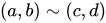


The addition of ordered pairs is done component-wise:[71] A straightforward computation shows that the equivalence class of the result depends only on the equivalence classes of the summands, and thus that this defines an addition of equivalence classes, that is, integers.[72] Another straightforward computation shows that this addition is the same as the above case definition.

Rational numbers (fractions)
[edit]Addition of rational numbers involves the fractions. The computation can be done by using the least common denominator, but a conceptually simpler definition involves only integer addition and multiplication: As an example, the sum .[73]
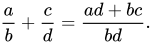

Addition of fractions is much simpler when the denominators are the same; in this case, one can simply add the numerators while leaving the denominator the same: so .[73]


The commutativity and associativity of rational addition are easy consequences of the laws of integer arithmetic.[74]
Real numbers
[edit]A common construction of the set of real numbers is the Dedekind completion of the set of rational numbers. A real number is defined to be a Dedekind cut of rationals: a non-empty set of rationals that is closed downward and has no greatest element. The sum of real numbers a and b is defined element by element:[75] This definition was first published, in a slightly modified form, by Richard Dedekind in 1872.[76] The commutativity and associativity of real addition are immediate; defining the real number 0 as the set of negative rationals, it is easily seen as the additive identity. Probably the trickiest part of this construction pertaining to addition is the definition of additive inverses.[77]



Unfortunately, dealing with the multiplication of Dedekind cuts is a time-consuming case-by-case process similar to the addition of signed integers.[78] Another approach is the metric completion of the rational numbers. A real number is essentially defined to be the limit of a Cauchy sequence of rationals, lim an. Addition is defined term by term:[79] This definition was first published by Georg Cantor, also in 1872, although his formalism was slightly different.[80] One must prove that this operation is well-defined, dealing with co-Cauchy sequences. Once that task is done, all the properties of real addition follow immediately from the properties of rational numbers. Furthermore, the other arithmetic operations, including multiplication, have straightforward, analogous definitions.[81]

Complex numbers
[edit]
Complex numbers are added by adding the real and imaginary parts of the summands.[82][83] That is to say:

Using the visualization of complex numbers in the complex plane, the addition has the following geometric interpretation: the sum of two complex numbers A and B, interpreted as points of the complex plane, is the point X obtained by building a parallelogram three of whose vertices are O, A and B.[84]
Generalizations
[edit]Many binary operations can be viewed as generalizations of the addition operation on the real numbers. The field of algebra is centrally concerned with such generalized operations, and they also appear in set theory and category theory.
Abelian group
[edit]In group theory, a Group is an algebraic structure that allows for composing any two elements.
In the special case where the order does not matter, the composition operator is sometimes called addition. Such groups are referred to as Abelian or commutative; the composition operator is often written as "+".
Linear algebra
[edit]In linear algebra, a vector space is an algebraic structure that allows for adding any two vectors and for scaling vectors. A familiar vector space is the set of all ordered pairs of real numbers; the ordered pair is interpreted as a vector from the origin in the Euclidean plane to the point in the plane. The sum of two vectors is obtained by adding their individual coordinates: This addition operation is central to classical mechanics, in which velocities, accelerations and forces are all represented by vectors.[85]
Matrix addition is defined for two matrices of the same dimensions. The sum of two m × n (pronounced "m by n") matrices A and B, denoted by A + B, is again an m × n matrix computed by adding corresponding elements:[86][87]
![{\displaystyle {\begin{aligned}\mathbf {A} +\mathbf {B} &={\begin{bmatrix}a_{11}&a_{12}&\cdots &a_{1n}\\a_{21}&a_{22}&\cdots &a_{2n}\\\vdots &\vdots &\ddots &\vdots \\a_{m1}&a_{m2}&\cdots &a_{mn}\\\end{bmatrix}}+{\begin{bmatrix}b_{11}&b_{12}&\cdots &b_{1n}\\b_{21}&b_{22}&\cdots &b_{2n}\\\vdots &\vdots &\ddots &\vdots \\b_{m1}&b_{m2}&\cdots &b_{mn}\\\end{bmatrix}}\\[8mu]&={\begin{bmatrix}a_{11}+b_{11}&a_{12}+b_{12}&\cdots &a_{1n}+b_{1n}\\a_{21}+b_{21}&a_{22}+b_{22}&\cdots &a_{2n}+b_{2n}\\\vdots &\vdots &\ddots &\vdots \\a_{m1}+b_{m1}&a_{m2}+b_{m2}&\cdots &a_{mn}+b_{mn}\\\end{bmatrix}}\\\end{aligned}}}](https://wikimedia.org/api/rest_v1/media/math/render/svg/ecb036aa8422068315b882ad5a5b7d02f40f057d)
For example:
![{\displaystyle {\begin{aligned}{\begin{bmatrix}1&3\\1&0\\1&2\end{bmatrix}}+{\begin{bmatrix}0&0\\7&5\\2&1\end{bmatrix}}&={\begin{bmatrix}1+0&3+0\\1+7&0+5\\1+2&2+1\end{bmatrix}}\\[8mu]&={\begin{bmatrix}1&3\\8&5\\3&3\end{bmatrix}}\end{aligned}}}](https://wikimedia.org/api/rest_v1/media/math/render/svg/dddc9dbb423d947a48a13619bf1c0d8cf527fe5c)
In modular arithmetic, the set of available numbers is restricted to a finite subset of the integers, and addition "wraps around" when reaching a certain value, called the modulus.[88] For example, the set of integers modulo 12 has twelve elements; it inherits an addition operation from the integers that is central to musical set theory.[89] The set of integers modulo 2 has just two elements; the addition operation it inherits is known in Boolean logic as the "exclusive or" function.[90] A similar "wrap around" operation arises in geometry, where the sum of two angle measures is often taken to be their sum as real numbers modulo 2π. This amounts to an addition operation on the circle, which in turn generalizes to the operations of higher-dimensional Lie groups.[91]
The general theory of abstract algebra allows an "addition" operation to be any associative and commutative operation on a set. Basic algebraic structures with such an addition operation include commutative monoids and abelian groups.[92]
Linear combinations combine multiplication and summation; they are sums in which each term has a multiplier, usually a real or complex number. Linear combinations are especially useful in contexts where straightforward addition would violate some normalization rule, such as mixing of strategies in game theory or superposition of states in quantum mechanics.[93]
Set theory and category theory
[edit]A far-reaching generalization of the addition of natural numbers is the addition of ordinal numbers and cardinal numbers in set theory. These give two different generalizations of the addition of natural numbers to the transfinite. Unlike most addition operations, the addition of ordinal numbers is not commutative.[94] Addition of cardinal numbers, however, is a commutative operation closely related to the disjoint union operation.[95]
In category theory, disjoint union is seen as a particular case of the coproduct operation,[96] and general coproducts are perhaps the most abstract of all the generalizations of addition. The coproduct such as direct sum is named to evoke their connection with addition.[97]
Related operations
[edit]Arithmetic
[edit]Subtraction can be thought of as a kind of addition—that is, the addition of an additive inverse. Subtraction is itself a sort of inverse to addition, in that adding and subtracting are inverse functions.[98] Given a set with an addition operation, one cannot always define a corresponding subtraction operation on that set; the set of natural numbers is a simple example. On the other hand, a subtraction operation uniquely determines an addition operation, an additive inverse operation, and an additive identity; for this reason, an additive group can be described as a set that is closed under subtraction.[99]

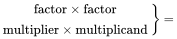
Multiplication can be thought of as repeated addition. If a single term x appears in a sum times, then the sum is the product of and x. Nonetheless, this works only for natural numbers.[100] By the definition in general, multiplication is the operation between two numbers, called the multiplier and the multiplicand, that are combined into a single number called the product.[101]

In the real and complex numbers, addition and multiplication can be interchanged by the exponential function:[102] This identity allows multiplication to be carried out by consulting a table of logarithms and computing addition by hand; it also enables multiplication on a slide rule. The formula is still a good first-order approximation in the broad context of Lie groups, where it relates multiplication of infinitesimal group elements with addition of vectors in the associated Lie algebra.[103]

There are even more generalizations of multiplication than addition.[104] In general, multiplication operations always distribute over addition; this requirement is formalized in the definition of a ring. In some contexts, integers, distributivity over addition, and the existence of a multiplicative identity are enough to determine the multiplication operation uniquely. The distributive property also provides information about the addition operation; by expanding the product in both ways, one concludes that addition is forced to be commutative. For this reason, ring addition is commutative in general.[105]

Division is an arithmetic operation remotely related to addition. Since , division is right distributive over addition: .[106] However, division is not left distributive over addition, such as is not the same as .[107]




Ordering
[edit]
The maximum operation is a binary operation similar to addition. In fact, if two nonnegative numbers and are of different orders of magnitude, their sum is approximately equal to their maximum. This approximation is extremely useful in the applications of mathematics, for example, in truncating Taylor series. However, it presents a perpetual difficulty in numerical analysis, essentially since "max" is not invertible. If is much greater than , then a straightforward calculation of can accumulate an unacceptable round-off error, perhaps even returning zero. See also Loss of significance.[60]


The approximation becomes exact in a kind of infinite limit; if either or is an infinite cardinal number, their cardinal sum is exactly equal to the greater of the two.[d] Accordingly, there is no subtraction operation for infinite cardinals.[109]
Maximization is commutative and associative, like addition. Furthermore, since addition preserves the ordering of real numbers, addition distributes over "max" in the same way that multiplication distributes over addition: For these reasons, in tropical geometry one replaces multiplication with addition and addition with maximization. In this context, addition is called "tropical multiplication", maximization is called "tropical addition", and the tropical "additive identity" is negative infinity.[110] Some authors prefer to replace addition with minimization; then the additive identity is positive infinity.[111]

Tying these observations together, tropical addition is approximately related to regular addition through the logarithm: which becomes more accurate as the base of the logarithm increases.[112] The approximation can be made exact by extracting a constant , named by analogy with the Planck constant from quantum mechanics,[113] and taking the "classical limit" as tends to zero: In this sense, the maximum operation is a dequantized version of addition.[114]



In probability theory
[edit]Convolution is used to add two independent random variables defined by distribution functions. Its usual definition combines integration, subtraction, and multiplication.[115]
See also
[edit]- Lunar arithmetic, a version of arithmetic with addition and multiplication replaced by digit-by-digit max and min
- Mental arithmetic, methods for performing addition without mechanical or written aid
- Minkowski sum, an addition operation on geometric shapes
- Parallel addition (mathematics), the reciprocal value of a sum of reciprocal values
- Prefix sum, computational problem of finding running totals
- Pythagorean addition, combining two side lengths of a right triangle to produce the length of the hypotenuse
- Verbal arithmetic (also known as cryptarithms), puzzles involving addition
- Velocity-addition formula for adding relativistic velocities
Notes
[edit]- ^ "Addend" is not a Latin word; in Latin it must be further conjugated, as in numerus addendus "the number to be added".
- ^ For example, al-Khwarizmi performed multi-digit addition in this way from left to right.[43]
- ^ This is according to a survey of the nations with highest TIMSS mathematics test scores.[62]
- ^ Enderton calls this statement the "Absorption Law of Cardinal Arithmetic"; it depends on the comparability of cardinals and therefore on the Axiom of Choice.
Footnotes
[edit]- ^ Enderton (1977), p. 138: "...select two sets K and L with card K = 2 and card L = 3. Sets of fingers are handy; sets of apples are preferred by textbooks."
- ^ a b c Musser, Peterson & Burger (2013), p. 87.
- ^ Devine, Olson & Olson (1991), p. 263.
- ^ Mazur (2014), p. 161.
- ^ Department of the Army (1961), Section 5.1.
- ^ Shmerko, Yanushkevich & Lyshevski (2009), p. 80; Schmid (1974); Schmid (1983).
- ^ a b Schwartzman (1994), p. 19.
- ^ Schubert, Hermann (1903). "Monism in Arithmetic". Mathematical Essays and Recreations. Chicago: Open Court. p. 10.
- ^ Karpinski (1925), pp. 56–57, reproduced on p. 104
- ^ Schwartzman (1994), p. 212.
- ^ Karpinski (1925), pp. 150–153.
- ^ Lewis (1974), p. 1.
- ^ Martin (2003), p. 49.
- ^ Stewart (1999), p. 8.
- ^ Apostol (1967), p. 37.
- ^ See Viro (2001) for an example of the sophistication involved in adding with sets of "fractional cardinality".
- ^ National Research Council (2001), p. 74.
- ^ Mosley (2001), p. 8.
- ^ Li & Lappan (2014), p. 204.
- ^ Musser, Peterson & Burger (2013), p. 89.
- ^ Berg (1967), p. 14.
- ^ Behr & Jungst (1971), p. 59.
- ^ Rosen (2013), See the Appendix I.
- ^ Posamentier et al. (2013), p. 71.
- ^ a b Musser, Peterson & Burger (2013), p. 90.
- ^ Bronstein & Semendjajew (1987).
- ^ Kaplan (2000), pp. 69–71.
- ^ Hempel (2001), p. 7.
- ^ Fierro (2012), Section 2.3.
- ^ Moebs, William; et al. (2022). "1.4 Dimensional Analysis". University Physics Volume 1. OpenStax. ISBN 978-1-947172-20-3.
- ^ Wynn (1998), p. 5.
- ^ Wynn (1998), p. 15.
- ^ Wynn (1998), p. 17.
- ^ Wynn (1998), p. 19.
- ^ Randerson, James (21 August 2008). "Elephants have a head for figures". The Guardian. Archived from the original on 2 April 2015. Retrieved 29 March 2015.
- ^ Smith (2002), p. 130.
- ^ Carpenter, Thomas; Fennema, Elizabeth; Franke, Megan Loef; Levi, Linda; Empson, Susan (1999). Children's mathematics: Cognitively guided instruction. Portsmouth, NH: Heinemann. ISBN 978-0-325-00137-1.
- ^ a b Henry, Valerie J.; Brown, Richard S. (2008). "First-grade basic facts: An investigation into teaching and learning of an accelerated, high-demand memorization standard". Journal for Research in Mathematics Education. 39 (2): 153–183. doi:10.2307/30034895. JSTOR 30034895.
- ^ Beckmann, S. (2014). The twenty-third ICMI study: primary mathematics study on whole numbers. International Journal of STEM Education, 1(1), 1–8. Chicago
- ^ Schmidt, W., Houang, R., & Cogan, L. (2002). "A coherent curriculum". American Educator, 26(2), 1–18.
- ^ a b c d e f g Fosnot & Dolk (2001), p. 99.
- ^ Some authors think that "carry" may be inappropriate for education; van de Walle (2004), p. 211 calls it "obsolete and conceptually misleading", preferring the word "trade". However, "carry" remains the standard term.
- ^ Crossley & Henry (1990).
- ^ Wingard-Nelson (2014), p. 40.
- ^ Cassidy, David; Holton, Gerald; Rutherford, James (2002). "Reviewing Units, Mathematics, and Scientific Notation". Understanding Physics. New York: Springer. p. 11. doi:10.1007/0-387-21660-X_3. ISBN 978-0-387-98755-2.
- ^ Dale R. Patrick, Stephen W. Fardo, Vigyan Chandra (2008) Electronic Digital System Fundamentals The Fairmont Press, Inc. p. 155
- ^ P.E. Bates Bothman (1837) The common school arithmetic. Henry Benton. p. 31
- ^ Truitt & Rogers (1960), pp. 1, 44–49, 2, 77–78.
- ^ Gschwind & McCluskey (1975), p. 233.
- ^ Ifrah, Georges (2001). The Universal History of Computing: From the Abacus to the Quantum Computer. New York: Wiley. ISBN 978-0-471-39671-0. p. 11
- ^ Marguin (1994), p. 48. Quoting Taton (1963).
- ^ Kistermann, F. W. (1998). "Blaise Pascal's adding machine: new findings and conclusions". IEEE Annals of the History of Computing. 20 (1): 69–76. Bibcode:1998IAHC...20a..69K. doi:10.1109/85.646211.
- ^ Campanile, Benedetta (2024). "La girandola di Poleni: un progetto destinato a scomparire". In Di Mauro, Marco; Romano, Luigi; Zanini, Valeria (eds.). Atti del XLIII Convegno annuale SISFA (in Italian). pp. 151–158. doi:10.6093/978-88-6887-278-6.
- ^ Flynn & Oberman (2001), pp. 2, 8.
- ^ Flynn & Oberman (2001), pp. 1–9; Liu et al. (2010), p. 194.
- ^ 301 - Programmer's Reference Manual (PDF). January 1962. 93-17-000. Retrieved July 9, 2025.
- ^ IBM 1620 Central Processing Unit, Model 1 (PDF). Archived from the original (PDF) on 2017-10-09. Retrieved 2017-12-18.
- ^ Joshua Bloch, "Extra, Extra – Read All About It: Nearly All Binary Searches and Mergesorts are Broken" Archived 2016-04-01 at the Wayback Machine. Official Google Research Blog, June 2, 2006.
- ^ Neumann (1987).
- ^ a b Goldberg, David (March 1991). "What every computer scientist should know about floating-point arithmetic". ACM Computing Surveys. 23 (1). Association for Computing Machinery (ACM): 5–48. doi:10.1145/103162.103163.
- ^ Enderton chapters 4 and 5, for example, follow this development.
- ^ Schmidt, Houang & Cogan (2002), p. 4.
- ^ Baez & Dolan (2001), p. 37 explains the historical development, in "stark contrast" with the set theory presentation: "Apparently, half an apple is easier to understand than a negative apple!"
- ^ Begle (1975), p. 49; Johnson (1975), p. 120; Devine, Olson & Olson (1991), p. 75.
- ^ Enderton (1977), p. 79.
- ^ For a version that applies to any poset with the descending chain condition, see Bergman (2005), p. 100
- ^ Enderton (1977), p. 79 observes, "But we want one binary operation , not all these little one-place functions."
- ^ Ferreirós (1999), p. 223.
- ^ Smith (1980), p. 234; Sparks & Rees (1979), p. 66.
- ^ Campbell (1970), p. 83.
- ^ Campbell (1970), p. 84.
- ^ Enderton (1977), p. 92.
- ^ a b Cameron & Craig (2013), p. 29.
- ^ The verifications are carried out in Enderton (1977), p. 104 and sketched for a general field of fractions over a commutative ring in Dummit & Foote (1999), p. 263.
- ^ Enderton (1977), p. 114.
- ^ Ferreirós (1999), p. 135; see section 6 of Stetigkeit und irrationale Zahlen Archived 2005-10-31 at the Wayback Machine.
- ^ The intuitive approach, inverting every element of a cut and taking its complement, works only for irrational numbers; see Enderton (1977), p. 117 for details.
- ^ Schubert, E. Thomas, Phillip J. Windley, and James Alves-Foss. "Higher Order Logic Theorem Proving and Its Applications: Proceedings of the 8th International Workshop, volume 971 of." Lecture Notes in Computer Science (1995).
- ^ Textbook constructions are usually not so cavalier with the "lim" symbol; see Burrill (1967), p. 138 for a more careful, drawn-out development of addition with Cauchy sequences.
- ^ Ferreirós (1999), p. 128.
- ^ Burrill (1967), p. 140.
- ^ Conway, John B. (1986), Functions of One Complex Variable I, Springer, ISBN 978-0-387-90328-6
- ^ Joshi, Kapil D (1989), Foundations of Discrete Mathematics, New York: Wiley, ISBN 978-0-470-21152-6
- ^ Özhan (2022), p. 10.
- ^ Gbur (2011), p. 1.
- ^ Lipschutz, S., & Lipson, M. (2001). Schaum's outline of theory and problems of linear algebra. Erlangga.
- ^ Riley, K.F.; Hobson, M.P.; Bence, S.J. (2010). Mathematical methods for physics and engineering. Cambridge University Press. ISBN 978-0-521-86153-3.
- ^ Omondi (2020), p. 142.
- ^ Princeton University Press (2008), p. 938.
- ^ Pratt (2017), p. 314.
- ^ Fenn, Roger (2012). Geometry. Springer Undergraduate Mathematics Series. Springer Science & Business Media. p. 42. ISBN 9781447103257.
- ^ Nicholson (2012), p. 70; Bhattacharya, Jain & Nagpaul (1994), p. 159.
- ^ Rieffel & Polak (2011), p. 16.
- ^ Cheng (2017), pp. 124–132.
- ^ Schindler (2014), p. 34.
- ^ Riehl (2016), p. 100.
- ^ Bhattacharya, Jain & Nagpaul (1994), p. 196.
- ^ Kay (2021), p. 44.
- ^ The set still must be nonempty. Dummit & Foote (1999), p. 48 discuss this criterion written multiplicatively.
- ^ Musser, Peterson & Burger (2013), p. 101.
- ^ Isoda, Olfos & Noine (2021), p. 163–164.
- ^ Rudin (1976), p. 178.
- ^ Lee (2003), p. 526, Proposition 20.9.
- ^ Linderholm (1971), p. 49 observes, "By multiplication, properly speaking, a mathematician may mean practically anything. By addition he may mean a great variety of things, but not so great a variety as he will mean by 'multiplication'."
- ^ Dummit & Foote (1999), p. 224. For this argument to work, one must assume that addition is a group operation and that multiplication has an identity.
- ^ For an example of left and right distributivity, see Loday (2002), p. 15.
- ^ Shortt, Roy F.; Trueblood, Cecil R. (June 1969). Teacher's Handbook; Elementary School Mathematics. Parts I and II (PDF). Pennsylvania State University Computer-Assisted Instruction Lab. pp. 52, 59.
- ^ Compare Viro (2001), p. 2, Figure 1.
- ^ Enderton (1977), p. 164.
- ^ Mikhalkin (2006), p. 1.
- ^ Akian, Bapat & Gaubert (2005), p. 4.
- ^ Mikhalkin (2006), p. 2.
- ^ Litvinov, Maslov & Sobolevskii (1999), p. 3.
- ^ Viro (2001), p. 4.
- ^ Gbur (2011), p. 300.

References
[edit]- Akian, Marianne; Bapat, Ravindra; Gaubert, Stephane (2005). "Min-plus methods in eigenvalue perturbation theory and generalised Lidskii-Vishik-Ljusternik theorem". INRIA Reports. arXiv:math.SP/0402090. Bibcode:2004math......2090A.
- Apostol, Tom M. (1967). Calculus. Vol. 1 (2nd ed.). Wiley.
- Baez, J.; Dolan, J. (2001). Mathematics Unlimited – 2001 and Beyond. From Finite Sets to Feynman Diagrams. p. 29. arXiv:math.QA/0004133. ISBN 3-540-66913-2.
- Begle, Edward (1975). The Mathematics of the Elementary School. McGraw-Hill. ISBN 978-0-07-004325-1.
- Berg, Lothar (1967). Lauwerier, H. A.; Koiter, W. T. (eds.). Introduction To The Operational Calculus. Vol. 2. North-Holland Publishing. ISBN 978-0-323-16245-6.
- Bergman, George (2005). An Invitation to General Algebra and Universal Constructions (2.3 ed.). General Printing. ISBN 978-0-9655211-4-7.
- Behr, Merlyn J.; Jungst, Dale G. (1971). Fundamentals of Elementary Mathematics. Academic Press.
- Bhattacharya, P. B.; Jain, S. K.; Nagpaul, S. R. (1994). Basic Abstract Algebra (2nd ed.). Cambridge University Press.
- Bronstein, Ilja Nikolaevič; Semendjajew, Konstantin Adolfovič (1987) [1945]. "2.4.1.1.". In Grosche, Günter; Ziegler, Viktor; Ziegler, Dorothea (eds.). Taschenbuch der Mathematik (in German). Vol. 1. Translated by Ziegler, Viktor. Weiß, Jürgen (23 ed.). Thun and Frankfurt am Main: Verlag Harri Deutsch (and B.G. Teubner Verlagsgesellschaft, Leipzig). pp. 115–120. ISBN 978-3-87144-492-0.
- Burrill, Claude (1967). Foundations of Real Numbers. McGraw-Hill. LCC QA248.B95.
- Cameron, Scyhrlet; Craig, Carolyn (2013). Adding and Subtracting Fractions, Grades 5–8. Mark Twain Incorporation.
- Campbell, Howard E. (1970). The structure of arithmetic. Appleton-Century-Crofts. ISBN 978-0-390-16895-5.
- Cheng, Eugenia (2017). Beyond Infinity: An Expedition to the Outer Limits of Mathematics. Basic Books. ISBN 978-1-541-64413-7.
- Crossley, J. N.; Henry, A. S. (1990). "Thus spake al-Khwārizmī: A translation of the text of Cambridge University Library Ms. Ii.vi.5". Historia Mathematica. 17 (2): 103–131. doi:10.1016/0315-0860(90)90048-i.
- Department of the Army (1961). Army Technical Manual TM 11-684: Principles and Applications of Mathematics for Communications-Electronics.
- Devine, D.; Olson, J.; Olson, M. (1991). Elementary Mathematics for Teachers (2e ed.). Wiley. ISBN 978-0-471-85947-5.
- Dummit, D.; Foote, R. (1999). Abstract Algebra (2nd ed.). Wiley. ISBN 978-0-471-36857-1.
- Enderton, Herbert (1977). Elements of Set Theory. Academic Press. ISBN 978-0-12-238440-0.
- Ferreirós, José (1999). Labyrinth of Thought: A History of Set Theory and Its Role in Modern Mathematics. Birkhäuser. ISBN 978-0-8176-5749-9.
- Fierro, R. (2012). Mathematics for Elementary School Teachers. Cengage Learning.
- Flynn, M.; Oberman, S. (2001). Advanced Computer Arithmetic Design. Wiley. ISBN 978-0-471-41209-0.
- Fosnot, Catherine T.; Dolk, Maarten (2001). Young Mathematicians at Work: Constructing Number Sense, Addition, and Subtraction. Heinemann. ISBN 978-0-325-00353-5.
- Gbur, Greg (2011). Mathematical Methods for Optical Physics and Engineering. Cambridge University Press. ISBN 978-0-511-91510-9. OCLC 704518582.
- Gowers, Timothy; Barrow-Green, June; Leader, Imre, eds. (2008). The Princeton Companion to Mathematics. Princeton University Press. ISBN 978-1-4008-3039-8.
- Gschwind, Hans W.; McCluskey, E. J. (1975). Design of Digital Computers: An Introduction (2nd ed.). Springer.
- Hempel, C. G. (2001). Fetzer, J. H. (ed.). The philosophy of Carl G. Hempel: studies in science, explanation, and rationality. Oxford University Press. ISBN 978-0-19-534387-8.
- Isoda, Masami; Olfos, Raimundo; Noine, Takeshi (2021). "The Teaching of Multidigit Multiplication in the Japanese Approach". Teaching Multiplication with Lesson Study: Japanese and Ibero-American Theories for International Mathematics Education. doi:10.1007/978-3-030-28561-6. ISBN 978-3-030-28561-6.
- Johnson, Paul (1975). From Sticks and Stones: Personal Adventures in Mathematics. Science Research Associates. ISBN 978-0-574-19115-1.
- Kaplan, Robert (2000). The Nothing That Is: A Natural History of Zero. Oxford University Press. ISBN 0-19-512842-7.
- Karpinski, Louis (1925). The History of Arithmetic. Rand McNally. LCC QA21.K3.
- Kay, Anthony (2021). Number Systems: A Path into Rigorous Mathematics. CRC Press. ISBN 978-0-429-60776-9.
- Lee, John (2003). Introduction to Smooth Manifolds. Springer. ISBN 978-0-387-95448-6.
- Lewis, Rhys (1974). "Arithmetic". First-Year Technician Mathematics. Palgrave, London: Macmillan. p. 1. doi:10.1007/978-1-349-02405-6_1. ISBN 978-1-349-02405-6.
- Li, Y.; Lappan, G. (2014). Mathematics curriculum in school education. Springer. doi:10.1007/978-94-007-7560-2. ISBN 978-94-007-7560-2.
- Linderholm, Carl (1971). Mathematics Made Difficult. Wolfe. ISBN 978-0-7234-0415-6.
- Litvinov, Grigory; Maslov, Victor; Sobolevskii, Andreii (1999). "Idempotent mathematics and interval analysis". arXiv:math/9911126.
- Liu, Feng; Tan, Qingping; Song, Xiaoyu; Chen, Gang (2010). Hsu, Ching-Hsien; Yang, Laurence T.; Park, Jong Hyuk; Yeo, Sang-Soo (eds.). Algorithms and Architectures for Parallel Processing: 10th International Conference, ICA3PP 2010, Busan, Korea, May 21–23, 2010. Proceedings, Vol. 1. Springer.
- Loday, Jean-Louis (2002). "Arithmetree". Journal of Algebra. 258: 275. arXiv:math/0112034. doi:10.1016/S0021-8693(02)00510-0.
- Marguin, Jean (1994). Histoire des Instruments et Machines à Calculer, Trois Siècles de Mécanique Pensante 1642–1942 (in French). Hermann. ISBN 978-2-7056-6166-3.
- Martin, John (2003). Introduction to Languages and the Theory of Computation (3rd ed.). McGraw-Hill. ISBN 978-0-07-232200-2.
- Mazur, Joseph (2014). Enlightening Symbols: A Short History of Mathematical Notation and Its Hidden Powers. Princeton University Press. doi:10.2307/j.ctt5hhpnp. ISBN 978-0-691-15463-3. JSTOR j.ctt5hhpnp.
- Mikhalkin, Grigory (2006). Sanz-Solé, Marta (ed.). Proceedings of the International Congress of Mathematicians (ICM), Madrid, Spain, August 22–30, 2006. Volume II: Invited lectures. Tropical Geometry and its Applications. Zürich: European Mathematical Society. pp. 827–852. arXiv:math.AG/0601041. ISBN 978-3-03719-022-7. Zbl 1103.14034.
- Mosley, F. (2001). Using number lines with 5–8 year olds. Vol. 4. Nelson Thornes. ISBN 978-1-874099-95-6.
- Musser, Gary L.; Peterson, Blake E.; Burger, William F. (2013). Mathematics for Elementary Teachers: A Contemporary Approach. Wiley. ISBN 978-1-118-48700-6.
- National Research Council (2001). Adding It Up: Helping Children Learn Mathematics. National Academy Press. doi:10.17226/9822. ISBN 978-0-309-06995-3.
- Neumann, Peter G. (2 February 1987). "The Risks Digest Volume 4: Issue 45". The Risks Digest. 4 (45). Archived from the original on 2014-12-28. Retrieved 2015-03-30.
- Nicholson, W. Keith (2012). Introduction to Abstract Algebra. Wiley.
- Omondi, Amos R. (2020). Cryptography Arithmetic: Algorithms and Hardware Architectures. Advances in Information Security. Vol. 77. doi:10.1007/978-3-030-34142-8. ISBN 978-3-030-34142-8.
- Özhan, Orhan (2022). Basic Transforms for Electrical Engineering. Springer. doi:10.1007/978-3-030-98846-3. ISBN 978-3-030-98846-3.
- Posamentier, Alfred S.; Farber, William; Germain-Williams, Terri L.; Paris, Elaine; Thaller, Bernd; Lehmann, Ingmar (2013). 100 Commonly Asked Questions in Math Class. Corwin Press. ISBN 978-1-4522-4308-5.
- Pratt, Vaughan (2017). "Aristotle, Boole, and Categories". In Başkent, Can; Moss, Lawrence S.; Ramanujam, Ramaswamy (eds.). Rohit Parikh on Logic, Language and Society. Outstanding Contributions to Logic. Vol. 11. Springer. doi:10.1007/978-3-319-47843-2. ISBN 978-3-319-47843-2.
- Rieffel, Eleanor G.; Polak, Wolfgang H. (4 March 2011). Quantum Computing: A Gentle Introduction. MIT Press. ISBN 978-0-262-01506-6.
- Riehl, Emily (2016). Category Theory in Context. Dover. ISBN 978-0-486-80903-8.
- Rudin, Walter (1976). Principles of Mathematical Analysis (3rd ed.). McGraw-Hill. ISBN 978-0-07-054235-8.
- Rosen, Kenneth (2013). Discrete Maths and Its Applications Global Edition. McGraw Hill. ISBN 978-0-07-131501-2.
- Schindler, Ralf-Dieter (2014). Set theory : exploring independence and truth. Universitext. Cham: Springer-Verlag. doi:10.1007/978-3-319-06725-4. ISBN 978-3-319-06725-4.
- Schmid, Hermann (1974). Decimal Computation (1st ed.). Binghamton, NY: Wiley. ISBN 0-471-76180-X.
- Schmid, Hermann (1983) [1974]. Decimal Computation (reprint of 1st ed.). Malabar, FL: Robert E. Krieger Publishing Company. ISBN 978-0-89874-318-0.
- Schmidt, W.; Houang, R.; Cogan, L. (2002). "A coherent curriculum". American Educator. 26 (2): 10–26.
- Schwartzman, Steven (1994). The Words of Mathematics: An Etymological Dictionary of Mathematical Terms Used in English. MAA. ISBN 978-0-88385-511-9.
- Shmerko, V. P.; Yanushkevich, Svetlana N.; Lyshevski, S. E. (2009). Computer arithmetics for nanoelectronics. CRC Press.
- Smith, Frank (2002). The Glass Wall: Why Mathematics Can Seem Difficult. Teachers College Press. ISBN 978-0-8077-4242-6.
- Smith, Karl (1980). The Nature of Modern Mathematics (3rd ed.). Wadsworth. ISBN 978-0-8185-0352-8.
- Sparks, F.; Rees, C. (1979). A Survey of Basic Mathematics. McGraw-Hill. ISBN 978-0-07-059902-4.
- Stewart, James (1999). Calculus: Early Transcendentals (4th ed.). Brooks/Cole. ISBN 978-0-534-36298-0.
- Taton, René (1963). Le Calcul Mécanique. Que Sais-Je ? n° 367 (in French). Presses universitaires de France. pp. 20–28.
- Truitt, T.; Rogers, A. (1960). Basics of Analog Computers. John F. Rider. LCC QA76.4 T7.
- van de Walle, John (2004). Elementary and Middle School Mathematics: Teaching developmentally (5e ed.). Pearson. ISBN 978-0-205-38689-5.
- Viro, Oleg (2001). Cascuberta, Carles; Miró-Roig, Rosa Maria; Verdera, Joan; Xambó-Descamps, Sebastià (eds.). European Congress of Mathematics: Barcelona, July 10–14, 2000, Volume I. Dequantization of Real Algebraic Geometry on Logarithmic Paper. Progress in Mathematics. Vol. 201. Basel: Birkhäuser. pp. 135–146. arXiv:math/0005163. Bibcode:2000math......5163V. ISBN 978-3-7643-6417-5. Zbl 1024.14026.
- Wingard-Nelson, Rebecca (2014). Decimals and Fractions: It's Easy. Enslow Publishers, Inc.
- Wynn, Karen (1998). "Numerical competence in infants". The Development of Mathematical Skills. Taylor & Francis. ISBN 0-86377-816-X.
Further reading
[edit]- Baroody, Arthur; Tiilikainen, Sirpa (2003). The Development of Arithmetic Concepts and Skills. Two perspectives on addition development. Routledge. p. 75. ISBN 0-8058-3155-X.
- Davison, David M.; Landau, Marsha S.; McCracken, Leah; Thompson, Linda (1999). Mathematics: Explorations & Applications (TE ed.). Prentice Hall. ISBN 978-0-13-435817-8.
- Bunt, Lucas N.H.; Jones, Phillip S.; Bedient, Jack D. (1976). The Historical roots of Elementary Mathematics. Prentice-Hall. ISBN 978-0-13-389015-0.
- Poonen, Bjorn (2010). "Addition". Girls' Angle Bulletin. 3 (3–5). ISSN 2151-5743.
- Weaver, J. Fred (1982). "Addition and Subtraction: A Cognitive Perspective". Addition and Subtraction: A Cognitive Perspective. Interpretations of Number Operations and Symbolic Representations of Addition and Subtraction. Taylor & Francis. p. 60. ISBN 0-89859-171-6.
| International | |
|---|---|
| National | |
| Other | |

Addition
View on GrokipediaNotation and Terminology
Notation
The plus sign (+) serves as the standard binary operator for addition in mathematics, denoting the operation of combining two quantities. This symbol, derived from the Latin word "et" meaning "and," was first introduced in print by the German mathematician Johannes Widmann in his 1489 arithmetic treatise Behende und hupsche Rechnung auf allen kauffmanschafft to represent surplus or addition in accounting contexts.[7] In inline notation, addition is typically expressed as , where and are the operands, such as in the arithmetic example . For the summation of multiple terms, the uppercase Greek letter sigma () is used in display form, as introduced by Leonhard Euler in 1755 to compactly represent repeated additions, for instance . This distinguishes finite summation from binary addition, though generalizes the concept of over a sequence.[5] Variations appear in specialized mathematical structures. For vector addition, the operator remains , written as , combining corresponding components. In matrix addition, the + operator is used to add corresponding elements element-wise. In Boolean algebra and logic, the vee symbol denotes disjunction, serving as an analogy to addition under modulo-2 arithmetic. The notation supports commutativity, where .[5]Terminology
In mathematics, the numbers or quantities being added together in an operation are known as addends, with each individual operand referred to as an addend.[8][9] The result of this addition is called the sum, which represents the total obtained by combining the addends.[10] When addition involves a sequence of multiple terms, such as in summation, each term in the sequence is termed a summand, a usage that emphasizes the additive process over multiple elements.[11] In some contexts, particularly historical or specific instructional materials, the term addendum is used interchangeably with addend to denote each number being added, though it is less common today.[12] An older distinction identifies the first addend as the augend, to which subsequent addends are applied, as seen in expressions like augend + addend = sum; however, due to the commutative nature of addition, this terminology is rarely emphasized in modern usage.[10][13] Addition is fundamentally a binary operation, involving exactly two operands, whereas extending it to more than two terms results in n-ary summation, where multiple summands are combined iteratively.[14][15] For example, in the equation 3 + 4 = 7, the addends are 3 and 4, and the sum is 7.[8]Definitions and Interpretations
Combining Sets
In set theory, addition of natural numbers can be understood as the operation of combining two disjoint sets to form their union, with the resulting size given by the sum of the individual sizes, or cardinalities. For disjoint sets and , the cardinality of the union satisfies , providing a foundational interpretation of addition where the natural numbers represent sizes of finite sets./01%3A__Sets/1.04%3A_Set_Operations_with_Two_Sets) This perspective traces back to the Peano axioms, formulated by Giuseppe Peano in 1889, which axiomatize the structure of natural numbers and admit models in set theory where numbers are constructed as sets (for instance, via the von Neumann ordinals) and addition aligns with disjoint union of such sets. ExampleConsider the disjoint sets and . Their union is , which has cardinality 4, matching ./01%3A__Sets/1.04%3A_Set_Operations_with_Two_Sets) To accommodate repetitions, the interpretation extends to multisets, where addition combines two multisets by summing the multiplicities of shared elements, yielding a cardinality that is the sum of the input cardinalities (each defined as the total of multiplicities).[16]
Extending Lengths
In the geometric interpretation of addition, lengths are added by concatenating line segments on a number line, where the sum represents the total distance from the origin to the endpoint of the combined segments. For instance, starting at 0 and moving 2 units to the right places one at point 2; adding another 3 units extends the path further right to point 5, illustrating that 2 + 3 = 5. This model emphasizes addition as a process of successive displacements or extensions along a continuous line, providing an intuitive basis for understanding positive integers before extending to other numbers.[17] A physical analogy for this interpretation involves combining tangible objects like rods or measuring tapes end-to-end to form a longer segment, where the total length equals the sum of the individual lengths. This approach mirrors real-world measurements, such as aligning two rods—one of 2 centimeters and another of 3 centimeters—to obtain a combined rod of 5 centimeters, directly observable and verifiable by rulers or calipers. Such manipulations highlight addition's role in quantifying cumulative extents in physical space, distinct from discrete counting but analogous in building totals incrementally.[1][18] The segment addition postulate formalizes this in Euclidean geometry: if points A, B, and C are collinear with B between A and C, then the length of AC equals the sum of AB and BC. For example, if AB measures 2 cm and BC measures 3 cm, then AC measures 5 cm, as the segments AB and BC concatenate without overlap to span AC. This postulate underpins geometric proofs involving collinear points and extends the intuitive rod-joining idea to rigorous deduction.[19] This length-extension view connects to the real numbers through the construction of reals as limits of rational approximations, where addition of irrationals or transcendentals inherits the rational addition laws via convergence. Every real number serves as the limit of a sequence of rationals, allowing sums like √2 + π to be defined as the limit of sums of rational approximations, preserving the geometric continuity of the number line while filling gaps left by rationals alone. This ties the intuitive concatenation of finite lengths to the complete, dense structure of the reals.[20]Other Interpretations
In logic, particularly within Boolean algebra, the disjunction operation (p ∨ q) can be interpreted as a form of addition of truth values, where the result is true if at least one of the propositions is true, analogous to Boolean addition that yields 1 (true) unless both inputs are 0 (false).[21] This view treats truth values as elements in a structure where disjunction acts like summation without carry-over, preserving the "or" semantics in computational and logical systems.[21] Addition also manifests in temporal contexts as the concatenation of durations, combining intervals of time to yield a total span, such as adding 2 hours to 3 hours to obtain 5 hours.[22] This process relies on additive principles similar to numerical summation but applied to measurable time units, often involving fractional components like minutes or seconds to ensure precise alignment.[22] In financial applications, addition serves to combine quantities or amounts, such as aggregating debts or assets to determine total obligations, exemplified by summing $75 owed to one party and $25 to another to reach a $100 total.[23] This interpretation underscores addition's role in accounting and economics for balancing ledgers or calculating net worth through the merger of monetary values.[23] A notable example appears in programming, where the plus operator (+) facilitates string concatenation, effectively "adding" textual elements end-to-end, as in combining "hello" and "world" to form "helloworld".[24] This usage extends the additive notation beyond numbers to symbolic sequences, common in languages like Visual Basic and Java.[24] The plus sign thus denotes concatenation in non-numeric domains, adapting its arithmetic connotation to diverse interpretive frameworks.[24]Properties
Commutativity
In arithmetic, the addition operation exhibits the commutative property, which asserts that the order of the addends does not affect the result: for all in the relevant domain (such as the natural numbers, integers, rationals, or reals), . This property is fundamental to the structure of abelian groups under addition and simplifies many algebraic manipulations by allowing terms to be rearranged freely. For the natural numbers, commutativity can be established through a set-theoretic construction. Natural numbers are represented as the cardinalities of finite sets, and addition is defined as the cardinality of the disjoint union of a set with elements and a set with elements. Since the disjoint union of two sets is independent of order—the cardinality of equals that of for disjoint sets and —it follows that .[25] A simple numerical example illustrates this: and . The commutative property extends to other contexts, such as vector addition in Euclidean spaces. Here, adding vectors and yields the same resultant vector regardless of order, as demonstrated by the parallelogram law: the diagonal of the parallelogram formed by and as adjacent sides is identical to that formed by and . This geometric interpretation underscores the property's role in physics and engineering applications involving force or displacement vectors. While addition is commutative in standard number systems and vector spaces, exceptions arise in certain advanced structures. For instance, in ordinal arithmetic, addition is not commutative: , where denotes the order type of the natural numbers, but , reflecting the non-symmetric concatenation of well-ordered sets.[26]Associativity
Addition is associative, meaning that for any integers , , and , the sum remains the same regardless of how the addends are grouped: .[27] This property can be proven for natural numbers using mathematical induction on the third addend , based on the Peano axioms and the recursive definition of addition where and . The base case holds when , as . For the inductive step, assume the property is true for some natural number ; then for , , completing the proof.[28] The property extends to all integers, where addition inherits associativity from the natural numbers via standard constructions such as equivalence classes of pairs of natural numbers with componentwise addition.[29][30] For instance, with natural numbers, and , yielding the same result. This associativity underpins the use of summation notation, such as , where the order of pairwise additions can be adjusted without altering the total sum.[31] Consequently, when performing a chain of additions like , explicit parentheses are unnecessary, as the result is independent of grouping while preserving the sequence of addends. Together with commutativity, associativity provides full flexibility in computing sums of multiple terms by allowing rearrangements in both order and grouping.[32]Identity Element
The additive identity element, denoted 0, is the element in a number system such that adding it to any element leaves unchanged: [0](/page/0) = [0](/page/0) + a = a for all . This defines 0 as the neutral element under addition, preserving the value of the operand.[33] In the integers , 0 is the unique additive identity, meaning no other integer satisfies the property for all integers; if for all , then . Similarly, in the real numbers , which form a field, the additive identity 0 is unique, as proven from the field axioms where supposing another element acts as identity leads to via substitution and inverse properties.[34][35] Historically, the role of 0 as the additive identity emerged prominently in the formalization of natural numbers through Giuseppe Peano's axioms in 1889, where 0 is posited as the base natural number, and addition is defined recursively with the base case for any natural number , establishing its identity property.[36][33] For example, , illustrating how 0 maintains the original quantity in basic arithmetic. The natural numbers are constructed from 0 via the successor function, which iteratively builds all positives while relying on 0's neutrality for addition.[37]Successor and Units
In the axiomatic construction of the natural numbers, the successor function serves as a fundamental primitive operation, denoted $ S(n) = n + 1 $, which generates each subsequent natural number from the previous one. This function is central to the Peano axioms, where it ensures that the natural numbers form an infinite sequence beginning with 0 and closed under succession, allowing the explicit construction of all natural numbers as iterated applications of $ S $. For instance, the number 3 is represented as $ S(S(S(0))) $, illustrating how the successor builds the entire structure of the naturals from the base element 0.[37][38] The concept of units in additive structures refers to the additive identity element, which is 0, satisfying $ a + 0 = 0 + a = a $ for any element $ a $ in the structure. This additive unit must be distinguished from the multiplicative unit, which is 1 and satisfies $ a \cdot 1 = 1 \cdot a = a $, as the two serve different roles in preserving elements under their respective operations. In the Peano framework, the additive unit 0 acts as the starting point for the successor function, clarifying that while both units are identities, they operate in distinct algebraic contexts and prevent conflation between addition and multiplication.[39][40] Addition itself is formally defined recursively using the successor function and the additive unit, providing a rigorous way to extend the operation beyond single steps. Specifically, for natural numbers $ a $ and $ b $, addition is given by the rules $ a + 0 = a $ and $ a + S(b) = S(a + b) $, which allow computation by reducing the second argument through successive applications of the successor until reaching 0. This recursive definition leverages the successor to build sums iteratively; for example, $ 2 + 3 = S(S(0)) + S(S(S(0))) $ unfolds to $ S(S(S(S(S(0))))) = 5 $, demonstrating how the structure emerges from the base cases without presupposing addition as primitive.[33][41]Performing Addition
Innate and Counting Methods
Humans possess an innate ability to recognize small quantities without explicit counting, a phenomenon known as subitizing, which allows for rapid and accurate perception of up to four items in a visual array.[42] This preattentive process operates at speeds of approximately 40-100 milliseconds per item and is thought to rely on parallel individuation of objects in early visual processing.[43] Evidence for such numerical intuition emerges early in development; for instance, experiments with 5-month-old infants demonstrate that they can detect violations in simple addition and subtraction outcomes, such as expecting 1 + 1 to result in two objects rather than one, as shown through longer looking times at incongruent events.[44] Beyond subitizing, addition is often performed through basic counting methods that build on principles like one-to-one correspondence, where each object in a set is matched to a unique number word or symbol in sequence. This foundational skill, observable in young children, ensures accurate enumeration by assigning numerals systematically to items. Tally marks represent an ancient extension of this approach, consisting of simple incisions or strokes to record quantities, with groupings (such as four vertical lines crossed by a diagonal for five) facilitating mental addition of sets. Archaeological evidence, including the Ishango bone from around 20,000 years ago in the Democratic Republic of Congo, features notched patterns interpreted as early tally systems for tracking and combining counts.[45] Finger counting provides another cross-cultural method for addition, leveraging the hands' digits to represent and sum small numbers, though conventions vary widely—for example, starting with the thumb in some Asian traditions versus the index finger in Western ones. In practice, one might add quantities of objects, such as combining two piles of three apples and two apples by counting each pile separately (one, two, three; one, two) and then recounting the total (one, two, three, four, five) to find the sum. While effective for small sets, these innate and counting-based methods become inefficient for larger quantities, as subitizing breaks down beyond four or five items and sequential counting grows increasingly time-consuming and error-prone, prompting the development of more mechanical techniques like written algorithms.[42]Single-Digit and Carry Processes
Single-digit addition forms the foundation of integer addition, relying on memorized basic facts for sums of two numbers between 0 and 9, such as 7 + 8 = 15. These facts are typically learned through repeated practice and pattern recognition in elementary education, enabling quick recall without counting. The Common Core State Standards for Mathematics require that by the end of grade 2, students know from memory all sums of two one-digit numbers. For multi-digit integers, the standard column addition algorithm aligns numbers by place value—units, tens, hundreds, and so on—and proceeds from right to left, adding corresponding digits in each column. This method, often introduced after mastery of single-digit facts and counting prerequisites, ensures systematic computation. If the sum in any column reaches or exceeds the base (10 in decimal), a carry-over process occurs: the excess value (tens digit) is added to the next column to the left, while the units digit is written in the current column. For instance, in base 10, adding 9 + 1 yields 10, so 0 is recorded and 1 is carried over.[46][47] Consider the example of adding 123 + 478 using the column method with carries: 1 2 3
+ 4 7 8
-------
Tens column: 2 + 7 + 1 (carry) = 10 (write 0, carry 1).
Hundreds column: 1 + 4 + 1 (carry) = 6 (write 6).
Result: 601. This illustrates how carries propagate to maintain place value integrity.[46] Mental strategies complement the written algorithm by decomposing numbers for easier computation, such as breaking 29 + 36 into (30 - 1) + 36 = 30 + 35 = 65, leveraging known facts like doubles or making tens. These approaches, emphasized in curricula to build flexibility, draw from place value understanding rather than rote procedure.[48]