Hubbry Logo
Doctor of TheologyDoctor of TheologyMain
Open search
Doctor of Theology
Community hub
Doctor of Theology
logo
8 pages, 0 posts
0 subscribers
Be the first to start a discussion here.
Doctor of Theology
Doctor of Theology
from Wikipedia
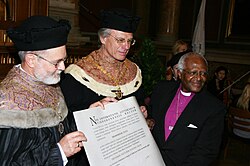
Conferral of a Doctorate of Theology honoris causa on Desmond Tutu (right) by the University of Vienna

Doctor of Theology (Latin: Doctor Theologiae, abbreviated DTh, ThD, DTheol, or Dr. theol.) is a terminal degree in the academic discipline of theology. The ThD, like the ecclesiastical Doctor of Sacred Theology, is an advanced research degree equivalent to the Doctor of Philosophy.[1][2]

Terminology

[edit]

In the academic study of theology, often deeply rooted in the Christian religion, the nomenclature of doctoral degrees varies between Doctor of Theology, Doctor of Philosophy, and Doctor of Sacred Theology. However, Doctor of Ministry is generally understood as a professional doctorate, whereas Doctor of Divinity is an academic doctorate in the UK and an honorary doctorate in the USA where it is often awarded as honoris causa.[citation needed]

United States

[edit]

In the United States, some of the older theological seminaries began offering the ThD as an equivalent to the research Doctor of Philosophy. In Princeton Theological Seminary, for example, this practice was inherited from the German system of education, since the professors involved in establishing the doctoral program were trained in German universities. Though the PhD was the doctorate of arts faculties in German universities (called the philosophy faculty in Germany, hence the Ph), Princeton Theological Seminary has since switched to using Doctor of Philosophy as its main designation.[3] A similar shift happened at Harvard Divinity School in 2015.[4] As of 2024, five Association of Theological Schools accredited schools currently accept students to ThD programs: Duke Divinity School, Kairos University (Evangelical Seminary), Northwest Nazarene University's Graduate School of Theology, Seventh-day Adventist Theological Seminary, and United Theological Seminary.[5]

Due to the secular push in doctoral studies, some ThD programs have moved to other known accreditation, like the Association for Biblical Higher Education (ABHE), Transnational Association of Christian Colleges and Schools (TRACS), or The Council of Private Colleges of America (CPCA).[6][7][8]

United Kingdom

[edit]

In the United Kingdom, the Doctor of Theology is a relatively new academic doctoral programme.[9] Certain universities have begun offering it as a form of research-based professional doctorate, not unlike the Doctor of Education.[10] To distinguish the more practical nature of the degree, some British universities have adopted the term Doctor of Practical Theology.[11]

References

[edit]
Revisions and contributorsEdit on WikipediaRead on Wikipedia
from Grokipedia
The Doctor of Theology (ThD or DTh) is a terminal research doctorate in the academic discipline of theology, designed to equip scholars with advanced expertise for vocations in teaching, research, and theological scholarship. This degree emphasizes original research, culminating in a dissertation that contributes new knowledge to the field. For programs accredited by the Association of Theological Schools (ATS), it requires a minimum of 36 semester credits, including coursework, comprehensive examinations, proficiency in relevant languages, and an oral defense. Institutions accredited by the ATS recognize the ThD as equivalent to the Doctor of Philosophy (PhD) in theology, serving as an alternative nomenclature for the same academically oriented program without substantive differences in standards or outcomes. While the ThD is prominent in North American theological education, equivalent degrees in other regions, such as the PhD in Theology in the UK and Europe, share similar research-oriented goals but may differ in nomenclature and structure. In contrast to professional doctorates like the Doctor of Ministry (DMin), which focus on practical leadership and ministry application through field-based projects, the ThD prioritizes theoretical depth and interdisciplinary analysis to prepare graduates for roles in seminaries, universities, and ecclesiastical settings. Programs in the ThD often concentrate on areas such as , , historical theology, or , fostering competencies in critical analysis, pedagogical methods, and the integration of with contemporary issues. Graduates pursue careers as professors, researchers, or thought leaders, advancing the understanding of religious doctrines, texts, and their cultural impacts. While the degree's structure ensures rigorous academic formation, educational is monitored through ongoing faculty assessments to align with evolving needs in theological .

Overview

Definition and Scope

The Doctor of Theology (ThD), from the Latin Doctor Theologiae, is a terminal awarded for advanced scholarship in the discipline of . It functions as the highest research-oriented qualification in theological studies, comparable to the (PhD) but with a specialized focus on Christian theological inquiry. This degree prepares scholars for roles in academia, research, and advanced leadership by demanding rigorous intellectual engagement with foundational and contemporary theological questions. The scope of the ThD extends across key subfields of theology, including systematic theology (doctrinal formulation and integration), biblical studies (exegesis and interpretation of scripture), historical theology (development of doctrines over time), ethics (moral theology and social justice), and practical theology (applications in ministry, liturgy, and pastoral care). These areas allow candidates to explore interdisciplinary connections, such as theology's intersections with philosophy, history, and culture, fostering a comprehensive understanding of Christian thought. Although predominantly focused on Christian theology, the degree's principles can apply to scholarly inquiry in other religious traditions. Central to the ThD is the production of original through a dissertation that advances theological knowledge in a chosen area. This capstone project, typically 50,000–100,000 words or equivalent in length, requires demonstrating scholarly innovation and is defended before a of experts. Full-time programs typically require 3–5 years to complete, beginning with advanced seminars and progressing to independent under faculty supervision. The Doctor of Theology (ThD) differs from the PhD in Theology primarily in its institutional and orientational focus: while the PhD is typically awarded by secular departments of and emphasizes interdisciplinary, non-confessional across , the ThD is conferred by schools or seminaries and integrates confessional Christian perspectives, often prioritizing theological scholarship in service to contexts. Both degrees require original dissertation and are considered equivalent terminal doctorates, but the ThD may incorporate ecclesiastical approval or from denominational bodies to ensure alignment with traditions. In contrast to the (STD), which is an degree granted exclusively by the Roman Catholic Church through pontifical universities for expertise in canonical and doctrinal matters, the ThD is a civil focused on broader research without mandatory ties to Catholic . The STD builds on the Licentiate in Sacred Theology (STL) and emphasizes fidelity to Church in scholarly work, whereas the ThD allows for diverse denominational or approaches and is not inherently limited to or canonical roles. The ThD stands apart from the (DMin), a doctorate designed for practicing to enhance applied ministry skills through project-based work rather than pure ; the DMin typically spans three years and culminates in a practical ministry project, while the ThD requires 3–5 years of rigorous academic study leading to a dissertation advancing theological knowledge. This distinction positions the ThD as preparation for teaching and scholarly contributions, in opposition to the DMin's emphasis on and contextual church practice. Unlike the (DD), which in the United States is predominantly an bestowed without coursework or for distinguished service in ministry or academia, the ThD demands original scholarly and formal academic training. In the , the DD can function as an academic qualification akin to a higher , but the ThD remains distinctly oriented toward comprehensive theological inquiry rather than post-doctoral honors. A defining feature of the ThD is its synthesis of rigorous academic standards with faith-based , fostering theological work that serves both the church and .

History

Origins in Medieval and Early Modern

The Doctor of Theology (ThD), known in Latin as Doctor Sacrae Theologiae, emerged in the 12th and 13th centuries within the burgeoning university systems of medieval , where it formed one of the four original higher faculties alongside arts, law, and . These universities, such as those in and , developed from associations of masters and students seeking structured under and secular oversight, with positioned as the capstone discipline requiring advanced mastery for teaching and doctrinal authority. At the , the faculty of was first explicitly documented around 1213, emphasizing rigorous scriptural , patristic study, and dialectical reasoning as prerequisites for the . The degree conferred the licentia docendi, granting recipients the universal right to teach across , underscoring its role in preserving and advancing Catholic amid growing intellectual debates. Scholastic theology played a pivotal role in solidifying the ThD as a distinct doctoral discipline, transforming it from informal ecclesiastical training into a systematic academic pursuit. Figures like exemplified this evolution; after completing his studies at the , Aquinas earned his ThD around 1256 and contributed seminal works such as the Summa Theologica, which integrated Aristotelian philosophy with Christian doctrine through scholastic methods of disputation and synthesis. His efforts helped establish theology as a "queen of the sciences," requiring candidates to undergo extended lectures, examinations, and public defenses, often spanning over a decade of preparation following a master's in arts. This scholastic framework, rooted in 13th-century Parisian statutes, prioritized conceptual depth in topics like Trinitarian theology and sacramental doctrine, influencing the degree's structure across European institutions. The 16th-century Reformation significantly shaped the ThD's trajectory in Protestant contexts, with newly founded universities formalizing advanced theological education to support reformed doctrines. At the University of , established in 1502 under Elector Frederick III of Saxony, received his ThD in 1512 after approximately four years of advanced study involving biblical and patristic studies, culminating in a week-long inception ceremony that obligated him to lifelong teaching. This model emphasized scriptural primacy and confessional training, diverging from Catholic while retaining the doctoral rigor; and other Protestant centers like and thereby adapted the ThD for pastoral and polemical expertise amid religious upheaval. In the , from the 17th to 18th centuries, Catholic institutions, particularly Jesuit colleges, refined the ThD to enhance doctrinal precision and missionary preparation. The Society of Jesus, approved by in 1540, expanded theological faculties in over 800 schools across Europe and beyond, integrating the degree with , moral theology, and to counter Protestant challenges and support efforts. At institutions like the (later Gregorian University), ThD candidates underwent extended curricula emphasizing Thomistic synthesis and patristic sources, with the degree serving as a hallmark of expertise for future bishops and educators. These developments, occurring before the Society's suppression in 1773, underscored the ThD's enduring role in cultivating specialized theological authority within a diversifying confessional landscape.

Development in the 19th and 20th Centuries

In the , the Doctor of Theology (ThD) degree was profoundly shaped by the in , which emphasized the unity of and within a framework of and scientific inquiry. This model, pioneered at the University of under Wilhelm von Humboldt's influence, transformed into a rigorous , or scientific discipline, integrating historical-critical methods and systematic analysis into theological study. German universities like and elevated the doctorate to a research-oriented qualification, inspiring the reconceptualization of the ThD as an advanced academic pursuit rather than merely an honor. The influence of this German approach extended to the United States, where 19th-century theologians trained in Germany, such as at —founded in 1812—imported these scholarly methods to American institutions. In the early , seminaries influenced by this tradition began establishing ThD programs, adapting the degree to emphasize original research in biblical, historical, and systematic theology while maintaining confessional commitments. A notable example is the 1914 establishment of Harvard Divinity School's ThD program, the first doctorate in religious studies at Harvard, which initially mirrored the German emphasis on scholarly depth but later evolved. In the , the ThD underwent significant shifts amid post-World War II ecumenical movements and the Second Vatican Council (1962–1965), which broadened the degree's scope to incorporate , , and collaborative scholarship across denominations. Ecumenical initiatives, such as those promoted by the formed in 1948, encouraged theological education to address global Christian unity, integrating diverse perspectives into ThD curricula. Vatican II further vivified doctoral programs at Catholic universities, expanding them to include pastoral applications and ecumenical elements while revitalizing theological inquiry in response to modern challenges. However, secularization trends in Western societies led to a decline in ThD offerings at secular universities during the late , with the degree persisting primarily in confessional seminaries committed to faith-based scholarship. Harvard's program, for instance, shifted to a PhD designation in 2015, reflecting broader harmonization with general academic doctorates.

Academic Requirements

Admission Prerequisites

Admission to Doctor of Theology (ThD) programs typically requires a in theology, divinity, or a closely related field, such as the (MDiv) or (MTh), from an accredited institution. Applicants must generally demonstrate strong academic performance, often with a minimum grade point average (GPA) of 3.0 to 3.5 on a 4.0 scale in prior graduate coursework, depending on the program. Proficiency in biblical languages such as Hebrew and Greek is often required, particularly for concentrations in , to engage with primary theological texts, alongside reading knowledge of at least one or two modern research languages such as German, French, or Latin, depending on the program and field of study. Additional application components often include Graduate Record Examination (GRE) scores, though many programs now treat them as optional; three to four letters of recommendation (typically academic and one from a church or context); a statement of intent outlining scholarly goals; and a writing sample demonstrating theological ability. Pastoral experience or is frequently expected or preferred, particularly to contextualize the applicant's commitment to theological scholarship within ecclesial life. In confessional ThD programs affiliated with specific denominations, such as Protestant or Catholic institutions, applicants must provide endorsement from their denominational body to affirm alignment with the program's doctrinal commitments. Typical ThD candidates are mid-career scholars or with several years of post-master's professional experience in ministry, academia, or related fields, seeking advanced research training for teaching or leadership roles.

Curriculum and Degree Completion

The Doctor of Theology (ThD) program typically spans 4 to 6 years of full-time study, beginning with 2 to 3 years of advanced followed by comprehensive examinations, and culminating in 2 to 4 years of dissertation under faculty supervision. This structure emphasizes scholarly depth in theological disciplines, building on prior master's-level preparation in or related fields. Students often achieve "" (ABD) status after completing coursework and exams, marking a common milestone in progression. Coursework requirements generally total 30 to 60 credit hours, delivered through seminars in advanced , methodology, and specialized electives tailored to the student's concentration, such as , , or . Core elements include training in hermeneutical methods, historical theology, and interdisciplinary approaches, with a minimum of 6 to 9 courses required in the primary area of study and additional units in secondary fields or outside the divinity school for breadth. Qualifying or comprehensive exams follow coursework, typically covering major theological loci like , , and ; these include written components on primary and secondary concentrations, plus an oral defense, ensuring readiness for independent . Language proficiencies in at least two modern research languages are often assessed during this phase. The dissertation phase requires an original scholarly contribution, usually a 200- to 300-page demonstrating rigorous theological insight and engagement with primary sources. Students first submit and defend a proposal before a , often within 6 months of passing exams, followed by supervised writing and revisions. The final work undergoes by faculty advisors and external examiners, with an oral defense required; some programs mandate partial publication in academic journals as a completion criterion. Assessment throughout involves maintaining a minimum GPA (e.g., 3.0 or B- average), regular progress reports, and evaluations to ensure and innovation.

Regional Variations

United States

The Doctor of Theology (ThD) degree was introduced to American theological education in the , largely through the influence of German immigrants who brought advanced scholarly approaches to from European universities. This period saw a surge in German theological thought, including mediating theology (Vermittlungstheologie), which shaped Reformed and Presbyterian institutions in the by emphasizing rigorous academic alongside commitments. The first ThD programs emerged at prominent seminaries, with conferring its inaugural ThD in 1940, marking the degree's adoption as a research-oriented terminal credential equivalent to the PhD but tailored to contexts. As of 2025, the ThD remains available at a limited number of institutions, primarily five schools accredited by the Association of Theological Schools (ATS): , Kairos University, Divinity School, Seventh-day Adventist Theological Seminary, and United Theological Seminary. Other programs operate under accreditations from the Association for Biblical Higher Education (ABHE) or the Transnational Association of Christian Colleges and Schools (TRACS), reflecting the degree's persistence in specialized evangelical settings. ThD degrees represent a niche within the broader PhD/ThD category, underscoring its specialized role in theological formation. In the United States, ThD programs often emphasize evangelical or perspectives, fostering deep engagement with confessional traditions while prioritizing original research in biblical, historical, or . These degrees frequently integrate with seminary-based (MDiv) curricula, allowing students—typically mid-career pastors or educators—to blend practical ministry training with advanced scholarship, as seen in programs designed for "pastor-scholars" who serve in church leadership roles. The ThD faces challenges in broader academic landscapes, particularly the shift toward PhD programs in secular or university-affiliated divinity schools, where the ThD's focus is seen as less aligned with interdisciplinary . For instance, merged its ThD into a PhD in Religion in 2015, while transitioned earlier in the to PhD offerings through Yale's Graduate School of Arts and Sciences. Despite this, the ThD endures in denominational seminaries, where it supports training and prepares graduates for roles in church-related academia and ministry.

United Kingdom

In the United Kingdom, the Doctor of Theology (ThD), often designated as DTheol or DTh, emerged in the post-1990s era as a professional research degree, coinciding with the expansion of higher education institutions and the rise of practice-oriented doctorates. This development responded to demands for advanced theological training that bridges academic scholarship and practical ministry, particularly within expanding university theology departments. Unlike traditional PhDs, these programs frequently integrate structured research training with applied components, sometimes merging into PhD pathways to align with broader doctoral frameworks. Prominent examples include the University of Birmingham's Doctor of Practical Theology (DPT), launched in the early 2000s to support reflective practitioners in ministry and related fields through a portfolio-based assessment combining literature reviews, publishable articles, and dissertations. Similarly, Durham University's Doctor of Theology and Ministry (DThM), introduced around the same period, emphasizes the interplay between and professional practice, such as ecclesial . Other notable offerings include the University of Roehampton's DTh in , which caters to ongoing ministry roles with flexible, part-time structures. These programs typically blend rigorous academic research—drawing on historical, systematic, and —with applied , focusing on church practices, mission, and ecumenical dialogue. Supervision often involves faculty affiliated with the or ecumenical bodies, ensuring relevance to contemporary religious contexts. These degrees adhere to the Quality Assurance Agency (QAA) standards for Level 8 qualifications, which mandate original contributions to , advanced skills, and equivalence to PhD-level outcomes, as outlined in the Doctoral Degree Characteristics Statement. Funding is available through the Arts and Humanities Council (AHRC) for eligible studentships in and , covering fees and stipends, alongside church-specific grants from bodies like the for ministry-focused . As of 2025, fewer than 10 dedicated ThD or equivalent programs exist across universities, with most institutions favoring PhD in or for its established academic prestige and broader applicability.

Continental Europe and Global Contexts

In Continental Europe, the (ThD), often designated as Doctor theologiae (Dr. theol.) in , maintains a strong tradition particularly in , where it has been a key academic qualification since the as part of the modern system's emphasis on -oriented theological . Universities such as the and exemplify this, offering rigorous doctoral programs in including the Dr. theol., which require a dissertation, oral examinations, and defense, akin to the process in its depth and scholarly demands, preparing candidates for academic careers in . In , these programs often integrate state church examinations, aligning academic pursuits with requirements for in Protestant contexts, where candidates complete theological studies leading to both the and the second examination. Catholic traditions in the region are prominent at institutions like in , which awards a in through its Faculty of and , focusing on advanced in dogmatic, moral, and . Similarly, the in offers the in Sacred (STD), a equivalent to the ThD, emphasizing patristic, dogmatic, and spiritual within the global Catholic framework. Beyond , the ThD adapts to diverse global contexts, reflecting regional theological priorities. In , programs mirror research-intensive models but incorporate ecumenical elements; for instance, Regis College at the , part of the School of Theology, offers the ThD with a focus on Roman Catholic perspectives, requiring comprehensive exams, , and a dissertation on topics like systematic or moral . In , the degree is typically pursued as a research-focused in , though equivalent to the ThD in scope, at institutions such as Trinity College Theological School (affiliated with the ) and the in Melbourne, where candidates engage in original scholarship on , , or over three to four years. In and , ThD programs are emerging prominently in missionary and evangelical seminaries, adapting to local cultural and contextual needs. South Korea's , through its United Graduate School of Theology and Global Institute of Theology, awards a PhD in equivalent to the ThD, emphasizing advanced biblical , systematic , and global , with a that integrates Korean cultural contexts and prepares graduates for and academic roles in a rapidly growing Christian . This growth aligns with the expansion of evangelical seminaries across , driven by increasing Christian populations and demand for advanced theological training. In , programs like the Latin American Doctoral Program in Theology (PRODOLA) emphasize contextual , incorporating liberation and themes to address , indigenous perspectives, and postcolonial issues through dissertation research. Similarly, in , emerging ThD equivalents at institutions such as the University of Pretoria's Faculty of Theology, often in partnership with international seminaries, focus on African-initiated churches and contextual ethics, fostering adaptations of theology to local challenges like and . These global variations highlight the ThD's flexibility, often building on core academic requirements like dissertation-based research while incorporating non-Western theological innovations.

Current Institutions and Programs

Accredited ThD Programs

Accreditation by bodies such as the Association of Theological Schools (ATS) in ensures that ThD programs meet rigorous standards for academic quality, including faculty qualifications where core faculty for advanced degrees must hold earned doctorates from accredited institutions or demonstrate equivalent expertise through advanced or publications. In the United States, based on 2024 data, five ATS-accredited institutions actively offer the Doctor of Theology (ThD): , which provides rigorous training in informed by practice; University, emphasizing theological reflection and ministry enhancement through a 42-credit -focused ; Northwest Nazarene University's Northwest Nazarene Divinity School, offering a 53-credit program in with mostly online delivery; , delivering an interdisciplinary ThD primarily for Seventh-day Adventist contexts; and United Theological Seminary, featuring a 42-credit advanced degree with summer intensives for pastor-scholars. Some non-ATS programs exist, such as those accredited by the Transnational Association of Christian Colleges and Schools (TRACS), though specific ThD offerings under TRACS remain limited and focused on evangelical institutions. In the and , ThD equivalents persist under national accreditation systems. The offers the Doctor of (DPT), a practice-based integrating experience with on theological impacts in ministry. provides the Doctor of Theology and Ministry (DThM), a blending theological study with practical application over six years part-time. In , the awards the Dr. theol. (Doctor theologiae), a traditional requiring a dissertation and oral defense, accredited through the German state system. The in offers the STD (Doctorate in Sacred Theology), a equivalent to the ThD with a hybrid structure combining licentiate preparation and original , accredited by the . Globally, accredited ThD programs appear in other regions through national or ecclesiastical bodies. Additional accreditation frameworks, such as the American Theological Library Association (ATLA) for resources or national equivalents like TEQSA, support program quality worldwide. As of the 2024-2025 , the Association of Theological Schools reports 71 research doctoral programs (PhD and ThD) among its North American member institutions, with ThD offerings concentrated in a small number of schools. Post-2020, many ThD programs have incorporated hybrid online formats to accommodate working professionals, as seen in offerings from University, United Theological Seminary, and , reflecting adaptations to global educational shifts while maintaining accreditation standards.

Shifts Toward PhD Equivalents

In the United States, major theological institutions have increasingly transitioned from the Doctor of Theology (ThD) to the (PhD) to better integrate with broader academic structures and enhance funding prospects. , for instance, merged its ThD program into a joint PhD offering with the Harvard Kenneth C. Graduate School of Arts and Sciences in 2015, allowing for greater alignment with university-wide resources and interdisciplinary collaboration. Similarly, School of Theology converted its ThD to a PhD in 2013, emphasizing the degree's 48-credit structure, research internships, and expanded appeal to diverse scholarly audiences. These changes reflect a strategic preference for the PhD's perceived neutrality and compatibility with secular university systems. The shift stems primarily from the secularization of higher education, which favors the PhD's interdisciplinary flexibility and universal recognition over the ThD's more orientation tied to traditions. The PhD facilitates easier international mobility and equivalence, addressing concerns that the ThD limits opportunities in non-theological academic contexts due to its explicit religious focus. This evolution has led to a significant reduction in ThD offerings, with only five Association of Theological Schools (ATS)-accredited programs remaining as of 2024: , University, , , and United Theological Seminary. Despite the decline, the ThD endures in a minority of programs—retained in roughly 20-30% of ATS doctoral offerings—for denomination-specific training, particularly in Catholic and evangelical settings where depth is prioritized over secular adaptability. In , the analogous Dr. theol. degree has stabilized, continuing as a standard qualification in countries like for advanced theological scholarship. Conversely, Asian theological has largely embraced PhD models, driven by the need for global alignment and research leadership in growing evangelical contexts.

Significance and Applications

Academic and Research Careers

Holders of the Doctor of Theology (ThD) degree are particularly well-suited for tenure-track positions in seminaries and divinity schools, where they often serve as professors in specialized fields such as , , or . These roles involve teaching future and scholars while advancing theological discourse through lectures, , and . Additionally, ThD graduates may pursue research positions at theological think tanks or institutions like the , which integrates theological perspectives with scientific inquiry in areas such as astronomy and faith-science dialogue. The ThD's emphasis on confessional provides a distinct advantage in denominational colleges and seminaries, where its rigorous engagement with specific traditions fosters deep scholarly contributions tailored to faith communities. The dissertation process, central to the degree, frequently results in peer-reviewed publications, books, or presentations that enhance academic profiles and influence broader theological conversations. This depth prepares graduates to serve as thought leaders, bridging doctrinal fidelity with innovative research. Approximately 60% of ThD and related theology doctoral graduates enter academic careers, reflecting the degree's alignment with teaching and research demands in religious higher education. In the United States, starting salaries for assistant professors of theology typically range from $60,000 to $80,000 annually, varying by institution and location. Notable ThD holders, such as , who earned his Doctor of Theology from the University of in 1927, have profoundly shaped 20th-century through works like Sanctorum Communio, demonstrating the degree's potential for lasting scholarly impact. Despite these opportunities, the academic job market for ThD graduates remains highly competitive, with limited tenure-track openings in an era of shrinking budgets. Secular universities often prefer PhD holders from religion departments over ThD recipients from divinity schools, viewing the latter as more confessionally oriented and less suited to interdisciplinary or non-religious studies programs. This preference exacerbates challenges in diversifying career trajectories beyond denominational contexts.

Ministerial and Professional Roles

Holders of the Doctor of Theology (ThD) degree often pursue ministerial roles that leverage their advanced theological expertise in practical church settings. These include senior pastorates, where they guide congregations through doctrinal teaching and , as well as positions as diocesan theologians advising bishops on matters of and policy. ThD graduates also serve as chaplains in hospitals, providing to patients and staff amid ethical and existential challenges, or in military contexts, supporting service members with spiritually informed counseling. Additionally, they contribute to ecumenical organizations like the (WCC) through consulting on interdenominational initiatives and theological dialogue. The ThD enhances credibility in doctrinal by bridging scholarly with everyday ministry praxis, enabling graduates to develop church policies, curricula, and ethical guidelines grounded in rigorous analysis. For instance, it equips leaders to address contemporary issues like or liturgical reform while maintaining fidelity to . This integration fosters innovative applications of in real-world contexts, such as community outreach or within denominations. Notable examples include ThD-holding clergy in the United States who lead seminaries or denominational bodies; for instance, Zacheriah Davis, ThD, serves as an Episcopal consultant and advocate for in ministry leadership roles. Similarly, historical figures like , who earned a ThD in 1512, exemplify its use in shaping church doctrine and reform. Many ThD holders enter full-time ministry positions such as or chaplaincy roles. Hybrid careers overlapping academia and ministry are prevalent, with graduates balancing teaching, , and to influence both scholarly and congregational spheres. In global contexts like and , the ThD bolsters missionary training by equipping leaders to develop that resonates with local cultures and challenges. For example, in , ThD programs train seminary faculty to create indigenous theological frameworks for church growth. In , holders like Gary R. Munson, EdD, ThD, have led ministry training initiatives across the continent, adapting to diverse needs.

References

Add your contribution
Related Hubs
User Avatar
No comments yet.