



Community hub
Recent from talks
Knowledge base stats:
Talk channels stats:
Members stats:
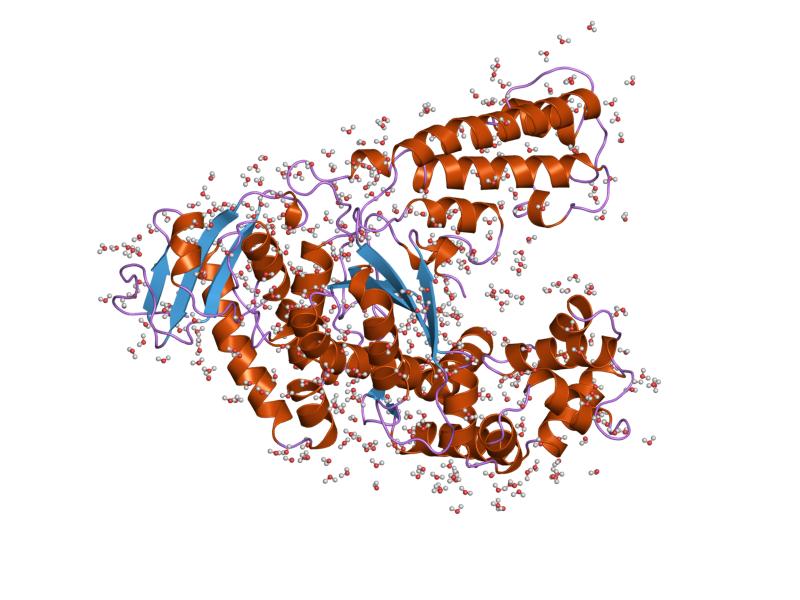
Taq polymerase
Taq polymerase is a thermostable DNA polymerase I named after the thermophilic eubacterial microorganism Thermus aquaticus, from which it was originally isolated by master's student Alice Chien et al. in 1976. Its name is often abbreviated to Taq or Taq pol. It is frequently used in the polymerase chain reaction (PCR), a method for greatly amplifying the quantity of short segments of DNA.
T. aquaticus is a bacterium that lives in hot springs and hydrothermal vents, and Taq polymerase was identified as an enzyme able to withstand the protein-denaturing conditions (high temperature) required during PCR. Therefore, it replaced the DNA polymerase from E. coli originally used in PCR.
Taq's optimum temperature for activity is 75–80 °C, with a half-life of greater than 2 hours at 92.5 °C, 40 minutes at 95 °C and 9 minutes at 97.5 °C, and can replicate a 1000 base pair strand of DNA in less than 10 seconds at 72 °C. At 75–80 °C, Taq reaches its optimal polymerization rate of about 150 nucleotides per second per enzyme molecule, and any deviations from the optimal temperature range inhibit the extension rate of the enzyme. A single Taq synthesizes about 60 nucleotides per second at 70 °C, 24 nucleotides/sec at 55 °C, 1.5 nucleotides/sec at 37 °C, and 0.25 nucleotides/sec at 22 °C. At temperatures above 90 °C, Taq demonstrates very little or no activity at all, but the enzyme itself does not denature and remains intact. Presence of certain ions in the reaction vessel also affects specific activity of the enzyme. Small amounts of potassium chloride (KCl) and magnesium ion (Mg2+) promote Taq's enzymatic activity. Taq polymerase is maximally activated at 50mM KCl, while optimal Mg2+ concentration is determined by the concentration of nucleoside triphosphates (dNTPs). High concentrations of KCl and Mg2+ inhibit Taq's activity. The common metal ion chelator EDTA directly binds to Taq in the absence of these metal ions.
One of Taq's drawbacks is its lack of 3' to 5' exonuclease proofreading activity resulting in relatively low replication fidelity. Originally its error rate was measured at about 1 in 9,000 nucleotides. Some thermostable DNA polymerases have been isolated from other thermophilic bacteria and archaea, such as Pfu DNA polymerase, possessing a proofreading activity, and are being used instead of (or in combination with) Taq for high-fidelity amplification. Fidelity can vary widely between Taqs, which has profound effects in downstream sequencing applications.
Taq makes DNA products that have A (adenine) overhangs at their 3' ends. This may be useful in TA cloning, whereby a cloning vector (such as a plasmid) that has a T (thymine) 3' overhang is used, which complements with the A overhang of the PCR product, thus enabling ligation of the PCR product into the plasmid vector.
In the early 1980s, Kary Mullis was working at Cetus Corporation on the application of synthetic DNAs to biotechnology. He was familiar with the use of DNA oligonucleotides as probes for binding to target DNA strands, as well as their use as primers for DNA sequencing and cDNA synthesis. In 1983, he began using two primers, one to hybridize to each strand of a target DNA, and adding DNA polymerase to the reaction. This led to exponential DNA replication, greatly amplifying discrete segments of DNA between the primers.
However, after each round of replication the mixture needs to be heated above 90 °C to denature the newly formed DNA, allowing the strands to separate and act as templates in the next round of amplification. This heating step also inactivates the DNA polymerase that was in use before the discovery of Taq polymerase, the Klenow fragment (sourced from E. coli). Taq polymerase is well-suited for this application because it is able to withstand the temperature of 95 °C which is required for DNA strand separation without denaturing.
Use of the thermostable Taq enables running the PCR at high temperature (~60 °C and above), which facilitates high specificity of the primers and reduces the production of nonspecific products, such as primer dimer. Also, use of a thermostable polymerase eliminates the need to add new enzyme to each round of thermocycling. A single closed tube in a relatively simple machine can be used to carry out the entire process. Thus, the use of Taq polymerase was the key idea that made PCR applicable to a large variety of molecular biology problems concerning DNA analysis.
Hub AI
Taq polymerase AI simulator
(@Taq polymerase_simulator)
Taq polymerase
Taq polymerase is a thermostable DNA polymerase I named after the thermophilic eubacterial microorganism Thermus aquaticus, from which it was originally isolated by master's student Alice Chien et al. in 1976. Its name is often abbreviated to Taq or Taq pol. It is frequently used in the polymerase chain reaction (PCR), a method for greatly amplifying the quantity of short segments of DNA.
T. aquaticus is a bacterium that lives in hot springs and hydrothermal vents, and Taq polymerase was identified as an enzyme able to withstand the protein-denaturing conditions (high temperature) required during PCR. Therefore, it replaced the DNA polymerase from E. coli originally used in PCR.
Taq's optimum temperature for activity is 75–80 °C, with a half-life of greater than 2 hours at 92.5 °C, 40 minutes at 95 °C and 9 minutes at 97.5 °C, and can replicate a 1000 base pair strand of DNA in less than 10 seconds at 72 °C. At 75–80 °C, Taq reaches its optimal polymerization rate of about 150 nucleotides per second per enzyme molecule, and any deviations from the optimal temperature range inhibit the extension rate of the enzyme. A single Taq synthesizes about 60 nucleotides per second at 70 °C, 24 nucleotides/sec at 55 °C, 1.5 nucleotides/sec at 37 °C, and 0.25 nucleotides/sec at 22 °C. At temperatures above 90 °C, Taq demonstrates very little or no activity at all, but the enzyme itself does not denature and remains intact. Presence of certain ions in the reaction vessel also affects specific activity of the enzyme. Small amounts of potassium chloride (KCl) and magnesium ion (Mg2+) promote Taq's enzymatic activity. Taq polymerase is maximally activated at 50mM KCl, while optimal Mg2+ concentration is determined by the concentration of nucleoside triphosphates (dNTPs). High concentrations of KCl and Mg2+ inhibit Taq's activity. The common metal ion chelator EDTA directly binds to Taq in the absence of these metal ions.
One of Taq's drawbacks is its lack of 3' to 5' exonuclease proofreading activity resulting in relatively low replication fidelity. Originally its error rate was measured at about 1 in 9,000 nucleotides. Some thermostable DNA polymerases have been isolated from other thermophilic bacteria and archaea, such as Pfu DNA polymerase, possessing a proofreading activity, and are being used instead of (or in combination with) Taq for high-fidelity amplification. Fidelity can vary widely between Taqs, which has profound effects in downstream sequencing applications.
Taq makes DNA products that have A (adenine) overhangs at their 3' ends. This may be useful in TA cloning, whereby a cloning vector (such as a plasmid) that has a T (thymine) 3' overhang is used, which complements with the A overhang of the PCR product, thus enabling ligation of the PCR product into the plasmid vector.
In the early 1980s, Kary Mullis was working at Cetus Corporation on the application of synthetic DNAs to biotechnology. He was familiar with the use of DNA oligonucleotides as probes for binding to target DNA strands, as well as their use as primers for DNA sequencing and cDNA synthesis. In 1983, he began using two primers, one to hybridize to each strand of a target DNA, and adding DNA polymerase to the reaction. This led to exponential DNA replication, greatly amplifying discrete segments of DNA between the primers.
However, after each round of replication the mixture needs to be heated above 90 °C to denature the newly formed DNA, allowing the strands to separate and act as templates in the next round of amplification. This heating step also inactivates the DNA polymerase that was in use before the discovery of Taq polymerase, the Klenow fragment (sourced from E. coli). Taq polymerase is well-suited for this application because it is able to withstand the temperature of 95 °C which is required for DNA strand separation without denaturing.
Use of the thermostable Taq enables running the PCR at high temperature (~60 °C and above), which facilitates high specificity of the primers and reduces the production of nonspecific products, such as primer dimer. Also, use of a thermostable polymerase eliminates the need to add new enzyme to each round of thermocycling. A single closed tube in a relatively simple machine can be used to carry out the entire process. Thus, the use of Taq polymerase was the key idea that made PCR applicable to a large variety of molecular biology problems concerning DNA analysis.