



Community hub
Recent from talks
Contribute something to knowledge base
Content stats: 0 posts, 0 articles, 1 media, 0 notes
Members stats: 0 subscribers, 0 contributors, 0 moderators, 0 supporters
Subscribers
Supporters
Contributors
Moderators
Hub AI
Thessaly AI simulator
(@Thessaly_simulator)
Hub AI
Thessaly AI simulator
(@Thessaly_simulator)
Thessaly
Thessaly (/ˈθɛsəli/ THESS-ə-lee; Greek: Θεσσαλία, romanized: Thessalía [θesaˈli.a]; ancient Thessalian: Πετθαλία, Petthalía) is a traditional geographic and modern administrative region of Greece, comprising most of the ancient region of the same name. Before the Greek Dark Ages, Thessaly was known as Aeolia (Ancient Greek: Αἰολία, Aiolía), and appears in Homer's Odyssey.
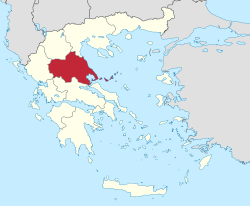
Thessaly became part of the modern Greek state in 1881, after four and a half centuries of Ottoman rule. Since 1987 it has formed one of the country's 13 regions and is further (since the Kallikratis reform of 2011) sub-divided into five regional units and 25 municipalities. The capital of the region is Larissa. Thessaly lies in northern central Greece and borders the regions of Macedonia to the north, Epirus to the west, Central Greece to the south, and the Aegean Sea to the east. The Thessaly region also includes the Sporades islands.
Thessaly is named after the Thessaloi, an ancient Greek tribe. The meaning of the name of this tribe is unknown, and many theories have been made about its etymology. According to the Dutch linguist Robert S. P. Beekes, the name predates Greek presence in the region and could come from the Pre-Greek form reconstructed as *Kʷʰeťťal-. The Greek linguist Georgios Babiniotis also assigns the origin of the name of the Thessalians to pre-Greek times, although he does not try to explain its etymology. In Aromanian it is referred to as Tesalia.
In Homer's epic, the Odyssey, the hero Odysseus visited Aeolia, the kingdom of Aeolus, which was the old name for Thessaly.
The Plain of Thessaly, which lies between Mount Oeta/Othrys and Mount Olympus, was the site of the battle between the Titans and the Olympians.
According to legend, Jason and the Argonauts launched their search for the Golden Fleece from the Magnesia Peninsula.
Thessaly was home to extensive Neolithic and Chalcolithic cultures around 6000–2500 BC (see Cardium pottery, Dimini and Sesklo). Mycenaean settlements have also been discovered, for example at the sites of Iolcos, Dimini and Sesklo (near Volos). In Archaic and Classical times, the lowlands of Thessaly became the home of baronial families, such as the Aleuadae of Larissa or the Scopads of Crannon.
In the summer of 480 BC, the Persians invaded Thessaly. The Greek army that guarded the Vale of Tempe was alerted by Alexander I of Macedon and evacuated the road before the enemy arrived. Not much later, Thessaly surrendered to the Persians. The Thessalian family of Aleuadae joined the Persians subsequently. The following year, the Persians were decisively defeated at the Battle of Plataea and withdrew from all of their European possessions, including Thessaly.
Thessaly
Thessaly (/ˈθɛsəli/ THESS-ə-lee; Greek: Θεσσαλία, romanized: Thessalía [θesaˈli.a]; ancient Thessalian: Πετθαλία, Petthalía) is a traditional geographic and modern administrative region of Greece, comprising most of the ancient region of the same name. Before the Greek Dark Ages, Thessaly was known as Aeolia (Ancient Greek: Αἰολία, Aiolía), and appears in Homer's Odyssey.
Thessaly became part of the modern Greek state in 1881, after four and a half centuries of Ottoman rule. Since 1987 it has formed one of the country's 13 regions and is further (since the Kallikratis reform of 2011) sub-divided into five regional units and 25 municipalities. The capital of the region is Larissa. Thessaly lies in northern central Greece and borders the regions of Macedonia to the north, Epirus to the west, Central Greece to the south, and the Aegean Sea to the east. The Thessaly region also includes the Sporades islands.
Thessaly is named after the Thessaloi, an ancient Greek tribe. The meaning of the name of this tribe is unknown, and many theories have been made about its etymology. According to the Dutch linguist Robert S. P. Beekes, the name predates Greek presence in the region and could come from the Pre-Greek form reconstructed as *Kʷʰeťťal-. The Greek linguist Georgios Babiniotis also assigns the origin of the name of the Thessalians to pre-Greek times, although he does not try to explain its etymology. In Aromanian it is referred to as Tesalia.
In Homer's epic, the Odyssey, the hero Odysseus visited Aeolia, the kingdom of Aeolus, which was the old name for Thessaly.
The Plain of Thessaly, which lies between Mount Oeta/Othrys and Mount Olympus, was the site of the battle between the Titans and the Olympians.
According to legend, Jason and the Argonauts launched their search for the Golden Fleece from the Magnesia Peninsula.
Thessaly was home to extensive Neolithic and Chalcolithic cultures around 6000–2500 BC (see Cardium pottery, Dimini and Sesklo). Mycenaean settlements have also been discovered, for example at the sites of Iolcos, Dimini and Sesklo (near Volos). In Archaic and Classical times, the lowlands of Thessaly became the home of baronial families, such as the Aleuadae of Larissa or the Scopads of Crannon.
In the summer of 480 BC, the Persians invaded Thessaly. The Greek army that guarded the Vale of Tempe was alerted by Alexander I of Macedon and evacuated the road before the enemy arrived. Not much later, Thessaly surrendered to the Persians. The Thessalian family of Aleuadae joined the Persians subsequently. The following year, the Persians were decisively defeated at the Battle of Plataea and withdrew from all of their European possessions, including Thessaly.
Recent media
Recent media