


Community hub
Recent from talks
Contribute something
Nothing was collected or created yet.
Iolcus
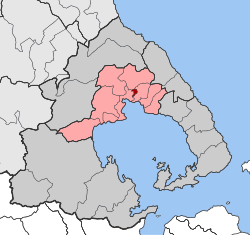
View on WikipediaIolcus (/aɪˈɒlkəs/; also rendered Iolkos /aɪˈɒlkɒs/; Ancient Greek: Ἰωλκός and Ἰαωλκός; Doric Greek: Ἰαλκός; Greek: Ιωλκός) is an ancient city, a modern village and a former municipality in Magnesia, Thessaly, Greece. Since the 2011 local government reform it is part of Volos, of which it is a municipal unit.[2] It is located in central Magnesia, north of the Pagasitic Gulf. Its land area is 1.981 km2.[3] The municipal unit is divided into three communities, Agios Onoufrios (pop. 433), Anakasia (pop. 888) and Ano Volos (pop. 687), with a total population of 2,008 (2021 census).[1] The seat of the former municipality was the village of Ano Volos.
Key Information


Mythology
[edit]

According to ancient Greek mythology, Aeson was the rightful king of Iolcus, but his half-brother Pelias usurped the throne. It was Pelias who sent Aeson's son Jason and his Argonauts to look for the Golden Fleece. The ship Argo set sail from Iolcus with a crew of fifty demigods and princes under Jason's leadership. Their mission was to reach Colchis in Aea at the eastern seaboard of the Black Sea and to reclaim and bring back the Golden Fleece.
Along with the Golden Fleece, Jason brought a wife, the sorceress Medea—king Aeetes's daughter, granddaughter of Helios, niece of Circe, princess of Aea, and later queen of Iolcus, Corinth and Aea, and also murderer of her brother Absyrtus, and her two sons from Jason. She is a tragic figure whose trials and tribulations were artfully dramatized in the much-staged play by Euripides, Medea.
History
[edit]Iolcus is mentioned by Homer, in the Catalogue of Ships in the Iliad, and later in the Odyssey; he gives it the epithets of ἐϋκτιμένη ("well built") and εὐρύχορος ("with broad places", "spacious").[4][5] The Bibliotheca of Pseudo-Apollodorus says the city was founded by Cretheus,[6] and to have been colonised by Minyans from Orchomenos.[7]
In antiquity, Iolcus was situated in Magnesia, ancient Thessaly, and was a polis (city-state).[8] It is rarely mentioned in historical times. It was given by the Thessalians to Hippias, upon his expulsion from Athens in 511/510 BCE, but he rejected it.[9] It is also quoted in the Periplus of Pseudo-Scylax as a city belonging to Magnesia.[10] The town afterward suffered from the disputes of its inhabitants, but it was finally ruined by Demetrius Poliorcetes's foundation of Demetrias in 294 BCE, when the inhabitants of Iolcus and of other adjoining towns were removed to that place.[11] It seems to have been no longer in existence in the time of Strabo, since he speaks of the place where Iolcus stood.[12] Strabo states that a festal assembly was held there in honor of Pelias.[11]
Site
[edit]The position of Iolcus is indicated by Strabo, who says that it was on the road from Boebe to Demetrias, and at the distance of 7 stadia from the latter.[13] In another passage he says that Iolcus is situated above the sea at the distance of 7 stadia from Demetrias.[14] Pindar places Iolcus is at the foot of Mount Pelion, consequently a little inland.[15] It might indeed appear, from Livy,[16] that Iolcus was situated upon the coast; but in this passage, as well as in Strabo,[14] the name of Iolcus seems to have been given to this part of the coast and the city itself.
Ancient Iolcus's location is at the Volos Kastro,[17][18] located at 39°21′59″N 22°58′08″E / 39.366305°N 22.96886°E.[18]
Historical population
[edit]See also
[edit]References
[edit]- ^ a b c "Αποτελέσματα Απογραφής Πληθυσμού - Κατοικιών 2021, Μόνιμος Πληθυσμός κατά οικισμό" [Results of the 2021 Population - Housing Census, Permanent population by settlement] (in Greek). Hellenic Statistical Authority. 29 March 2024.
- ^ "ΦΕΚ B 1292/2010, Kallikratis reform municipalities" (in Greek). Government Gazette.
- ^ a b "Population & housing census 2001 (incl. area and average elevation)" (PDF) (in Greek). National Statistical Service of Greece. Archived (PDF) from the original on 2015-09-21.
- ^ Homer. Iliad. Vol. 2.712.
- ^ 1
- ^ Bibliotheca of Pseudo-Apollodorus, 1.9.11
- ^ Strabo. Geographica. Vol. ix. p.414. Page numbers refer to those of Isaac Casaubon's edition.
- ^ Mogens Herman Hansen & Thomas Heine Nielsen (2004). "Thessaly and Adjacent Regions". An inventory of archaic and classical poleis. New York: Oxford University Press. p. 719. ISBN 0-19-814099-1.
- ^ Herodotus. Histories. Vol. 5.94.
- ^ Periplus of Pseudo-Scylax 65.
- ^ a b Strabo. Geographica. Vol. 9.5.15. Page numbers refer to those of Isaac Casaubon's edition.
- ^ ὁ τῆς Ἰωλκοῦ τόπος, Strabo. Geographica. Vol. ix. p.438. Page numbers refer to those of Isaac Casaubon's edition.
- ^ Strabo. Geographica. Vol. ix. p.438. Page numbers refer to those of Isaac Casaubon's edition.
- ^ a b Strabo. Geographica. Vol. ix. p.436. Page numbers refer to those of Isaac Casaubon's edition.
- ^ Pindar N. 4.88.
- ^ Livy. Ab urbe condita Libri [History of Rome]. Vol. 44.12, 13.
- ^ Richard Talbert, ed. (2000). Barrington Atlas of the Greek and Roman World. Princeton University Press. p. 55, and directory notes accompanying. ISBN 978-0-691-03169-9.
- ^ a b Lund University. Digital Atlas of the Roman Empire.
- ^ "Απογραφή Πληθυσμού - Κατοικιών 2011. ΜΟΝΙΜΟΣ Πληθυσμός" (in Greek). Hellenic Statistical Authority.
 This article incorporates text from a publication now in the public domain: Smith, William, ed. (1854–1857). "Iolcus". Dictionary of Greek and Roman Geography. London: John Murray.
| International | |
|---|---|
| Geographic | |
| Other | |

Iolcus
View on GrokipediaGeography and Setting
Location and Topography
Iolcus was an ancient city located in the region of Magnesia in Thessaly, Greece. The location of ancient Iolcus is subject to scholarly debate; the classical site is often identified with Volos Kastro, with coordinates approximately 39°21′59″N 22°58′08″E,[2] while the Mycenaean settlement associated with it is identified with Dimini, about 4 km west of Volos.[3] This position placed it in close proximity to the Pagasitic Gulf to the south and Mount Pelion to the east, integrating the settlement into a landscape of coastal plains and mountainous terrain.[4] Topographically, Iolcus lay at the foot of Mount Pelion, a prominent massif rising over 1,600 meters, which provided natural protection and resources while overlooking the fertile lowlands extending toward the sea. The site was situated inland, approximately 7 stadia (about 1.3 kilometers) from the nearby port city of Demetrias, as described by the ancient geographer Strabo, positioning it strategically along inland routes connecting to coastal access points. As a near-coastal settlement, Iolcus benefited from its adjacency to the sea, enabling participation in maritime activities through linkages with Demetrias and the gulf's harbors.[4] The Pagasitic Gulf, a sheltered inlet of the Aegean Sea reaching depths of up to 102 meters, held significant environmental and strategic value in antiquity due to its calm waters and position as a gateway for navigation between Thessaly and broader eastern Mediterranean routes. This gulf facilitated trade in goods such as timber from Pelion's forests and agricultural products from surrounding plains, underscoring Iolcus's role in regional exchange networks.[5]Ancient and Modern Contexts
In antiquity, Iolcus was identified as a prominent Thessalian polis situated in the region of Magnesia, serving as an important urban center in central Greece.[4] It appears in Homeric epics, where it is portrayed as a well-built and spacious city, underscoring its established role in early Greek society as referenced in the Iliad and Odyssey.[4] The site's significance waned over time, particularly with the establishment of Demetrias in 294 BCE, which drew away inhabitants and economic activity to the new Hellenistic stronghold.[4] In the modern era, Iolcus has evolved into a modest village, fully integrated into the Municipality of Volos through the Kallikratis reform enacted by Greek Law 3852/2010 in 2011, which restructured local government units across the country.[6] This marks a stark contrast to its ancient urban configuration as a bustling polis; today, it functions as a small-scale rural community covering 1.981 km², primarily supporting local agriculture and residential life on the outskirts of the urbanized Volos area.[4]Mythology
Legendary Origins
In Greek mythology, Iolcus was founded by Cretheus, a son of Aeolus, the eponymous ancestor of the Aeolians and ruler of regions in Thessaly. Cretheus established the city after marrying Tyro, daughter of Salmoneus, and fathering several sons, including Aeson, Amythaon, and Pheres, thereby establishing the early royal line.[7] The settlement was further shaped by colonization from the Minyans, a people originating from Orchomenus in Boeotia, who migrated to Iolcus and contributed to its cultural and demographic foundation in ancient lore. The succession myths of Iolcus center on a bitter dynastic conflict following Cretheus's death. Aeson, as the eldest legitimate son, was the rightful heir to the throne, but his half-brother Pelias—born to Tyro and the god Poseidon—usurped power through treachery and violence. To consolidate his rule, Pelias systematically targeted potential rivals within the family, including ordering the deaths of Aeson's male heirs; when Aeson and his wife Alcimede gave birth to Jason, they faked the infant's death and secretly entrusted him to the centaur Chiron on Mount Pelion for safekeeping, sparing him from Pelias's infanticide.[8][9] Aeson himself later perished, reportedly by drinking bull's blood under duress from Pelias, solidifying the usurper's control over Iolcus.[9] The etymology of the city's name, Ἰωλκός (Iolkos), remains uncertain. In Doric Greek dialects, it appears as Ἰαλκός (Ialkos), suggesting phonetic variations across regions. This usurpation and the resulting tensions prompted Pelias to dispatch Jason on a perilous quest intended to remove him from contention.Jason and the Argonauts
In Greek mythology, Iolcus served as the starting point for Jason's renowned quest for the Golden Fleece, prompted by a dire prophecy received by his uncle, King Pelias. Pelias, who had usurped the throne from Jason's father Aeson, consulted the oracle at Delphi, which warned that he would be slain by a man wearing a single sandal. When Jason arrived in Iolcus as a young man, having lost one sandal while crossing the river Anaurus, Pelias viewed him as the prophesied threat and devised a seemingly impossible task to eliminate him: Jason must retrieve the Golden Fleece from Colchis, a distant land ruled by King Aeetes. This fleece, the hide of a golden ram sent by Zeus to save Phrixus and Helle, hung in a sacred grove guarded by a sleepless dragon.[10] To undertake the perilous voyage, Jason assembled a band of Greece's greatest heroes in Iolcus, forming the group known as the Argonauts. Among them were Heracles, Orpheus, the twins Castor and Pollux, and the sons of Boreas, totaling over fifty warriors drawn from various regions. Under Athena's guidance, Argus son of Arestor constructed the ship Argo in the city's shipyards, incorporating a prophetic beam from the sacred oak at Dodona; the vessel's name derived from its builder, and it was uniquely designed with fifty oars to accommodate the crew. The Argonauts launched from the nearby harbor of Pagasae, offering sacrifices to Apollo and receiving favorable omens before setting sail eastward through the Hellespont toward Colchis.[10][7] Upon successfully obtaining the Golden Fleece with the aid of Aeetes' daughter Medea—a sorceress who fell in love with Jason and used her magic to help him yoke fire-breathing bulls, sow dragon's teeth that sprouted armed warriors, and lull the guarding dragon to sleep—the Argonauts returned to Iolcus after a circuitous journey fraught with adventures. Medea, now Jason's wife, devised a cunning plan to fulfill their vengeance against Pelias. Pretending to demonstrate her rejuvenating powers, she slaughtered an old ram, boiled its remains in a cauldron with herbs, and produced a young lamb to convince Pelias's daughters that the same could restore their father's youth. Deceived, the daughters dismembered and boiled Pelias himself, leading to his death, though the promised rejuvenation failed.[7][11] The murder of Pelias provoked his son Acastus to exile Jason and Medea from Iolcus, driving them to seek refuge in Corinth, where they initially lived in harmony with their two sons. However, Jason's decision to divorce Medea and marry the local princess Creusa, daughter of King Creon, for political gain shattered their union and ignited Medea's fury. In Euripides' tragedy Medea, this betrayal culminates in Medea's vengeful acts: she sends a poisoned robe to Creusa, causing her agonizing death along with Creon's, murders her own children to punish Jason, and escapes to Athens in a chariot provided by her grandfather Helios, leaving Jason desolate and cursing the gods.[12][13]History
Early and Mycenaean Periods
The region around Iolcus, corresponding to modern Volos in Thessaly, features evidence of Neolithic settlements that served as precursors to later Bronze Age occupation. Dimini, located approximately 5 km west of Volos, was a substantial Late Neolithic site dating to the end of the 5th millennium BCE, characterized by 30-40 houses accommodating 200-300 inhabitants within six concentric stone enclosures.[14] Nearby Sesklo, about 3 km further west, represents an even earlier Neolithic center from the 7th-6th millennia BCE, with both sites illustrating early agricultural communities engaged in farming, animal husbandry, and possible fishing along ancient maritime routes.[14] These settlements transitioned into the Early and Middle Bronze Age, with activity shifting to nearby flatlands and the Dimini hill used as a cemetery containing 16 cist graves, indicating continuity in population and land use before the emergence of more complex societies.[14] During the Late Bronze Age Mycenaean period (ca. 1400-1200 BCE), Iolcus emerged as a prominent center in Thessaly, identified with the palace complex at Dimini, the only known palatial structure in the region.[15] The site featured a sophisticated administrative and ceremonial layout, including two main megarons (Megaron A oriented east-west with residential and workshop wings, and Megaron B with similar divisions), a central court, and storage facilities containing cereals, olives, and grapes, alongside metalworking tools and stone matrices evidencing craft specialization.[15] This palace-based society, constructed over a 14th-century BCE predecessor and abandoned by the early 12th century BCE following destruction by fire, reflects a hierarchical organization with elite control over resources and production.[15] Archaeological evidence from Dimini, Kastro-Palia, and Pefkakia in the Bay of Volos further indicates a network of interdependent settlements without a strict central hierarchy, where power was distributed among multiple groups, challenging traditional models of Mycenaean palatial dominance.[16] Iolcus's Mycenaean prominence is underscored by elite burials, such as tholos tombs at nearby Kapakli and Kazanaki, suggesting a warrior aristocracy, and administrative records evidenced by Linear B symbols inscribed on a stone weight from a Dimini workshop, pointing to bureaucratic oversight of weights and measures.[15] These inscriptions, datable to the 13th century BCE, align with broader Mycenaean practices and predate Homeric epics, while artifacts and raw materials indicate economic ties to the eastern Mediterranean through maritime trade, facilitated by the site's proximity to the Pagasitic Gulf harbor at Pefkakia.[15] The palace's destruction around 1200 BCE marks the end of this phase, coinciding with wider regional upheavals in the Mycenaean world.[16]Classical to Hellenistic Eras
In the Homeric epics, Iolcus appears as a prominent Thessalian settlement, contributing to the Greek coalition against Troy in the Iliad's Catalogue of Ships, where it is described alongside other locales under the leadership of Eumelus, son of Admetus, and characterized as a "well-built" city.[17] The Odyssey further portrays it as "spacious Iolcus," the domain of Pelias, emphasizing its regional significance in the heroic age.[18] These attestations reflect a continuity from its Mycenaean roots into the poetic tradition of the Archaic period, underscoring Iolcus's enduring cultural memory as a fortified coastal hub. During the Classical era, Iolcus's political autonomy was constrained within the broader Thessalian framework, where it participated in the loose confederacy known as the Thessalian League, dominated by powerful centers like Larissa.[19] This structure limited the independence of peripheral poleis such as Iolcus, which lay in the Magnesian district and served more as a maritime outpost than a dominant power.[19] In 511/510 BCE, the Thessalians offered Iolcus as a refuge to the exiled Athenian tyrant Hippias, though he declined it in favor of Sigeum in the Troad, highlighting its strategic value but subordinate status.[20] During the Persian Wars, Iolcus, as part of Thessaly, submitted to Xerxes' invasion in 480 BCE, with the region providing guides and supplies to the Persian forces, reflecting the league's pro-Persian alignment under Larissa's influence.[21] The Hellenistic period marked Iolcus's decline, culminating in its effective abandonment after 294 BCE, when Demetrius I Poliorcetes founded the nearby city of Demetrias by consolidating and relocating inhabitants from Iolcus and surrounding villages to bolster his new Macedonian stronghold at the head of the Pagasaean Gulf.[22][23] This synoecism integrated Iolcus's population into Demetrias, which rapidly grew into a major port and royal residence, eclipsing the older settlement and reducing it to obscurity.[23]Archaeology
Excavation History
The archaeological exploration of the area associated with ancient Iolcus near modern Volos began in the late 19th century with initial surveys and limited excavations conducted by Greek and foreign archaeologists. In 1886, German archaeologist Heinrich Lolling and British scholar Henry Beauchamp Walters investigated the first tholos tomb at Dimini, providing early evidence of monumental Mycenaean architecture in the region.[14] Around the same time, Greek archaeologist Antonios Arvanitopoulos carried out surveys and excavations in the broader Demetrias area, including the Pefkakia promontory, identifying prehistoric remains that hinted at the site's significance as a potential port for Iolcus.[24] These efforts focused on surface collections and tomb explorations, establishing the vicinity of Volos as a key locus for Thessalian antiquity without yet confirming the precise location of Iolcus. Systematic excavations intensified in the late 20th century, particularly targeting Mycenaean layers at Dimini and Pefkakia under the auspices of the Greek Archaeological Service. At Dimini, Vassiliki Adrimi-Sismani initiated digs in 1980, uncovering extensive Late Bronze Age structures tentatively identified as part of Iolcus, with work continuing through the 1990s to delineate the settlement's layout.[14] Concurrently, rescue excavations at Pefkakia from 1986 to 1991, directed by the Ephorate of Antiquities of Magnesia, revealed a Mycenaean settlement south of the Magoula tell, confirming its role as a coastal outpost linked to Iolcus through stratigraphic and ceramic evidence.[25] Teams from the University of Thessaly collaborated in these efforts starting in the 1990s, contributing to the analysis of Mycenaean phases and integrating data from nearby sites like Kastro-Palaia.[26] Since the 2000s, ongoing archaeological work has emphasized non-invasive methods and preservation under the Greek Ministry of Culture. Geophysical surveys, including magnetometry and electrical resistivity, were conducted at Dimini and Pefkakia in the early 2000s to map subsurface features without further disturbance, aiding in site management.[27] Collaborative projects, such as the 2016–2021 excavations at Pefkakia involving the University of Thessaly and Professor Ione Tournavitou, focused on Hellenistic overlays masking Mycenaean remains, while a 2022–2026 Polish-Greek initiative by the Ephorate and University of Warsaw has employed multi-method approaches like ground-penetrating radar to explore the harbor area's extent.[25][28] These efforts, coordinated by the Ministry, prioritize conservation amid urban pressures from Volos, reinforcing Pefkakia's identification as Iolcus's ancient harbor through integrated survey data.[29]Key Findings and Interpretations
Excavations at Dimini have revealed a Mycenaean administrative center associated with ancient Iolcus, featuring two prominent megaron structures (Megaron A and Megaron B) that served as central buildings in a planned urban complex dating to the Late Helladic IIIB period (ca. 1300–1200 BCE). These megarons, along with associated pottery kilns and storage facilities, indicate organized craft production and resource management, pointing to a palatial economy integrated into broader Mycenaean networks despite evidence of shared rather than strictly centralized power among regional elites.[30] Linear B inscriptions and clay sealings found at the site further support administrative functions, such as record-keeping for goods and labor, underscoring Dimini's role in regional governance and economic oversight.[26] Chamber tombs and tholos tombs in the vicinity of Dimini and the Bay of Volos have yielded elite burials interpreted as warrior graves, containing bronze weapons like swords and spearheads, alongside gold and silver jewelry such as signet rings, diadems, and granulated beads. These graves also include imports like Minoan-style pottery and ivory artifacts from the Aegean islands, suggesting connections to long-distance exchange and the prominence of a militarized elite class that likely controlled local resources and defense. The presence of such high-status items, including decorative elements for weapons and attire, highlights social stratification and the role of warfare in Mycenaean Thessalian society.[31] At the seaside site of Pefkakia, near the Pagasitic Gulf, archaeological evidence points to a Mycenaean settlement functioning as a key harbor for Iolcus during the Late Bronze Age, with remains of quays, anchors, and storage areas facilitating maritime activities. Numerous transport stirrup jars, primarily from Cretan workshops with some mainland Greek origins, attest to active participation in Aegean trade networks, exchanging commodities like olive oil, wine, and possibly metals. Scholars interpret these findings as providing a historical basis for the Argonaut myths, positing that legends of Jason's voyages reflect real Mycenaean maritime expeditions from Iolcus to distant regions, blending factual trade routes with heroic narrative.[32][33]Modern Relevance
Demographics and Administration
The Iolcus municipal unit, part of the Municipality of Volos in the regional unit of Magnesia, Greece, underwent significant administrative changes with the implementation of the Kallikratis Programme in 2011, which merged the former independent municipality of Iolcus into the expanded Volos municipality as one of its units.[34] This reform aimed to streamline local governance and enhance administrative efficiency across Greece. Population trends in the Iolcus municipal unit reflect modest variations influenced by rural migration patterns and regional economic factors. According to data from the Hellenic Statistical Authority (ELSTAT), the permanent population stood at 2,143 in 1991, declined to 2,081 in 2001 (a decrease of 2.9%), increased slightly to 2,138 in 2011 (a rise of 2.7%), and then dropped to 2,008 in 2021 (a reduction of 6.1%).[35][36]| Census Year | Population | Change from Previous (%) |
|---|---|---|
| 1991 | 2,143 | - |
| 2001 | 2,081 | -2.9 |
| 2011 | 2,138 | +2.7 |
| 2021 | 2,008 | -6.1 |
Cultural and Touristic Legacy
Iolcus's mythical association with Jason and the Argonauts has profoundly shaped its presence in modern popular culture, ensuring the city's legendary status endures through various adaptations. The 1963 film Jason and the Argonauts, directed by Don Chaffey and featuring groundbreaking stop-motion effects by Ray Harryhausen, draws directly from the ancient epic Argonautica by Apollonius Rhodius, portraying Iolcus as the starting point of Jason's quest for the Golden Fleece and emphasizing themes of heroism and divine intervention. Similarly, the 2000 NBC miniseries Jason and the Argonauts reimagines the tale with a focus on Iolcus's royal intrigue, starring Jason London as the titular hero and highlighting the city's role as a hub of ancient Thessalian power.[37] These cinematic works, alongside literary retellings such as the graphic novel Jason and the Argonauts: A Modern Graphic Greek Myth (2024), which adapts the story for contemporary audiences while rooting it in Iolcus's historical context, perpetuate the myth's allure and introduce it to global viewers.[38] Tourism in the Volos region capitalizes on Iolcus's heritage, drawing visitors to explore its archaeological remnants and myth-inspired sites. The Dimini archaeological site, widely identified as ancient Iolcus and dating to the Neolithic and Mycenaean periods, serves as a key attraction just 5 km west of Volos, featuring preserved settlement structures and tombs that evoke the city's Bronze Age prominence.[3] Artifacts from Iolcus excavations, including pottery and tools from the Early Helladic era, are displayed at the Athanasakeion Archaeological Museum of Volos, one of Greece's oldest such institutions founded in 1909, providing insights into the region's prehistoric life.[39] Complementing these, the replica of Jason's ship Argo moored in Volos harbor symbolizes the Argonauts' voyage, while hiking trails in nearby Mount Pelion, such as the Centaurs' Path, connect to broader myths of the area's centaur inhabitants and divine retreats, offering immersive experiences tied to Iolcus's narrative.[40] In education, Iolcus features prominently in Greek school curricula as a cornerstone of mythology and Bronze Age history, fostering national pride in Thessaly's ancient legacy. Greek primary history textbooks integrate the Argonauts myth, including Iolcus as Jason's homeland, to teach cultural heritage and narrative traditions, often linking it to archaeological evidence from sites like Dimini.[41] Internationally, studies of Bronze Age Thessaly highlight Iolcus's role as a major Mycenaean center, influencing academic explorations of early Greek urbanization and trade. This educational emphasis extends to cultural events, such as the annual Argonaftika Festival in Afissos near Volos, which honors Jason through theater performances, concerts, and reenactments, blending myth with community celebration.[42] During Navy Week in late June, Volos hosts spectacles reenacting the Argonauts' departure from Iolcus's ancient port, attracting locals and tourists alike.[43]References
- https://en.wikisource.org/wiki/The_Plays_of_Euripides_(Coleridge)/Medea