Hubbry Logo
Thom spaceThom spaceMain
Open search
Thom space
Community hub
Thom space
logo
7 pages, 0 posts
0 subscribers
Be the first to start a discussion here.
Contribute something
Thom space
Thom space
from Wikipedia

In mathematics, the Thom space, Thom complex, or Pontryagin–Thom construction (named after René Thom and Lev Pontryagin) of algebraic topology and differential topology is a topological space associated to a vector bundle, over any paracompact space.

Construction of the Thom space

[edit]

One way to construct this space is as follows. Let

be a rank n real vector bundle over the paracompact space B. Then for each point b in B, the fiber is an n-dimensional real vector space. We can form an n-sphere bundle by taking the one-point compactification of each fiber and gluing them together to get the total space.[further explanation needed] Finally, from the total space we obtain the Thom space as the quotient of by B; that is, by identifying all the new points to a single point , which we take as the basepoint of . If B is compact, then is the one-point compactification of E.

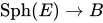
For example, if E is the trivial bundle , then is and, writing for B with a disjoint basepoint, is the smash product of and ; that is, the n-th reduced suspension of .

Alternatively,[citation needed] since B is paracompact, E can be given a Euclidean metric and then can be defined as the quotient of the unit disk bundle of E by the unit -sphere bundle of E.

The Thom isomorphism

[edit]

The significance of this construction begins with the following result, which belongs to the subject of cohomology of fiber bundles. (We have stated the result in terms of coefficients to avoid complications arising from orientability; see also Orientation of a vector bundle#Thom space.)

Let be a real vector bundle of rank n. Then there is an isomorphism called a Thom isomorphism

for all k greater than or equal to 0, where the right hand side is reduced cohomology.

This theorem was formulated and proved by René Thom in his famous 1952 thesis.

We can interpret the theorem as a global generalization of the suspension isomorphism on local trivializations, because the Thom space of a trivial bundle on B of rank k is isomorphic to the kth suspension of , B with a disjoint point added (cf. #Construction of the Thom space.) This can be more easily seen in the formulation of the theorem that does not make reference to Thom space:

Thom isomorphism Let be a ring and be an oriented real vector bundle of rank n. Then there exists a class

where B is embedded into E as a zero section, such that for any fiber F the restriction of u

is the class induced by the orientation of F. Moreover,

is an isomorphism.

In concise terms, the last part of the theorem says that u freely generates as a right -module. The class u is usually called the Thom class of E. Since the pullback is a ring isomorphism, is given by the equation:

In particular, the Thom isomorphism sends the identity element of to u. Note: for this formula to make sense, u is treated as an element of (we drop the ring )

[1]

The standard reference for the Thom isomorphism is the book by Bott and Tu.

Significance of Thom's work

[edit]

In his 1952 paper, Thom showed that the Thom class, the Stiefel–Whitney classes, and the Steenrod operations were all related. He used these ideas to prove in the 1954 paper Quelques propriétés globales des variétés differentiables that the cobordism groups could be computed as the homotopy groups of certain Thom spaces MG(n). The proof depends on and is intimately related to the transversality properties of smooth manifolds—see Thom transversality theorem. By reversing this construction, John Milnor and Sergei Novikov (among many others) were able to answer questions about the existence and uniqueness of high-dimensional manifolds: this is now known as surgery theory. In addition, the spaces MG(n) fit together to form spectra MG now known as Thom spectra, and the cobordism groups are in fact stable. Thom's construction thus also unifies differential topology and stable homotopy theory, and is in particular integral to our knowledge of the stable homotopy groups of spheres.

If the Steenrod operations are available, we can use them and the isomorphism of the theorem to construct the Stiefel–Whitney classes. Recall that the Steenrod operations (mod 2) are natural transformations

defined for all nonnegative integers m. If , then coincides with the cup square. We can define the ith Stiefel–Whitney class of the vector bundle by:

Consequences for differentiable manifolds

[edit]

If we take the bundle in the above to be the tangent bundle of a smooth manifold, the conclusion of the above is called the Wu formula, and has the following strong consequence: since the Steenrod operations are invariant under homotopy equivalence, we conclude that the Stiefel–Whitney classes of a manifold are as well. This is an extraordinary result that does not generalize to other characteristic classes. There exists a similar famous and difficult result establishing topological invariance for rational Pontryagin classes, due to Sergei Novikov.

Thom spectrum

[edit]

Real cobordism

[edit]

There are two ways to think about bordism: one as considering two -manifolds are cobordant if there is an -manifold with boundary such that

Another technique to encode this kind of information is to take an embedding and considering the normal bundle

The embedded manifold together with the isomorphism class of the normal bundle actually encodes the same information as the cobordism class . This can be shown[2] by using a cobordism and finding an embedding to some which gives a homotopy class of maps to the Thom space defined below. Showing the isomorphism of

requires a little more work.[3]

Definition of Thom spectrum

[edit]

By definition, the Thom spectrum[4] is a sequence of Thom spaces

where we wrote for the universal vector bundle of rank n. The sequence forms a spectrum.[5] A theorem of Thom says that is the unoriented cobordism ring;[6] the proof of this theorem relies crucially on Thom’s transversality theorem.[7] The lack of transversality requires that alternative methods be found to compute cobordism rings of, say, topological manifolds from Thom spectra.

See also

[edit]

Notes

[edit]

References

[edit]
[edit]
Revisions and contributorsEdit on WikipediaRead on Wikipedia
from Grokipedia
In algebraic topology, the Thom space of a vector bundle ξ:EB\xi: E \to B is a topological space constructed as the one-point compactification of the total space EE, denoted Th(ξ)=E+Th(\xi) = E^+, or equivalently as the quotient of the disk bundle D(ξ)D(\xi) by the sphere bundle S(ξ)S(\xi), where the sphere bundle is collapsed to a single basepoint. Introduced by French mathematician René Thom in his 1954 paper "Quelques propriétés globales des variétés différentiables," the Thom space revolutionized the study of manifolds and vector bundles by providing a tool to translate geometric problems into homotopy-theoretic ones. Thom's work, which earned him the Fields Medal in 1958, demonstrated that the unoriented cobordism groups of smooth manifolds are isomorphic to the homotopy groups of certain Thom spaces associated to the universal stable bundle over the classifying space BOBO, enabling the computation of these groups via stable homotopy theory. The Pontryagin–Thom construction extends to the oriented case, with analogous isomorphisms over BSOBSO, linking Stiefel–Whitney classes to bordism invariants. A key feature of Thom spaces is the Thom isomorphism, which asserts that for an oriented bundle of rank nn, the of the base Hq(B;Z)H^q(B; \mathbb{Z}) maps isomorphically to a shifted of the Thom space H~n+q(Th(ξ);Z)\tilde{H}^{n+q}(Th(\xi); \mathbb{Z}) via with the Thom class, a fundamental class supported in the fibers. These spaces are functorial under bundle maps and play a central role in generalized theories, such as KK-theory and cobordism spectra like MUMU for complex-oriented bundles, influencing applications from index theorems to modern stable homotopy computations.

Construction and Basic Definitions

Vector Bundles and Associated Disk Bundles

A real vector bundle EE of rank nn over a paracompact base space BB consists of a total space EE, which is a topological space, and a continuous surjective projection map p:EBp: E \to B such that each fiber Eb=p1(b)E_b = p^{-1}(b) for bBb \in B is homeomorphic to Rn\mathbb{R}^n as a . The base space BB is assumed to be paracompact, meaning it is Hausdorff and admits partitions of unity subordinate to any open cover, which facilitates constructions like bundle embeddings and characteristic classes. Locally, BB admits an open cover {Uα}\{U_\alpha\} with homeomorphisms ϕα:p1(Uα)Uα×Rn\phi_\alpha: p^{-1}(U_\alpha) \to U_\alpha \times \mathbb{R}^n that are linear isomorphisms on each fiber and satisfy pϕα1(u,v)=up \circ \phi_\alpha^{-1}(u, v) = u for uUαu \in U_\alpha, vRnv \in \mathbb{R}^n. On overlaps UαUβU_\alpha \cap U_\beta, the transition maps ϕβϕα1:(UαUβ)×Rn(UαUβ)×Rn\phi_\beta \circ \phi_\alpha^{-1}: (U_\alpha \cap U_\beta) \times \mathbb{R}^n \to (U_\alpha \cap U_\beta) \times \mathbb{R}^n take the form (u,v)(u,gαβ(u)v)(u, v) \mapsto (u, g_{\alpha\beta}(u) v), where gαβ:UαUβGL(n,R)g_{\alpha\beta}: U_\alpha \cap U_\beta \to GL(n, \mathbb{R}) is continuous. To construct the associated disk and sphere bundles, equip EE with a bundle metric, which exists globally over paracompact bases by averaging local Euclidean metrics via partitions of unity. The disk bundle D(E)D(E) is the subspace of EE consisting of all vectors with norm at most 1, i.e., D(E)={vEv1}D(E) = \{ v \in E \mid \|v\| \leq 1 \}, where \| \cdot \| denotes the metric norm on fibers. This forms a over BB with fiber the closed nn-disk Dn={xRnx1}D^n = \{ x \in \mathbb{R}^n \mid \|x\| \leq 1 \}, and the inclusion D(E)ED(E) \hookrightarrow E is a bundle with local trivializations restricting to those of EE. The bundle S(E)S(E) is the subspace of unit vectors, S(E)={vEv=1}S(E) = \{ v \in E \mid \|v\| = 1 \}, forming a over BB with fiber the unit Sn1S^{n-1}. The boundary of D(E)D(E) is precisely S(E)S(E), and both are compact if BB is compact. For the trivial bundle E=B×RnBE = B \times \mathbb{R}^n \to B, the projection is (b,v)b(b, v) \mapsto b, with global trivialization the identity map. Over a point B={pt}B = \{pt\}, ERnE \cong \mathbb{R}^n, so D(E)DnD(E) \cong D^n and S(E)Sn1S(E) \cong S^{n-1}. Over the sphere B=SkB = S^k, the trivial bundle yields D(E)Sk×DnD(E) \cong S^k \times D^n and S(E)Sk×Sn1S(E) \cong S^k \times S^{n-1}, illustrating how the bundles decompose as products when trivial. The quotient space D(E)/S(E)D(E)/S(E), obtained by collapsing the entire sphere bundle S(E)S(E) to a single point, serves as a preliminary in Thom space theory by effectively performing a fiberwise one-point compactification of the open disk interiors. Each fiber disk DnD^n is quotiented by its boundary Sn1S^{n-1} to yield SnS^n, with the collapse identifying the boundaries across fibers. This quotient is equivalent to the fiberwise one-point compactification of the total space EE, where each fiber Rn\mathbb{R}^n adds a , followed by collapsing the section at infinity (corresponding to S(E)S(E)) to the base point.

Definition of the Thom Space

The Thom space of a real EBE \to B of finite rank nn over a BB, equipped with a Riemannian metric, is defined as the quotient space Th(E)=D(E)/S(E)\operatorname{Th}(E) = D(E)/S(E), where D(E)D(E) is the disk bundle consisting of all vectors in EE with norm at most 1, and S(E)S(E) is the sphere bundle consisting of vectors with norm exactly 1 (with S(E)S(E) collapsed to a basepoint). This construction yields a pointed topological space, and Th(E)\operatorname{Th}(E) is compact whenever the rank is finite. If BB is a CW-complex, then Th(E)\operatorname{Th}(E) inherits a CW-structure from BB, with cells corresponding to those of BB shifted by the bundle rank. Equivalently, the Thom space Th(E)\operatorname{Th}(E) is the quotient of the fiberwise one-point compactification of the total space EE by the section at infinity over BB. For a compact base BB, Th(E)\operatorname{Th}(E) is homeomorphic to the one-point compactification of the total EE, and this agrees with the Alexandroff topology given by the quotient E+/s(B)E^+ / s_\infty(B). Another perspective views Th(E)\operatorname{Th}(E) as the mapping cone of the projection map from the sphere bundle S(E)BS(E) \to B. The mapping cone of a continuous map f:XYf: X \to Y is the quotient space YfCXY \cup_f CX, where CX=X×[0,1]/X×{1}CX = X \times [0,1] / X \times \{1\} is the cone on XX, and the attachment is via (x,0)f(x)(x,0) \mapsto f(x). In this case, it identifies the base BB with the cone on the sphere bundle S(E)S(E). For the trivial bundle E=B×RnE = B \times \mathbb{R}^n, the Thom simplifies to Th(E)ΣnB+\operatorname{Th}(E) \cong \Sigma^n B_+, the nn-fold suspension of the B+B_+ obtained by adjoining a disjoint basepoint to BB.

Cohomological Properties

The Thom Class

The Thom class of an nn-dimensional real EBE \to B is defined as an element uEHn(Th(E),Th(E)0;Z/2)u_E \in H^n(\operatorname{Th}(E), \operatorname{Th}(E)_0; \mathbb{Z}/2), where Th(E)\operatorname{Th}(E) denotes the Thom space obtained by quotienting the disk bundle D(E)D(E) of EE by its boundary sphere bundle S(E)S(E), and Th(E)0\operatorname{Th}(E)_0 is the image of the zero section s:BTh(E)s: B \to \operatorname{Th}(E). This class is characterized by the property that its restriction to the Thom space of each fiber is the generator of Hn(Dn,Sn1;Z/2)Z/2H^n(D^n, S^{n-1}; \mathbb{Z}/2) \cong \mathbb{Z}/2. The existence of the Thom class follows from the orientability of the bundle in the unoriented sense, which holds for all real vector bundles with Z/2\mathbb{Z}/2-coefficients. One construction proceeds via local orientations: since the base BB is paracompact, EE admits an open cover by trivializing neighborhoods where the Thom class is defined locally as the generator on each disk fiber relative to its boundary, and these local classes glue together globally using a partition of unity. Specifically, a partition of unity subordinate to this cover consists of smooth functions that weight the local cochain representatives of the Thom classes, allowing their weighted sum to define a global cochain in the relative singular cochain complex, which represents the Thom class in cohomology. Alternatively, the classifying map f:BGrn(R)BO(n)f: B \to \mathrm{Gr}_n(\mathbb{R}^\infty) \simeq BO(n) to the pulls back the universal Thom class uBO(n)Hn(Th(γn),Th(γn)0;Z/2)u_{BO(n)} \in H^n(\operatorname{Th}(\gamma^n), \operatorname{Th}(\gamma^n)_0; \mathbb{Z}/2) from the tautological bundle γnBO(n)\gamma^n \to BO(n), yielding uE=fuBO(n)u_E = f^* u_{BO(n)}; the universal class exists because BO(n)BO(n) is a CW complex with cells corresponding to Schubert varieties that support the required relative cohomology generator. The Thom class uEu_E is the unique cohomology class satisfying these restriction properties and generates Hn(Th(E),Th(E)0;Z/2)H^n(\operatorname{Th}(E), \operatorname{Th}(E)_0; \mathbb{Z}/2) as a Z/2\mathbb{Z}/2-module. In particular, the along the zero section satisfies suE=0Hn(B;Z/2)s^* u_E = 0 \in H^n(B; \mathbb{Z}/2), since s(B)=Th(E)0s(B) = \operatorname{Th}(E)_0 and relative cohomology vanishes on the subspace by definition; this follows from the long exact sequence of the pair (Th(E),Th(E)0)(\operatorname{Th}(E), \operatorname{Th}(E)_0) and the fact that the inclusion i:Th(E)0Th(E)i: \operatorname{Th}(E)_0 \hookrightarrow \operatorname{Th}(E) induces the zero map in degree nn on .

The Thom Isomorphism

The Thom isomorphism provides a fundamental link between the cohomology of the base space of a vector bundle and the reduced cohomology of its Thom space. For an nn-plane vector bundle EBE \to B over a paracompact base BB, there exists an isomorphism Φ:Hk(B;Z/2)H~k+n(Th(E);Z/2)\Phi: H^k(B; \mathbb{Z}/2) \to \tilde{H}^{k+n}(\mathrm{Th}(E); \mathbb{Z}/2) defined by Φ(x)=pr(x)uE\Phi(x) = \mathrm{pr}^*(x) \cup u_E, where \cup denotes the cup product, the ring multiplication structure on cohomology groups, pr:D(E)B\mathrm{pr}: D(E) \to B is the bundle projection, and uEHn(D(E),S(E);Z/2)u_E \in H^n(\mathrm{D}(E), \mathrm{S}(E); \mathbb{Z}/2) is the Thom class. This map is well-defined because the zero section identifies BB with a subspace Th(E)0Th(E)\mathrm{Th}(E)_0 \subset \mathrm{Th}(E) such that H(Th(E)0;Z/2)H(B;Z/2)H^*(\mathrm{Th}(E)_0; \mathbb{Z}/2) \cong H^*(B; \mathbb{Z}/2), and the cup product extends naturally via the projection and local trivializations ensuring H(D(E),S(E);Z/2)H(B;Z/2)H(Dn,Sn1;Z/2)H^*(D(E), S(E); \mathbb{Z}/2) \cong H^*(B; \mathbb{Z}/2) \otimes H^*(D^n, S^{n-1}; \mathbb{Z}/2). The proof of the Thom isomorphism relies on local trivializations of the vector bundle. Since BB is paracompact, there exists an open cover {Ui}\{U_i\} of BB such that EUiE|_{U_i} is trivial for each ii. On each UiU_i, the restricted Thom space Th(EUi)\mathrm{Th}(E|_{U_i}) is homotopy equivalent to Ui×Th(Rn)U_i \times \mathrm{Th}(\mathbb{R}^n), and the long exact sequence in cohomology for the pair (Th(EUi),Th(EUi)0)(\mathrm{Th}(E|_{U_i}), \mathrm{Th}(E|_{U_i})_0) shows that the relative cohomology H(Th(EUi),Th(EUi)0;Z/2)H^*(\mathrm{Th}(E|_{U_i}), \mathrm{Th}(E|_{U_i})_0; \mathbb{Z}/2) is isomorphic to H(Ui;Z/2)H^*(U_i; \mathbb{Z}/2) shifted by nn, where it is generated by cup products with the local Thom class uEiHn(Th(EUi),Th(EUi)0;Z/2)u_{E_i} \in H^n(\mathrm{Th}(E|_{U_i}), \mathrm{Th}(E|_{U_i})_0; \mathbb{Z}/2). The boundary map δ:Hn(Th(EUi),Th(EUi)0;Z/2)Hn+1(Th(EUi)0;Z/2)\delta: H^n(\mathrm{Th}(E|_{U_i}), \mathrm{Th}(E|_{U_i})_0; \mathbb{Z}/2) \to H^{n+1}(\mathrm{Th}(E|_{U_i})_0; \mathbb{Z}/2) satisfies δ(uEi)=0\delta(u_{E_i}) = 0. The local Thom class uEiu_{E_i} corresponds to the generator of the cohomology of the fiber. In the product structure, it is effectively 1×ι1 \times \iota, where $1 \in H^0(U_i)andand\iota \in H^n(D^n, S^{n-1})isthefundamentalclassofthediskrelativetoitsboundary.Theboundarymapis the fundamental class of the disk relative to its boundary. The boundary map\deltasatisfiesa"productrule"(Leibnizrule).Whenappliedtotheproductsatisfies a "product rule" (Leibniz rule). When applied to the product1 \times \iota: $$\delta(1 \times \iota) \approx (\delta 1) \times \iota \pm 1 \times (\delta \iota)$$ \delta 1 = 0becauseitisaclassonthebasespacebecause it is a class on the base spaceU_i(whichhasnoboundaryinthiscontext).(which has no boundary in this context).\delta \iota \in H^{n+1}(S^{n-1}) = 0becausebecauseS^{n-1}hasnocohomologyindegreehas no cohomology in degreen+1.Therefore,. Therefore, \delta(u_{E_i}) = 0.Thevanishingoftheboundarymap(. The vanishing of the boundary map (\delta = 0)confirmsthatthelocalcohomologybehavesexactlylikeasimpletensorproduct,allowingthe"shift"tohappenwithoutobstruction.Inthelongexactsequence,theboundarymap) confirms that the local cohomology behaves exactly like a simple tensor product, allowing the "shift" to happen without obstruction. In the long exact sequence, the boundary map \deltaconnectstherelativecohomologygroup(whereconnects the relative cohomology group (whereu_{E_i}lives)totheabsolutecohomologygroupofthesubspace.Iflives) to the absolute cohomology group of the subspace. If\deltawerenonzero,itwouldmixthedegreesandcreateacomplicated"twisting"(likeanontrivialEulerclass).Becausewere non-zero, it would mix the degrees and create a complicated "twisting" (like a non-trivial Euler class). Because\delta(u_{E_i})=0,theThomclass, the Thom class u_{E_i}isa"permanentcycle."Itallowsustotreattherelativecohomologyis a "permanent cycle." It allows us to treat the relative cohomologyH^(\mathrm{Th}(E|{U_i}), \mathrm{Th}(E|{U_i})_0; \mathbb{Z}/2)asafreemoduleoverthecohomologyofthebaseas a free module over the cohomology of the baseH^(U_i; \mathbb{Z}/2).Thestructuremeansthatanyelementintherelativecohomologycanbewrittenuniquelyasaproduct. The structure means that any element in the relative cohomology can be written uniquely as a product x \cup u_{E_i},where, where xisanelementfromthebaseis an element from the baseH^*(U_i; \mathbb{Z}/2).If. If xhasdegreehas degreek,and, and u_{E_i}hasdegreehas degreen,theresult, the result x \cup u_{E_i}hasdegreehas degreek+n.Thisonetoonecorrespondence. This one-to-one correspondence x \leftrightarrow x \cup u_{E_i}isthelocalshiftisomorphismis the local shift isomorphismH^k(U_i; \mathbb{Z}/2) \cong \tilde{H}^{k+n}(\mathrm{Th}(E|{U_i}); \mathbb{Z}/2),implyinglocalshiftisomorphisms, implying local shift isomorphisms H^k(U_i; \mathbb{Z}/2) \cong H^k(\mathrm{Th}(E|{U_i})0; \mathbb{Z}/2) \cong \tilde{H}^{k+n}(\mathrm{Th}(E|{U_i}); \mathbb{Z}/2)viacupproductwithvia cup product withu_{E_i}$. For product spaces, the Künneth formula allows us to express the cohomology of the product as the tensor product of the cohomologies of the factors: H(Ui×Dn,Ui×Sn1;Z/2)H(Ui;Z/2)H(Dn,Sn1;Z/2).H^*(U_i \times D^n, U_i \times S^{n-1}; \mathbb{Z}/2) \cong H^*(U_i; \mathbb{Z}/2) \otimes H^*(D^n, S^{n-1}; \mathbb{Z}/2). The cohomology of the fiber pair H(Dn,Sn1;Z/2)H^*(D^n, S^{n-1}; \mathbb{Z}/2) is zero in all degrees except nn, where it is Z/2\mathbb{Z}/2 generated by the local Thom class uEiu_{E_i} (corresponding to the fundamental class of the disk relative to its boundary). Because the fiber cohomology is supported only in degree nn with a single generator uEiu_{E_i}, every element in the relative cohomology is uniquely of the form xuEix \otimes u_{E_i} for xH(Ui;Z/2)x \in H^*(U_i; \mathbb{Z}/2), which corresponds to the cup product pr(x)uEi\mathrm{pr}^*(x) \cup u_{E_i}. The local Thom classes glue to a global Thom class uEHn(D(E),S(E);Z/2)u_E \in H^n(\mathrm{D}(E), \mathrm{S}(E); \mathbb{Z}/2) using the over the cover, as real vector bundles are orientable modulo 2. Similarly, the explicit isomorphism Φ\Phi is constructed globally by Φ(x)=pr(x)uE\Phi(x) = \mathrm{pr}^*(x) \cup u_E, and the Five Lemma applied to the commutative diagram arising from the Mayer-Vietoris exact sequences for the Thom spaces shows that the local isomorphisms glue to the global Thom isomorphism. For oriented bundles, an analogous holds with integer coefficients Z\mathbb{Z}, relying on an orientation to define the Thom class integrally. This reliance stems from the fact that an orientation of the bundle provides a consistent choice of generator for the top-dimensional integer cohomology of each fiber, enabling the Thom class to exist in Hn(D(E),S(E);Z)H^n(\mathrm{D}(E), \mathrm{S}(E); \mathbb{Z}) rather than just modulo 2. though the mod 2 version applies universally to real bundles without orientation assumptions. As a representative example, when EE is the trivial bundle of rank nn over BB, the Thom space Th(E)\mathrm{Th}(E) is homotopy equivalent to the nn-fold suspension ΣnB+\Sigma^n B_+, and the Thom recovers the standard suspension Hk(B;Z/2)H~k+n(ΣnB+;Z/2)H^k(B; \mathbb{Z}/2) \cong \tilde{H}^{k+n}(\Sigma^n B_+; \mathbb{Z}/2).

Historical Significance and Characteristic Classes

Thom's Original Contributions (1952–1954)

In 1952, René introduced the concept of the Thom space and established the Thom isomorphism in mod 2 through his seminal paper "Espaces fibrés en sphères et carrés de Steenrod." This work focused on spherical fibrations and their relation to Steenrod squares, providing a foundational between the cohomology of the base space and the relative cohomology of the associated Thom space. The Thom isomorphism serves as the core result, linking the topology of vector bundles to algebraic invariants in mod 2 coefficients. Thom's motivations for this development stemmed from his interests in , particularly the analysis of stable normal bundles in the study of embeddings and immersions of manifolds. These areas required tools to study the global behavior of manifolds under embeddings and immersions, where singularities arise and normal bundles play a central role in classifying such phenomena. By addressing these, Thom aimed to bridge geometric intuitions with cohomological structures, enabling a deeper understanding of manifold embeddings and their topological obstructions. Building on this foundation, Thom extended his results in 1954 with the paper "Quelques propriétés globales des variétés différentiables," where he developed the theory of , employing characteristic classes such as the Stiefel-Whitney classes for unoriented manifolds. In this work, he classified manifolds up to using the Thom space construction, demonstrating that the unoriented ring is generated by specific low-dimensional manifolds. A key aspect of his 1952 proof for the existence of the Thom class involved using the as the for vector bundles, where the class is obtained via pullback from the universal Thom class over the . These contributions had immediate impacts by establishing the Thom class as a pivotal element that connects the geometry of vector bundles directly to . This linkage facilitated early computations in theory, revealing the structure of cobordism groups and influencing subsequent work on manifold classification. Thom's innovations thus provided essential machinery for differential topologists to quantify global properties of manifolds through cohomological means.

Connections to Stiefel–Whitney Classes and Steenrod Operations

The Thom space of a real EBE \to B of rank rr provides a geometric framework for relating to Steenrod operations through the Thom isomorphism in mod 2 . Let uEHr(Th(E);Z/2)u_E \in H^r(\mathrm{Th}(E); \mathbb{Z}/2) denote the Thom class, which generates the image of the Thom isomorphism ϕ:H(B;Z/2)H+r(Th(E);Z/2)\phi: H^*(B; \mathbb{Z}/2) \to H^{*+r}(\mathrm{Th}(E); \mathbb{Z}/2), defined by ϕ(x)=π(x)uE\phi(x) = \pi^*(x) \cup u_E, where π:Th(E)B\pi: \mathrm{Th}(E) \to B is the projection induced by the zero section. The action of the Steenrod square Sqk\mathrm{Sq}^k on uEu_E satisfies Sqk(uE)=ϕ(wk(E))\mathrm{Sq}^k(u_E) = \phi(w_k(E)), where wk(E)w_k(E) is the kk-th of EE. Thus, the inverse yields the explicit relation wk(E)=ϕ1(Sqk(uE))w_k(E) = \phi^{-1}(\mathrm{Sq}^k(u_E)). This construction, due to Thom, identifies the Stiefel–Whitney classes as the unique classes satisfying the naturality and product axioms while aligning with the of the Thom space under Steenrod operations. More precisely, the total Stiefel–Whitney class w(E)=1+w1(E)++wr(E)w(E) = 1 + w_1(E) + \cdots + w_r(E) arises from the restriction of the Thom class via the zero section s:BTh(E)s: B \to \mathrm{Th}(E), but the full identification relies on the Thom isomorphism to "push forward" the base classes. Specifically, s(uE)s^*(u_E) corresponds to the mod 2 in the oriented case, but for general real bundles, the Steenrod operations on uEu_E encode the obstructions to sections, with Sqk(uE)\mathrm{Sq}^k(u_E) reflecting the kk-th obstruction class, isomorphic to wk(E)w_k(E). This relation holds because the Thom space cohomology is a over H(B;Z/2)H^*(B; \mathbb{Z}/2) generated by uEu_E, and the action is determined by its effect on the generator. For a closed smooth manifold MnM^n, the Wu formula further connects these structures by expressing the Stiefel–Whitney classes in terms of Steenrod squares on the fundamental class. Considering the normal bundle ν\nu of an MRn+kM \hookrightarrow \mathbb{R}^{n+k}, the properties of the Thom class uνu_\nu and the naturality of Steenrod operations relate the classes of MM. The Wu classes viv_i are defined such that vix,[M]=Sqi(x),[M]\langle v_i \cup x, [M] \rangle = \langle \mathrm{Sq}^i(x), [M] \rangle for xH(M;Z/2)x \in H^*(M; \mathbb{Z}/2); for such an embedding, vi=wi(ν)v_i = w_i(\nu), and w(TM)=w(ν)1w(TM) = w(\nu)^{-1}. Thom's insight reveals that applying Sqi\mathrm{Sq}^i to the Thom class produces classes tied to bundle obstructions: for instance, Sqi(uE)\mathrm{Sq}^i(u_E) vanishes if and only if the bundle admits ii linearly independent sections over the base, mirroring the vanishing of wi(E)w_i(E). In the Thom space, this action is multiplicative under Whitney sums, ensuring the Stiefel–Whitney classes satisfy the product formula w(EF)=w(E)w(F)w(E \oplus F) = w(E) \smile w(F). These relations underscore the Thom space's role in axiomatizing characteristic classes via algebraic cohomology operations.

Applications to Manifolds and Cobordism

Consequences for Differentiable Manifolds

For a smooth nn-manifold MM embedded in Rn+k\mathbb{R}^{n+k}, the normal bundle ν\nu over MM admits a Thom space Th(ν)\mathrm{Th}(\nu) whose relates to that of MM via the Thom , which identifies Hq(M;Z/2)H^q(M; \mathbb{Z}/2) with Hq+k(Th(ν);Z/2)H^{q+k}(\mathrm{Th}(\nu); \mathbb{Z}/2) for q0q \geq 0. This arises from the Thom class in the of the Thom space, providing a tool to extract bundle invariants from the topology of the disk bundle quotient. The Stiefel-Whitney classes wi(M)w_i(M) of the tangent bundle TMTM are diffeomorphism invariants of MM, as a diffeomorphism induces an isomorphism of tangent bundles, preserving the classifying map to the Grassmannian and thus the pullback of universal Stiefel-Whitney classes from BO(k)BO(k). This invariance follows from the Thom isomorphism applied to the normal bundle of an embedding, combined with the splitting principle and the fact that Stiefel-Whitney classes are stable under Whitney sum, ensuring consistency under diffeomorphisms. In contrast to Stiefel-Whitney classes, Pontryagin classes pi(M)p_i(M) are diffeomorphism invariants but not always topological invariants for non-orientable manifolds, where integral Pontryagin classes can differ between homeomorphic but not diffeomorphic structures, though their rational versions are topological. A representative example occurs for real projective spaces RPn\mathbb{RP}^n, where the Stiefel-Whitney classes of the tangent bundle are computed using the Thom space of the tautological line bundle γn1\gamma^1_n over RPn\mathbb{RP}^n, whose total class is w(γn1)=1+aw(\gamma^1_n) = 1 + a with aa the generator of H1(RPn;Z/2)H^1(\mathbb{RP}^n; \mathbb{Z}/2). The relation TRPnϵ1(n+1)γn1T\mathbb{RP}^n \oplus \epsilon^1 \cong (n+1)\gamma^1_n yields w(TRPn)=(1+a)n+1w(T\mathbb{RP}^n) = (1 + a)^{n+1} via the Thom isomorphism and multiplicative properties.

Oriented and Unoriented Cobordism

In unoriented cobordism theory, two closed nn-dimensional manifolds MM and NN are cobordant if there exists a compact (n+1)(n+1)-dimensional manifold WW such that W=MN\partial W = M \sqcup N. The set of cobordism classes of such nn-manifolds forms the unoriented group NnN_n, which under becomes an ; these groups assemble into a N=nNnN_* = \bigoplus_n N_n with multiplication induced by the product of manifolds. To relate this to Thom spaces, embed MM into Rn+k\mathbb{R}^{n+k} for kk sufficiently large, yielding a νM\nu_M of rank kk. The Pontryagin-Thom construction associates to [M][M] a class in πn+k(Th(νM))\pi_{n+k}(\mathrm{Th}(\nu_M)), and since νM\nu_M is stably equivalent to the universal bundle over BO(k)\mathrm{BO}(k), this induces a map Nnπn+k(MOk)N_n \to \pi_{n+k}(\mathrm{MO}_k), where MOk=Th(γk)\mathrm{MO}_k = \mathrm{Th}(\gamma^k) is the Thom space of the canonical kk-plane bundle γkBO(k)\gamma^k \to \mathrm{BO}(k). For k>nk > n, this map is an , establishing Nnπn(MO)N_n \cong \pi_n(\mathrm{MO}) as kk \to \infty, where MO\mathrm{MO} is the Thom spectrum. Oriented cobordism proceeds analogously but requires orientable manifolds and oriented vector bundles. Two closed oriented nn-manifolds MM and NN are oriented cobordant if there is a compact oriented (n+1)(n+1)-manifold WW with W=M(N)\partial W = M \sqcup (-N), where N-N denotes NN with reversed orientation. The oriented cobordism groups ΩnSO\Omega_n^{\mathrm{SO}} form a ring ΩSO\Omega_*^{\mathrm{SO}} under and product. Embedding an oriented MM into Rn+k\mathbb{R}^{n+k} (kk large) gives an oriented νM\nu_M, and the Pontryagin-Thom map sends [M][M] to πn+k(MSk)\pi_{n+k}(\mathrm{MS}_k), where MSk=Th(γkBSO(k))\mathrm{MS}_k = \mathrm{Th}(\gamma^k \to \mathrm{BSO}(k)) is the Thom space for the oriented case. Thom's theorem asserts that ΩnSOπn(MSO)\Omega_n^{\mathrm{SO}} \cong \pi_n(\mathrm{MSO}) for the Thom spectrum MSO\mathrm{MSO}, providing a homotopy-theoretic model for the oriented cobordism ring. A concrete illustration arises in low-dimensional unoriented , computed via the groups of Thom spaces. For instance, N0Z/2ZN_0 \cong \mathbb{Z}/2\mathbb{Z} is generated by a point (two points bound an interval); N1=0N_1 = 0 since circles bound disks; N2Z/2ZN_2 \cong \mathbb{Z}/2\mathbb{Z} is generated by RP2\mathbb{RP}^2 (which does not bound); and N3(Z/2Z)2N_3 \cong (\mathbb{Z}/2\mathbb{Z})^2, detected by Stiefel-Whitney numbers from the cell decomposition of MOk\mathrm{MO}_k. These groups reflect the F2\mathbb{F}_2-polynomial structure of NF2[w1,w2,]N_* \cong \mathbb{F}_2[w_1, w_2, \dots ] in homology, with generators corresponding to projective spaces.

Thom Spectra

Definition of the Thom Spectrum

In , a virtual bundle η\eta over a base space BB is an element of the reduced real group KO~(B)\tilde{KO}(B), formally represented as the difference of two real classes [ξ][ζ][\xi] - [\zeta] where ξ\xi and ζ\zeta are vector bundles over BB. This formal difference captures stable equivalence classes of bundles under addition of trivial bundles, enabling the extension of Thom spaces from actual vector bundles to virtual ones in the stable regime. The Thom spectrum Th(η)\mathrm{Th}(\eta) associated to such a virtual bundle η\eta is constructed as a sequence of Thom spaces {Th(γn)}nZ\{\mathrm{Th}(\gamma_n)\}_{n \in \mathbb{Z}}, where for sufficiently large nn, γn\gamma_n is a genuine over BB realizing η\eta in the sense that [γn]=η+n[ϵ][\gamma_n] = \eta + n[\epsilon] in KO~(B)\tilde{KO}(B), with ϵ\epsilon denoting the trivial . The structure maps of the spectrum are induced by bundle maps γnϵγn+1\gamma_n \oplus \epsilon \to \gamma_{n+1}, which yield suspension maps ΣTh(γn)Th(γn+1)\Sigma \mathrm{Th}(\gamma_n) \to \mathrm{Th}(\gamma_{n+1}) after passing to Thom spaces; these maps are compatible under stabilization and ensure that the resulting object is a spectrum in the stable category. Finite Thom spaces serve as the building blocks for this infinite-dimensional generalization. A canonical example is the universal Thom spectrum, obtained by taking η=\eta = -\infty to be the tautological virtual bundle over the classifying space BOBO for the stable orthogonal group, which is the stable inverse of the universal stable bundle over BOBO. This yields the MO spectrum, whose spaces are the Thom spaces of the universal bundles γn\gamma_n over BO(n)BO(n), stabilized via the inclusions BO(n)BO(n+1)BO(n) \to BO(n+1). The Thom spectrum Th(η)\mathrm{Th}(\eta) is an Ω\Omega-spectrum, meaning that the structure maps induce weak homotopy equivalences Th(γn)ΩTh(γn+1)\mathrm{Th}(\gamma_n) \simeq \Omega \mathrm{Th}(\gamma_{n+1}) for large nn, and its homotopy groups πTh(η)\pi_* \mathrm{Th}(\eta) are naturally isomorphic to bordism groups associated to manifolds equipped with stable structures classified by η\eta.

Real Cobordism and the MO Spectrum

The MO spectrum is the Thom spectrum associated to the virtual vector bundle of dimension −∞ pulled back to the classifying space BO for the stable orthogonal group O. Its underlying spaces are given by MO⟨n⟩ = Th(γ_n^⊥), where γ_n denotes the universal n-dimensional real vector bundle over the Grassmannian BO_n and γ_n^⊥ is its orthogonal complement in the tautological infinite-dimensional bundle over BO. This construction endows MO with the structure of an Ω-spectrum in positive dimensions, representing the generalized cohomology theory of unoriented bordism. The homotopy groups of the MO spectrum form the unoriented real cobordism ring, with π_(MO) ≅ Ω^O_(pt), where Ω^O_(pt) is the graded abelian group of cobordism classes of closed smooth unoriented manifolds, under the operation of disjoint union. The ring multiplication on π_(MO) arises from the smash product of spectrum spaces, which corresponds geometrically to the Cartesian product of manifolds, while the additive structure reflects disjoint unions; connected sums induce relations in the bordism classes. This isomorphism, established via the Pontryagin–Thom construction, identifies bordism classes with stable maps to the Thom spaces. Low-dimensional computations yield π_0(MO) ≅ ℤ/2, generated by the class of the point manifold; π_1(MO) = 0; π_2(MO) ≅ ℤ/2, generated by [ℝℙ²]; π_3(MO) = 0; π_4(MO) ≅ ℤ/2, generated by [ℂℙ²] (noting that [ℝℙ⁴] is twice this class in the group); π_5(MO) = 0; π_6(MO) ≅ ℤ/2, generated by [ℝℙ⁶]; and π_7(MO) = 0. Higher homotopy groups in even dimensions are ℤ/2-vector spaces generated by classes of real projective spaces ℝℙ^{2k} and certain quotients of spheres by free involutions, with the full additive structure being a single ℤ/2 in each even dimension, generated by the class of ℝℙ^{2k}. The ring Ω^O_* has a multiplicative structure induced by the Cartesian product of manifolds, forming a commutative ℤ/2-algebra generated by the classes [ℝℙ^{2k}] in degree 2k, subject to relations that preserve the additive rank of 1 in each even degree. A key relation exists between π_(MO) and the image of the J-homomorphism J: π_(O) → π_^s (the stable homotopy groups of spheres), as the Pontryagin–Thom collapse map sends bordism classes to stable homotopy classes lying in im J; specifically, the image of Ω^O_ under this map is contained within im J, reflecting that projective space bordisms arise from limits of orthogonal representations. In modern applications up to 2025, the MO spectrum informs , where unoriented cobordism obstructions classify manifolds up to via the surgery exact sequence of C.T.C. ; recent extensions incorporate equivariant bordism and algebraic to address structure sets for high-dimensional manifolds, bridging Thom's original computations with computational tools like the .

References

Add your contribution
Related Hubs
Contribute something
User Avatar
No comments yet.