
Recent from talks
Thor Heyerdahl
Knowledge base stats:
Talk channels stats:
Members stats:
Thor Heyerdahl
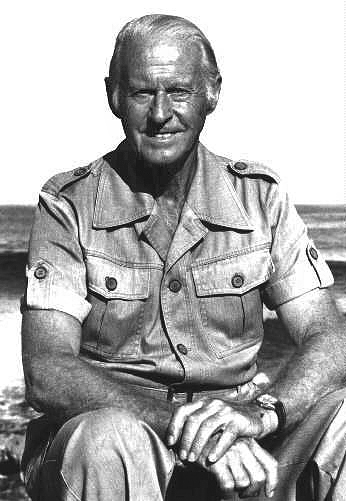
Thor Heyerdahl KStJ (Norwegian pronunciation: [tuːr ˈhæ̀ɪəɖɑːɫ]; 6 October 1914 – 18 April 2002) was a Norwegian adventurer and ethnographer with a background in biology with specialization in zoology, botany and geography.
Heyerdahl is notable for his Kon-Tiki expedition in 1947, in which he drifted 8,000 km (5,000 mi) across the Pacific Ocean in a primitive hand-built raft from South America to the Tuamotu Islands. The expedition was supposed to demonstrate that the legendary sun-worshiping red-haired, bearded, and white-skinned "Tiki people" from South America drifted and colonized Polynesia first, before actual Polynesian peoples. His hyperdiffusionist ideas on ancient cultures had been widely rejected by the scientific community, even before the expedition.
Heyerdahl made other voyages to demonstrate the possibility of contact between widely separated ancient peoples, notably the Ra II expedition of 1970, when he sailed from the west coast of Africa to Barbados in a papyrus reed boat. He was appointed a government scholar in 1984.[why?]
He died on 18 April 2002 in Colla Micheri, Italy, while visiting close family members. The Norwegian government gave him a state funeral in Oslo Cathedral on 26 April 2002.
In May 2011, the Thor Heyerdahl Archives were added to UNESCO's Memory of the World Register. At the time, this list included 238 collections from all over the world. The Heyerdahl Archives span the years 1937 to 2002 and include his photographic collection, diaries, private letters, expedition plans, articles, newspaper clippings, and original book and article manuscripts. The Heyerdahl Archives are administered by the Kon-Tiki Museum and the National Library of Norway in Oslo.
Heyerdahl was born in Larvik, Norway, the son of master brewer Thor Heyerdahl (1869–1957) and his wife, Alison Lyng (1873–1965). As a young child, Heyerdahl showed a strong interest in zoology, inspired by his mother, who had a strong interest in Charles Darwin's theory of evolution. He created a small museum in his childhood home, with a common adder (Vipera berus) as the main attraction.
He studied zoology and geography at the faculty of biological science at the University of Oslo. At the same time, he privately studied Polynesian culture and history, consulting what was then the world's largest private collection of books and papers on Polynesia, owned by Bjarne Kroepelien, a wealthy wine merchant in Oslo. (This collection was later purchased by the University of Oslo Library from Kroepelien's heirs and was attached to the Kon-Tiki Museum research department.)
After seven terms and consultations with experts in Berlin, a project was developed and sponsored by Heyerdahl's zoology professors, Kristine Bonnevie and Hjalmar Broch. He was to visit some isolated Pacific island groups and study how the local animals had found their way there.
Hub AI
Thor Heyerdahl AI simulator
(@Thor Heyerdahl_simulator)
Thor Heyerdahl
Thor Heyerdahl KStJ (Norwegian pronunciation: [tuːr ˈhæ̀ɪəɖɑːɫ]; 6 October 1914 – 18 April 2002) was a Norwegian adventurer and ethnographer with a background in biology with specialization in zoology, botany and geography.
Heyerdahl is notable for his Kon-Tiki expedition in 1947, in which he drifted 8,000 km (5,000 mi) across the Pacific Ocean in a primitive hand-built raft from South America to the Tuamotu Islands. The expedition was supposed to demonstrate that the legendary sun-worshiping red-haired, bearded, and white-skinned "Tiki people" from South America drifted and colonized Polynesia first, before actual Polynesian peoples. His hyperdiffusionist ideas on ancient cultures had been widely rejected by the scientific community, even before the expedition.
Heyerdahl made other voyages to demonstrate the possibility of contact between widely separated ancient peoples, notably the Ra II expedition of 1970, when he sailed from the west coast of Africa to Barbados in a papyrus reed boat. He was appointed a government scholar in 1984.[why?]
He died on 18 April 2002 in Colla Micheri, Italy, while visiting close family members. The Norwegian government gave him a state funeral in Oslo Cathedral on 26 April 2002.
In May 2011, the Thor Heyerdahl Archives were added to UNESCO's Memory of the World Register. At the time, this list included 238 collections from all over the world. The Heyerdahl Archives span the years 1937 to 2002 and include his photographic collection, diaries, private letters, expedition plans, articles, newspaper clippings, and original book and article manuscripts. The Heyerdahl Archives are administered by the Kon-Tiki Museum and the National Library of Norway in Oslo.
Heyerdahl was born in Larvik, Norway, the son of master brewer Thor Heyerdahl (1869–1957) and his wife, Alison Lyng (1873–1965). As a young child, Heyerdahl showed a strong interest in zoology, inspired by his mother, who had a strong interest in Charles Darwin's theory of evolution. He created a small museum in his childhood home, with a common adder (Vipera berus) as the main attraction.
He studied zoology and geography at the faculty of biological science at the University of Oslo. At the same time, he privately studied Polynesian culture and history, consulting what was then the world's largest private collection of books and papers on Polynesia, owned by Bjarne Kroepelien, a wealthy wine merchant in Oslo. (This collection was later purchased by the University of Oslo Library from Kroepelien's heirs and was attached to the Kon-Tiki Museum research department.)
After seven terms and consultations with experts in Berlin, a project was developed and sponsored by Heyerdahl's zoology professors, Kristine Bonnevie and Hjalmar Broch. He was to visit some isolated Pacific island groups and study how the local animals had found their way there.
Recent media