Hubbry Logo
Toasted ravioliToasted ravioliMain
Open search
Toasted ravioli
Community hub
Toasted ravioli
logo
8 pages, 0 posts
0 subscribers
Be the first to start a discussion here.
Toasted ravioli
Toasted ravioli
from Wikipedia
Toasted ravioli
Alternative namesT-ravs
TypeFried dish, pasta
Place of originUnited States
Region or stateSt. Louis, Missouri
Created bydisputed
Main ingredientsFlour, eggs, water, cheese, ground meat (sometimes), tomato sauce
  •   Media: Toasted ravioli

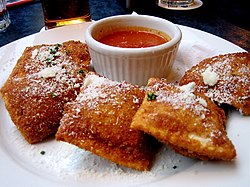
Toasted ravioli, colloquially known as T-ravs,[1][2] is breaded deep-fried ravioli, usually served as an appetizer and also used to consume dipping sauce.[3] It was created and popularized in St. Louis, Missouri.

Origin

[edit]

Most accounts of toasted ravioli trace its origins to a predominantly Italian-American neighborhood of St. Louis, The Hill. Supposedly, in the early 1940s, a ravioli was accidentally dropped into the fryer by a chef. Shortly thereafter, the item began appearing on menus across The Hill. While many restaurants on The Hill claim its creation,[4] Charlie Gitto's "On The Hill" restaurant (then known as "Angelo's") is where it was made famous. That story claims that a chef at Angelo's, Mario Battocletti, accidentally dropped the pasta into oil after a misunderstanding. Chef and restaurateur Charlie Gitto, Jr. inherited the original recipe and still serves it at his restaurants to this day.

Another claim is from Mama Campisi's as well as Louis Oldani.[5] Oldani is said to have named the dish 'toasted' ravioli because he thought 'toasted' was more appealing than 'fried'.[6]

Lombardo's Restaurants, located around the St. Louis area, also claim to have been among the first to bring toasted ravioli to the States from Sicily; their current owner, Tony Lombardo, shows menus from the 1930s that include it.[7] Lombardo's toasted ravioli frequently tops lists as the "best t-ravs in St. Louis".[8]

Composition, varieties, and service

[edit]

Generally, some type of meat is wrapped in square ravioli, breaded and deep fried until the pasta shell becomes slightly crispy, dry and browned. Toasted ravioli is generally served with marinara sauce for dipping[9] and Parmesan cheese may also be sprinkled on top. Toasted ravioli can be stored pre-made and frozen, which allows it to be easily prepared by fry cooks or bar staff without special skill or training.[citation needed]

See also

[edit]

References

[edit]
[edit]
Revisions and contributorsEdit on WikipediaRead on Wikipedia
from Grokipedia
Toasted ravioli, colloquially known as T-ravs, is a popular appetizer consisting of small, square or half-moon-shaped that are lightly breaded, deep-fried until golden and crisp, and typically served with warm for dipping and a sprinkle of grated or cheese on top. The are usually filled with traditional Italian-American mixtures such as seasoned , and cheese, or a blend of cheeses like and Provel, though modern variations may include more creative fillings. The dish originated in St. Louis, Missouri, within the city's Italian-American enclave known as The Hill neighborhood, where it emerged as a local innovation in the early 1940s. The name "toasted ravioli" was reportedly chosen to elevate the perception of the fried preparation, avoiding less appealing terms like "fried," and it first appeared in print advertising on January 30, 1943, at Oldani's restaurant (now Mama's on The Hill). While the exact invention is disputed among historic establishments— with claims from Mama's on The Hill citing a 1943 kitchen accident involving a tipsy cook dropping ravioli into hot oil, Charlie Gitto's attributing it to a 1947 mishap at the former Angelo's where a German chef misinterpreted instructions, and Lombardo's asserting earlier service on 1930s menus—the consensus points to The Hill as the birthplace during a period of vibrant Italian immigration and culinary adaptation. Some historians suggest possible influences from older Italian traditions, such as the Abruzzese holiday treat calcionetti, which features deep-fried ravioli, though no direct lineage has been confirmed. Preparation typically involves starting with fresh or frozen , which may be briefly boiled or parboiled to set the filling, then coated in a mixture of , , and breadcrumbs (often seasoned with Italian herbs), and deep-fried at around 350°F (175°C) for 2–3 minutes until crispy. They are drained on paper towels and finished with cheese, emphasizing a contrast of crunchy exterior and tender, melty interior. By the 1950s, the dish had proliferated across Italian restaurants and beyond, with commercial production beginning in the late by local companies like Louisa Foods, which helped standardize and distribute frozen versions nationwide. As a hallmark of St. Louis cuisine, toasted ravioli symbolizes the city's Italian heritage and has evolved from a neighborhood secret to a national menu staple, appearing at chains like and inspiring variations in other regions. Its enduring popularity underscores the fusion of Italian traditions with American ingenuity, remaining a point of local pride amid ongoing debates over its precise origins.

History

Origins and Invention

Toasted ravioli originated in St. Louis's The Hill neighborhood, a predominantly Italian-American enclave settled by immigrants starting in the who worked in local clay mines and later established a tight-knit community of family-owned businesses and . The dish first appeared on menus around 1943, marking its emergence as a novel appetizer in the area's Italian eateries. According to local legend, the invention stemmed from an accidental mishap in the when a chef at one of The Hill's restaurants dropped uncooked into a pot of hot oil meant for another preparation, resulting in a crispy, breaded exterior that transformed the traditional boiled into a fried treat. This version was breaded for added texture before frying, and despite the deep-frying method, it earned the name "toasted ravioli" as a more appealing descriptor suggested by a owner who found "fried" less enticing. Early development of the dish occurred at establishments such as Angelo's and Oldani's restaurants during the , where it was introduced to Italian-American diners as a shareable starter, quickly gaining favor for its crunchy bite and familiar filling of meat or cheese encased in dough. The concept drew influence from Sicilian and other Italian immigrant traditions in , adapting the classic —typically a boiled filled —from regions like into a portable, fried suited to American appetites and local culture, though earlier recipes for fried appeared in U.S. newspapers as far back as 1917.

Popularization and Disputes

Following its initial emergence in the 1940s, toasted ravioli rapidly gained traction in during the 1950s, particularly among Italian restaurants on The Hill neighborhood, where it appeared on menus at establishments such as Angelo’s on The Hill, Ruggeri’s, Lombardo’s, & Biggie’s Steakhouse, Farotto’s Pizzeria, and Kemoll’s Italian Restaurant. This adoption extended beyond Italian venues, reflecting the dish's versatility as a shareable appetizer suitable for bars and casual dining. By the mid-1950s, its local fame was evident when a 1956 column in the solicited reader recipes for the item, underscoring its status as a beloved regional specialty. The popularization of toasted ravioli has been accompanied by longstanding disputes over its invention, with three primary claimants emerging from St. Louis's Italian restaurant scene, though none offer definitive proof beyond family lore and limited records. Charlie Gitto's, originally Angelo’s on The Hill, attributes the dish to 1947, when a chef reportedly accidentally fried a batch of intended for and enhanced it with cheese to salvage the mishap. Mama's on The Hill, formerly Oldani’s, claims an earlier origin in 1943, stemming from a tipsy chef named Fritz who dropped into hot oil while preparing a dish in red wine sauce; the restaurant advertised "toasted ravioli" that same year in the St. Louis Star and Times, providing the earliest documented menu reference. A variant , recounted in a 1987 New York Times article, describes a German cook at an Oldani's-related operation who misheard instructions and fried instead of them, leading to positive reception; this account relies on later family recollections and overlaps with the Oldani’s narrative. These accounts rely heavily on passed down through restaurant families, with menu records like the 1943 advertisement offering the strongest but still inconclusive evidence. The dish's spread was propelled by word-of-mouth within St. Louis's tight-knit Italian-American communities, where it became a staple at gatherings and eateries by the , eventually appearing in local culinary publications and frozen product lines like those from Louisa Foods. Contributing factors included post-World War II waves of Italian immigration, which bolstered The Hill's cultural enclave and demand for familiar yet innovative comfort foods, alongside the ravioli's appeal as an affordable, communal bar snack that paired well with marinara dipping sauce.

Description and Preparation

Ingredients and Composition

Toasted ravioli features a thin typically composed of all-purpose , , , salt, , and extra-virgin , which is rolled out into sheets and cut into small squares approximately 2 inches on each side. The traditional meat filling consists of finely , , and blended with , , , , chopped , , and seasonings such as salt, pepper, and . A cheese-only variation uses a mixture of , , and sometimes , bound with and seasoned similarly, omitting the . For breading, the assembled are dipped in a mixture of beaten eggs and , then coated in Italian-seasoned breadcrumbs incorporating herbs like , , and , along with grated and salt. These are traditionally served hot, sprinkled with additional grated cheese and optionally chopped , alongside warm for dipping.

Cooking Method

The preparation of toasted ravioli begins with the assembly of the pockets, where fresh is rolled thin, filled with a such as or , and sealed tightly to prevent leakage during cooking. In homemade , the are typically cut into squares or rounds after sealing, ensuring no air pockets remain. Some traditional methods include a brief step, blanching the assembled in salted boiling water for about 3 minutes to partially cook and set the before breading, though this is optional and often omitted when using pre-made or frozen . The breading process follows to create the signature crispy exterior. Each ravioli is first dredged lightly in to help the coating adhere, though this step can be skipped for simpler preparations. It is then dipped in an , often mixed with a splash of or for better adhesion, before being rolled in seasoned Italian breadcrumbs containing herbs like , , and . For a thicker, more authentic crunch as prepared in restaurants, the process is repeated—dipping again in the and breadcrumbs for a double —allowing the breading to set briefly in the freezer if needed. Frying transforms the breaded ravioli into the golden, crisp dish. or canola oil is heated in a deep pot or fryer to 350–375°F (175–190°C), and the ravioli are added in small batches of 4–6 to avoid and maintain oil . They are fried for 2–3 minutes, turning once halfway through, until evenly golden brown and the filling is heated through. Excess oil is drained by transferring the ravioli to a wire rack or paper towels immediately after frying. Finally, while still hot to ensure the cheese melts into the breading, the toasted ravioli are sprinkled generously with grated cheese. They are served promptly with warm for dipping to preserve the contrast between the crunchy exterior and soft interior, as delaying service can lead to sogginess.

Varieties

Traditional Varieties

Traditional varieties of toasted ravioli, as developed in St. Louis's Italian-American community, primarily feature two classic fillings that reflect the Sicilian heritage of the immigrant families in The Hill neighborhood. The most common is the meat-filled version, typically made with a seasoned mixture of —often blended with , cheese, along with other cheeses like for added richness. This filling draws from Sicilian culinary traditions brought by early 20th-century immigrants, emphasizing hearty, savory profiles suited to the breaded and fried preparation. A vegetarian alternative, the cheese ravioli, offers a lighter option popular as an appetizer, filled primarily with and cheeses, occasionally incorporating or for subtle flavor enhancement. This variety maintains the dish's Italian roots while appealing to broader preferences in restaurants. In terms of form, traditional toasted ravioli are small, square pockets, approximately 1.5 to 2 inches per side, always coated in breadcrumbs and deep-fried to a crisp golden exterior before being dusted with grated cheese. They are conventionally served in appetizer portions of 8 to 12 pieces alongside for dipping. While the core recipe remains consistent across original Hill establishments, regional tweaks include incorporating into the breading for a sharper tang or using variations of homemade , such as those infused with fresh herbs, to personalize the dish without altering its foundational elements.

Modern Adaptations

In recent years, toasted ravioli has evolved to incorporate non-traditional fillings that extend beyond the classic meat and cheese varieties, appealing to diverse dietary preferences and culinary trends. Health-conscious preparations have gained popularity, with baked or air-fried methods replacing traditional deep-frying to reduce oil content while preserving the signature crispiness. These techniques involve coating frozen or fresh ravioli in breadcrumbs and cooking at around 350°F for 8-10 minutes, resulting in a lighter appetizer that aligns with modern wellness trends. Frozen commercial products, such as those from Louisa Foods, have made toasted ravioli accessible for home use since the late , with expanded distribution through grocery stores nationwide. Brands like Louisa offer pre-breaded options in flavors including and four-cheese, ready to bake or air-fry in under 10 minutes. Adaptations have spread to other Italian-American communities, and is available in regional grocery outlets. In areas like New York, variations pair the dish with bolder sauces, such as spicy arrabbiata, to incorporate heat from chili peppers and for a contemporary edge. Recipes in contemporary cookbooks emphasize customization, encouraging home cooks to experiment with fillings, seasonings, or even keto-friendly coatings like pork rind crumbs to suit personal tastes.

Cultural Impact

Role in St. Louis Cuisine

Toasted ravioli holds a prominent place as a "St. Louis original" in the city's culinary landscape, often celebrated alongside other local icons like and as signature dishes that define Midwestern Italian-American fare. This deep-fried ravioli appetizer embodies the inventive spirit of 's Italian community, particularly in the historic Hill neighborhood, where it emerged as a beloved staple. It frequently appears at local events, including sports games at —where variations like the "Taste of the Hill" burger incorporate toasted ravioli elements—and neighborhood festivals such as the annual Foodies Eat First Festival and the dedicated St. Louis Toasted Ravioli Week in . In St. Louis's restaurant culture, toasted ravioli is ubiquitous, especially on The Hill, home to over 20 Italian eateries that feature it prominently on their menus as a house specialty or appetizer. Establishments like Charlie Gitto's, Mama's on the Hill, and Rigazzi's trace their versions to family-owned traditions, with recipes and origin stories passed down through generations of Italian restaurateurs in the neighborhood. This prevalence has inspired tourist activities, such as "t-rav crawls," where visitors sample the dish at multiple spots along The Hill's Shaw Avenue, fostering a sense of culinary exploration tied to local heritage. Economically, toasted ravioli bolsters tourism by drawing food enthusiasts to The Hill and beyond, contributing to the city's vibrant Italian-American dining scene that supports local businesses and events. As a protected regional specialty—though without formal geographic indication—it underscores the area's Italian immigrant roots, established by settlers in the early 1800s, and remains a point of pride in Midwestern cuisine. Socially, it graces family gatherings, weddings, and bar menus across the city, often served as a shareable that evokes communal traditions and the fusion of Italian heritage with life.

National and Beyond Recognition

Toasted ravioli began gaining national recognition in the United States during the late , transitioning from a specialty to a menu staple at Italian-American restaurant chains. By the , as proliferated through expanding chains, the dish appeared on broader menus, with incorporating it as a signature appetizer featuring lightly fried filled with seasoned and served with . Today, it is widely available at regional Midwest spots and national outlets, bolstered by commercial frozen versions from brands like Louisa Foods, , and Farm Rich, which are distributed through supermarkets such as and online retailers like Amazon, allowing home preparation across the country. The dish's portrayal in media has further elevated its profile, highlighting its role in American regional cuisine. A 1987 New York Times article described toasted ravioli as a "secret" St. Louis innovation from the 1950s, born from a kitchen mishap at Angelo Oldani's restaurant, and speculated on its potential to spread like other regional favorites such as Buffalo wings. It has since been featured on television shows, including episodes of Diners, Drive-Ins and Dives with Guy Fieri sampling it at local Hill neighborhood eateries. Books on American regional foods include discussions of toasted ravioli as a symbol of Midwestern Italian-American adaptation. Beyond the U.S., toasted ravioli has seen limited adoption, often reinterpreted as "fried ravioli" in fusion contexts. In , it appears on menus at Toronto-area Italian restaurants like Viaggio and Piano Piano, where it is served as a breaded, fried appetizer similar to the St. Louis style. In , particularly , fried ravioli exists as a traditional called ravioli fritti, but fusion menus occasionally blend it with local ingredients, as seen in recipes from Sanpellegrino promoting it as a versatile starter. Frozen exports remain occasional, with U.S. brands like Louisa Foods available for international shipping via platforms like Amazon, though primarily targeted at expatriates. In recent years, toasted ravioli has gone viral on , sparking modern trends and discussions on authenticity. Since 2020, has hosted numerous recipe videos, including budget-friendly hacks using canned ravioli like for crispy, air-fried versions that garner millions of views and encourage home experimentation. These adaptations have fueled debates about preserving the original method—deep-fried fresh ravioli with beef or cheese fillings—versus non-traditional spins, with food enthusiasts questioning whether chain or DIY versions dilute its regional heritage.

References

Add your contribution
Related Hubs
User Avatar
No comments yet.