Hubbry Logo
Tokyo ExpressTokyo ExpressMain
Open search
Tokyo Express
Community hub
Tokyo Express
logo
8 pages, 0 posts
0 subscribers
Be the first to start a discussion here.
Tokyo Express
Tokyo Express
from Wikipedia
Tokyo Express
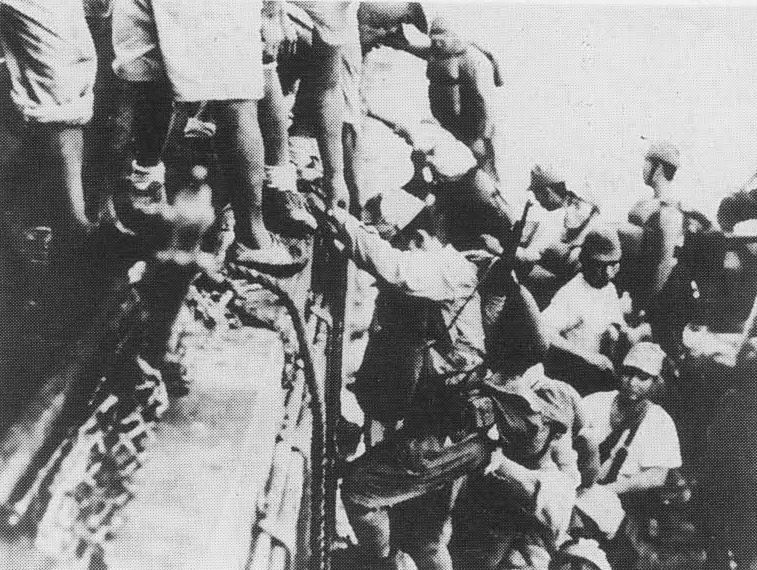
Japanese troops load onto a warship in preparation for a "Tokyo Express" run sometime in 1942.
ActiveAugust 1942 – November 1943
Country Empire of Japan
AllegianceImperial Japanese Armed Forces
BranchImperial Japanese Navy
TypeAd hoc military logistics organization
RoleSupply and reinforcement to Japanese Army and Navy units located in the Solomon Islands and New Guinea
SizeVaried
Garrison/HQRabaul, New Britain
Shortland Islands and Buin, Solomon Islands
NicknamesCactus Express
"Rat" or "Ant" transportation (Japanese names)
EngagementsBattle of Cape Esperance
Battle of Tassafaronga
Operation Ke
Battle of Blackett Strait
Battle of Kula Gulf
Battle of Kolombangara
Battle of Vella Gulf
Battle off Horaniu
Naval Battle of Vella Lavella
Battle of Cape St. George
Commanders
Notable
commanders
Gunichi Mikawa
Raizo Tanaka
Shintarō Hashimoto[1]
Matsuji Ijuin

The Tokyo Express was the name given by Allied forces to the use of Imperial Japanese Navy ships at night to deliver personnel, supplies, and equipment to Japanese forces operating in and around New Guinea and the Solomon Islands during the Pacific campaign of World War II. The operation involved loading personnel or supplies aboard fast warships (mainly destroyers), later submarines, and using the warships' speed to deliver the personnel or supplies to the desired location and return to the originating base all within one night so Allied aircraft could not intercept them by day.

Name

[edit]
Japanese reinforcements arriving on Guadalcanal c. September 1942; Savo Island in background.

The original name of the resupply missions was "The Cactus Express", coined by Allied forces on Guadalcanal, who used the code name "Cactus" for the island. After the U.S. press began referring to it as the "Tokyo Express", apparently in order to preserve operational security for the code word, Allied forces also began to use the phrase. The Japanese themselves called the night resupply missions "Rat Transportation" (鼠輸送, nezumi yusō), because they took place at night.

History

[edit]
Tokyo Express through "The Slot"

Night transportation was necessary for Japanese forces due to Allied air superiority in the South Pacific, established soon after the Allied landings on Guadalcanal and the subsequent establishment of Henderson Field as a base for the "Cactus Air Force" in August 1942. Delivery of troops and material by slow transport ships to Japanese forces on Guadalcanal and New Guinea soon proved too vulnerable to daytime air attack. The Japanese Combined Fleet commander Admiral Isoroku Yamamoto therefore authorized the use of faster warships to make the deliveries at night when the threat of detection was much less and aerial attack minimal.[2]

Solomon Islands Campaign

The Tokyo Express began soon after the Battle of Savo Island in August 1942 and continued until late in the Solomon Islands campaign when one of the last large Express runs was intercepted and almost completely destroyed in the Battle of Cape St. George on November 26, 1943. Because the destroyers typically used were not configured for cargo handling, many supplies were sealed inside steel drums lashed together and simply pushed into the water without the ships stopping; ideally, the drums would float ashore or were picked up by barge. However, many drums were lost or damaged; a typical night in December 1942 resulted in 1500 drums being rolled into the sea, with only 300 recovered.[3]

Most of the warships used for Tokyo Express missions came from the Eighth Fleet, based at Rabaul and Bougainville, although ships from Combined Fleet units based at Truk were often temporarily attached for use in Express missions. The warship formations assigned to Express missions were often formally designated as the "Reinforcement Unit", but the size and composition of this unit varied from mission to mission.[4]

John F. Kennedy

[edit]

John F. Kennedy's PT-109 was lost on a "poorly planned and uncoordinated" attack on a Tokyo Express run on the night of 1-2 August 1943.[5] Fifteen PT boats with sixty torpedoes fired over thirty and did not register a single hit, while PT-109 was rammed and sunk by the destroyer Amagiri, which was returning from her supply run, estimated to be traveling in excess of 30 knots (56 km/h; 35 mph) with no running lights.

Strategic importance

[edit]

The Tokyo Express ended up being a lose-lose gambit for the Japanese, because many destroyers were lost during the fifteen months of the Tokyo Express, for no gain. These ships could not be replaced by the stressed Japanese shipyards, and were already in short supply. In addition, they were desperately needed for convoy duty to protect Japanese shipping supplying the Home Islands from the depredations of American submarines.[6]

The Imperial Japanese Navy was caught in a Catch-22, since American airpower from Henderson Field denied the Japanese the use of slow cargo ships. Compared to destroyers, cargo ships were much more economical in fuel usage while having the capacity to carry full loads of troops plus sufficient equipment and supplies, and having efficient cargo loading and unloading equipment. However, they were slow and comparatively un-maneuverable, and thus easily sunk – not merely sending irreplaceable supplies and freighters to the bottom but leaving their increasingly desperate troops un-provisioned and ever less able to fight.

As a result, the Navy was in essence forced to "fight as uneconomical a campaign as could possibly be imagined", since in using destroyers they had to "expend much larger quantities of fuel than they wanted" considering Imperial Japan's disadvantage in oil supply, and this "fuel was used to place very valuable (and vulnerable) fleet destroyers in an exposed forward position while delivering an insufficient quantity of men and supplies to the American meatgrinder on the island".[7] Even at its best (with only one-fifth of the supplies dropped ever making it to shore) the destroyer strategy amounted to waging a losing war of attrition on land and an extremely expensive rolling naval defeat.

Thereafter, the Japanese increasingly relied on convoys of barges escorted by armored boats to replenish or evacuate their forces. A typical configuration allowing for the transport of 1,000 men, 300 miles, would consist of 2 Soukoutei-class armored boats as escort for 2 special large landing barges (Toku Daihatsu), 40 large landing barges (Daihatsu), and 15 small landing barges (Shohatsu).[8]

Demise

[edit]

By early February of 1943 the Allies had triumphed on Guadalcanal and had effective control of the area of The Slot that had been used to man and provision it, preventing a highly stressed Japanese military from being able to wage an effort to retake it and its extremely valuable Henderson Airfield. To signify final victory over the Japanese on the island, General Alexander Patch, commander of the Allied land forces on the island, messaged his superior, Admiral William F. Halsey on February 9, 1943, "Tokyo Express no longer has terminus on Guadalcanal."[9]

See also

[edit]

Citations

[edit]
References
  1. ^ Evans 176
  2. ^ Coombe, Derailing the Tokyo Express, p. 33.
  3. ^ "HyperWar: History of USMC Operations in WWII, Vol. I: Pearl Harbor to Guadalcanal, Part VI [Chapter 9]". www.ibiblio.org. Retrieved 2024-12-26.
  4. ^ Frank, p. 559.
  5. ^ National Geographic Search for the PT-109 DVD
  6. ^ Parillo
  7. ^ "Oil and Japanese Strategy in the Solomons: A Postulate". www.combinedfleet.com. Retrieved 2024-12-26.
  8. ^ "Japanese Use of Military Barges, from Tactical and Technical Trends, No. 43". lonesentry.com. January 27, 1944. Retrieved 2024-12-26.
  9. ^ "The Guadalcanal Campaign (David Llewellyn James)". Angelfire. Retrieved 2024-12-26.
Bibliography
[edit]
Revisions and contributorsEdit on WikipediaRead on Wikipedia
from Grokipedia
The Tokyo Express was the informal name given by Allied forces to the Imperial Japanese Navy's high-speed, nighttime resupply operations during , in which destroyers and other fast warships ferried troops, equipment, and supplies to Japanese positions in the , primarily to sustain the from August 1942 to February 1943. These runs, often conducted through "The Slot"—a narrow passage between and —exploited darkness and Japanese expertise in night fighting to evade Allied air and surface interdiction, allowing to reinforce its isolated garrisons despite growing U.S. dominance in the region. Dubbed "Rat Transportation" by the Japanese themselves, the operations typically involved destroyers towing or carrying buoyant supply drums that were released near shore for retrieval by smaller boats, a method necessitated by the vulnerability of slower merchant vessels to Allied aircraft. The Tokyo Express played a pivotal role in prolonging the Guadalcanal struggle, where Japanese forces, facing severe shortages on what they called "Starvation Island," relied on these runs to deliver critical , , and reinforcements—sometimes up to 1,000 troops per mission—despite the high risks posed by Allied PT boats, submarines, and surface forces. Early successes, such as Raizo Tanaka's repeated convoys in late 1942, underscored Japan's tactical ingenuity, with destroyers achieving speeds of over 30 knots while armed with the formidable Type 93 "Long Lance" , which outranged and outpowered U.S. equivalents. However, the operations exacted a heavy toll; by mid-1943, Allied advancements in technology, particularly the SG surface-search , enabled devastating ambushes, shifting the balance as U.S. destroyers began exploiting superior detection to launch coordinated strikes. Key engagements highlighted the Express's vulnerabilities and the Allies' countermeasures. In the on August 6–7, 1943, Commander Frederick Moosbrugger's Task Group 31.3 used radar-guided tactics to sink three Japanese destroyers without loss, marking a turning point in night . Similarly, the on November 24–25, 1943, saw Arleigh A. Burke's decimate a under Kiyoto Kagawa, sinking three destroyers and damaging others in a one-sided action that effectively ended large-scale Tokyo Express runs. By early 1944, as U.S. forces advanced northward, the strategy became untenable, contributing to Japan's broader logistical collapse in the Pacific theater.

Background and Naming

Historical Context of the Guadalcanal Campaign

The marked a pivotal shift in the Pacific Theater of , representing the Allies' first major offensive against Japanese-held territory as part of an emerging island-hopping strategy aimed at recapturing strategic positions to isolate and neutralize . Following the Japanese expansion after , which threatened Allied supply lines to and , U.S. planners targeted the to disrupt enemy bases at and secure sea lanes. On August 7, 1942, the U.S. , under Alexander A. Vandegrift, launched Operation Watchtower, landing approximately 11,000 troops on and nearby and Florida Islands with naval support from Task Force 61, including carriers Enterprise, , and Wasp. This amphibious assault caught Japanese forces—primarily construction units building an airfield—by surprise, allowing the to seize the unfinished airstrip near Lunga Point with minimal initial resistance. The captured airfield, renamed Henderson Field in honor of Maj. , proved essential for establishing Allied air superiority in the chain. Operational by August 20, 1942, it enabled the ""—a mix of Marine, Army, and Navy aircraft—to conduct reconnaissance, bombing, and fighter patrols that interdicted Japanese shipping and troop movements during daylight hours, effectively denying the enemy uncontested control of the surrounding waters known as "The Slot." Control of Henderson Field was crucial because it extended Allied air coverage over vital sea routes, preventing Japanese reinforcements from landing in force and supporting broader operations against , thereby protecting Allied communications in the South Pacific. Japanese counteroffensives began almost immediately, with the Imperial Japanese Navy's Eighth Fleet and Eleventh Air Fleet from launching air raids and naval bombardments to regain the initiative. The first ground counterattack came on August 12-13, when the Ichiki Detachment of about 900 troops attempted to overrun Marine positions at the but was repulsed with heavy losses, highlighting Japan's underestimation of Allied defenses. Subsequent efforts, including the Kawaguchi Detachment's assault on Bloody Ridge in September, aimed to seize Henderson Field but failed due to rugged terrain, supply shortages, and interdiction, forcing Japan into a protracted attritional struggle. Early Japanese resupply efforts relied on slower, limited methods like seaplanes and , which proved inadequate amid and naval pressure. Seaplanes, such as Mavis models operating from , attempted airdrops and liaison flights starting in mid-, delivering small quantities of ammunition and food but suffering high losses to Henderson Field fighters due to their vulnerability and short range for sustained operations. Submarines, including I-class boats, conducted sporadic runs from late , transporting up to 20 tons of cargo in deck tubes but were hampered by low capacity for troops or , long transit times from distant bases, and risks from Allied patrols, resulting in minimal impact on ground forces facing and . These constraints underscored Japan's logistical vulnerabilities, as surface shipping became too hazardous after initial attempts were disrupted. The on August 23-25, 1942, further restricted Japanese naval movements, as U.S. carriers Saratoga and Enterprise intercepted a reinforcement bound for , sinking the light carrier Ryujo and damaging others while losing no carriers. This tactical draw forced to divert troops via destroyers rather than larger transports, limiting reinforcements to "rat transportation" runs at night and ceding daylight sea control to the Allies, which compounded resupply difficulties and set the stage for prolonged attrition around the island.

Origin and Terminology

The term "Tokyo Express" was coined by U.S. Marines stationed on in late August 1942 to describe the Imperial Japanese Navy's rapid nighttime destroyer runs delivering personnel, supplies, and equipment to the island. These missions, which began shortly after the Allied landings on August 7, 1942, were characterized by their high speed and nocturnal timing to evade American detection and interdiction, evoking the image of a swift express train originating from . The nickname quickly spread among Allied ground and naval forces as a way to refer to the persistent Japanese reinforcement efforts through "The Slot," the narrow waterway between and the northern . An alternative Allied designation was the " Express," directly referencing the operation's "Cactus" for itself. This term, used interchangeably with " Express" in early U.S. , underscored the island's central role in the campaign while maintaining brevity in reporting. Both names highlighted the logistical ingenuity of the Japanese tactics but also the frustration they caused among American defenders facing intermittent but crucial enemy buildups. From the Japanese perspective, these resupply operations were known as "Nezumi Yūsō" (鼠輸送), or "Rat Transportation," a term that captured the stealthy, scurrying quality of the missions conducted to slip past Allied patrols. The reflected the precarious and evasive nature of the runs, which relied on destroyers' speed rather than larger, more vulnerable transports. The " Express" moniker gained wider currency in U.S. media and official military dispatches throughout 1942 and 1943, evolving from informal Marine into a standardized reference that aided operational security by obscuring specific details about . This usage avoided explicit mentions of the island's location or strategic vulnerabilities, allowing public reporting on Pacific engagements without compromising sensitive intelligence. The term's adoption in press accounts, such as those in contemporary newspapers, helped shape Allied narratives of the while emphasizing Japanese logistical determination.

Organization and Operations

Structure and Logistics

The Tokyo Express operated under the command of the Imperial Japanese Navy's Eighth Fleet, headquartered at on , with overall integration into the Combined Fleet's strategic framework for the . assumed primary command of (DesRon 2) in October 1942, leading most runs under Vice Admiral Gunichi Mikawa's oversight as commander of the Eighth Fleet. This structure emphasized rapid, decentralized execution by destroyer flotillas to bypass Allied interdiction, with Tanaka earning the nickname "Tanaka the Tenacious" for his persistent leadership despite mounting losses. The core of the operation relied on high-speed destroyers, primarily from classes like the Kagero, which could exceed 35 knots, conducting nighttime runs through "the Slot"—the chain of islands and waters between and . These vessels departed or forward bases like Shortland Island after dusk, covering round-trip distances of approximately 1,000-1,100 nautical miles while maintaining strict to evade detection. Cargo typically included troops, , , and , loaded into destroyer holds or lashed on deck; a single could carry 200-240 drums of supplies, often 200-liter barrels designed for . To minimize exposure during unloading, Japanese forces employed the "shake method," daisy-chaining drums with ropes and jettisoning them overboard near the shore, where small motor boats towed them to the beach. This allowed typical runs to complete offloading in 20-30 minutes, enabling destroyers to retreat before dawn and avoid Allied from Henderson Field. Submarines provided auxiliary supply support, transporting critical personnel and equipment in floating rubber containers released while submerged at night, though their role was secondary to surface runs due to limited capacity. Logistical challenges were acute, including chronic fuel shortages that restricted sortie frequency and forced reliance on destroyer speed over armored escorts or larger transports. compounded coordination issues, often resulting in isolated flotillas navigating by pre-planned routes, while Allied air and submarine threats frequently sank drums or vessels mid-run, significantly reducing effective delivery rates.

Key Runs and Engagements

The Tokyo Express operations commenced in mid-August 1942, with Japanese initiating nightly reinforcement runs to starting on 16 August, landing small numbers of troops and supplies under cover of darkness to evade Allied air attacks. These initial efforts marked a shift from slower daytime convoys to high-speed transports, setting the pattern for subsequent missions despite the limitations of destroyers in carrying heavy . A major reinforcement attempt occurred on 24–25 August during the , when Raizo Tanaka's convoy—comprising the Jintsu, eight destroyers, and three transports carrying approximately 1,500 troops—approached but was intercepted by U.S. carrier aircraft. The Japanese lost the light carrier Ryujo, destroyer Mutsuki, and transport Kinryu Maru, with no troops successfully delivered, though Tanaka's surviving destroyers withdrew to fight another day. This engagement highlighted the vulnerability of the Express to daylight , compelling the Japanese to rely more heavily on nocturnal destroyer-only runs that minimized exposure but restricted supply volumes. By October 1942, the operations intensified amid escalating ground fighting on . On the night of 11–12 October, during the , a U.S. under Norman Scott ambushed a Japanese bombardment and reinforcement group transiting the Slot, sinking the heavy cruiser Furutaka and destroyers Fubuki and Natsugumo while damaging the heavy cruiser Aoba. The Americans suffered the sinking of destroyer Duncan (the following day) and heavy damage to cruiser Boise, with approximately 175 killed, but the action temporarily disrupted Japanese resupply efforts. The carrier Battle of the Santa Cruz Islands from 25–27 October indirectly supported ongoing Express runs by drawing U.S. naval forces away from the Slot, allowing Japanese reinforcements to land despite the battle's heavy toll on carrier air groups. achieved a tactical victory, sinking the carrier and damaging Enterprise, but lost 148 experienced pilots and numerous , further eroding their ability to provide air cover for future supply missions. Japanese destroyers in the supporting force escaped significant losses, enabling continued nocturnal operations. Peak activity occurred in October and November 1942, with frequent destroyer runs delivering thousands of troops—contributing to roughly 2,000 reinforcements amid broader efforts to build up to 10,000 men—though rough seas, Allied interdiction, and the destroyers' limited cargo capacity often resulted in only partial supplies reaching shore. One such mission on 30 November, the Battle of Tassafaronga, saw eight Japanese destroyers under Tanaka employ "Rat Transportation" drums for supplies; they inflicted severe damage on four U.S. cruisers—sinking Northampton and crippling Minneapolis, New Orleans, and Pensacola with Long Lance torpedoes—while losing only the destroyer Takanami. U.S. casualties exceeded 395 killed, underscoring Japanese destroyer effectiveness in night actions despite the overall strain on their logistics. By early 1943, as wound down, the Tokyo Express adapted to support operations in the central Solomons and adjacent campaigns, with destroyer runs shifting northward to reinforce and Vila. A notable engagement came on 6 March in the Battle of Blackett Strait, where U.S. destroyers sank two Japanese vessels (Murasame and Minegumo) attempting a supply run through Kula Gulf, killing 174 Japanese sailors and disrupting reinforcements for . Further interdictions in August, including actions, continued to challenge these extended lines.

Strategic Role and Impact

Implications for Japanese Supply Efforts

The Tokyo Express played a crucial role in sustaining Japanese forces on by delivering critical reinforcements during key phases of the campaign. In mid-October 1942, Japanese naval forces successfully landed approximately 4,500 additional troops on the island amid a major offensive, which helped prolong the stalemate on and supported ground counterattacks, including the broader October offensive by the 17th Army. These reinforcements bolstered Japanese defensive positions, allowing troops to maintain pressure on Allied forces and extend the campaign's duration beyond initial expectations. The supply runs contributed significantly to Japan's defensive strategy in the , providing logistical support that bought time for larger fleet engagements. By sustaining ground operations through nighttime destroyer deliveries, the Express enabled the to coordinate with army efforts, ultimately facilitating decisive actions such as the from November 12-15, 1942, where Japanese forces attempted to reinforce and resupply under cover of darkness. This approach temporarily preserved Japanese control over key sectors, delaying Allied advances in the region. Despite these short-term successes, the Tokyo Express suffered from notable inefficiencies in cargo delivery, particularly with supplies pushed overboard in steel that often drifted away or were lost to Allied . In some runs, recovery rates were as low as 20-30%, with drifting frequently unrecoverable due to currents, , and U.S. air and surface attacks; for instance, one late-1942 operation saw only about 250 reach shore out of those deployed. These limitations meant that while troops could be ferried directly, bulk supplies arrived in insufficient quantities, hampering sustained operations. The reliance on the Express diverted a substantial portion of Japan's destroyer fleet from frontline fleet actions, weakening overall naval capabilities across the Pacific theater. Fast s, essential for escort and screening duties, were repeatedly committed to these high-risk runs, tying down dozens of vessels that could have supported carrier operations or other offensives elsewhere. Over the course of the campaign, this commitment imposed a long-term strain on resources, as the cumulative demands of personnel transport and resupply eroded the fleet's readiness and contributed to broader logistical exhaustion.

Losses, Challenges, and Japanese Perspective

The Tokyo Express operations resulted in significant cumulative losses for the , with 10 destroyers sunk and 19 damaged during the campaign's supply runs from November 1942 to February 1943 alone. These figures contributed to broader attrition, representing approximately 10% of the IJN's force by early 1943 and exacerbating shortages of ships, experienced crews, and aviators across the Pacific theater. Environmental and tactical challenges compounded these losses, including perilous night navigation through "The Slot" where full moons and Allied increased detection risks. Allied PT boats and aircraft frequently harassed the runs, sinking drums of supplies before they could reach shore, while adverse weather like heavy rain and storms disrupted communications and caused up to 70% of floated supply drums to be lost to currents, reefs, or unrecoverable positions. Overall, Japanese troops recovered less than 30% of the approximately 20,000 drums of rice delivered via these methods. From the Japanese viewpoint, Admiral , commander of the , approved the high-risk night runs as a necessary expedient despite their vulnerabilities, viewing them as essential to sustaining the Guadalcanal garrison after initial daylight reinforcement attempts failed disastrously. , who led many Express missions, reported profound exhaustion among his crews due to repeated failures and relentless combat, contributing to declining morale as the operations devolved into a desperate attrition strategy. Internal debates in highlighted tensions over resource allocation, with naval leaders like prioritizing to counter Allied advances, while some argued for shifting focus to the central Pacific to preserve forces amid the broader . Army-navy disagreements further strained efforts, as ground commanders rejected certain naval transport proposals, forcing reliance on improvised destroyer tactics that amplified losses.

Notable Incidents

Sinking of PT-109 and

On the night of August 1-2, 1943, during the , PT-109, a 78-foot Elco commanded by Lieutenant (junior grade) , was one of 15 PT boats patrolling Blackett Strait in the as part of Allied efforts to interdict Japanese supply runs, known as the Tokyo Express, to Kolombangara. PT boats like the 109 were lightly armed and relied on speed and torpedoes to challenge larger destroyers, though they often operated in groups to cover the strait effectively. The patrol aimed to ambush Japanese vessels evacuating or resupplying forces near Vila, but visibility was poor due to moonless conditions and the boats were scattered. At approximately 2:30 a.m. on August 2, PT-109, idling with engines off to listen for enemy ships, was suddenly rammed amidships by the Japanese Amagiri, a Fubuki-class vessel under Kohei , traveling at about 40 knots during a Tokyo Express run. The collision split the in two, ignited a fire from exploding fuel, and killed two crewmen—Motor 1st Class John E. Maguire and Seaman 2nd Class Harris E. Wood—while throwing the remaining 11 survivors into the water near Gizo Island. Kennedy, despite a back injury, quickly organized the survivors, helping the injured board the bow section before it sank, and the group clung to wreckage for hours. The survivors, including badly burned Motor Machinist's Mate 1st Class Patrick H. McMahon and injured Motor Machinist's Mate 2nd Class Charles A. Harris, swam approximately 3.5 to 4 miles to the safety of Plum Pudding Island (later renamed ) by mid-afternoon, with Kennedy towing McMahon using a life jacket strap clenched in his teeth. Over the next four days, the group subsisted on coconuts and rainwater, with Kennedy making multiple nighttime swims through shark-infested Ferguson Passage to seek rescue, carving a message on a coconut husk that was delivered by local natives to coastwatcher Arthur Reginald . On August 7, Evans coordinated with PT boats, and on August 8 at 5:30 a.m., PT-157 under (jg) William F. Liebenow picked up the crew, returning them to the base at Rendova by evening. In the aftermath, Kennedy was awarded the for his "extremely heroic conduct" in leading the rescue efforts, along with a for his injuries, highlighting his leadership under duress. The incident boosted his reputation as a war hero, influencing his later political career, including his presidential campaign where the PT-109 story was prominently featured. The Amagiri continued operations until it struck a mine and sank in the on April 23, 1944, with no direct connection to the PT-109 event affecting Tokyo Express runs.

Other Significant Destroyer Actions

During the on July 6, 1943, Japanese destroyers escorting a Express reinforcement run to intercepted Task Group 36.1, leading to the sinking of the U.S. light cruiser USS Helena by torpedoes from destroyers Amagiri and Hatsuyuki. The engagement highlighted the offensive potential of Japanese forces, as they disrupted Allied interdiction efforts despite losing their flagship Niizuki to gunfire from the cruiser Leander and U.S. ships. Helena's loss, with 168 crewmen killed, underscored the risks of night surface actions against the Express but also demonstrated Japanese destroyers' torpedo prowess in defensive roles. In the evolving Allied tactics against the Tokyo Express, U.S. PT boats played a supporting role in screening Vella Gulf approaches, culminating in the on August 6-7, 1943, where Captain Frederick Moosbrugger's Task Group 31.3 ambushed and sank three Japanese destroyers, including Kawakaze. Earlier on August 1-2, PT boats from Squadron 2 had engaged a Japanese destroyer group during a supply run, firing over two dozen torpedoes but scoring no hits, which contributed to Allied pressure on Tokyo Express routes. This action, resulting in over 1,500 Japanese casualties with no U.S. losses, marked a tactical shift toward coordinated radar-guided ambushes that neutralized Express reinforcements without PT boats directly sinking Kawakaze. Submarine operations complemented surface efforts, with USS Guardfish achieving notable success against Japanese destroyers supporting Express logistics in early 1943. On January 12, Guardfish sank the auxiliary patrol vessel No. 1 (formerly the destroyer Shimakaze), and on January 23, she torpedoed and sank the destroyer Hakaze south of Steffen Strait while it was en route to reinforce garrisons. These strikes disrupted protections and demonstrated submarines' ability to target high-value escorts in contested waters, though Guardfish's actions predated the July peak of Express activity. Arleigh Burke's , nicknamed the "Little Beavers," exemplified tactical innovations in countering the Tokyo Express through aggressive night intercepts in late 1943. In the on November 24-25, Burke's five destroyers—using for precise positioning—sank three Japanese destroyers (Yūgiri, Ōnami, and Makinami) and damaged a fourth (Uzuki) during a run to Buka, with no U.S. losses; the Amagiri, which had rammed PT-109 earlier, was also damaged but escaped. This engagement, one of the last major Express runs, showcased shifts to high-speed flanking maneuvers and concentrated torpedo fire, effectively halting Japanese surface reinforcements in the northern Solomons.

End and Legacy

Termination on Guadalcanal

By December 1942, Allied forces had achieved decisive air superiority over through operations based at Henderson Field, compelling the Japanese Tokyo Express to conduct all runs exclusively at night to evade devastating daylight attacks. This shift intensified losses for Japanese destroyers and troop transports, with air strikes sinking or damaging multiple vessels and contributing to a high casualty rate among personnel and supplies during late-night approaches. Cumulative losses from these engagements, combined with ground attrition, ultimately forced the Japanese high command to abandon offensive efforts on the island and prioritize evacuation. The final major Tokyo Express operation commenced on the night of 1–2 February 1943, as part of Operation Ke, when 20 Japanese destroyers under Rear Admiral Shintarō Hashimoto successfully evacuated 4,935 troops—primarily from the 38th Division—from Cape Esperance on Guadalcanal's northwestern coast. Allied interference was minimal, with U.S. PT boats detecting the force but unable to mount an effective attack due to the destroyers' speed and darkness, allowing the convoy to withdraw unscathed to Buin on Bougainville. Two additional runs followed on the nights of 4–5 and 7–8 , extracting the remaining Japanese forces without significant opposition, as Allied failed to anticipate the full scale of the withdrawal. These operations successfully removed approximately 11,000 to 13,000 troops in total, marking the end of the six-month and a strategic Allied victory. On 9 February 1943, U.S. Army Major General Alexander Patch, commander of XIV Corps, formally declared the Japanese defeat, radioing Admiral William Halsey: "Total defeat of Japs reported. Tokyo Express no longer has terminus on Guadalcanal." This announcement confirmed the complete abandonment of the island by Japanese forces, securing Guadalcanal for the Allies.

Post-Guadalcanal Adaptations and Broader Use

Following the Allied capture of in early 1943, the (IJN) faced severe destroyer shortages from cumulative losses in the , prompting a shift to more vulnerable barge-based supply operations in the "Slot" (). These small-craft runs, often conducted at night along coastal routes to evade Allied air and surface interdiction, supported Japanese forces during the (June–October 1943) and the subsequent Bougainville invasion (November 1943). For instance, PT boats from Squadron 11 encountered and sank multiple Japanese barges in Blackett Strait between late July and early August 1943, highlighting the IJN's reliance on shallow-draft vessels that were harder to but easier to destroy with gunfire. Destroyer-led runs persisted in other theaters, particularly , where the Tokyo Express model was adapted for reinforcement and evacuation efforts amid Allied advances. In September , Japanese destroyers attempted to support operations around during Operation Postern, though most troops were forced into overland withdrawals; similar efforts at involved coastal evacuations as Australian forces closed in, with evidence of abandoned equipment indicating hasty retreats by early October. These operations were increasingly curtailed by late as Allied air superiority and patrols disrupted IJN , forcing a broader reliance on submarines and aircraft for supply. The Tokyo Express overall accelerated Japanese naval attrition, with the Solomon Islands campaigns alone accounting for approximately 25 destroyers sunk and over 10,000 personnel lost, depleting the IJN's surface fleet and contributing to its diminished effectiveness at the in October 1944. This improvised system, while enabling short-term reinforcements, proved unsustainable against Allied , as destroyers—intended for fleet actions—were diverted to roles, exacerbating shortages and reducing operational readiness for decisive engagements. Recent historical analyses, including Richard B. Frank's seminal 1990 account Guadalcanal: The Definitive Account of the Landmark Battle (reprinted with annotations in subsequent editions), portray the Express as a resourceful of Japanese ingenuity in but ultimately a strategic miscalculation that prioritized tactical survival over long-term naval preservation. Declassified IJN records, such as operational commentaries from the period, reveal that repeated losses not only strained material resources but also eroded crew morale, with reports of fatigue and pessimism among crews due to the relentless night runs and high casualty rates.

References

Add your contribution
Related Hubs
User Avatar
No comments yet.