

.jpg/250px-St_Kentigerns_Church_HDR_(8226826999).jpg)

Tone mapping
View on Wikipedia.jpg)
Tone mapping is a technique used in image processing and computer graphics to map one set of colors to another to approximate the appearance of high-dynamic-range (HDR) images in a medium that has a more limited dynamic range. Print-outs, CRT or LCD monitors, and projectors all have a limited dynamic range that is inadequate to reproduce the full range of light intensities present in natural scenes. Tone mapping addresses the problem of strong contrast reduction from the scene radiance to the displayable range while preserving the image details and color appearance important to appreciate the original scene content.
Inverse tone mapping is the inverse technique that allows to expand the luminance range, mapping a low dynamic range image into a higher dynamic range image.[1] It is notably used to upscale SDR videos to HDR videos.[2]
Background
[edit]The introduction of film-based photography created issues since capturing the wide dynamic range of lighting from the real world on a chemically limited negative was very difficult. Early film developers attempted to remedy this issue by designing film stocks and print development systems that gave a desired S-shaped tone curve with slightly enhanced contrast (about 15%) in the middle range and gradually compressed highlights and shadows [1]. The advent of the Zone System, which bases exposure on the desired shadow tones along with varying the length of time spent in the chemical developer (thus controlling highlight tones) extended the tonal range of black and white (and later, color) negative film from its native range of about seven stops to about ten. Photographers have also used dodging and burning to overcome the limitations of the print process [2].
The advent of digital photography gave hope for better solutions to this problem. One of the earliest algorithms employed by Land and McCann in 1971 was Retinex, inspired by theories of lightness perception [3].This method is inspired by the eye’s biological mechanisms of adaptation when lighting conditions are an issue. Gamut mapping algorithms were also extensively studied in the context of color printing. Computational models such as CIECAM02 or iCAM were used to predict color appearance. Despite this, if algorithms could not sufficiently map tones and colors, a skilled artist was still needed, as is the case with cinematographic movie post-processing.
Computer graphic techniques capable of rendering high-contrast scenes shifted the focus from color to luminance as the main limiting factor of display devices. Several tone mapping operators were developed to map high dynamic range images to standard displays. More recently, this work has branched away from utilizing luminance to extend image contrast and towards other methods such as user-assisted image reproduction. Currently, image reproduction has shifted towards display-driven solutions since displays now possess advanced image processing algorithms that help adapt rendering of the image to viewing conditions, save power, up-scale color gamut and dynamic range.
Purpose and methods
[edit]The goals of tone mapping can be differently stated depending on the particular application. In some cases producing just aesthetically pleasing images is the main goal, while other applications might emphasize reproducing as many image details as possible, or maximizing the image contrast. The goal in realistic rendering applications might be to obtain a perceptual match between a real scene and a displayed image even though the display device is not able to reproduce the full range of luminance values.
Various tone mapping operators have been developed in the recent years.[4] They all can be divided in two main types:
- global (or spatially uniform) operators: they are non-linear functions based on the luminance and other global variables of the image. Once the optimal function has been estimated according to the particular image, every pixel in the image is mapped in the same way, independent of the value of surrounding pixels in the image. Those techniques are simple and fast[3] (since they can be implemented using look-up tables), but they can cause a loss of contrast. Examples of common global tone mapping methods are contrast reduction and color inversion.
- local (or spatially varying) operators: the parameters of the non-linear function change in each pixel, according to features extracted from the surrounding parameters. In other words, the effect of the algorithm changes in each pixel according to the local features of the image. Those algorithms are more complicated than the global ones; they can show artifacts (e.g. halo effect and ringing); and the output can look unrealistic, but they can (if used correctly) provide the best performance, since human vision is mainly sensitive to local contrast.
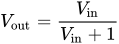
A simple example of global tone mapping filter is (Reinhard), where Vin is the luminance of the original pixel and Vout is the luminance of the filtered pixel.[4] This function will map the luminance Vin in the domain to a displayable output range of While this filter provides a decent contrast for parts of the image with low luminance (particularly when Vin < 1), parts of the image with higher luminance will get increasingly lower contrast as the luminance of the filtered image goes to 1. Variations on this filter are commonly used in rendering.[5]


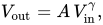
A perhaps more useful global tone mapping method is gamma compression, which has the filter where A > 0 and 0 < γ < 1. This function will map the luminance Vin in the domain to the output range γ regulates the contrast of the image; a lower value for lower contrast. While a lower constant γ gives a lower contrast and perhaps also a duller image, it increases the exposure of underexposed parts of the image while at the same time, if A < 1, it can decrease the exposure of overexposed parts of the image enough to prevent them from being overexposed.
![{\displaystyle [0,A^{-1/\gamma }]}](https://wikimedia.org/api/rest_v1/media/math/render/svg/0e1d2e8a520c5c41f02a2624c8307e39af026719)
![{\displaystyle [0,1].}](https://wikimedia.org/api/rest_v1/media/math/render/svg/8786b5ef9daedb24adb59e7825c4096d99a99648)
An even more sophisticated group of tone mapping algorithms is based on contrast or gradient domain methods, which are 'local'. Such operators concentrate on preserving contrast between neighboring regions rather than absolute value, an approach motivated by the fact that the human perception is most sensitive to contrast in images rather than absolute intensities. Those tone mapping methods usually produce very sharp images, which preserve very well small contrast details; however, this is often done at the cost of flattening an overall image contrast, and may as a side effect produce halo-like glows around dark objects. Examples of such tone mapping methods include: gradient domain high dynamic range compression[5] and A Perceptual Framework for Contrast Processing of High Dynamic Range Images[6] (a tone mapping is one of the applications of this framework).
Another approach to tone mapping of HDR images is inspired by the anchoring theory of lightness perception.[7] This theory explains many characteristics of the human visual system such as lightness constancy and its failures (as in the checker shadow illusion), which are important in the perception of images. The key concept of this tone mapping method (Lightness Perception in Tone Reproduction[8]) is a decomposition of an HDR image into areas (frameworks) of consistent illumination and the local calculation of the lightness values. The net lightness of an image is calculated by merging of the frameworks proportionally to their strength. Particularly important is the anchoring—relating of the luminance to a known luminance, namely estimating which luminance value is perceived as white in the scene. This approach to tone mapping does not affect the local contrast and preserves the natural colors of an HDR image due to the linear handling of luminance.
One simple form of tone mapping takes a standard image (not HDR –the dynamic range already compressed) and applies unsharp masking with a large radius, which increases local contrast rather than sharpening. See unsharp masking: local contrast enhancement for details.
One of the commonly used tone mapping algorithms is the iCAM06 which is based on both the color appearance model and hierarchical mapping.[9] After bilateral filtering, the image is broken into a base layer and a detail layer. White point adaptation and chrominance adaptation are applied to the base layer, while detail enhancement is applied to the detail layer. Eventually the two layers are merged and converted to the IPT color space. In general, this method is good but has some shortcomings, specifically in how computationally heavy the filtering method is. A proposed solution[10] to this involves performance optimization of the filter. The base layer of the image is also converted to the RGB space for tone compression. This method also allows for more output adjustment and saturation enhancement, making it be less computationally intensive and better at reducing the overall halo effect.
Digital photography
[edit].jpg)
Forms of tone mapping long precede digital photography. The manipulation of film and development process to render high contrast scenes, especially those shot in bright sunlight, on printing paper with a relatively low dynamic range, is effectively a form of tone mapping, although it is not usually called that. Local adjustment of tonality in film processing is primarily done via dodging and burning, and is particularly advocated by and associated with Ansel Adams, as described in his book The Print; see also his Zone System.
The normal process of exposure compensation, brightening shadows and altering contrast applied globally to digital images as part of a professional or serious amateur workflow is also a form of tone mapping.
However, HDR tone mapping, usually using local operators, has become increasingly popular amongst digital photographers as a post-processing technique, where several exposures at different shutter speeds are combined to produce an HDR image and a tone mapping operator is then applied to the result. There are now many examples of locally tone mapped digital images, inaccurately known as "HDR photographs", on the internet, and these are of varying quality. This popularity is partly driven by the distinctive appearance of locally tone mapped images, which many people find attractive, and partly by a desire to capture high-contrast scenes that are hard or impossible to photograph in a single exposure, and may not render attractively even when they can be captured. Although digital sensors actually capture a higher dynamic range than film, they completely lose detail in extreme highlights, clipping them to pure white, producing an unattractive result when compared with negative film, which tends to retain color and some detail in highlights.
In some cases local tone mapping is used even though the dynamic range of the source image could be captured on the target media, either to produce the distinctive appearance of a locally tone mapped image, or to produce an image closer to the photographer's artistic vision of the scene by removing sharp contrasts, which often look unattractive. In some cases, tone mapped images are produced from a single exposure which is then manipulated with conventional processing tools to produce the inputs to the HDR image generation process. This avoids the artifacts that can appear when different exposures are combined, due to moving objects in the scene or camera shake. However, when tone mapping is applied to a single exposure in this way, the intermediate image has only normal dynamic range, and the amount of shadow or highlight detail that can be rendered is only that which was captured in the original exposure.
Display devices
[edit]One of the original goals of tone mapping was to be able to reproduce a given scene or image onto a display device such that the brightness sensation of the image to a human viewer closely matches the real-world brightness sensation. However, a perfect match for this problem is never possible and thus the output image on a display is often built from a tradeoff between different image features. Choosing between features is often based on the necessary application, and given appropriate metrics for the application, one possible solution is to treat the issue as an optimization problem[11].
For this method, models for the Human Visual System (HVS) and the display are first generated, along with a simple tone mapping operator. The contrast distortions are weighted according to their individual visibilities approximated by the HVS. With these models, an objective function that defines the tone curve can be created and solved using a fast quadratic solver.
With the addition of filters, this method can also be extended to videos. The filters ensure that the rapid changing of the tone-curve between frames are not salient in the final output image.
Example of the imaging process
[edit]

The images on the right show the interior of a church, a scene which has a variation in radiance much larger than that which can be displayed on a monitor or recorded by a conventional camera. The six individual exposures from the camera show the radiance of the scene in some range transformed to the range of brightnesses that can be displayed on a monitor. The range of radiances recorded in each photo is limited, so not all details can be displayed at once: for example, details of the dark church interior cannot be displayed at the same time as those of the bright stained-glass window. An algorithm is applied to the six images to recreate the high dynamic range radiance map of the original scene (a high dynamic range image). Alternatively, some higher-end consumer and specialist scientific digital cameras are able to record a high dynamic range image directly, for example with RAW images.
In the ideal case, a camera might measure luminance directly and store this in the HDR image; however, most high dynamic range images produced by cameras today are not calibrated or even proportional to luminance, due to practical reasons such as cost and time required to measure accurate luminance values — it is often sufficient for artists to use multiple exposures to gain an "HDR image" which grossly approximates the true luminance signal.
The high dynamic range image is passed to a tone mapping operator, in this case a local operator, which transforms the image into a low dynamic range image suitable for viewing on a monitor. Relative to the church interior, the stained-glass window is displayed at a much lower brightness than a linear mapping between scene radiance and pixel intensity would produce. However, this inaccuracy is perceptually less important than the image detail, which can now be shown in both the window and the church interior simultaneously.
Local tone mapping technique of HDR image processing often produces a number of characteristic effects in images such as bright halos around dark objects, dark halos around bright objects, and sometimes a "cartoon-like" appearance due to extremely vivid colors and lack of large-scale color variations. These results are caused by application of geometric space distortion of captured image along with color space distortion, while only color space distortions are a tone mapping effect, and all other distortions are rather a custom filtering technique than any tone or color space mapping. So, the results of local tone mapping are often judged as perverting the nature of a documentalist photographic image and far from photographic realism.
Not all tone mapped images are visually distinctive. Reducing dynamic range with tone mapping is often useful in bright sunlit scenes, where the difference in intensity between direct illumination and shadow is great. In these cases the global contrast of the scene is reduced, but the local contrast maintained, while the image as a whole continues to look natural. Use of tone mapping in this context may not be apparent from the final image:
-
 Regions of direct illumination and shadow on the Grand Canyon
 -

-
 Cartoon-like appearance


Tone mapping can also produce distinctive visual effects in the final image, such as the visible halo around the tower in the Cornell Law School image in the thumbnail. It can be used to produce these effects even when the dynamic range of the original image is not particularly high. Halos in images come about because the local tone mapping operator will brighten areas around dark objects, to maintain the local contrast in the original image, which fools the human visual system into perceiving the dark objects as being dark, even if their actual luminance is the same as that of areas of the image perceived as being bright. Usually this effect is subtle, but if the contrasts in the original image are extreme, or the photographer deliberately sets the luminance gradient to be very steep, the halos become visible.
Gallery
[edit]-
 HDR tone mapping example
 -
 Five exposure tone mapping of the Isola Tiberina in Rome
 -
 3 exposure (-2,0,+2) tone mapped image of a scene at Nippori Station
 -
 HDR view from Tower Bridge in London tone-mapped from five exposures
 -
 HDR view from St Paul's Cathedral in London tone-mapped from nine exposures
 -
 Local tone-mapping using Snapseed brought out detail in shadow in a single photograph


See also
[edit]References
[edit]- ^ Livingstone, M. 2002. "Vision and Art: The Biology of Seeing." Harry N Abrams
- ^ Hunt, R. 2004. "The Reproduction of Colour in Photography, Printing and Television: 6th Edition." John Wiley & Sons.
- ^ Adams, A. 1981. "The Print, The Ansel Adams Photography Series 3." New York Graphic Society
- ^ Land, E. H., and McCann, J. J. 1971. "Lightness and the retinex theory." Journal of the Optical Society of America 61, 1, 1–11.
- ^ Kate Devlin, Alan Chalmers, Alexander Wilkie, Werner Purgathofer. "STAR Report on Tone Reproduction and Physically Based Spectral Rendering" in Eurographics 2002. DOI: 10.1145/1073204.1073242
- ^ Raanan Fattal, Dani Lischinski, Michael Werman. "Gradient Domain High Dynamic Range Compression"
- ^ Rafal Mantiuk, Karol Myszkowski, Hans-Peter Seidel. "A Perceptual Framework for Contrast Processing of High Dynamic Range Images"
- ^ Alan Gilchrist. "An Anchoring Theory of Lightness Perception".
- ^ Grzegorz Krawczyk, Karol Myszkowski, Hans-Peter Seidel. "Lightness Perception in Tone Reproduction for High Dynamic Range Images"
- ^ Fairchild, M. D., Johnson, G.M.: ‘The iCAM framework for image appearance, differences and quality’. J Electron. Imaging, 2004
- ^ Xiao, J., Li, W., Liu, G., Shaw, S., & Zhang, Y. (n.d.). Hierarchical tone mapping based on image color appearance model. [12]
- ^ Mantiuk, R., Daly, S., & Kerofsky, L. (n.d.). Display Adaptive Tone Mapping. https://resources.mpi-inf.mpg.de/hdr/datmo/mantiuk08datm.pdf
- ^ https://web.archive.org/web/20150206044300/http://docs.opencv.org/trunk/doc/tutorials/photo/hdr_imaging/hdr_imaging.html
- ^ Durand and Julie Dorsey, “Fast Bilateral Filtering for the Display of High-Dynamic-Range Images”. ACM Transactions on Graphics, 2002, 21, 3, 257 - 266. https://people.csail.mit.edu/fredo/PUBLI/Siggraph2002/DurandBilateral.pdf
- ^ Banterle, Francesco; Ledda, Patrick; Debattista, Kurt; Chalmers, Alan (2006-11-29). "Inverse tone mapping". Proceedings of the 4th international conference on Computer graphics and interactive techniques in Australasia and Southeast Asia. GRAPHITE '06. New York, NY, USA: Association for Computing Machinery. pp. 349–356. doi:10.1145/1174429.1174489. ISBN 978-1-59593-564-9. S2CID 5417678.
- ^ "Inverse tone mapping - upscaling SDR content to HDR". Dolby. 2021-06-18. Retrieved 2022-04-06.
- ^ G. Qiu et al, "Tone Mapping for HDR Image using Optimization-A New Closed Form Solution", Proc. ICPR 2006, 18th International Conference on Pattern Recognition, vol.1, pp.996-999
- ^ Reinhard, Erik (2002). "Photographic tone reproduction for digital images" (PDF). ACM Transactions on Graphics. 21 (3): 267–276. doi:10.1145/566654.566575.
- ^ Taylor, Matt. "Tone Mapping". Retrieved 8 August 2021.
External links
[edit]
- CVLTonemap: GPU accelerated tone mapping
- HDR Darkroom
- pfstmo: implementation of tone mapping operators
- exrtools: a collection of utilities for manipulating OpenEXR images (includes some tone mapping operators)
- pfstools is an open-source set of command line programs for reading, writing and manipulating high-dynamic range (HDR) images and video frames
- Luminance HDR/QtPfsGui is a free (open-source) HDR-workflow software for Linux, Windows and Mac OS X based around the pfstools package
- LDR tonemapping is a free (open-source) tonemapper for low dynamic range images (a.k.a. "pseudo-HDR")
- Atlas is a free (open-source) port of the pfstmo tone mapping operators to Adobe After Effects
- Flickr HDR pool, a collection of surreal tone mappings
- UC Berkeley paper with raw data for Purkinje effect
- Stuck in Customs, an extensive tutorial to make HDR images
Tone mapping algorithms
[edit]- Perceptually Based Tone Mapping for Low-Light Conditions
- Photographic Tone Reproduction for Digital Images
- Lightness Perception in Tone Reproduction for High Dynamic Range Images
- Contrast Processing of High Dynamic Range Images
- Fast Bilateral Filtering for the Display of High-Dynamic-Range Images
- A Fast Approximation of the Bilateral Filter using a Signal Processing Approach
- Gradient Domain High Dynamic Range Compression
Tone mapping
View on GrokipediaFundamentals
Definition and Principles
Tone mapping is a technique in image processing and computer graphics that compresses the wide range of luminance values in a high dynamic range (HDR) scene—typically spanning contrasts of up to 10^6:1 or more—to fit the limited dynamic range of standard displays, which often handle only about 100:1 to 1000:1, while avoiding clipping in highlights or loss of detail in shadows.[4] This process ensures that the reproduced image maintains perceptual fidelity to the original scene as perceived by the human eye, by mapping scene luminances to display-adapted luminances without introducing artifacts like halos or washed-out colors.[5] The key principles of tone mapping are rooted in the adaptation mechanisms of the human visual system (HVS), which dynamically adjusts sensitivity to light levels across a vast range, from 10^{-6} cd/m² in dim moonlight to 10^9 cd/m² in direct sunlight.[6] Central to this is Weber's law, which states that the just-noticeable difference in luminance (ΔL) is proportional to the background luminance (L_b), expressed as ΔL / L_b ≈ constant (typically around 0.01 to 0.02), allowing the HVS to perceive relative contrasts consistently despite absolute intensity changes.[6] Tone mapping applies luminance compression to replicate this adaptation, scaling intensities logarithmically or via power functions to preserve local contrasts and overall appearance, while ideally leaving color reproduction unchanged by operating primarily in luminance channels before reconverting to RGB.[4] A basic form of tone mapping is the linear operator, defined as $ T(L) = a L + b $, where $ L $ is the input scene luminance, $ a $ is a scaling factor to fit the scene's range within the display's gamut (e.g., 0 to 1 or 0 to 255), and $ b $ provides an offset for brightness adjustment, often set to 0 for simplicity.[4] This equation derives from the need to constrain output values to the display's physical limits, such as maximum luminance and black level, ensuring no overflow while maintaining proportional relationships in mid-tones; however, it may require clipping (e.g., $ T(L) = \min(\max(a L + b, 0), L_{\max}) $) to handle extremes.[7] Perceptually, tone mapping motivates the simulation of the eye's nonlinear response to light, drawing from models like the Michaelis-Menten equation for photoreceptor saturation, to produce images that appear natural and consistent with human brightness perception rather than raw photometric accuracy.[6] By prioritizing relative luminance differences over absolute values, as dictated by HVS adaptation, the technique enhances viewer immersion without the distortions seen in naive scaling or truncation.[5]Historical Development
The development of tone mapping began in the field of computer graphics during the late 1980s and early 1990s, as researchers sought methods to reproduce realistic images from high dynamic range (HDR) scene data on low dynamic range displays. Early efforts focused on perceptually based approaches that accounted for human vision models to compress luminance without losing essential details. A seminal contribution came from Jack Tumblin and Holly Rushmeier, who in 1993 introduced a tone reproduction framework that matched display luminances to perceived brightness levels, drawing on psychophysical principles to ensure realism in rendered images. This work, published in IEEE Computer Graphics and Applications, formalized tone mapping as a distinct process in graphics pipelines and laid the groundwork for subsequent algorithms.[8] The 1990s marked the emergence of HDR imaging techniques, which necessitated advanced tone mapping to handle captured real-world radiance data. Paul Debevec and Jitendra Malik's 1997 SIGGRAPH paper demonstrated the recovery of HDR radiance maps from sequences of standard dynamic range photographs, using bracketed exposures to estimate scene luminances exceeding display capabilities. This innovation, often referred to as the light probe technique, enabled image-based lighting and realistic scene relighting, spurring demand for effective tone operators to visualize such data. By the 2000s, tone mapping algorithms proliferated, with Erik Reinhard and colleagues' 2002 SIGGRAPH paper on photographic tone reproduction introducing a global operator inspired by traditional film processing, which adaptively scaled luminances to preserve photographic aesthetics across diverse scenes.[9] These developments were prominently featured at conferences like SIGGRAPH, where dozens of tone mapping operators were presented, ranging from histogram-based to gradient domain methods, reflecting the field's rapid maturation.[1] In the 2010s, tone mapping evolved toward real-time applications, driven by hardware advances in HDR capture and display technologies. Researchers optimized operators for efficiency, enabling integration into consumer devices such as smartphones and televisions; for instance, Apple's iPhone 4 introduced HDR photography in 2010, relying on real-time tone mapping to merge exposures on-device. This era saw a shift from offline rendering to interactive pipelines, with SIGGRAPH papers emphasizing low-latency global and local operators suitable for video streams. Post-2020, artificial intelligence has transformed tone mapping, particularly for mobile HDR workflows, where neural networks learn adaptive curves from data to outperform traditional methods in detail preservation and artifact reduction. Notable examples include deep learning-based operators presented at NeurIPS, such as real-time scene-adaptive models that process automotive HDR scenes with minimal latency. These AI-assisted techniques, often leveraging convolutional networks, have expanded tone mapping's accessibility in edge computing environments.Techniques
Global Operators
Global operators in tone mapping apply a single transfer function uniformly to all pixels in an image, compressing the high dynamic range based on aggregate statistics such as the mean luminance. This approach ensures consistent adjustment across the entire scene without considering local variations, making it fundamentally different from spatially adaptive methods.[10] A foundational example is the Reinhard operator, developed in 2002 and inspired by the dynamic range compression characteristics of photographic film, particularly the Zone System used in traditional photography to balance exposure. The operator first computes the geometric mean luminance \bar{L}_w, scales the input world luminance L_w to L = a \bar{L}_w L_w where a is an exposure key value (typically 0.18), and then applies the mappingLocal Operators
Local operators in tone mapping adjust luminance values based on spatial analysis of image regions, allowing the mapping function to vary per pixel or localized area rather than applying a uniform transformation across the entire image. This approach leverages edge-preserving filters and other spatial techniques to compress high-dynamic-range (HDR) content while maintaining details in both bright and dark areas, effectively handling scenes with extreme local contrasts that global methods might oversimplify. A seminal example is the bilateral filter-based method proposed by Durand and Dorsey, which decomposes the image into a large-scale base layer capturing overall illumination and a small-scale detail layer preserving edges and textures. The base layer undergoes logarithmic compression to fit within display limits, while the detail layer is added back with minimal alteration, resulting in enhanced local contrast without introducing artifacts like halos around bright objects. This technique, computationally efficient for real-time applications, has been widely adopted in image processing pipelines due to its simplicity and effectiveness in natural scenes. Another influential local operator is Fattal's gradient domain approach, which attenuates high-magnitude gradients in the HDR image to reduce contrast while preserving low-magnitude ones for detail retention. The tone-mapped image $ L $ is obtained by solving the Poisson equation $ \nabla^2 L = \text{div}(t(\nabla I)) $, where $ I $ is the input HDR luminance, $ \nabla $ denotes the gradient, $ \text{div} $ is the divergence, and $ t $ is a scaling function that compresses large gradients. This method excels in rendering intricate details under varying lighting but requires iterative solvers, making it more resource-intensive than filter-based alternatives. Local operators offer advantages such as superior preservation of local contrast and reduction of halo artifacts compared to global techniques, enabling more natural-looking results in complex HDR scenes. However, they often incur higher computational costs due to spatial processing and can introduce over-sharpening in textured regions if parameters are not tuned carefully. Implementation of local operators frequently involves multi-scale decomposition, such as using a Gaussian pyramid to separate frequency bands and apply region-specific compressions at each level, which helps manage intra-region variations effectively. Recent advancements in edge-aware filters have optimized these processes; for instance, developments in adaptive bilateral filtering integrate hardware acceleration to achieve real-time performance while minimizing gradient reversal artifacts. These updates address limitations in older implementations by incorporating learning-based edge detection for more precise local adaptations.Hybrid and Advanced Methods
Hybrid and advanced methods in tone mapping integrate elements from global and local operators or leverage machine learning to enhance dynamic range compression while preserving perceptual quality. These approaches address limitations of standalone techniques by combining uniform scene adjustments with spatially varying adaptations, or by learning mappings from data-driven models trained on high dynamic range (HDR) to low dynamic range (LDR) image pairs. For instance, hybrid operators merge global luminance scaling with local contrast enhancements to avoid artifacts like haloing in bright regions while maintaining computational efficiency.[14] A seminal example is the Reinhard photographic tone reproduction operator, which applies a global sigmoidal curve inspired by film response and incorporates local dodging-and-burning adjustments to simulate selective exposure in dark and bright areas, thereby balancing overall exposure with regional detail recovery. Another foundational hybrid is the adaptive logarithmic mapping, which uses a logarithmic compression function with spatially adaptive parameters to handle high-contrast scenes, ensuring visibility across luminance levels without excessive detail loss in shadows or highlights.[11] In recent years, deep learning has introduced advanced neural operators for tone mapping, such as region-adaptive self-supervised deep learning, which achieves superior perceptual uniformity by optimizing against human vision models during training on diverse HDR-LDR datasets.[15] Such hybrid and neural techniques offer advantages in balancing processing speed and output quality, often outperforming traditional operators in subjective evaluations by reducing distortions while enabling real-time applications. Recent trends emphasize GPU-accelerated implementations, such as differential zone mixing of multiple operators on graphics hardware, which supports interactive rendering at over 60 frames per second for high-resolution HDR video.[16]Applications
Digital Photography
In digital photography, tone mapping plays a crucial role in transforming high dynamic range (HDR) captures into viewable images suitable for print or web display. The process typically begins with bracketed exposures—multiple shots of the same scene at varying shutter speeds, such as -2, 0, and +2 EV—to capture details in shadows, midtones, and highlights beyond a single sensor's capabilities. These exposures are merged into an HDR radiance map, a linear representation of scene luminance, using software that estimates camera response functions to align and combine pixel values accurately. For instance, Adobe Photoshop's Merge to HDR Pro automates this fusion into a 32-bit floating-point image, followed by tone mapping to compress the dynamic range while preserving perceptual details through methods like local adaptation, which simulates human vision by adjusting contrast regionally.[17][18] Merging bracketed exposures presents challenges, particularly sensor noise amplified in underexposed shadow areas, where low photon counts lead to higher signal-to-noise ratios when details are recovered, and ghosting artifacts from subject or camera motion across frames, which misaligns content during fusion. These issues degrade image quality, with noise appearing as grainy textures in dark regions and ghosting creating blurred or duplicated elements in dynamic scenes. To mitigate them, exposure fusion techniques directly blend the bracketed images into a single standard dynamic range (SDR) output, weighting pixels based on quality metrics like saturation, exposure, and contrast without generating an intermediate HDR map, thereby reducing both noise and ghosting for more robust results in handheld photography. This approach, introduced in seminal work by Mertens et al., prioritizes perceptual quality over absolute radiance accuracy and is implemented in tools like Luminance HDR.[19][20][21] Standards for HDR metadata in digital photography include extensions to the Exchangeable Image File Format (EXIF), where cameras embed tags indicating HDR processing, such as Apple's iOS-specific values for HDR modes (e.g., 2 for HDR without original saved), though full standardization remains vendor-dependent via MakerNotes. The evolution toward smartphone computational photography has integrated on-device tone mapping, exemplified by Google Pixel's HDR+ pipeline in the 2024 Pixel 9 series, which processes bursts of raw frames through alignment, denoising, and AI-driven tone mapping to produce SDR outputs directly on the device, enhancing efficiency for mobile workflows.[22][23] Effective tone mapping in these pipelines yields outcomes like natural skin tones through accurate color rendering and balanced skies by compressing highlight roll-off without clipping, avoiding the unnatural halos or flattened contrasts seen in unprocessed HDR. Post-2020 advancements in mobile AI, such as Pixel's refreshed HDR+ imaging, further refine these results by leveraging machine learning for selective detail enhancement, ensuring photorealistic images even in mixed lighting.[24][25]Display Devices
Display devices vary significantly in their dynamic range capabilities, necessitating tone mapping to adapt high dynamic range (HDR) content for optimal reproduction. Traditional cathode-ray tube (CRT) displays, which dominated early television and computer monitors, offered limited dynamic ranges typically below 100:1 contrast ratios and peak brightness around 100-200 cd/m², constraining the rendering of luminance details in both shadows and highlights. In contrast, modern organic light-emitting diode (OLED) televisions in 2025 achieve peak brightness exceeding 1000 nits for small highlight areas, enabling much wider dynamic ranges up to 1,000,000:1, though sustained full-screen brightness remains lower at around 250 nits to manage power and prevent burn-in. This evolution requires tone mapping operators to compress or expand luminance signals to match device constraints, preserving perceptual fidelity as outlined in fundamental luminance mapping principles. Metadata-driven tone mapping enhances adaptation for these displays by embedding scene-specific information in the signal. For instance, HDR10+ employs dynamic metadata to adjust tone mapping on a scene-by-scene or frame-by-frame basis, allowing displays to optimize brightness and contrast without static assumptions about content. Similarly, Dolby Vision utilizes the perceptual quantizer (PQ) electro-optical transfer function (EOTF) as defined in SMPTE ST 2084, which maps normalized code values to luminance levels up to 10,000 cd/m² using a specific non-linear curve based on human visual perception, enabling precise mapping from code values to absolute luminance. Automatic techniques, such as those in HDR10+, analyze content in real-time for broad compatibility, while manual methods in professional workflows allow creators to define custom curves for specific displays, balancing automation with artistic intent. Challenges in tone mapping for displays include black level crushing, where low-luminance details are lost due to insufficient contrast, and color shifts arising from independent channel adjustments in one-dimensional lookup tables (LUTs). These issues are particularly pronounced in OLEDs during HDR playback, as aggressive compression can alter hue ratios and clip shadow information. Solutions incorporate standardized tone mapping curves in broadcast protocols, such as those recommended in ITU-R BT.2390, which provide sample mappings for displays with black levels as low as 0.1 cd/m² and white levels up to 1000 cd/m², ensuring consistent reproduction across transmission chains. Recent advances in 2025, including micro-LED displays with peak brightness surpassing 4000 nits and near-perfect blacks, introduce the need for inverse tone mapping to upscale legacy low dynamic range (LDR) content for these high-fidelity panels. Unlike earlier LCD-focused approaches, micro-LED's expanded capabilities demand algorithms that expand rather than compress luminance, as explored in ongoing research challenges on inverse tone mapping to enhance detail visibility without introducing artifacts.Computer Graphics and Video Rendering
In computer graphics, tone mapping is integrated into rendering pipelines to compress high dynamic range (HDR) scene data generated from physically-based shading into low dynamic range (LDR) outputs suitable for display. This process typically occurs as a post-shading step after lighting calculations and before final compositing, ensuring that synthetic images retain perceptual realism while fitting display constraints. For instance, in Unreal Engine 5, the filmic tonemapper applies a non-linear curve to HDR color data in the post-process volume, simulating photographic exposure and contrast for physically-based rendered scenes.[26] For video rendering, maintaining frame-consistent tone mapping is essential to prevent temporal artifacts like flicker, which arise from varying luminance mappings across frames. Techniques such as adaptive temporal filtering adjust the tone curve based on scene motion and global luminance statistics, enforcing coherence by propagating parameters from previous frames while adapting to content changes. In broadcast HDR video production, the Hybrid Log-Gamma (HLG) standard facilitates backward-compatible tone mapping, encoding HDR signals in a single stream that renders as SDR on legacy devices or enhanced HDR on compatible ones, as defined in ITU-R BT.2100.[27] Real-time applications in gaming leverage hardware-accelerated tone mapping for ray-traced HDR scenes, enabling immersive visuals at interactive frame rates. NVIDIA's RTX technologies, updated in 2024 with DLSS 3.5, incorporate tone mapping within ray reconstruction pipelines to denoise and map ray-traced lighting data efficiently, as seen in titles like Horizon Forbidden West Complete Edition supporting full ray tracing. In film visual effects (VFX), the Academy Color Encoding System (ACES) workflow employs Input Device Transforms (IDT) to linearize scene-referred data and Output Device Transforms (ODT) combined with the Reference Rendering Transform (RRT) for tone mapping, ensuring consistent color across compositing tools like Nuke and rendering in Maya. Key challenges in these domains include achieving temporal coherence amid dynamic lighting and camera movement, often addressed through hybrid methods that blend global and local operators for stability. Recent research, such as foveated HDR methods proposed in 2024, explores applying higher-fidelity HDR compression only in the user's gaze region for VR/AR headsets to optimize performance on edge devices while leveraging visual attention models.[28]Examples and Processes
Imaging Pipeline Overview
The high dynamic range (HDR) imaging pipeline encompasses a sequence of stages designed to capture, process, and display scenes with luminance ranges exceeding those of conventional low dynamic range (LDR) devices, typically spanning 10-14 stops or more. It begins with scene capture, where specialized cameras acquire multiple LDR images at varying exposure times to sample the full dynamic range of the scene, often using bracketed exposures to avoid saturation in bright areas and underexposure in shadows.[1] This step leverages sensor capabilities, such as those in multi-exposure HDR cameras, to gather raw data that encodes both high-intensity highlights and low-intensity details.[29] Following capture, radiance map estimation reconstructs an HDR representation of the scene by merging the input images, estimating absolute luminance values through techniques like weighted averaging or inverting the camera response function (CRF) to account for camera response functions.[1][30] The resulting radiance map, often stored in formats like OpenEXR to preserve floating-point precision and linear light values, serves as the scene-referred input for subsequent processing.[31] Next, tone mapping application compresses this wide luminance range into an LDR format suitable for standard displays (e.g., 8-bit per channel), employing global or local operators to simulate human vision's adaptation while retaining contrast and detail.[1] For instance, processing an input HDR image in OpenEXR format might involve applying a tone mapping operator (TM) pixel-wise, as in the following pseudocode:for each pixel in image:
L_out = TM(L_in)
Algorithmic Implementations
Implementing tone mapping algorithms requires careful consideration of computational efficiency, numerical stability, and hardware constraints. A seminal global operator, the Reinhard photographic tone reproduction method, provides a straightforward starting point for practical implementations. This operator first computes the log-average luminance across the image as , where is the number of pixels, is the world luminance at each pixel, and is a small constant (e.g., ) to avoid log singularities.[5] The luminance is then scaled by a key value (typically 0.18 for middle-gray scenes) to obtain . Finally, the display luminance is mapped as , with an optional white-point adjustment where is the desired maximum display luminance (e.g., 100 cd/m²).[5] To normalize for display, the resulting RGB values are scaled by the maximum channel value and gamma-corrected (e.g., ). Pseudocode for the full Reinhard global operator with normalization is as follows:function ReinhardGlobalToneMap(HDR_image, key=0.18, white=1.0, gamma=2.2):
# Assume HDR_image is a floating-point RGB array [0, inf)
# Compute luminance (simple weighted sum)
L_w = 0.299 * R + 0.587 * G + 0.114 * B # for each pixel
# Log-average luminance
log_sum = sum(log(max(epsilon, L_w))) / num_pixels
L_bar = exp(log_sum)
# Scale
L = key * L_w / L_bar
# Tone map
if white > 0:
L_d = L * (1 + L / white**2) / ((1 + L) * (1 + L / white))
else:
L_d = L / (1 + L)
# Reconstruct RGB
LDR = HDR_image * (L_d / L_w) # Preserve ratios, handle L_w=0 edge case
# Normalize to [0,1]
max_val = max over all channels in LDR
LDR = LDR / max_val
# Gamma correction
LDR = pow(LDR, 1/gamma)
return clamp(LDR, 0, 1)
cv::TonemapReinhard class, which applies the global operator with parameters for intensity scaling (default -1.0 for automatic), light adaptation (0.0-1.0, default 1.0), and color adaptation (0.0-1.0, default 0.6); usage involves creating a tonemap object, calling process() on an HDR image (32-bit float), and converting to 8-bit via convertTo().[33][35] MATLAB's Image Processing Toolbox provides the tonemap function, which renders HDR images using methods like 'reinhard' (global sigmoid), 'drago' (logarithmic), or 'local' (bilateral-based); for example, RGB = tonemap(HDR, 'Method', 'reinhard', 'KeyValue', 0.18) normalizes and gamma-corrects output to [0,1].[36] For real-time applications, GPU shaders in GLSL enable efficient processing; a basic Reinhard fragment shader might sample HDR texture values, apply , normalize by luminance max, and output gamma-corrected fragments. With WebGPU browser support available since 2023 (e.g., Chrome 113 and later), WGSL shaders replace GLSL for cross-platform web rendering, maintaining similar compute pipelines for tone mapping.[37][38]
To assess implementation quality, the Tone-Mapped Image Quality Index (TMQI) combines a multi-scale structural fidelity measure (based on modified SSIM) with a naturalness metric evaluating intensity statistics against natural image distributions; higher TMQI scores (0-1 range) indicate better preservation of details and perceptual realism.[39] Common pitfalls include overflow in floating-point computations during luminance scaling or filter summations, which can be mitigated by clamping inputs to [0, max_lum] (e.g., 10^5 cd/m²) and using half-precision floats on GPUs, or by iterative normalization in OpenCV's minMaxLoc to avoid location-return errors in bindings.[40][41]
Recent advancements integrate neural backends; for instance, the 2024 CATMO library in Python uses PyTorch for contrastive learning-based deep tone mapping, optimizing end-to-end priors on HDR datasets, while colour-hdri provides HDRI tools compatible with TensorFlow for custom neural extensions like histogram-guided networks.[42][43]