


Community hub
Recent from talks
Contribute something
Nothing was collected or created yet.
Bilateral filter
View on Wikipedia
A bilateral filter is a non-linear, edge-preserving, and noise-reducing smoothing filter for images. It replaces the intensity of each pixel with a weighted average of intensity values from nearby pixels. This weight can be based on a Gaussian distribution. Crucially, the weights depend not only on Euclidean distance of pixels, but also on the radiometric differences (e.g., variations in color intensity or depth). This dual dependency preserves sharp edges while suppressing noise.
Definition
[edit]The bilateral filter is defined as[1][2]

and normalization term, , is defined as


where
- is the filtered image;
- is the original input image to be filtered;
- are the coordinates of the current pixel to be filtered;
- is the window centered in , so is another pixel;
- is the range kernel for smoothing differences in intensities (this function can be a Gaussian function);
- is the spatial (or domain) kernel for smoothing differences in coordinates (this function can be a Gaussian function).


The weight is assigned using the spatial closeness (using the spatial kernel ) and the intensity difference (using the range kernel ).[2] Consider a pixel located at that needs to be denoised in image using its neighbouring pixels and one of its neighbouring pixels is located at . Then, assuming the range and spatial kernels to be Gaussian kernels, the weight assigned for pixel to denoise the pixel is given by



where σd and σr are smoothing parameters, and I(i, j) and I(k, l) are the intensity of pixels and respectively.
After calculating the weights, normalize them:
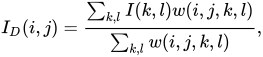
where is the denoised intensity of pixel .

Parameters
[edit]- As the range parameter σr increases, the bilateral filter gradually approaches Gaussian convolution more closely because the range Gaussian widens and flattens, which means that it becomes nearly constant over the intensity interval of the image.
- As the spatial parameter σd increases, the larger features get smoothened.
Limitations
[edit]The bilateral filter in its direct form can introduce several types of image artifacts:
- Staircase effect – intensity plateaus that lead to images appearing like cartoons[3]
- Gradient reversal – introduction of false edges in the image.[4]
There exist several extensions to the filter that deal with these artifacts, like the scaled bilateral filter that uses downscaled image for computing the weights.[5] Alternative filters, like the guided filter,[6] have also been proposed as an efficient alternative without these limitations.
Implementations
[edit]Adobe Photoshop implements a bilateral filter in its surface blur tool.
GIMP implements a bilateral filter in its Filters → Blur tools; and it is called Selective Gaussian Blur. The free G'MIC plugin Repair → Smooth [bilateral] for GIMP adds more control.[7] A simple trick to efficiently implement a bilateral filter is to exploit Poisson-disk subsampling.[1]
OpenCV implements the function: bilateralFilter( source, destination, , , ).
Related models
[edit]The bilateral filter has been shown to be an application of the short time kernel of the Beltrami flow [8] [9] [10] that was introduced as an edge preserving selective smoothing mechanism before the bilateral filter.
Other edge-preserving smoothing filters include: anisotropic diffusion,[11] weighted least squares,[12] edge-avoiding wavelets,[13] geodesic editing,[14] guided filtering,[15] and domain transforms.[16]
See also
[edit]References
[edit]- ^ a b Banterle, F.; Corsini, M.; Cignoni, P.; Scopigno, R. (2011). "A Low-Memory, Straightforward and Fast Bilateral Filter Through Subsampling in Spatial Domain". Computer Graphics Forum. 31 (1): 19–32. doi:10.1111/j.1467-8659.2011.02078.x. hdl:11380/1170184. S2CID 18288647.
- ^ a b Tomasi, C; Manduchi, R (1998). Bilateral filtering for gray and color images (PDF). Sixth International Conference on Computer Vision. Bombay. pp. 839–846. doi:10.1109/ICCV.1998.710815. Archived from the original (PDF) on 2008-08-29. Retrieved 2009-11-18.
- ^ Kornprobst, Pierre (2007). "Limitations? - A Gentle Introductionto Bilateral Filteringand its Applications" (PDF). Retrieved 7 May 2017.
- ^ He, Kaiming; Sun, Jian; Tang, Xiaoou. "Guided Image Filtering" (PDF). Archived from the original (PDF) on 9 December 2017. Retrieved 7 May 2017.
- ^ Aswatha, Shashaank M.; Mukhopadhyay, Jayanta; Bhowmick, Partha (December 2011). "Image Denoising by Scaled Bilateral Filtering". 2011 Third National Conference on Computer Vision, Pattern Recognition, Image Processing and Graphics. pp. 122–125. doi:10.1109/NCVPRIPG.2011.33. ISBN 978-1-4577-2102-1. S2CID 25738863.
- ^ He, Kaiming. "Guided Image Filtering". Archived from the original on 19 December 2017. Retrieved 7 May 2017.
- ^ "G'MIC - GREYC's Magic for Image Computing: An Open and Full-Featured Framework for Image Processing". gmic.eu. Archived from the original on 2014-12-27.
- ^ R. Kimmel, R. Malladi, and N. Sochen. Images as embedding maps and minimal surfaces: Movies, color, and volumetric medical images. IEEE CVPR'97, pp. 350-355, Puerto Rico, June 17–19, 1997. https://www.cs.technion.ac.il/~ron/PAPERS/cvpr97.pdf
- ^ R. Kimmel, R. Malladi, and N. Sochen. Images as Embedded Maps and Minimal Surfaces: Movies, Color, Texture, and Volumetric Medical Images. International Journal of Computer Vision, 39(2):111-129, Sept. 2000. https://www.cs.technion.ac.il/~ron/PAPERS/KimMalSoc_IJCV2000.pdf
- ^ N. Sochen, R. Kimmel, and A.M. Bruckstein. Diffusions and confusions in signal and image processing, Journal of Mathematical Imaging and Vision, 14(3):195-209, 2001.https://www.cs.technion.ac.il/~ron/PAPERS/SocKimBru_JMIV2001.pdf
- ^ Durand, Frédo and Dorsey, Julie. "Fast Bilateral Filtering for the Display of High-Dynamic-Range Images" In ACM Transactions on Graphics, Volume 21, Issue 3, pp 257–266. https://people.csail.mit.edu/fredo/PUBLI/Siggraph2002/DurandBilateral.pdf
- ^ Farbman, Zeev, Raanan Fattal, Dani Lischinski, and Richard Szeliski. "Edge-preserving decompositions for multi-scale tone and detail manipulation." In ACM Transactions on Graphics, vol. 27, no. 3 (2008): 67. http://www.cs.huji.ac.il/~danix/epd/
- ^ Fattal, Raanan. "Edge-avoiding wavelets and their applications." In ACM Transactions on Graphics vol. 28, no. 3 (2009): 22. http://www.cs.huji.ac.il/~raananf/projects/eaw/
- ^ Criminisi, Antonio, Toby Sharp, Carsten Rother, and Patrick Pérez. "Geodesic image and video editing." In ACM Transactions on Graphphics (TOG), vol. 29, no. 5 (2010): 134. http://research.microsoft.com/apps/pubs/default.aspx?id=81528
- ^ He, Kaiming, Jian Sun, and Xiaoou Tang. "Guided image filtering." In Computer Vision–ECCV 2010, pp. 1-14. Springer Berlin Heidelberg, 2010. http://kaiminghe.com/eccv10/index.html Archived 2017-12-19 at the Wayback Machine
- ^ Gastal, Eduardo S. L., and Manuel M. Oliveira. "Domain transform for edge-aware image and video processing." In ACM Transactions on Graphics, vol. 30, no. 4 (2011): 69. http://inf.ufrgs.br/~eslgastal/DomainTransform/
Bilateral filter
View on GrokipediaOverview and History
Definition
The bilateral filter is a non-linear, edge-preserving smoothing technique used in image processing that replaces the intensity value of each pixel with a weighted average of its neighboring pixels, where the weights are determined by both spatial proximity and radiometric similarity, such as differences in intensity or color.[3][4] This approach ensures that only pixels that are close in both location and value contribute significantly to the output, enabling effective noise reduction without compromising important structural features.[3] The core purpose of the bilateral filter is to achieve smoothing for denoising while preserving sharp edges and discontinuities in the image, in contrast to linear filters like the Gaussian blur, which indiscriminately average nearby pixels and thus blur edges along with noise.[4][3] By incorporating this dual weighting mechanism, the filter maintains the visual integrity of object boundaries and fine details, making it particularly valuable in scenarios where edge preservation is critical.[4] Conceptually, the bilateral filter generalizes the traditional Gaussian filter by adding a range kernel that accounts for intensity differences alongside the spatial kernel for distance, thereby preventing the smoothing of pixels across dissimilar regions.[4] For instance, in a grayscale image, it computes the average intensity of neighbors based on both their spatial distance and value similarity, effectively smoothing uniform areas like noisy backgrounds while avoiding the blending of distinct steps, such as those between foreground and background.[3]Historical Development
The origins of the bilateral filter can be traced to 1995, when Volker Aurich and Jörg Weule introduced nonlinear Gaussian filters for edge-preserving diffusion in medical imaging applications, laying early groundwork for techniques that smooth images while maintaining boundaries.[4] The concept was independently rediscovered by S.M. Smith and J.M. Brady in 1997 as part of the SUSAN (Smallest Univalue Segment Assembling Nucleus) approach for low-level image processing.[4] This approach emphasized iterative diffusion processes to achieve smoothing without blurring edges, influencing subsequent edge-aware filtering methods.[4] The explicit bilateral filter framework was popularized in 1998 by Carlo Tomasi and Roberto Manduchi, who proposed a non-iterative, local method for smoothing gray and color images by incorporating both spatial and intensity-based weights, enabling efficient edge preservation.[3] Their seminal paper demonstrated the filter's utility in denoising while avoiding the staircasing artifacts common in anisotropic diffusion methods, marking a key advancement in nonlinear image processing.[4] Subsequent developments from 2007 to 2009 expanded the theoretical foundations, applications, and efficient approximations of the bilateral filter. In 2007, Sylvain Paris and Frédo Durand delivered an influential SIGGRAPH course providing an intuitive overview and practical guidance for its use in image editing, tone mapping, and video processing, highlighting fast implementation strategies like separable approximations.[2] Building on this, Paris and Pierre Kornprobst's 2009 monograph offered a comprehensive analysis of the filter's mathematical properties, decomposition capabilities, and extensions, including optimizations for real-time performance.[4] During the 2000s, the concept evolved into variants such as joint bilateral filtering, which uses a guidance image to transfer edge information for tasks like upsampling, as introduced by Johannes Kopf and colleagues in 2007 for applications in tone mapping and disparity refinement.[5] This variant enhanced the filter's flexibility in guided processing scenarios, such as fusing low- and high-resolution data.[5] Post-2010, the bilateral filter has seen no major paradigm shifts but continues to undergo refinements for real-time implementations in hardware-accelerated environments, with recent approximations focusing on energy efficiency for embedded systems.[6]Mathematical Foundation
Filter Formulation
The bilateral filter is a nonlinear image processing operator that smooths an image while preserving edges by weighting pixel contributions based on both their spatial proximity and photometric similarity to the central pixel. Introduced by Tomasi and Manduchi, the filter computes the output intensity at a pixel as a weighted average of nearby pixel intensities, where the weights incorporate two kernels: a spatial kernel that decays with geometric distance and a range kernel that decays with intensity differences.[3] In its continuous formulation, the filtered value is given by where is the input image, is the spatial kernel (domain filter), is the range kernel (photometric filter), and the integral is over the image domain. The normalization factor ensures the weights sum to unity: This formulation arises from combining a domain convolution (weighting by spatial closeness via ) with a range convolution (weighting by intensity similarity via ), which downweights contributions from pixels across edges—regions of high intensity gradient—thereby preserving discontinuities while smoothing homogeneous areas.[3] For discrete images, the formulation adapts to a summation over a local neighborhood around : with the normalization In practice, for a pixel at coordinates , the sum is computed over a window of offsets , yielding weights .[3] The filter extends naturally to color images by treating pixel values as vectors in a color space (e.g., RGB), where the range distance becomes the Euclidean norm in that space, averaging only colors that are perceptually similar while respecting edges in chrominance or luminance.[3]Weight Functions
The bilateral filter employs two primary weight functions to balance spatial proximity and photometric similarity: the spatial kernel and the range kernel. The spatial kernel, denoted as , measures geometric closeness between the center pixel at position and a neighboring pixel at . It is typically defined using a Gaussian function: where determines the extent of the neighborhood influence, ensuring that pixels farther apart contribute less to the filtered value.[3] This formulation promotes isotropy and radial symmetry, making it shift-invariant and suitable for local averaging without directional bias.[4] The range kernel, , assesses the similarity in intensity (or color values) between pixels, and . It is also commonly Gaussian: with controlling the sensitivity to intensity differences; larger differences yield smaller weights, thereby preserving edges by downweighting contributions across discontinuities.[3] For color images, the intensity distance may be computed in a perceptually uniform space like CIE-LAB to better capture human vision.[3] The overall weight for a neighbor is the product of these kernels, , which enforces locality in both domain and range, enabling edge-preserving smoothing.[4] Both kernels are positive, symmetric, and monotonically decreasing, allowing normalization such that their sum approximates unity over the support, which maintains the filter's unbiased nature for constant signals.[3] While Gaussian kernels dominate due to their smoothness and mathematical tractability, alternatives exist, such as uniform (box) functions for the spatial kernel or tent (linear decay) functions for the range kernel, as implemented in tools like Adobe Photoshop's surface blur for computational efficiency.[4] Other decreasing functions, like rational forms, have been explored in extensions but are less common owing to the Gaussian's superior isotropy and ease of analysis.[3]Parameters and Tuning
Key Parameters
The bilateral filter is primarily controlled by two standard deviation parameters that govern its spatial and intensity-based weighting, along with a practical window size for implementation. These parameters allow users to balance smoothing and edge preservation, with their values influencing the filter's behavior in a complementary manner.[3] The spatial standard deviation, denoted as , determines the size of the neighborhood considered for each pixel, effectively controlling the geometric extent of the low-pass filtering. Larger values of enable smoothing over broader areas by incorporating pixels from greater distances, which can enhance noise reduction but may risk blending in structurally dissimilar regions. Typically measured in pixels, is independent of image intensity and is often set in the range of 2 to 10 pixels as a starting point for many applications.[3][7] The range standard deviation, denoted as , regulates the filter's sensitivity to differences in pixel intensities, weighting contributions based on photometric similarity to preserve edges. Higher values permit more aggressive smoothing across intensity variations, potentially approaching the effect of a standard Gaussian blur, while lower values emphasize local similarity to maintain sharp boundaries. This parameter scales with the image's dynamic range—for instance, in 8-bit grayscale images spanning 0 to 255, common initial values fall between 10 and 50 to align with typical noise levels and contrast.[3][7] The window size defines the discrete spatial domain over which the filter computes weights, often implemented as a square kernel with odd dimensions for centering, such as 5×5 or 9×9. For efficiency, it is typically set to 2 to 3 times to capture the significant portion of the Gaussian spatial kernel without excessive computation, ensuring negligible contributions from pixels beyond this radius.[2][3] These parameters exhibit interdependence, as must be tuned relative to the image's intensity scale while remains pixel-based, and the window size adapts to to optimize performance without altering the filter's core response.[3]Selection and Effects
The tuning process for the bilateral filter begins with selecting the spatial parameter σ_d based on the scale of features in the image, such as using a small value (e.g., 2-3 pixels) to preserve fine details like textures, while larger values (e.g., 10 pixels or 2% of the image dimensions) suit broader smoothing needs.[2][3] Once σ_d is set, σ_r is adjusted to balance noise reduction and edge preservation, often through iterative visual inspection or quantitative metrics like peak signal-to-noise ratio (PSNR) in denoising tasks.[2] Low values of σ_d effectively preserve small-scale textures and edges by limiting the spatial neighborhood, but they may inadequately suppress noise in uniform regions.[3][2] Conversely, high σ_d values enable broad smoothing across larger areas, reducing overall noise but potentially introducing halo artifacts around strong edges due to excessive weighting of distant pixels.[2][3] For the range parameter σ_r, low values enhance edge sharpening by heavily penalizing intensity differences, thereby retaining more noise in smooth areas while strongly preserving discontinuities.[3][2] High σ_r values, however, promote greater noise reduction through wider intensity weighting, at the cost of blurring weaker edges and approaching the behavior of a Gaussian blur.[3][2] Adaptive variants of the bilateral filter make σ_r image-dependent to improve performance, such as modulating it based on local variance (e.g., σ_r proportional to noise variance divided by local standard deviation) to apply stronger smoothing in flat regions and preserve details near edges.[8] These approaches enhance PSNR by 0.4-1 dB over fixed-parameter versions without introducing derivations for full adaptation.[8] In practice, for denoising applications, set σ_r to approximately 5-10% of the dynamic intensity range or 1.95 times the noise standard deviation to effectively remove Gaussian noise while minimizing detail loss.[2] Over-smoothing can be avoided by limiting filter iterations to 1-5 passes, using narrow σ_d to ensure stability and prevent artifact accumulation.[2]Applications
Image Denoising
The bilateral filter serves as a primary tool for image denoising, particularly effective against Gaussian noise, where it averages pixel intensities from spatially nearby regions while weighting contributions based on intensity similarity to prevent smoothing across edges. This edge-preserving mechanism allows it to reduce noise variance without compromising structural details, making it suitable for applications requiring high-fidelity restoration. For Poisson noise, common in photon-limited imaging, adaptations of the bilateral filter modify the range weighting to account for the signal-dependent nature of the noise, enhancing its applicability in such scenarios.[3][9] In the denoising process, the bilateral filter is typically applied iteratively—often 2 to 5 times—to progressively suppress noise while refining details, with a spatial standard deviation set to a moderate value like 5 pixels to balance locality and coverage, and the range standard deviation tuned to the estimated noise level for optimal intensity weighting. This iterative strategy outperforms the median filter for Gaussian noise, as the bilateral approach better maintains sharp transitions and fine textures without introducing the blocky artifacts sometimes seen in median filtering. Quantitative evaluations on standard test images with added Gaussian noise demonstrate that such configurations can yield peak signal-to-noise ratio (PSNR) improvements of 3-5 dB over unfiltered inputs, depending on noise intensity.[10][11][12] Practical examples highlight its utility in medical imaging, where it denoises MRI scans corrupted by Gaussian or Rician noise while preserving anatomical edges essential for diagnosis, and in digital photography, where it mitigates sensor noise in low-light shots to recover cleaner images without loss of subject sharpness. Compared to wavelet denoising, the bilateral filter excels in preserving textures near edges, as wavelets may introduce ringing artifacts in those regions during coefficient thresholding. In the original demonstration by Tomasi and Manduchi, synthetic grayscale images with superimposed Gaussian noise were filtered to showcase robust edge retention alongside significant noise reduction, establishing its foundational role in denoising benchmarks.[13][14][12][3]Computational Photography
The bilateral filter has become a cornerstone in computational photography, enabling advanced image processing techniques that enhance photographic quality while preserving perceptual fidelity. In high-dynamic-range (HDR) imaging, it facilitates tone mapping by performing edge-aware smoothing to compress the extensive dynamic range of captured scenes into a displayable format, maintaining local contrast and avoiding unnatural artifacts like halos. This is achieved through a multi-scale decomposition where the filter separates the image into a base layer for global luminance adjustment and a detail layer that retains sharpness, as pioneered by Durand and Dorsey in their 2002 work on fast bilateral filtering for HDR display.[15] Such applications yield natural-looking results in professional photography pipelines, where preserving edges ensures that bright highlights and dark shadows transition smoothly without loss of textural detail. In non-photorealistic rendering and image stylization, the bilateral filter supports creative effects by smoothing intensities within perceptually similar regions, thereby generating painterly or cartoonish outputs that emphasize artistic intent over realism. Iterated applications of the filter progressively simplify content into piecewise constant areas, ideal for stylization tasks, and have been integrated into commercial software like Adobe Photoshop's Surface Blur filter, which employs a bilateral mechanism with a tent intensity function to denoise and stylize while respecting object boundaries.[2] For dynamic content, Winnemöller et al. extended this to real-time video stylization in 2006, using iterative bilateral filtering to abstract frames into a cartoon aesthetic by enhancing edges and reducing intra-region variance, enabling live processing at interactive frame rates.[16] Joint variants of the bilateral filter further advance 3D-aware photography through depth upsampling, refining low-resolution depth maps from sensors (e.g., time-of-flight cameras) by leveraging co-registered high-resolution RGB images as guidance. This edge-preserving interpolation aligns depth discontinuities with color edges, improving accuracy for applications like 3D reconstruction and augmented reality. Kopf et al. introduced a multi-scale joint bilateral upsampling approach in 2007, which propagates weights from the color image to densify sparse depth data, achieving sub-pixel precision without introducing smoothing across boundaries.[17] Additional applications include flash/no-flash denoising, where the joint bilateral filter transfers fine details from a well-lit flash image to a noisy no-flash counterpart, mitigating shadows and noise while preserving the ambient lighting's natural tone, as demonstrated by Petschnigg et al. in 2004.[18] It also supports multi-scale decomposition for selective detail enhancement and texture removal or editing, amplifying or suppressing textures in base layers derived from bilateral smoothing. In raw image processing, the bilateral filter aids demosaicking by interpolating color filter array data (e.g., Bayer patterns) through edge-aware weighting, reducing color artifacts like zipper effects while reconstructing full-color images from subsampled channels, as explored in works like Ramanath and Snyder (2004).[4][19] In computer vision, bilateral filtering regularizes optical flow estimation by smoothing flow fields while respecting motion discontinuities, improving accuracy in occlusion handling and dense correspondence computation, as in adaptive bilateral approaches for multi-frame sequences (Proesmans et al., 2006).[20] Beyond 2D imagery, extensions apply to 3D graphics for mesh smoothing, where vertex positions are filtered based on spatial proximity and geometric similarity (e.g., normal or curvature differences) to denoise scanned models without blurring features, as introduced by Jones et al. in 2003.[21] In contemporary mobile photography, real-time bilateral filters power features like beauty modes on smartphones, applying edge-aware skin smoothing to live previews and captures; optimizations such as the bilateral grid data structure enable efficient GPU-accelerated processing for video at 30 frames per second.[22] The filter's adoption in computational photography evolved rapidly after 2000, starting with HDR integrations like Durand and Dorsey's operator and expanding in the 2010s to video and mobile domains through hardware-friendly approximations that ensure temporal coherence and low latency.[15]Limitations and Artifacts
Common Issues
One prominent artifact in the bilateral filter is the staircasing effect, where gradual intensity gradients are transformed into flat plateaus separated by artificial boundaries, resulting in a piecewise constant appearance that resembles a cartoonish rendering in smooth regions.[4][23] This occurs due to biased averaging in the filter's nonlinear combination of nearby pixel values, particularly at inflection points where the spatial and range kernels unevenly weight contributions from convex or concave signal parts.[4] Another issue is gradient reversal, in which the filter introduces spurious edges or inverts weak gradients adjacent to strong edges, producing halo-like distortions or false structural details.[24] This artifact arises from the filter's edge-preserving mechanism over-amplifying discontinuities near high-contrast boundaries, leading to aliased or reversed intensity transitions.[4] The bilateral filter also tends to suppress fine textures, treating repetitive or low-contrast patterns as noise and over-smoothing them into uniform areas, especially when the range parameter σ_r is set high.[4] Such suppression diminishes perceptual detail in textured regions like foliage or fabric, as the range kernel flattens variations that fall within its influence.[4] Parameter selection significantly affects these artifacts, with the filter exhibiting high sensitivity to the spatial σ_d and range σ_r values; for instance, a small σ_d may fail to incorporate sufficiently distant pixels with similar intensities, exacerbating incomplete smoothing and edge artifacts.[4][25]Mitigation Strategies
One effective approach to mitigate over-smoothing while refining edges in the bilateral filter involves iterative application, where the filter is applied in multiple passes with progressively decreasing spatial standard deviation . This strategy allows initial passes with larger to perform coarse denoising, followed by finer passes that preserve details without introducing excessive blurring. Such iterative schemes have been shown to approximate piecewise constant signals effectively, reducing artifacts like the staircase effect observed in single-pass applications.[4] Cross-bilateral and guided variants address edge definition issues by incorporating an external guidance image, decoupling the range weighting from the input image's intensity. In the cross-bilateral filter, the range kernel is computed using a separate, higher-quality image (e.g., a flash image for no-flash denoising), enabling better preservation of edges in noisy inputs without relying solely on the degraded signal's statistics. This technique significantly reduces blurring across weak edges and has been foundational in flash photography enhancement.[4] Pre- and post-processing combinations enhance the bilateral filter's performance by integrating complementary operations for texture preservation and gradient correction. Similarly, combining bilateral filtering with anisotropic diffusion post-processing preserves fine textures in homogeneous regions while allowing diffusion along edges, improving overall detail retention in medical and natural images. These hybrid approaches have demonstrated superior noise reduction compared to standalone bilateral filtering, particularly for Gaussian and impulse noise.[26] Parameter adaptation, such as locally varying the range standard deviation based on image statistics, prevents uniform application that can exacerbate artifacts in heterogeneous regions. By estimating local noise levels or variance (e.g., setting where is the noise standard deviation), the filter adapts to content, reducing over-smoothing in low-contrast areas and enhancing edge fidelity. This local adjustment has been empirically validated to improve denoising quality metrics like PSNR in varied lighting conditions.[4] Empirical fixes further alleviate issues like haloing by constraining the filter window size and employing multi-scale pyramids. Limiting the spatial domain radius (e.g., to 2-3 times ) curtails excessive averaging around strong edges, minimizing halo artifacts that arise from large kernels in tone mapping. Additionally, processing images via a bilateral pyramid—decomposing into scales using the filter itself—enables efficient handling of large images and avoids halos by isolating details at appropriate resolutions, as demonstrated in shape enhancement tasks where traditional pyramids fail.[27]Implementations and Optimizations
Algorithms
The naive implementation of the bilateral filter computes the output for each pixel as a weighted sum over a local neighborhood, where weights are determined by both spatial proximity and intensity similarity. This brute-force approach requires evaluating the summation for every pixel in the image, leading to a computational complexity of O(N w²), where N is the total number of pixels and w ≈ 2σ_d + 1 is the effective window size determined by the spatial standard deviation σ_d.[4] To address the high complexity of the naive method, several fast approximations have been developed. One common approach uses separable 1D passes along rows and columns with 1D Gaussian filters to approximate the 2D spatial kernel, achieving O(N w) complexity while preserving edge details, though it may introduce minor streaking artifacts in some cases.[4] Another efficient technique employs polynomial expansion of the range kernel, as in the 2008 method by Porikli, which enables constant-time O(1) per-pixel computation without subsampling by representing the Gaussian range weights as low-order polynomials convolved with the spatial kernel, facilitating real-time processing on standard hardware. GPU acceleration leverages the parallel nature of graphics hardware to perform per-pixel computations independently using shaders, significantly reducing runtime for large images. For instance, implementations on early consumer GPUs like the NVIDIA GeForce 8800 GTX achieved over 400 frames per second for 1-megapixel images, and with advancements in parallel processing up to 2025, such methods routinely deliver 100+ fps for high-definition (HD) 1080p images in real-time applications.[28] Multi-scale approaches apply the bilateral filter recursively across an image pyramid to efficiently handle large σ_d values without excessive computation. In the seminal two-scale decomposition by Durand and Dorsey (2002), a large-scale base layer is obtained by applying a bilateral filter with a broad spatial kernel (e.g., σ_d at 2% of image dimensions) after log-transforming intensities for piecewise-linear approximation, while details are preserved in a high-pass residual; this recursive structure on downsampled levels manages wide support efficiently, with subsampling factors up to 25 yielding speedups of 100x over naive methods.[15] Overall complexity analysis reveals that the standard bilateral filter scales as O(N k²) with k ≈ 2σ_d, but optimizations like local histogram maintenance reduce it to O(N log N) by processing neighborhoods in a tree-like structure with distributive updates, enabling handling of arbitrary kernel sizes in near-linear time.[29] Further refinements, such as those in the bilateral grid method, achieve effective O(N) scaling in practice by quantizing the range domain into a 3D voxel grid for trilinear interpolation, balancing accuracy and speed for megapixel images processed in seconds on CPUs or milliseconds on GPUs.[4]Software and Libraries
The bilateral filter is implemented in several widely-used software libraries and tools, enabling efficient application in image processing workflows. OpenCV, an open-source computer vision library, provides thebilateralFilter() function, which applies the filter to grayscale or color images using parameters for spatial sigma (σ_d), color sigma (σ_r), and neighborhood diameter; it supports real-time processing for video streams due to optimized C++ and hardware acceleration capabilities.[30]
MATLAB's Image Processing Toolbox includes the imbilatfilt() function for bilateral filtering on grayscale or RGB images, facilitating rapid prototyping with adjustable smoothing degrees and support for GPU acceleration via Parallel Computing Toolbox when using gpuArray inputs.[31]
In commercial image editing software, Adobe Photoshop incorporates the Surface Blur filter, which operates on bilateral filtering principles to smooth images while preserving edges, using radius and threshold parameters for noise reduction and artistic effects.[32] Similarly, the open-source GIMP image editor accesses bilateral filtering through the G'MIC plugin, particularly via the "Smooth [bilateral]" tool, which enables selective blurring based on edge preservation for non-destructive editing.[33]
For Python-based environments, the scikit-image library offers skimage.restoration.denoise_bilateral(), an edge-preserving denoising function with parameters for spatial and intensity sigmas, including multichannel support and adaptive options for varying noise levels in scientific computing tasks.
In deep learning frameworks, the Kornia library for PyTorch includes a bilateral filter implementation in its filters module, supporting GPU acceleration for integration into neural network pipelines.[34]
Additional implementations include CUDA-accelerated versions in NVIDIA's Performance Primitives (NPP) library, such as nppiFilterBilateralGaussBorder(), which provide high-performance bilateral Gaussian filtering on GPUs for large-scale image processing applications. As of 2025, web-based demonstrations of bilateral filtering are available in JavaScript using WebGL, allowing interactive browser-based experimentation without native installations, as seen in open-source demos on platforms like CodeSandbox.[35]