


Community hub
Recent from talks
Knowledge base stats:
Talk channels stats:
Members stats:
Topical drug delivery
Topical drug delivery (TDD) is a route of drug administration that allows the topical formulation to be delivered across the skin upon application, hence producing a localized effect to treat skin disorders like eczema. The formulation of topical drugs can be classified into corticosteroids, antibiotics, antiseptics, and anti-fungal. The mechanism of topical delivery includes the diffusion and metabolism of drugs in the skin. Historically, topical route was the first route of medication used to deliver drugs in humans in ancient Egyptian and Babylonian in 3000 BCE. In these ancient cities, topical medications like ointments and potions were used on the skin. The delivery of topical drugs needs to pass through multiple skin layers and undergo pharmacokinetics, hence factor like dermal diseases minimize the bioavailability of the topical drugs. The wide use of topical drugs leads to the advancement in topical drug delivery. These advancements are used to enhance the delivery of topical medications to the skin by using chemical and physical agents. For chemical agents, carriers like liposomes and nanotechnologies are used to enhance the absorption of topical drugs. On the other hand, physical agents, like micro-needles is other approach for enhancement ofabsorption. Besides using carriers, other factors such as pH, lipophilicity, and drug molecule size govern the effectiveness of topical formulation.
In ancient times, human skin was used as a layer for self-expression by painting cosmetic products on it. They used those products as a protection for their skin from the sun and dry environment. Later on in 2000 BCE, the Chinese used topical remedies that wrap in bandages to treat skin diseases. The contact between these topical remedies and skin deliver its therapeutic effect on the skin. The newer development of topical drugs occurred between 130 and 200 AD. This development was made by Claudius Galenus, a Greek physician. He first loaded the herb medication to Western medicine and formulated it as cream. More recently in the 1920s, some observations were made when applying topical skin, such as to determine its systemic effects. In 1938, Zondek successfully managed urogenital infections after applying chloroxylenol on the skin by the use of disinfectant in ointment form. After some years, observations were made from various experiments. These experiments led to the development of skin toxicology in the mid-1970s, including symptoms like irritation, skin inflammation, and skin photo-toxicity upon application of topical drugs. After the development of toxicology, a mathematical model was also created for skin diffusion coefficient formulated by Michaels. This formulation suggests how they related to the aqueous solubility and partition coefficient in skin.
The human body's largest organ is the skin layers, which protects against foreign particles. Human skin contains several layers, including the subcutaneous layer, the dermis, the epidermis, the stratum corneum, and the appendages. Each of these layers have an effect on the absorption of topical drug. When the topical drug is applied to the skin, it must pass via the stratum corneum, which is the outermost skin layer. Stratum corneum's function includes prevention of water loss in skin and inhibit the penetration of foreign molecules into the dermal layers. Hence, it also prevents the hydrophilic molecules to get absorbed into the skin since it is made out of bilayered lipids. With this barrier, stratum corneum affects the permeability of topical drugs. Another part of the skin is called the appendages, and it is known as the "shortcut" for topical drug delivery. The shortcut pathway allows the drug molecules to first pass the stratum corneum barrier via hair follicles.
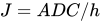
When drugs are applied to skin topically, the drug molecules will undergo passive diffusion. This process occurs down the concentration gradient when drug molecules move to one area to another region. Diffusion is described by a mathematical equation. The drug molecule (J), known as flux and it represents the entry of topical drug molecules across the skin membrane. The skin membrane is the area (A) for the topical drug molecules to travel across. The skin membrane thickness is known as (h) in the expression, and it determines the diffusion path length. The (C) is the concentration of the diffusing substance across the skin layers and the (D) is the diffusion coefficient. The expression illustrates the transportation of topical drug molecules across the stratum corneum membrane through diffusion.
Diffusion expression:
Upon application of the topical drug on the skin, it will diffuse to the outer layer of the skin, known as stratum corneum. There are three routes possible for the drugs to cross the skin. The first route is through the appendages. It is known as the "first cut" where the drug molecules will be partitioned into the sweat gland to bypass the stratum corneum barrier. If the drug molecules is not transported via the "first cut", it is usually remains in the stratum corneum's bilayered lipids, where the drug molecules transport through either the transcellular route or paracellular route into the deeper area of the skin like subcutaneous layer. For the paracellular route, it means that the solutes transport via the junction between the cell. When the topical drug molecules transport via the paracellular route, it needs to travel across the stratum corneum, which is a highly fat region, but between the cells. On the other hand, the topical drug molecules may travel through the transcellular route. This route allows molecules to be transported via the cell. Transcellular route transports the drug molecule into the bilayered lipid cells found in stratum corneum. Inside of the bilayered lipids in the stratum corneum is a water-soluble environment, and the drug molecules will diffuse through these bilayered lipids into deeper area of the skin. During the transportation of the topical drug molecules, it can bind to the keratin that exists as one of the skin components in the stratum corneum.
The activities of skin metabolism are commonly occurring on the skin surface, appendages, the stratum corneum, and the viable epidermis. This process comprises phase one hydrolysis, reduction, and oxidation, also known as functionalization phase. If phase one is insufficient to metabolize the drugs, phase two conjugation reaction occurs. This phase includes glucuronidation, sulfation, and acetylation. It is found that phase two activities are lower than phase two in the skin. One common example is thearylamine-type hair dye, after it is applied topically, it will undergo metabolism in the skin through enzyme N-acetyltransferase, thus resulting in a N-acetylated metabolite. These metabolic enzymes cause the loss of topical drug activities, thus reducing its bioavailability. They may eventually form atoxic compound that reaches to the systemic circulation and causes damage to the skin layers. The longer the topical drug remains in the skin, the greater amount of it will be metabolized by the underlying enzymes. To reduce such an effect, the topical drug needs to remain on the skin for a shorter period of time. Also, certain amount of topical molecules needs to be applied to the skin and cause metabolic enzymes saturation.
Hub AI
Topical drug delivery AI simulator
(@Topical drug delivery_simulator)
Topical drug delivery
Topical drug delivery (TDD) is a route of drug administration that allows the topical formulation to be delivered across the skin upon application, hence producing a localized effect to treat skin disorders like eczema. The formulation of topical drugs can be classified into corticosteroids, antibiotics, antiseptics, and anti-fungal. The mechanism of topical delivery includes the diffusion and metabolism of drugs in the skin. Historically, topical route was the first route of medication used to deliver drugs in humans in ancient Egyptian and Babylonian in 3000 BCE. In these ancient cities, topical medications like ointments and potions were used on the skin. The delivery of topical drugs needs to pass through multiple skin layers and undergo pharmacokinetics, hence factor like dermal diseases minimize the bioavailability of the topical drugs. The wide use of topical drugs leads to the advancement in topical drug delivery. These advancements are used to enhance the delivery of topical medications to the skin by using chemical and physical agents. For chemical agents, carriers like liposomes and nanotechnologies are used to enhance the absorption of topical drugs. On the other hand, physical agents, like micro-needles is other approach for enhancement ofabsorption. Besides using carriers, other factors such as pH, lipophilicity, and drug molecule size govern the effectiveness of topical formulation.
In ancient times, human skin was used as a layer for self-expression by painting cosmetic products on it. They used those products as a protection for their skin from the sun and dry environment. Later on in 2000 BCE, the Chinese used topical remedies that wrap in bandages to treat skin diseases. The contact between these topical remedies and skin deliver its therapeutic effect on the skin. The newer development of topical drugs occurred between 130 and 200 AD. This development was made by Claudius Galenus, a Greek physician. He first loaded the herb medication to Western medicine and formulated it as cream. More recently in the 1920s, some observations were made when applying topical skin, such as to determine its systemic effects. In 1938, Zondek successfully managed urogenital infections after applying chloroxylenol on the skin by the use of disinfectant in ointment form. After some years, observations were made from various experiments. These experiments led to the development of skin toxicology in the mid-1970s, including symptoms like irritation, skin inflammation, and skin photo-toxicity upon application of topical drugs. After the development of toxicology, a mathematical model was also created for skin diffusion coefficient formulated by Michaels. This formulation suggests how they related to the aqueous solubility and partition coefficient in skin.
The human body's largest organ is the skin layers, which protects against foreign particles. Human skin contains several layers, including the subcutaneous layer, the dermis, the epidermis, the stratum corneum, and the appendages. Each of these layers have an effect on the absorption of topical drug. When the topical drug is applied to the skin, it must pass via the stratum corneum, which is the outermost skin layer. Stratum corneum's function includes prevention of water loss in skin and inhibit the penetration of foreign molecules into the dermal layers. Hence, it also prevents the hydrophilic molecules to get absorbed into the skin since it is made out of bilayered lipids. With this barrier, stratum corneum affects the permeability of topical drugs. Another part of the skin is called the appendages, and it is known as the "shortcut" for topical drug delivery. The shortcut pathway allows the drug molecules to first pass the stratum corneum barrier via hair follicles.
When drugs are applied to skin topically, the drug molecules will undergo passive diffusion. This process occurs down the concentration gradient when drug molecules move to one area to another region. Diffusion is described by a mathematical equation. The drug molecule (J), known as flux and it represents the entry of topical drug molecules across the skin membrane. The skin membrane is the area (A) for the topical drug molecules to travel across. The skin membrane thickness is known as (h) in the expression, and it determines the diffusion path length. The (C) is the concentration of the diffusing substance across the skin layers and the (D) is the diffusion coefficient. The expression illustrates the transportation of topical drug molecules across the stratum corneum membrane through diffusion.
Diffusion expression:
Upon application of the topical drug on the skin, it will diffuse to the outer layer of the skin, known as stratum corneum. There are three routes possible for the drugs to cross the skin. The first route is through the appendages. It is known as the "first cut" where the drug molecules will be partitioned into the sweat gland to bypass the stratum corneum barrier. If the drug molecules is not transported via the "first cut", it is usually remains in the stratum corneum's bilayered lipids, where the drug molecules transport through either the transcellular route or paracellular route into the deeper area of the skin like subcutaneous layer. For the paracellular route, it means that the solutes transport via the junction between the cell. When the topical drug molecules transport via the paracellular route, it needs to travel across the stratum corneum, which is a highly fat region, but between the cells. On the other hand, the topical drug molecules may travel through the transcellular route. This route allows molecules to be transported via the cell. Transcellular route transports the drug molecule into the bilayered lipid cells found in stratum corneum. Inside of the bilayered lipids in the stratum corneum is a water-soluble environment, and the drug molecules will diffuse through these bilayered lipids into deeper area of the skin. During the transportation of the topical drug molecules, it can bind to the keratin that exists as one of the skin components in the stratum corneum.
The activities of skin metabolism are commonly occurring on the skin surface, appendages, the stratum corneum, and the viable epidermis. This process comprises phase one hydrolysis, reduction, and oxidation, also known as functionalization phase. If phase one is insufficient to metabolize the drugs, phase two conjugation reaction occurs. This phase includes glucuronidation, sulfation, and acetylation. It is found that phase two activities are lower than phase two in the skin. One common example is thearylamine-type hair dye, after it is applied topically, it will undergo metabolism in the skin through enzyme N-acetyltransferase, thus resulting in a N-acetylated metabolite. These metabolic enzymes cause the loss of topical drug activities, thus reducing its bioavailability. They may eventually form atoxic compound that reaches to the systemic circulation and causes damage to the skin layers. The longer the topical drug remains in the skin, the greater amount of it will be metabolized by the underlying enzymes. To reduce such an effect, the topical drug needs to remain on the skin for a shorter period of time. Also, certain amount of topical molecules needs to be applied to the skin and cause metabolic enzymes saturation.