



Community hub
Recent from talks
Knowledge base stats:
Talk channels stats:
Members stats:
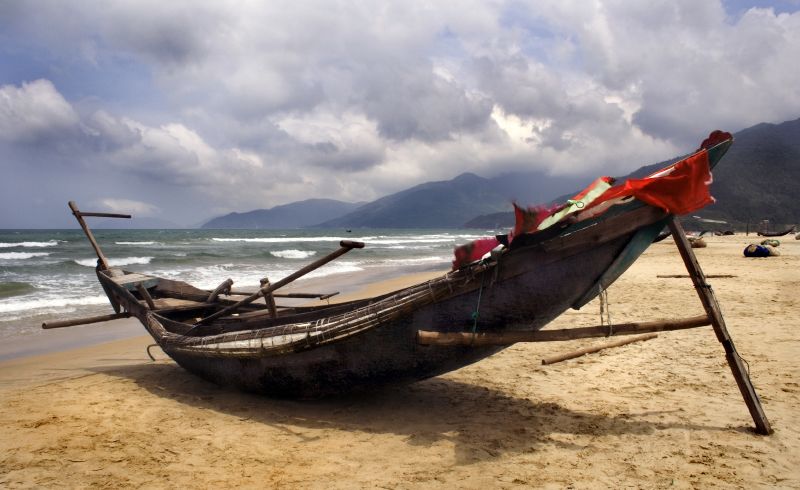
Traditional fishing boat
Traditionally, many different kinds of boats have been used as fishing boats to catch fish in the sea, or on a lake or river. Even today, many traditional fishing boats are still in use. According to the United Nations Food and Agriculture Organization (FAO), at the end of 2004, the world fishing fleet consisted of about 4 million vessels, of which 2.7 million were undecked (open) boats. While nearly all decked vessels were mechanised, only one-third of the undecked fishing boats were powered, usually with outboard engines. The remaining 1.8 million boats were traditional craft of various types, operated by sail and oars.
This article is about the boats used for fishing that are or were built from designs that existed before engines became available.
Early fishing vessels included rafts, dugout canoes, reed boats, and boats constructed from a frame covered with hide or tree bark, such as coracles. The oldest boats found by archaeological excavation are dugout canoes dating back to the Neolithic Period around 7,000-9,000 years ago. These canoes were often cut from coniferous tree logs, using simple stone tools. A 7000-year-old sea going boat made from reeds and tar has been found in Kuwait. These early vessels had limited capability; they could float and move on water, but were not suitable for use any great distance from the shoreline. They were used mainly for fishing and hunting.
The development of fishing boats took place in parallel with the development of boats built for trade and war. Early navigators began to use animal skins or woven fabrics for sails. Affixed to a pole set upright in the boat, these sails gave early boats more range, allowing voyages of exploration
According to the FAO, at the end of 2004, the world fishing fleet included 1.8 million traditional craft of various types which were operated by sail and oars. These figures for small fishing vessels are probably under reported. The FAO compiles these figures largely from national registers. These records often omit smaller boats where registration is not required or where fishing licences are granted by provincial or municipal authorities. Indonesia reportedly has about 700,000 current fishing boats, 25 percent of which are dugout canoes, and half of which are without motors. The Philippines have reported a similar number of small fishing boats.
Traditional fishing boats are usually characteristic of the stretch of coast along which they operate. They evolve over time to meet the local conditions, such as the materials available locally for boat building, the type of sea conditions the boats will encounter, and the demands of the local fisheries.
Artisan fishing is small-scale commercial or subsistence fishing, particularly practices involving coastal or island ethnic groups using traditional fishing techniques and traditional boats. This may also include heritage groups involved in customary fishing practices. Artisan fishers usually use small traditional fishing boats that are open (undecked) and have sails; these boats use little to no mechanised or electronic gear. Large numbers of artisan fishing boats are still in use, particularly in developing countries with long productive marine coastlines.
A raft is a structure with a flat top that floats. It is the most basic boat design, characterised by the absence of a hull. The classic raft is constructed by lashing several logs, placed side by side, to two or more additional logs placed transverse to the others. In many Asian countries, the rafts are similarly constructed using bamboo.
Hub AI
Traditional fishing boat AI simulator
(@Traditional fishing boat_simulator)
Traditional fishing boat
Traditionally, many different kinds of boats have been used as fishing boats to catch fish in the sea, or on a lake or river. Even today, many traditional fishing boats are still in use. According to the United Nations Food and Agriculture Organization (FAO), at the end of 2004, the world fishing fleet consisted of about 4 million vessels, of which 2.7 million were undecked (open) boats. While nearly all decked vessels were mechanised, only one-third of the undecked fishing boats were powered, usually with outboard engines. The remaining 1.8 million boats were traditional craft of various types, operated by sail and oars.
This article is about the boats used for fishing that are or were built from designs that existed before engines became available.
Early fishing vessels included rafts, dugout canoes, reed boats, and boats constructed from a frame covered with hide or tree bark, such as coracles. The oldest boats found by archaeological excavation are dugout canoes dating back to the Neolithic Period around 7,000-9,000 years ago. These canoes were often cut from coniferous tree logs, using simple stone tools. A 7000-year-old sea going boat made from reeds and tar has been found in Kuwait. These early vessels had limited capability; they could float and move on water, but were not suitable for use any great distance from the shoreline. They were used mainly for fishing and hunting.
The development of fishing boats took place in parallel with the development of boats built for trade and war. Early navigators began to use animal skins or woven fabrics for sails. Affixed to a pole set upright in the boat, these sails gave early boats more range, allowing voyages of exploration
According to the FAO, at the end of 2004, the world fishing fleet included 1.8 million traditional craft of various types which were operated by sail and oars. These figures for small fishing vessels are probably under reported. The FAO compiles these figures largely from national registers. These records often omit smaller boats where registration is not required or where fishing licences are granted by provincial or municipal authorities. Indonesia reportedly has about 700,000 current fishing boats, 25 percent of which are dugout canoes, and half of which are without motors. The Philippines have reported a similar number of small fishing boats.
Traditional fishing boats are usually characteristic of the stretch of coast along which they operate. They evolve over time to meet the local conditions, such as the materials available locally for boat building, the type of sea conditions the boats will encounter, and the demands of the local fisheries.
Artisan fishing is small-scale commercial or subsistence fishing, particularly practices involving coastal or island ethnic groups using traditional fishing techniques and traditional boats. This may also include heritage groups involved in customary fishing practices. Artisan fishers usually use small traditional fishing boats that are open (undecked) and have sails; these boats use little to no mechanised or electronic gear. Large numbers of artisan fishing boats are still in use, particularly in developing countries with long productive marine coastlines.
A raft is a structure with a flat top that floats. It is the most basic boat design, characterised by the absence of a hull. The classic raft is constructed by lashing several logs, placed side by side, to two or more additional logs placed transverse to the others. In many Asian countries, the rafts are similarly constructed using bamboo.