


Community hub
Recent from talks
Contribute something to knowledge base
Content stats: 0 posts, 0 articles, 1 media, 0 notes
Members stats: 0 subscribers, 0 contributors, 0 moderators, 0 supporters
Subscribers
Supporters
Contributors
Moderators
Hub AI
Coracle AI simulator
(@Coracle_simulator)
Hub AI
Coracle AI simulator
(@Coracle_simulator)
Coracle
A coracle is a small, rounded, lightweight boat traditionally used in Wales, Ireland, particularly on the River Boyne, and Scotland, particularly on the River Spey. The word is also used for similar boats found in India, Vietnam, Iraq, and Tibet. The word coracle is an English spelling of the original Welsh cwrwgl, cognate with Irish and Scottish Gaelic currach, and is recorded in English text as early as the sixteenth century. Other historical English spellings include corougle, corracle, curricle and coricle.
A typical coracle's structure consists of a framework of split, interwoven willow rods, tied with willow bark. The outer layer was originally an animal skin such as horse or bullock hide (corium), with a thin layer of tar to waterproof it; today replaced by tarred calico, canvas, or fibreglass. The Vietnamese/Asian version of the coracle is made of interwoven bamboo and made water proof by using resin and coconut oil. Oval in shape and very similar to half a walnut shell, the coracle has a keel-less flat bottom to evenly spread the load across the structure and to reduce the required depth of water; often to only a few inches. This structure helps to make the boat more maneuverable and less likely to snag when used on narrow and/or shallow slow-running waterways.[citation needed]
Each coracle is tailored to the local river conditions. In general there is one design per river, but this is not always the case. The Teifi coracle, for instance, is flat-bottomed, as it is designed to negotiate shallow rapids, common on the river in the summer, while the Carmarthen coracle is rounder and deeper, because it is used in tidal waters on the Tywi, where there are no rapids. Teifi coracles are made from locally harvested wood: willow for the laths (body of the boat), hazel for the weave (Y bleth in Welsh.) Tywi coracles have been made from sawn ash for a long time. The working boats tend to be made from fiberglass these days. Teifi coracles use no nails, relying on the interweaving of the laths for structural coherence, whilst the Carmarthen ones use copper nails and interweaving.[citation needed]
They are an effective fishing vessel because, when powered by a skilled person, they hardly disturb the water or the fish, and they can be easily manoeuvred with one arm, while the other arm tends to the net; two coracles to a net. The coracle is propelled by means of a broad-bladed paddle, which traditionally varies in design between different rivers. It is used in a sculling action, the blade describing a figure-of-eight pattern in the water. The paddle is used towards the front of the coracle, pulling the boat forward, with the paddler facing in the direction of travel.
The Welsh Coracle is intended to be carried on the back; Welsh saying is Llwyth dyn ei gorwgl (load of a man is his coracle).[citation needed]
Designed for use in swiftly flowing streams, the coracle has been in use on the British Isles for millennia, having been noted by Julius Caesar in his invasion of Britain in the mid first century BC, and used in his military campaigns in Spain. Remains interpreted as a possible coracle were found in an Early Bronze Age grave at Barns Farm near Dalgety Bay, and others have been described, from Corbridge and from near North Ferriby.
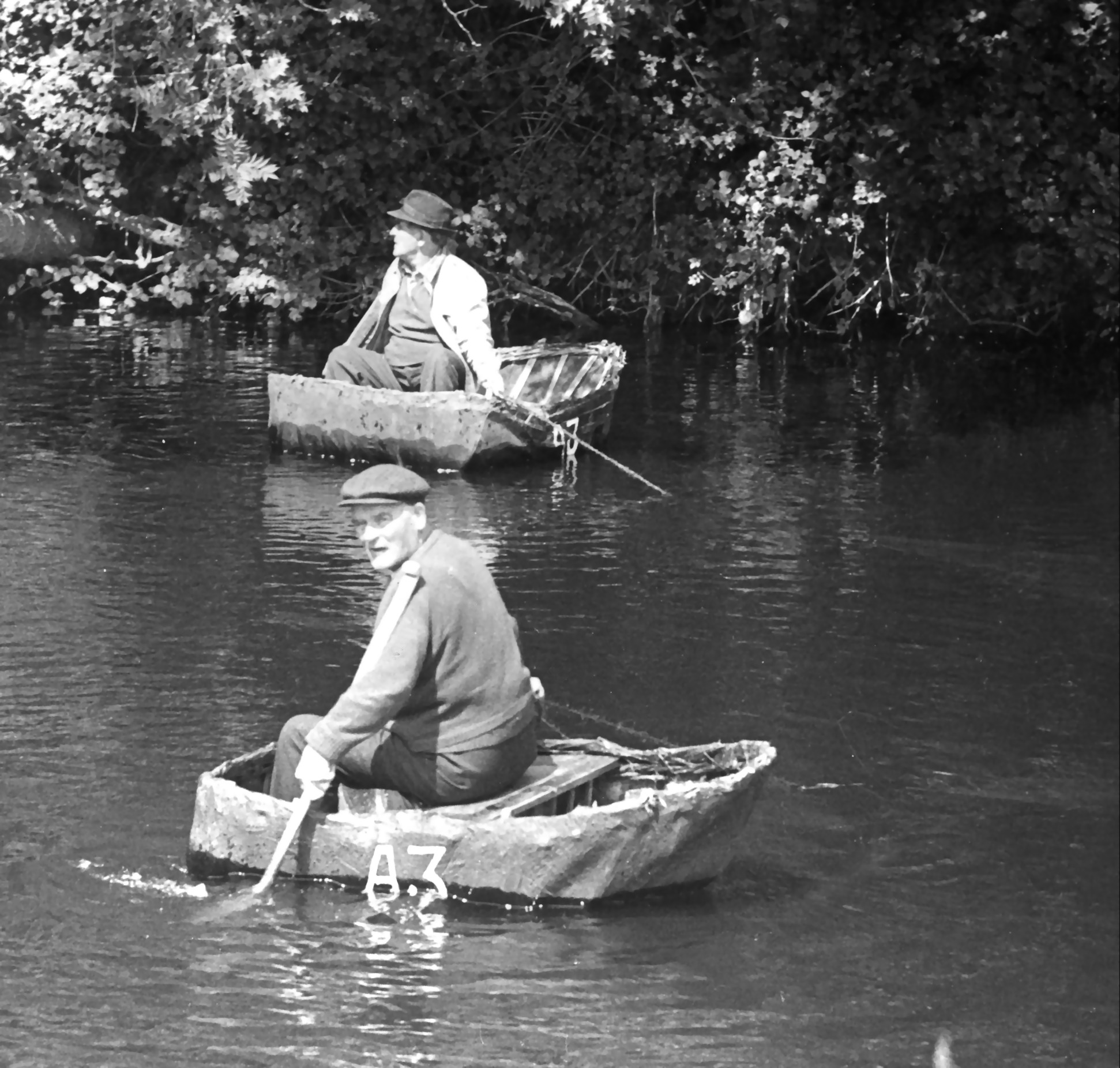
Where coracle fishing is performed by two coraclers the net is stretched across the river between the two coracles. The coraclers will paddle one handed, dragging the net in the other, and draw the net downstream. When a fish is caught, each hauls up an end of the net until the two boats are brought to touch, and the fish is then secured, using a priest (or knocker – a small block of wood) to stun the fish.[citation needed]
A new tax was introduced in 1863 on the commercial capture of migratory fish in Wales; this led to a decline in the number of coracles. During the 1930s, the government decided to begin revoking the licences of commercial fisher families on the death of the main licensees. It took some years for this plan to be completed but eventually led to a more significant decline in the number of craft.
Coracle
A coracle is a small, rounded, lightweight boat traditionally used in Wales, Ireland, particularly on the River Boyne, and Scotland, particularly on the River Spey. The word is also used for similar boats found in India, Vietnam, Iraq, and Tibet. The word coracle is an English spelling of the original Welsh cwrwgl, cognate with Irish and Scottish Gaelic currach, and is recorded in English text as early as the sixteenth century. Other historical English spellings include corougle, corracle, curricle and coricle.
A typical coracle's structure consists of a framework of split, interwoven willow rods, tied with willow bark. The outer layer was originally an animal skin such as horse or bullock hide (corium), with a thin layer of tar to waterproof it; today replaced by tarred calico, canvas, or fibreglass. The Vietnamese/Asian version of the coracle is made of interwoven bamboo and made water proof by using resin and coconut oil. Oval in shape and very similar to half a walnut shell, the coracle has a keel-less flat bottom to evenly spread the load across the structure and to reduce the required depth of water; often to only a few inches. This structure helps to make the boat more maneuverable and less likely to snag when used on narrow and/or shallow slow-running waterways.[citation needed]
Each coracle is tailored to the local river conditions. In general there is one design per river, but this is not always the case. The Teifi coracle, for instance, is flat-bottomed, as it is designed to negotiate shallow rapids, common on the river in the summer, while the Carmarthen coracle is rounder and deeper, because it is used in tidal waters on the Tywi, where there are no rapids. Teifi coracles are made from locally harvested wood: willow for the laths (body of the boat), hazel for the weave (Y bleth in Welsh.) Tywi coracles have been made from sawn ash for a long time. The working boats tend to be made from fiberglass these days. Teifi coracles use no nails, relying on the interweaving of the laths for structural coherence, whilst the Carmarthen ones use copper nails and interweaving.[citation needed]
They are an effective fishing vessel because, when powered by a skilled person, they hardly disturb the water or the fish, and they can be easily manoeuvred with one arm, while the other arm tends to the net; two coracles to a net. The coracle is propelled by means of a broad-bladed paddle, which traditionally varies in design between different rivers. It is used in a sculling action, the blade describing a figure-of-eight pattern in the water. The paddle is used towards the front of the coracle, pulling the boat forward, with the paddler facing in the direction of travel.
The Welsh Coracle is intended to be carried on the back; Welsh saying is Llwyth dyn ei gorwgl (load of a man is his coracle).[citation needed]
Designed for use in swiftly flowing streams, the coracle has been in use on the British Isles for millennia, having been noted by Julius Caesar in his invasion of Britain in the mid first century BC, and used in his military campaigns in Spain. Remains interpreted as a possible coracle were found in an Early Bronze Age grave at Barns Farm near Dalgety Bay, and others have been described, from Corbridge and from near North Ferriby.
Where coracle fishing is performed by two coraclers the net is stretched across the river between the two coracles. The coraclers will paddle one handed, dragging the net in the other, and draw the net downstream. When a fish is caught, each hauls up an end of the net until the two boats are brought to touch, and the fish is then secured, using a priest (or knocker – a small block of wood) to stun the fish.[citation needed]
A new tax was introduced in 1863 on the commercial capture of migratory fish in Wales; this led to a decline in the number of coracles. During the 1930s, the government decided to begin revoking the licences of commercial fisher families on the death of the main licensees. It took some years for this plan to be completed but eventually led to a more significant decline in the number of craft.
Recent media
Recent media