


Community hub
Recent from talks
Contribute something
Nothing was collected or created yet.
Bark (botany)
View on Wikipedia | This article needs additional citations for verification. (September 2022) |

Bark is the outermost layer of stems and roots of woody plants. Plants with bark include trees, woody vines, and shrubs. Bark refers to all the tissues outside the vascular cambium and is a nontechnical term.[1] It overlays the wood and consists of the inner bark and the outer bark. The inner bark, which in older stems is living tissue, includes the innermost layer of the periderm. The outer bark on older stems includes the dead tissue on the surface of the stems, along with parts of the outermost periderm and all the tissues on the outer side of the periderm. The outer bark on trees which lies external to the living periderm is also called the rhytidome.[2][3][4][5][6][7][8][9][10][11][excessive citations]
Products derived from bark include bark shingle siding and wall coverings, spices, and other flavorings, tanbark for tannin, resin, latex, medicines, poisons, various hallucinogenic chemicals, and cork. Bark has been used to make cloth, canoes, and ropes and used as a surface for paintings and map making.[12] A number of plants are also grown for their attractive or interesting bark colorations and surface textures or their bark is used as landscape mulch.[13][14]
The process of removing bark is decortication and a log or trunk from which bark has been removed is said to be decorticated.[15][16][17][18][19]
Botanical description
[edit]Bark is present only on woody plants - herbaceous plants and stems of young plants lack bark.

From the outside to the inside of a mature woody stem, the layers include the following:[20]
- Bark
- Periderm
- Cork (phellem or suber), includes the rhytidome
- Cork cambium (phellogen)
- Phelloderm
- Cortex
- Phloem
- Periderm
- Vascular cambium
- Wood (xylem)
- Pith (medulla)
In young stems, which lack what is commonly called bark, the tissues are, from the outside to the inside:
- Epidermis, which may be replaced by periderm
- Cortex
- Primary and secondary phloem
- Vascular cambium
- Secondary and primary xylem.
Cork cell walls contain suberin, a waxy substance which protects the stem against water loss, the invasion of insects into the stem, and prevents infections by bacteria and fungal spores.[21] The cambium tissues, i.e., the cork cambium and the vascular cambium, are the only parts of a woody stem where cell division occurs; undifferentiated cells in the vascular cambium divide rapidly to produce secondary xylem to the inside and secondary phloem to the outside. Phloem is a nutrient-conducting tissue composed of sieve tubes or sieve cells mixed with parenchyma and fibers. The cortex is the primary tissue of stems and roots. In stems the cortex is between the epidermis layer and the phloem, in roots the inner layer is not phloem but the pericycle.[22][23][24][25][26][27][28][29][3][excessive citations]
As the stem ages and grows, changes occur that transform the surface of the stem into the bark. The epidermis is a layer of cells that cover the plant body, including the stems, leaves, flowers and fruits, that protects the plant from the outside world. In old stems the epidermal layer, cortex, and primary phloem become separated from the inner tissues by thicker formations of cork. Due to the thickening cork layer these cells die because they do not receive water and nutrients. This dead layer is the rough corky bark that forms around tree trunks and other stems.
Cork, sometimes confused with bark in colloquial speech, is the outermost layer of a woody stem, derived from the cork cambium. It serves as protection against damage from parasites, herbivorous animals and diseases, as well as dehydration and fire.
Periderm
[edit]
Often a secondary covering called the periderm forms on small woody stems and many non-woody plants, which is composed of cork (phellem), the cork cambium (phellogen), and the phelloderm. The periderm forms from the phellogen which serves as a lateral meristem. The periderm replaces the epidermis, and acts as a protective covering like the epidermis. Mature phellem cells have suberin in their walls to protect the stem from desiccation and pathogen attack. Older phellem cells are dead, as is the case with woody stems. The skin on the potato tuber (which is an underground stem) constitutes the cork of the periderm.[30][31]
In woody plants, the epidermis of newly grown stems is replaced by the periderm later in the year. As the stems grow a layer of cells form under the epidermis, called the cork cambium, these cells produce cork cells that turn into cork. A limited number of cell layers may form interior to the cork cambium, called the phelloderm. As the stem grows, the cork cambium produces new layers of cork which are impermeable to gases and water and the cells outside the periderm, namely the epidermis, cortex and older secondary phloem die.[32]
Within the periderm are lenticels, which form during the production of the first periderm layer. Since there are living cells within the cambium layers that need to exchange gases during metabolism, these lenticels, because they have numerous intercellular spaces, allow gaseous exchange with the outside atmosphere. As the bark develops, new lenticels are formed within the cracks of the cork layers.
Rhytidome
[edit]The rhytidome is the most familiar part of bark, being the outer layer that covers the trunks of trees. It is composed mostly of dead cells and is produced by the formation of multiple layers of suberized periderm, cortical and phloem tissue.[33] The rhytidome is especially well developed in older stems and roots of trees. In shrubs, older bark is quickly exfoliated and thick rhytidome accumulates.[34] It is generally thickest and most distinctive at the trunk or bole (the area from the ground to where the main branching starts) of the tree.
Chemical composition
[edit]Bark tissues make up by weight between 10 and 20% of woody vascular plants and consists of various biopolymers, tannins, lignin, suberin and polysaccharides.[35] Up to 40% of the bark tissue is made of lignin, which forms an important part of a plant, providing structural support by crosslinking between different polysaccharides, such as cellulose.[35]
Condensed tannin, which is in fairly high concentration in bark tissue, is thought to inhibit decomposition.[35] It could be due to this factor that the degradation of lignin is far less pronounced in bark tissue than it is in wood. It has been proposed that, in the cork layer (the phellogen), suberin acts as a barrier to microbial degradation and so protects the internal structure of the plant.[35][36]
Analysis of the lignin in the bark wall during decay by the white-rot fungi Lentinula edodes (Shiitake mushroom) using 13C NMR revealed that the lignin polymers contained more Guaiacyl lignin units than Syringyl units compared to the interior of the plant.[35] Guaiacyl units are less susceptible to degradation as, compared to syringyl, they contain fewer aryl-aryl bonds, can form a condensed lignin structure, and have a lower redox potential.[37] This could mean that the concentration and type of lignin units could provide additional resistance to fungal decay for plants protected by bark.[35]
Damage and repair
[edit]Bark can sustain damage from environmental factors, such as frost crack and sun scald, as well as biological factors, such as woodpecker and boring beetle attacks. Male deer and other male members of the Cervidae (deer family) can cause extensive bark damage during the rutting season by rubbing their antlers against the tree to remove their velvet.

The bark is often damaged by being bound to stakes or wrapped with wires. In the past, this damage was called bark-galling and was treated by applying clay laid on the galled place and binding it up with hay.[38] In modern usage, "galling" most typically refers to a type of abnormal growth on a plant caused by insects or pathogens.
Bark damage can have several detrimental effects on the plant. Bark serves as a physical barrier to disease pressure, especially from fungi, so its removal makes the plant more susceptible to disease. Damage or destruction of the phloem impedes the transport of photosynthetic products throughout the plant; in extreme cases, when a band of phloem all the way around the stem is removed, the plant will usually quickly die. Bark damage in horticultural applications, as in gardening and public landscaping, results in often unwanted aesthetic damage.
The degree to which woody plants are able to repair gross physical damage to their bark is quite variable across species and type of damage. Some are able to produce a callus growth which heals over the wound rapidly, but leaves a clear scar, whilst others such as oaks do not produce an extensive callus repair. Sap is sometimes produced to seal the damaged area against disease and insect intrusion.[citation needed]
A number of living organisms live in or on bark, including insects,[39] fungi and other plants like mosses, algae and other vascular plants. Many of these organisms are pathogens or parasites but some also have symbiotic relationships.

-
 The patterns left in the bark of a Chinese Evergreen Elm after repeated visits by a Yellow-Bellied Sapsucker (woodpecker) in early 2012.
 -
 The self-repair of the Chinese Evergreen Elm showing new bark growth, lenticels, and other self-repair of the holes made by a Yellow-Bellied Sapsucker (woodpecker) about two years earlier.
 -
 Alder bark (Alnus glutinosa) with characteristic lenticels and abnormal lenticels on callused areas.
 -
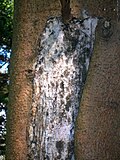 Sun scald damage on Sitka spruce


Uses
[edit]The inner bark (phloem) of some trees is edible. In hunter-gatherer societies and in times of famine, it is harvested and used as a food source. In Scandinavia, bark bread is made from rye to which the toasted and ground innermost layer of bark of scots pine or birch is added. The Sami people of far northern Europe use large sheets of Pinus sylvestris bark that are removed in the spring, prepared and stored for use as a staple food resource. The inner bark is eaten fresh, dried or roasted.[40]

Bark can be used as a construction material, and was used widely in pre-industrial societies. Some barks, particularly birch bark, can be removed in long sheets and other mechanically cohesive structures, allowing the bark to be used in the construction of canoes, as the drainage layer in roofs, for shoes, backpacks, and other useful items.[41] Bark was also used as a construction material in settler colonial societies, particularly Australia, both as exterior wall cladding and as a roofing material.[42][43]

In the cork oak (Quercus suber) the bark is thick enough to be harvested as a cork product without killing the tree;[44] in this species the bark may get very thick (e.g. more than 20 cm has been reported[45]).
Some stem barks have significantly different phytochemical content from other parts. Some of these phytochemicals have pesticidal, culinary, or medicinally and culturally important ethnopharmacological properties.[46]
Bark contains strong fibres known as bast, and there is a long tradition in northern Europe of using bark from coppiced young branches of the small-leaved lime (Tilia cordata) to produce cordage and rope, used for example in the rigging of Viking Age longships.[47]
Among the commercial products made from bark are cork, cinnamon, quinine[48] (from the bark of Cinchona)[49] and aspirin (from the bark of willow trees). The bark of some trees, notably oak (Quercus robur) is a source of tannic acid, which is used in tanning. Bark chips generated as a by-product of lumber production are often used in bark mulch. Bark is important to the horticultural industry since in shredded form it is used for plants that do not thrive in ordinary soil, such as epiphytes.[50]

Wood bark contains lignin which when pyrolyzed yields a liquid bio-oil product rich in natural phenol derivatives. These are used as a replacement for fossil-based phenols in phenol-formaldehyde (PF) resins used in oriented strand board (OSB) and plywood.[51]
Gallery
[edit]-
 Eucalypt bark
 -
 Close-up of living bark on a tree in England
 -
 Acer capillipes (Red Snakebark Maple)
 -
 Monterey Pine bark
 -
 A rare Black Poplar tree, showing the bark and burls.
 -
 The typical appearance of Sycamore bark from an old tree.
 -
 Quercus robur bark with a large burl and lichen.
 -
 Kauri bark
 -
 Beech bark with callus growth following fire (heat) damage
 -
 Damaged bark
 -
 Common oak bark
 -
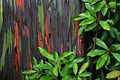 "Rainbow" Eucalyptus bark on the Hawaiian island of Maui
 -
 The old bark has a metallic luster. In 2016, the height of the tree was 15 meters and the bust circumference was 5.7 meters. Samanea saman


.jpg)


See also
[edit]
- Bark beetle
- Bark painting
- Trunk (botany)
- Bark isolate
- Bark-binding, a diseased condition of tree bark
References
[edit]- ^ Raven, Peter H.; Evert, Ray F.; Curtis, Helena (1981), Biology of Plants, New York, N.Y.: Worth Publishers, p. 641, ISBN 0-87901-132-7, OCLC 222047616
- ^ "rhytidome, n.", Oxford English Dictionary, Oxford University Press, 2 March 2023, doi:10.1093/oed/1202365019, retrieved 9 October 2023
- ^ a b Larson, Philip R. (1994), "Defining the Cambium", The Vascular Cambium, Springer Series in Wood Science, Berlin, Heidelberg: Springer Berlin Heidelberg, pp. 33–97, doi:10.1007/978-3-642-78466-8_4, ISBN 978-3-642-78468-2, retrieved 9 October 2023
- ^ "Growing Shrubs and Vines", Shrubs and Vines of Iowa, University of Iowa Press, pp. 215–222, doi:10.2307/j.ctt20p57wz.12, retrieved 9 October 2023
- ^ Cells Tissues Organs. S. Karger AG. 2015. doi:10.1159/issn.1422-6405. S2CID 138777755.
- ^ "Periderm". AccessScience. doi:10.1036/1097-8542.498200. Retrieved 9 October 2023.
- ^ "Growing Woody Plants for Experimental Purposes", Woody Plants and Woody Plant Management, CRC Press, pp. 545–558, 29 March 2001, doi:10.1201/9781482270563-23, ISBN 9780429078057, retrieved 9 October 2023
- ^ Specification for percussive rock-drilling bits, rods and stems. Integral stems, BSI British Standards, doi:10.3403/30309158, retrieved 9 October 2023
- ^ Meeting Trees, Indiana University Press, doi:10.2307/j.ctv3c0tgz.2, retrieved 9 October 2023
- ^ "What the bark tells me of the tree...", Bark, The MIT Press, pp. 114–121, 2017, doi:10.7551/mitpress/11239.003.0021, ISBN 9780262342629, retrieved 9 October 2023
- ^ Vines, Sydney Howard; Vines, Sydney Howard (1898). An elementary text-book of botany, by Sydney H. Vines ... London: S. Sonnenschein & Co. doi:10.5962/bhl.title.22654.
- ^ Taylor, Luke. 1996. Seeing the Inside: Bark Painting in Western Arnhem Land. Oxford Studies in Social and Cultural Anthropology. Oxford: Clarendon Press.
- ^ Sandved, Kjell Bloch, Ghillean T. Prance, and Anne E. Prance. 1993. Bark: the Formation, Characteristics, and Uses of Bark around the World. Portland, Or: Timber Press.
- ^ Vaucher, Hugues, and James E. Eckenwalder. 2003. Tree Bark: a Color Guide. Portland: Timber
- ^ Jepson, Willis Linn; Betts, Harold S.; Mell, Clayton D. (1911). California tanbark oak. Part I. Tanbark oak and the tanning industry. Washington: Govt. Print. Off. doi:10.5962/bhl.title.24278.
- ^ Pizzi, Antonio (1999), "Tannin Autocondensation and Polycondensation for Zero Emission Tannin Wood Adhesives", Plant Polyphenols 2, Boston, MA: Springer US, pp. 805–821, doi:10.1007/978-1-4615-4139-4_45, ISBN 978-0-306-46218-4, retrieved 9 October 2023
- ^ "Contact-pressure resin (contact resin, impression resin, low-pressure resin)", Encyclopedic Dictionary of Polymers, New York, NY: Springer New York, p. 226, 2007, doi:10.1007/978-0-387-30160-0_2815, ISBN 978-0-387-31021-3, retrieved 9 October 2023
- ^ "Latex and Lingerie". Latex and Lingerie. 2010. doi:10.5040/9781847888778.
- ^ "Hallucinogenic Mushrooms", Magical Mushrooms, Mischievous Molds, Princeton University Press, pp. 172–185, 31 December 2019, doi:10.2307/j.ctvs32r8v.16, S2CID 28656244, retrieved 9 October 2023
- ^ Pereira, Helena (2007), Cork, Amsterdam: Elsevier, p. 8, ISBN 978-0-444-52967-1, OCLC 162131397
- ^ "Botany Glossary "P"". .puc.edu. Archived from the original on 20 July 2006. Retrieved 2 January 2012.
- ^ "suberin, n.", Oxford English Dictionary, Oxford University Press, 2 March 2023, doi:10.1093/oed/9944932193, retrieved 9 October 2023
- ^ "How Bacteria communicate". SciVee. 29 May 2009. doi:10.4016/11355.01 (inactive 1 July 2025). Retrieved 9 October 2023.
{{cite journal}}: CS1 maint: DOI inactive as of July 2025 (link) - ^ Ray, Samriddha; Lechler, Terry (2011). "Regulation of asymmetric cell division in the epidermis". Cell Division. 6 (1): 12. doi:10.1186/1747-1028-6-12. ISSN 1747-1028. PMC 3123617. PMID 21645362.
- ^ SEVANTO, SANNA; HÖLTTÄ, TEEMU; HOLBROOK, N. MICHELE (18 February 2011). "Effects of the hydraulic coupling between xylem and phloem on diurnal phloem diameter variation". Plant, Cell & Environment. 34 (4): 690–703. Bibcode:2011PCEnv..34..690S. doi:10.1111/j.1365-3040.2011.02275.x. ISSN 0140-7791. PMID 21241327.
- ^ "Parenchyma". AccessScience. doi:10.1036/1097-8542.489500. Retrieved 9 October 2023.
- ^ "A Comparison of Drug-Nutrient and Nutrient- Nutrient Interactions", Nutrient Interactions, CRC Press, pp. 381–394, 19 May 1988, doi:10.1201/9781482259476-17, ISBN 9780429090875, retrieved 9 October 2023
- ^ Ellis, Richard A. (1964), "Enzymes of the Epidermis", The Epidermis, Elsevier, pp. 135–144, doi:10.1016/b978-1-4832-3293-5.50015-2, ISBN 9781483232935, retrieved 9 October 2023
{{citation}}: ISBN / Date incompatibility (help) - ^ Rolls, Edmund T. (5 June 2019), "Orbitofrontal cortex output pathways: cingulate cortex, basal ganglia, and dopamine", The Orbitofrontal Cortex, Oxford University Press, pp. 145–164, doi:10.1093/oso/9780198845997.003.0005, ISBN 978-0-19-884599-7, retrieved 9 October 2023
- ^ Artschwager, E (1924). "Studies on the potato tuber". J. Agr. Res. 27: 809–835.
- ^ Peterson, R.L.; Barker, W.G. (1979). "Early tuber development from explanted stolon nodes of Solanum tuberosum var. Kennebec". Botanical Gazette. 140 (4): 398–406. doi:10.1086/337104. S2CID 85217835.
- ^ Mauseth, James D. (2003), Botany: an Introduction to Plant Biology, Jones & Bartlett Learning, p. 229, ISBN 0-7637-2134-4
- ^ Dickison, WC. 2000. Integrative Plant Anatomy, Academic Press, San Diego, 186–195.
- ^ Katherine Easu (1977). Anatomy of Seed Plants. Plant Anatomy (2nd ed.). John Wiley & Sons. p. 185. ISBN 0-471-24520-8.
- ^ a b c d e f Vane, C. H.; et al. (2006). "Bark decay by the white-rot fungus Lentinula edodes: Polysaccharide loss, lignin resistance and the unmasking of suberin". International Biodeterioration & Biodegradation. 57 (1): 14–23. Bibcode:2006IBiBi..57...14V. doi:10.1016/j.ibiod.2005.10.004.
- ^ Kolattukudy, P.E. (1984). "Biochemistry and function of cutin and suberin". Canadian Journal of Botany. 62 (12): 2918–2933. Bibcode:1984CaJB...62.2918K. doi:10.1139/b84-391.
- ^ Vane, C. H.; et al. (2001). "Degradation of Lignin in Wheat Straw during Growth of the Oyster Mushroom (Pleurotus ostreatus) Using Off-line Thermochemolysis with Tetramethylammonium Hydroxide and Solid-State 13C NMR". Journal of Agricultural and Food Chemistry. 49 (6): 2709–2716. Bibcode:2001JAFC...49.2709V. doi:10.1021/jf001409a. PMID 11409955.
- ^ Tegg, Thomas (1829). The London encyclopaedia: or Universal dictionary of science, art, literature, and practical mechanics, comprising a popular view of the present state of knowledge (Volume 3 ed.). Retrieved 13 February 2014.
- ^ Lieutier, François. 2004. Bark and Wood Boring Insects in Living Trees in Europe, a Synthesis. Dordrecht: Kluwer Academic Publishers.
- ^ Zackrisson, O.; Östlund, L.; Korhonen, O.; Bergman, I. (200), "The ancient use of Pinus sylvestris L. (scots pine) inner bark by Sami people in northern Sweden, related to cultural and ecological factors = Ancienne usage d'écorce de Pinus sylvestris L. (Pin écossais) par les peuples Sami du nord de la Suède en relation avec les facteurs écologiques et culturels", Vegetation History and Archaeobotany, 9 (2): 99–109, doi:10.1007/bf01300060, S2CID 129174312, archived from the original on 26 January 2012, retrieved 25 October 2008
- ^ Adney, Tappan, and Howard Irving Chapelle. 1964. The Bark Canoes and Skin Boats of North America. Washington: Smithsonian Institution.
- ^ English: Turners Creek School, 1922, 1922, retrieved 9 April 2024
- ^ "The Prince of Wales mine at Reno, near Gundagai, New South Wales, 1900?, 2 [picture]". Trove. Retrieved 9 April 2024.
- ^ Aronson J.; Pereira J.S.; Pausas J.G., eds. (2009). Cork Oak Woodlands on the Edge: conservation, adaptive management, and restoration. Washington DC: Island Press.
- ^ Paulo Fernandes (3 January 2011). "j.g. pausas' blog " Bark thickness: a world record?". Jgpausas.blogs.uv.es. doi:10.1016/j.foreco.2010.07.010. hdl:10261/32660. S2CID 85573811. Retrieved 2 January 2012.
{{cite journal}}: Cite journal requires|journal=(help) - ^ Ibrahim, Mohammed Auwal; Mohammed, Aminu; Isah, Murtala Bindawa; Aliyu, Abubakar Babando (2014). "Anti-trypanosomal activity of African medicinal plants: A review update". Journal of Ethnopharmacology. 154 (1). International Society of Ethnopharmacology (ISE): 26–54. doi:10.1016/j.jep.2014.04.012. ISSN 0378-8741. PMID 24742753.
- ^ Myking, T.; Hertzberg, A.; Skrøppa, T. (2005). "History, manufacture and properties of lime bast cordage in northern Europe". Forestry. 78 (1): 65–71. doi:10.1093/forestry/cpi006.
- ^ Duran-Reynals, Marie Louise de Ayala. 1946. The Fever Bark Tree; the Pageant of Quinine. Garden City, N.Y.: Doubleday.
- ^ Markham, Clements R. 1880. Peruvian Bark. A Popular Account of the Introduction of Chinchona Cultivation into British India. London: J. Murray.
- ^ Harkin, John M. (1971). Bark and Its Possible Uses. Forest Products Laboratory, U.S. Forest Service.
- ^ "Archived copy" (PDF). Archived from the original (PDF) on 11 April 2008. Retrieved 30 January 2008.
{{cite web}}: CS1 maint: archived copy as title (link)
Other references
[edit]- Cédric Pollet, Bark: An Intimate Look at the World's Trees. London, Frances Lincoln, 2010. (Translated by Susan Berry) ISBN 978-0-7112-3137-5
| Animals | |
|---|---|
| Plants | |

| International | |
|---|---|
| National | |
| Other | |

