Hubbry Logo
Unit trainUnit trainMain
Open search
Unit train
Community hub
Unit train
logo
8 pages, 0 posts
0 subscribers
Be the first to start a discussion here.
Unit train
Unit train
from Wikipedia
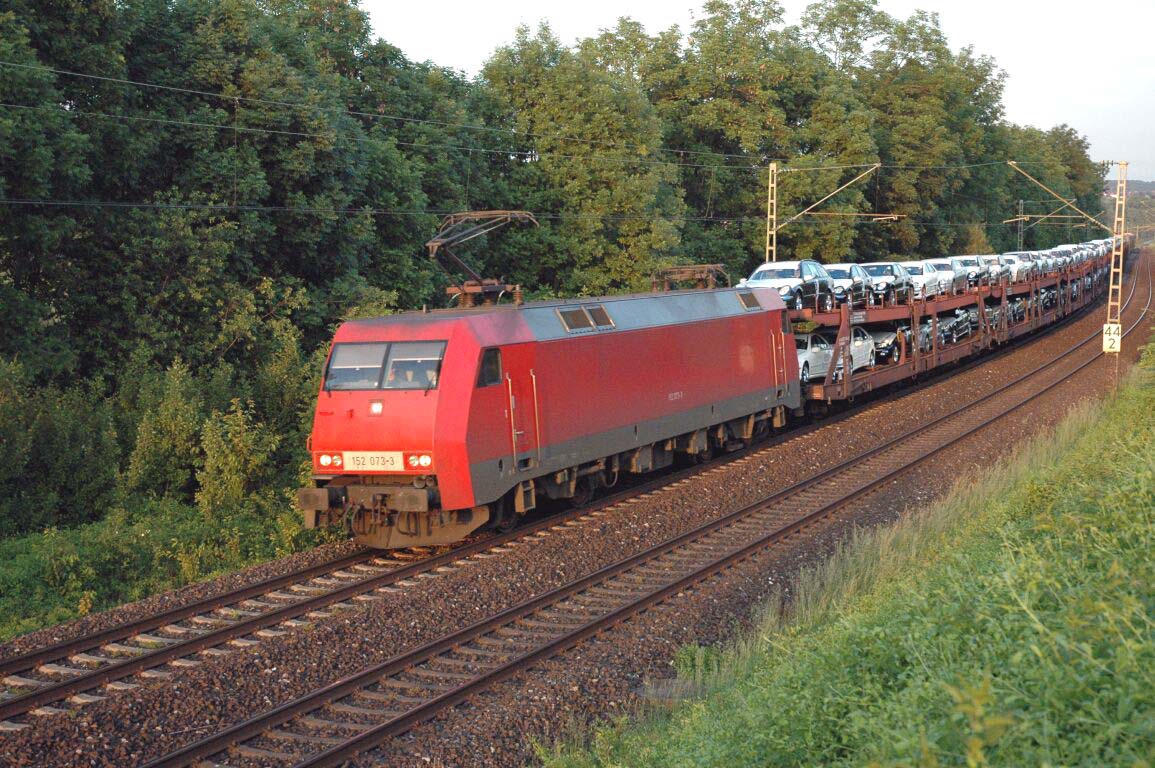
A Deutsche Bahn unit train working for Daimler AG between the factories at Sindelfingen and Bremen

A unit train, also called a block train or a trainload service, is a train in which all cars (wagons) carry the same commodity and are shipped from the same origin to the same destination, without being split up or stored en route.[1] They are distinct from wagonload trains, composed of differing numbers of cars for various customers.[2]

Unit trains enable railways to compete more effectively with road and internal waterway transport systems. Time and money are saved by avoiding the complexities and delays that would otherwise involve assembling and disassembling trains at rail yards near the origin and destination.

Unit trains are particularly efficient and economical for high-volume commodities. Since they often carry only one commodity, cars are of all the same type; often identical. Some commodities (e.g., coal) can be loaded at the origin while the train moves slowly on a loop track. The procedure is reversed at the receiving end, and because there generally is not any commodity to be hauled in the opposite direction, the train returns empty. In the United States the Santa Fe is credited with operating the first true unit train, hauling coal from a mine near Raton, New Mexico to a steel mill at Fontana, California.[3]

Use

[edit]

Unit trains are typically used for the transportation of bulk goods. These can be solid substances such as:

Bulk liquids are transported in unit trains made up of tank cars, such as:

  • Crude oil from oil fields to refineries (can be [60,000 barrels (9,500 m3)] of oil in a unit train of 100 tank cars)[5]
  • Ethanol from ethanol plants to motor fuel blending facilities[6]
  • Molten sulfur (non-US:sulphur)

Food, such as:

Other examples include:

See also

[edit]

References

[edit]
Revisions and contributorsEdit on WikipediaRead on Wikipedia
from Grokipedia
A unit train is a dedicated freight train consisting of similar railcars, typically numbering 50 or more, all loaded with the same bulk commodity—such as , , or chemicals—and operated intact from a single origin to a single destination without intermediate switching, unloading, or reconfiguration. This operational model enables efficient, high-volume transport over long distances, bypassing classification yards and reducing handling costs compared to traditional manifest freight trains. Unit trains emerged during the mid-20th century as railroads sought to compete with emerging trucking for bulk shipments, with early innovations like the Southern Railway's "Big John" 100-ton hopper cars for appearing in the early . Prior regulatory constraints under the (ICC) limited pricing flexibility, making such dedicated services unprofitable until a ruling permitted differential rates. The of 1980 further accelerated their adoption by deregulating much of the industry, allowing railroads to negotiate confidential contracts and set market-based rates, which spurred efficiency gains and network expansions. As of 2023, unit trains handle a significant portion of North American rail freight, particularly for energy, agriculture, and industrial commodities, contributing to the railroads' role in moving about 1.6 billion tons of goods annually with lower emissions per ton-mile than trucks.

Definition and Characteristics

Definition

A unit train is a type of composed entirely of rail cars carrying the same commodity, typically in identical types of cars such as , gondolas, or tank cars, and operated intact from a single origin to a single destination without uncoupling, switching, or intermediate handling en route. This dedicated configuration ensures the train functions as a cohesive block, often consisting of 90 or more cars to maximize throughput. In contrast to manifest trains, which assemble a variety of cars with mixed commodities, origins, and destinations in classification yards and require disassembly upon arrival, unit trains avoid such processes to streamline operations. Wagonload services, a similar mixed-freight approach common in international rail networks, also differ by combining shipments from multiple sources into shared trains, necessitating sorting and redistribution. The basic makeup of a unit train generally includes one or more locomotives positioned at the head and sometimes the rear for , a string of specialized freight cars, and, in earlier operations, a at the end for crew monitoring—though cabooses are now largely obsolete due to technological advancements. This structure contributes to operational efficiencies by eliminating yard delays and enabling direct point-to-point service.

Key Characteristics

Unit trains are defined by their uniformity in composition, consisting entirely of identical rail cars tailored to a specific , such as covered hoppers for or open hoppers for , which facilitates efficient, standardized loading and unloading processes. This homogeneity ensures that the entire consist remains intact as a single unit from origin to destination, minimizing sorting and handling variability. In terms of scale, unit trains typically comprise 100 to 150 cars, transporting payloads of 10,000 to 15,000 tons, with some configurations reaching up to 17,000 tons and lengths exceeding 1 mile. To manage these substantial loads, configurations are employed, placing remote-controlled locomotives at intermediate points, such as mid-train or rear positions, to distribute and improve control over long, heavy consists. Design adaptations further enhance operational efficiency, including compatibility with rotary dumpers that rotate hopper or gondola cars for rapid bulk unloading. Facilities at origins and destinations commonly feature loop or tracks to allow continuous train movement during loading, avoiding the need to reposition the consist. Empty return trips are standard for many unit trains unless a backhaul is available to utilize the capacity in the reverse direction. For safety in modern operations, unit trains frequently incorporate end-of-train devices (EOTs) in lieu of traditional cabooses, providing real-time monitoring of brake pipe pressure and train integrity from the rear to enhance emergency braking and prevent undetected separations.

History

Origins

The unit train concept emerged in the United States during the post-World War II era, driven by surging demand for efficient bulk transport of coal and minerals to fuel industrial expansion and energy production. Prior regulatory constraints by the (ICC) limited pricing flexibility for dedicated services, but a 1960s Supreme Court ruling permitted differential rates, enabling profitability. Prior to this, rail freight often relied on mixed consists, leading to inefficiencies in loading, switching, and delivery for large-volume shipments. The unit train addressed these issues by dedicating an entire train—typically 50 or more identical cars—to a single commodity and customer, enabling streamlined operations from origin to destination without intermediate handling. This innovation was particularly vital in the , with its expansive rail network and resource-rich regions, marking the as the birthplace of the modern unit train system. Although influenced by earlier European block train practices, where groups of cars for a single purpose were handled as units (common for in the UK and since the 19th century), the formalized the unit for high-volume industrial applications, optimizing for speed, capacity, and cost savings. The primary motivations were the postwar rise in , which outpaced traditional methods, and intensifying competition from trucks, which benefited from federal highway investments. Railroads responded by developing unit trains to offer volume-based rate reductions and faster transit times for bulk goods, thereby reclaiming in long-haul freight. Key enablers included advancements in diesel-electric locomotives, which provided the horsepower for longer, heavier trains following the widespread replacement of steam power in the 1940s and 1950s, and infrastructure upgrades allowing axle loads up to 263,000 pounds per car. One of the earliest dedicated unit train services was operated by the Atchison, Topeka and Santa Fe Railway starting in 1967, hauling coking from the York Canyon mine near , to the Kaiser Steel mill at , using 84 specialized gondola cars in a round-trip cycle every three days. This operation exemplified the unit train's potential for reliable, high-capacity bulk movement and paved the way for broader adoption beyond .

Development and Expansion

The adoption of unit trains in the United States accelerated during the 1960s and 1970s, particularly for transporting coal and grain, as railroads sought to compete with alternative modes like barges and trucks. The Norfolk and Western Railway exemplified this growth in 1967 by operating a record-breaking 500-car coal unit train from Iaeger, West Virginia, to Portsmouth, Ohio—a four-mile-long consist weighing 48,170 tons and pulled by six diesel locomotives, covering 159 miles and demonstrating the scale potential of dedicated bulk movements. Similarly, in 1966, the Illinois Central Railroad and Cargill pioneered a 115-car grain unit train, filling covered hoppers with sufficient volume to enable efficient long-haul shipments from rural origins to export ports, marking a shift toward standardized, high-volume grain transport. These developments were driven by the need for railroads to handle surging demand for bulk commodities amid post-World War II industrial expansion. The of 1980 further propelled unit train expansion by deregulating the industry, allowing railroads greater flexibility in pricing and operations, which boosted efficiency and volume for and shipments. Post-deregulation, unit trains became the dominant method for bulk freight, substantially reducing costs compared to mixed-freight trains through minimized switching and faster cycle times. Globally, the concept spread in the mid-20th century; in the , "Merry-go-round" unit trains—featuring hopper wagons that loaded and unloaded while in motion—were introduced in the early 1960s to supply power stations, revolutionizing domestic distribution. Expansion continued in resource-rich regions: Australia's ore railways, developed in the late and by companies like Hamersley Iron and Mount Newman Mining, utilized heavy-haul unit trains on dedicated lines up to 426 km long, with initial consists of 90 cars enabling exports of millions of tons annually. In , unit trains emerged in the late , with the first 115-car shipment from Northgate in 1969 supporting fertilizer exports via major carriers like Canadian Pacific. Modern applications include China's deployment of intelligent heavy-haul unit trains for transport since the 2010s, such as the 2023 introduction of digitally monitored consists on key routes to facilitate domestic and export flows from regions like . Technological advancements supported this growth, including the widespread installation of automated unloading terminals in the , featuring rotary dumpers and conveyor systems that enabled rapid discharge of unit train hoppers—often in under an hour per train—enhancing throughput at and facilities. By the , some operations integrated unit train principles with intermodal elements, creating hybrid systems for bulk commodities in containers to improve flexibility on shared networks.

Operations

Train Formation and Loading

Unit trains are typically assembled at dedicated loading facilities near the origin, such as mines, elevators, or bulk terminals, where railcars are gathered from a single source or multiple nearby locations to ensure uniformity in and destination. The formation process involves gathering the cars at the dedicated loading facility and coupling them into a single consist using automatic couplers that connect via impact and secure the train's integrity. are then attached, often employing units (DPUs) positioned mid-train or at the rear, which are remotely controlled from the lead locomotive to enhance traction, stability, and braking on long hauls exceeding 100 cars. Loading methods for bulk commodities in unit trains primarily rely on specialized hopper cars designed for efficient top-loading and bottom-unloading. For solids like or , gravity-fed systems pour material through open tops or hatches, while conveyor belts or pneumatic systems transfer cargo into covered hoppers via roof openings, ensuring even distribution across multiple bays. Open-top hoppers, common for , feature sloped floors and sliding for self-clearing discharge, with loading occurring directly from overhead chutes. In high-volume operations, continuous loop tracks enable loading while the train moves slowly at 2-3 mph, using surge bins and chutes to fill wagons sequentially without halting the entire consist, achieving rates over 10,000 tons per hour. Post-loading preparation includes weighing each car or the full train on scales to verify load limits, typically 197,000-224,000 pounds per hopper, followed by inspections of brakes, couplers, wheels, and securement to comply with safety standards. Scheduling coordinates with shipper volumes to form viable consists, requiring a minimum of 65-100 cars for economic operation, often using leased railcars owned by shippers or independent leasing companies to match dedicated service needs. The entire formation and loading process generally takes 4-10 hours, significantly faster than assembling mixed-freight trains due to the standardized, single-commodity focus. Commodity-specific adaptations, such as pneumatic loading for food-grade to prevent , further optimize these processes for unit train efficiency.

Transit and Unloading

Unit trains operate on direct mainline routing to maximize efficiency, typically avoiding yards and intermediate stops to preserve the integrity of the dedicated consist. Where feasible, dedicated tracks or priority paths are utilized to minimize delays from mixed freight traffic. For heavy loads, such as or , operational speeds generally range from 25 to 50 , governed by track conditions and load weight to ensure safe transit. Real-time monitoring during transit is facilitated by GPS systems for location tracking and end-of-train (EOT) devices, which provide data on brake pressure, speed, and train integrity to the crew. These technologies enable remote oversight by dispatchers and help detect issues like air brake failures in real time. For long-haul journeys exceeding 1,000 miles, crew changes occur at designated sidings or terminals to comply with hours-of-service regulations, allowing the train to continue without full stops. At the destination, unloading occurs via specialized facilities such as loop tracks or rotary dumpers, particularly for bulk commodities like and , where individual are rotated up to 180 degrees to discharge contents rapidly. An entire unit train of 100-135 can be unloaded in 2-4 hours using these methods, depending on the facility's capacity and commodity type. Following discharge, empty are inspected, cleaned if necessary, and prepared for repositioning or return to the origin, often as part of a continuous cycle. Operations adhere to (FRA) regulations on track classes and speed limits, with unit trains typically running on Class 3 or higher mainline tracks permitting freight speeds up to 40-60 mph, subject to load-specific restrictions. Emergency protocols for incidents like derailments emphasize immediate notification to public safety answering points and containment measures tailored to the single-commodity load, such as spill control for bulk solids to mitigate environmental risks.

Commodities Transported

Bulk Solids

Unit trains transporting bulk solids represent a cornerstone of rail freight operations, primarily hauling non-fluid commodities such as , ores, grains, and minerals in dedicated consists of hopper or cars. These trains enable efficient, high-volume movement from extraction or production sites to end-users like power plants, mills, ports, and processing facilities, minimizing handling and maximizing payload consistency. Coal dominates bulk solids traffic in unit trains, comprising the largest volume among U.S. rail commodities at about 28% of originated as of 2023, with nearly all rail coal shipments occurring in such dedicated formations. Typical coal unit trains consist of 100 to 115 cars, each with a capacity of around 116 tons, allowing a single consist to carry over 11,000 tons directly to utility power plants for generation. This scale underscores coal's role as the "king" of unit train operations, supporting consistent supply chains for production. As of 2025, coal unit train volumes have shown a modest rebound. Iron ore and aggregates follow as key bulk solids, transported in open-top gondola cars optimized for heavy, dense loads from mines to steel mills or construction sites. For instance, specialized 29-foot ore gondolas with high sides and rotary dumping capabilities handle pellets from U.S. ranges like Minnesota's Mesabi to integrated facilities, often in unit train configurations to ensure steady raw material flow for . Aggregates such as and use similar gondolas, leveraging unit trains for bulk delivery to projects. Agricultural products like are shipped in covered hopper cars, which shield , corn, and soybeans from weather exposure during transit from grain elevators to export ports or processors. These hoppers, typically 3,000 to 5,000 cubic feet in capacity, form unit trains of 75 to 110 cars, transporting hundreds of thousands of bushels per consist—such as 425,000 bushels of or 450,000 bushels of corn—while preventing moisture damage that could degrade quality. This protection is essential for maintaining commodity integrity over long hauls. Other solid bulks include frac sand for hydraulic fracturing in oilfields, moved in covered or open hoppers within unit trains of up to 150 cars carrying over 16,500 tons to well sites in regions like the Permian Basin. Minerals such as and employ specialized covered hoppers to transport fine powders without spillage or contamination, with often shipped in shuttle unit trains from mines in and to plants nationwide. These diverse solids collectively account for approximately 70% of U.S. unit train traffic, highlighting their dominance in rail bulk logistics.

Liquids and Chemicals

Unit trains transporting liquids and chemicals utilize specialized tank cars designed to safely contain and move fluid commodities over long distances. These trains typically consist of uniform tank cars, either non-pressurized models like the DOT-111 for general service or pressurized variants for gases and volatile liquids, enabling efficient shipment of substances such as crude oil, , and various chemicals. Non-pressurized tank cars are commonly used for crude oil and , while pressure tank cars handle compressed chemicals, with capacities varying by design but often reaching 30,000 gallons per car. For example, a 100-car unit train of such tank cars can transport approximately 70,000 barrels of oil, providing a scale advantage over truck transport for bulk movements. Key commodities shipped via these unit trains include petroleum products, hazardous chemicals, and . Petroleum products, such as refined fuels, are moved from refineries to distribution centers in dedicated trains to support supply chains, particularly during periods of increased domestic production. Hazardous chemicals like acids and fertilizers require placarding for identification and safe handling, with railroads transporting about 20% of all U.S. chemicals by . , a , is frequently railed from Midwest plants to coastal blending facilities, with unit trains facilitating large-volume deliveries to meet blending mandates. Handling of these unit trains involves specialized procedures to ensure safety and efficiency, including valved unloading at dedicated fixed terminals where pumps transfer liquids from bottom outlet valves. Many tank cars feature insulation for temperature-sensitive loads, such as certain chemicals or fuels that require to prevent degradation during transit. All operations comply with (FRA) regulations for hazardous materials, including tank car integrity standards and routing requirements to mitigate risks. Liquids and chemicals account for approximately 20% of unit train traffic as of 2023. While of crude oil peaked in the mid-2010s and has since declined due to development, shares for chemicals and biofuels like have remained stable or grown. This segment benefits from rail's capacity to move high volumes securely, though it remains subject to ongoing regulatory enhancements for flammable liquids.

Advantages and Challenges

Economic and Efficiency Benefits

Unit trains provide substantial economic advantages through , enabling lower transportation costs per ton-mile compared to alternative modes like trucking. For instance, rail shipping via unit trains can achieve costs as low as $70.27 per ton for direct service, significantly less than the $214.96 per ton for over-the-road trucking on comparable routes, representing potential savings of over 65% depending on distance and . These savings stem from the ability to transport large volumes—often 90 or more cars—in a single dedicated train, minimizing per-unit overhead and avoiding the and handling fees associated with mixed-freight yards, where unit trains bypass intermediary facilities entirely. Efficiency gains further enhance the economic viability of unit trains, with nonstop operations reducing transit times compared to mixed-freight services that require sorting and delays at multiple yards. This streamlined approach allows for higher asset utilization, often exceeding 90% capacity on dedicated routes, and superior fuel economy, achieving up to 500 ton-miles per or more for fully loaded unit trains as of 2025, which is three to four times better than trucking. By concentrating on bulk commodities, unit trains optimize and car usage, lowering overall operating expenses and enabling railroads to offer competitive rates that capture market share from less efficient modes. The competitive edge of unit trains extends to environmental and benefits, supporting rail's dominance in bulk freight with up to 75% lower CO2 emissions per ton-mile than as of 2023, which translates to indirect cost savings through and incentives. In industries like , where and similar commodities rely on just-in-time delivery, unit trains facilitate reliable, high-volume flows that reduce holding costs and enhance operational predictability for shippers.

Operational Limitations and Risks

Unit trains, by design, exhibit significant operational inflexibility due to their reliance on high-volume shipments from a single shipper and dedicated routing. These trains typically require minimum volumes exceeding 10,000 tons to justify formation, as seen in shuttle configurations involving 100 to 110 hopper cars for commodities like or , where smaller loads would not economically support the dedicated and scheduling. Fixed routes from origin to destination, bypassing intermediate yards, limit adaptability to fluctuating market demands or alternative destinations, often resulting in empty backhauls that elevate costs without return loads to offset outbound expenses. This structure suits stable, high-demand commodities but constrains shippers facing variable production or seasonal disruptions. Scheduling unit trains presents unique challenges, as their single-commodity focus amplifies vulnerabilities to bottlenecks at loading points. Delays from weather events at mines or ports, such as heavy rains halting extraction, can cascade across the entire consist, idling 80-110 cars and disrupting downstream supply chains for days. Similarly, labor strikes or infrastructure failures on shared lines affect the full train, with no mixed-cargo flexibility to reroute portions, leading to network-wide delays that exceed those of manifest trains by up to 50% in affected corridors. Safety risks are heightened for unit trains due to their length and weight, increasing derailment potential compared to shorter manifests. On mainline routes, loaded unit trains experience a 27% higher derailment rate at 0.85 incidents per million train-miles compared to 0.67 for manifest trains as of 2024, though unit trains show 30% lower rates when adjusted per billion ton-miles; average severity on mainline involves about 11.3 cars derailed, driven by amplified in-train forces on curves or grades. Environmental hazards intensify when transporting concentrated hazmat, as all cars carry the same substance—such as crude oil or —amplifying spill impacts; a single derailment can release 90,000-150,000 gallons, threatening waterways and populations far beyond isolated incidents. Mitigation strategies include mandatory (PTC) systems, deployed across U.S. freight lines since the 2010s and fully operational by December 2020, which automatically enforce speed limits and prevent over-speed derailments or collisions on long consists. Regulatory measures, such as routing protocols for high-hazard trains and insurance requirements under the Hazardous Materials Transportation Act, further address risks by mandating safer paths and financial accountability for potential spills.

Notable Examples

Coal and Energy Trains

Coal unit trains have been a dominant mode of bulk commodity transport since the 1950s, when railroads like the Virginian Railway, Norfolk and Western Railway, and Baltimore and Ohio Railroad pioneered dedicated coal services in the eastern United States to efficiently deliver fuel to power plants and industries. These operations evolved significantly with the development of the Powder River Basin (PRB) in Wyoming and Montana, which became the largest U.S. coal-producing region by the 1980s, supplying low-sulfur coal primarily to Midwest and utility markets via rail. Typical PRB coal unit trains consist of 100 to 135 hopper cars, each loaded with approximately 117 tons of coal, enabling shipments of over 10,000 tons per train to destinations such as power plants in the Midwest. Historically, unit trains have handled a substantial portion of U.S. , with rail accounting for about 70% of coal deliveries to power plants and peaking at around 800 million tons annually in the mid-2000s when total coal consumption exceeded 1 billion tons. The PRB routes, operated primarily by and Union Pacific, exemplify this scale, with trains traveling over 1,000 miles to unload at dedicated facilities, supporting efficient, high-volume energy supply chains. Beyond coal, unit trains play a key role in transporting other energy commodities, such as crude oil from the Bakken Shale formation in and to refineries along the Gulf Coast and East Coast, typically using 70 to 120 tank cars per train to carry up to 70,000 barrels. production, derived from corn in the Midwest , also relies on unit trains to deliver the biofuel to blending terminals and fuel distributors across , with BNSF providing flexible dedicated services for these movements. Major railroads like and maintain dedicated coal unit train operations, with CSX focusing on eastern and Appalachian coal flows and BNSF dominating PRB shipments through specialized infrastructure and scheduling. However, coal unit train volumes have declined since 2010 due to the shift toward for , reducing annual rail coal shipments by over 40% from their peak, though coal still accounts for approximately 25-30% of U.S. rail ton-miles as of 2023. These energy unit trains remain critical to U.S. power infrastructure, with rail-transported coal supporting about 15% of electricity generation in 2024, down from over 30% in the early 2010s but underscoring rail's enduring role in long-haul energy logistics.

Grain and Agricultural Trains

Unit trains play a vital role in transporting grain from production regions in the Midwest United States to export facilities at Gulf and Atlantic ports, utilizing dedicated fleets of covered hopper cars to protect against weather exposure. These shuttle or unit trains typically consist of 90 to 110 cars, each carrying wheat, soybeans, or other grains from a single origin, such as grain elevators in states like Iowa or Illinois, to a single destination like export terminals in New Orleans or Houston. For example, a standard train might haul approximately 100 cars loaded with soybeans, enabling efficient bulk movement during peak harvest seasons from September to November, when volumes surge to meet export demands. Major railroads such as Union Pacific (UP) and BNSF Railway dominate these operations, with UP alone transporting about 1.3 billion bushels of grain annually, of which 30 to 40 percent supports exports to markets in Asia and Europe via port connections. BNSF complements this by operating up to 140 shuttle trains during harvest peaks, directing grain to Pacific Northwest and Gulf ports for overseas shipment. These unit trains facilitate the handling of hundreds of millions of bushels yearly, underpinning U.S. agricultural exports that reached over 5 billion bushels of major grains (corn, soybeans, and wheat) in recent marketing years, such as 2023/24. Beyond outbound grain shipments, unit trains also support inbound agricultural , particularly for transported from and to distributors across the Midwest and Plains states. BNSF's dedicated unit train network moves , , and other inputs in covered hoppers or specialized cars, ensuring timely delivery during planting seasons to enhance crop yields. The Association of American Railroads notes that rail handles the bulk of these movements, connecting remote operations to widespread networks for efficient distribution. Other agricultural commodities, such as and products, utilize specialized rail cars in unit train configurations to maintain product integrity. Bulk from beet facilities is shipped in covered hopper cars by BNSF to refineries and export points, while chips for pulp or are transported in open or covered chip cars from forested regions to mills, often in dedicated trains of 50 or more cars. These operations leverage rail's capacity for high-volume, low-value goods, minimizing road congestion and supporting downstream industries like and . Economically, and agricultural unit trains enable a reliable global by reducing transportation costs and transit times, with covered hoppers preventing spoilage from moisture or contaminants during long hauls to ports. This efficiency has been crucial for U.S. farmers, as rail's scale allows competitive pricing, contributing to agricultural valued at billions annually while sustaining rural economies in key production areas.

References

Add your contribution
Related Hubs
User Avatar
No comments yet.