Hubbry Logo
Tree (set theory)Tree (set theory)Main
Open search
Tree (set theory)
Community hub
Tree (set theory)
logo
8 pages, 0 posts
0 subscribers
Be the first to start a discussion here.
Tree (set theory)
Tree (set theory)
from Wikipedia
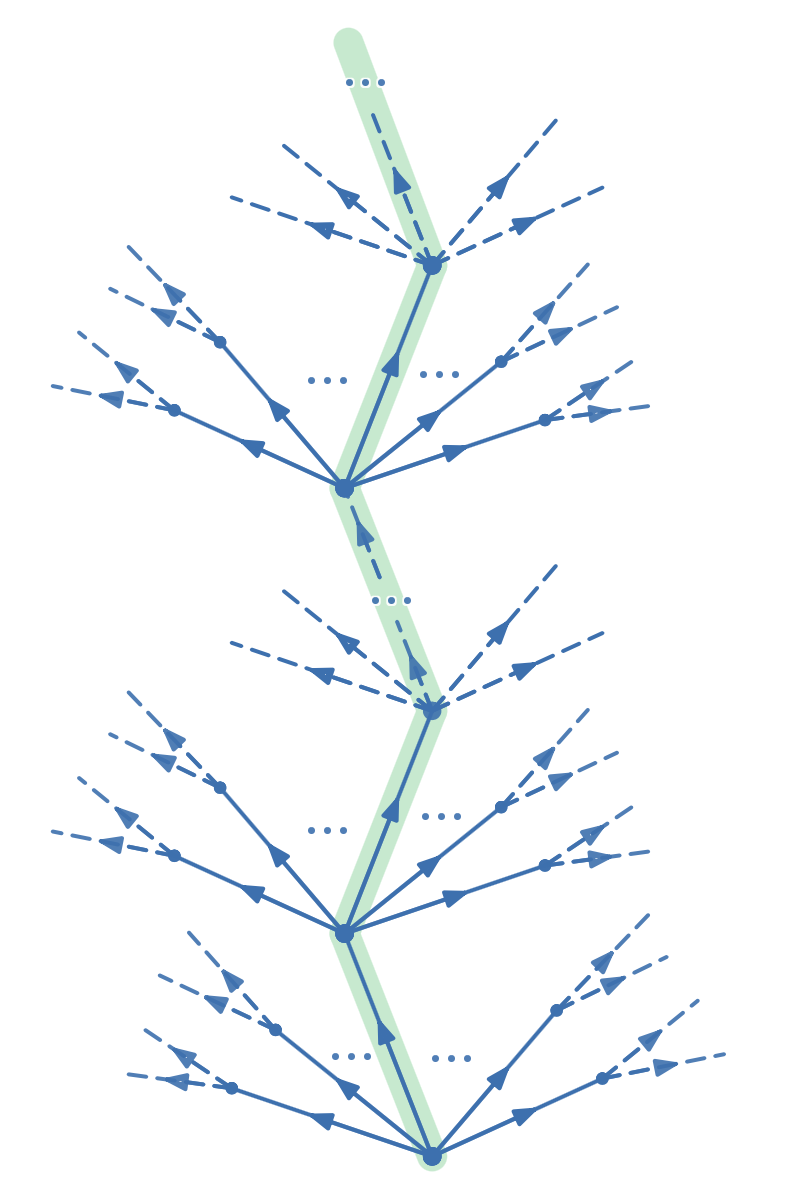
A branch (highlighted green) of a set-theoretic tree. Here dots represent elements, arrows represent the order relation, and ellipses and dashed arrows represent (possibly infinite) un-pictured elements and relationships.

In set theory, a tree is a partially ordered set such that for each , the set is well-ordered by the relation . Frequently trees are assumed to have only one root (i.e. minimal element), as the typical questions investigated in this field are easily reduced to questions about single-rooted trees.

Definition

[edit]
Small finite examples: The three partially ordered sets on the left are trees (in blue); one branch of one of the trees is highlighted (in green). The partially ordered set on the right (in red) is not a tree because x1 < x3 and x2 < x3, but x1 is not comparable to x2 (dashed orange line).

A tree is a partially ordered set (poset) such that for each , the set is well-ordered by the relation . In particular, each well-ordered set is a tree. For each , the order type of is called the height, rank,[1] or level[2] of . The height of itself is the least ordinal greater than the height of each element of . A root of a tree is an element of height 0. Frequently trees are assumed to have only one root.

Trees with a single root may be viewed as rooted trees in the sense of graph theory in one of two ways: either as a tree (graph theory) or as a trivially perfect graph. In the first case, the graph is the undirected Hasse diagram of the partially ordered set, and in the second case, the graph is simply the underlying (undirected) graph of the partially ordered set. However, if is a tree whose height is greater than the smallest infinite ordinal number , then the Hasse diagram definition does not work. For example, the partially ordered set does not have a Hasse Diagram, as there is no predecessor to . Hence a height of at most is required to define a graph-theoretic tree in this way.


A branch of a tree is a maximal chain in the tree (that is, any two elements of the branch are comparable, and any element of the tree not in the branch is incomparable with at least one element of the branch). The length of a branch is the ordinal that is order isomorphic to the branch. For each ordinal , the th level of is the set of all elements of of height . A tree is a -tree, for an ordinal number , if and only if it has height and every level has cardinality less than the cardinality of . The width of a tree is the supremum of the cardinalities of its levels.

Any single-rooted tree of height forms a meet-semilattice, where the meet (common predecessor) is given by the maximal element of the intersection of predecessors; this maximal element exists as the set of predecessors is non-empty and finite. Without a single root, the intersection of predecessors can be empty (two elements need not have common ancestors), for example where the elements are not comparable; while if there are infinitely many predecessors there need not be a maximal element. An example is the tree where are not comparable.

A subtree of a tree is a tree where and is downward closed under , i.e., if and then . The height of each element of a subtree equals its height in the whole tree.[1] This differs from the notion of subtrees in graph theory, which often have different roots than the whole tree.

Set-theoretic properties

[edit]

There are some fairly simply stated yet hard problems in infinite tree theory. Examples of this are the Kurepa conjecture and the Suslin conjecture. Both of these problems are known to be independent of Zermelo–Fraenkel set theory. By Kőnig's lemma, every -tree has an infinite branch. On the other hand, it is a theorem of ZFC that there are uncountable trees with no uncountable branches and no uncountable levels; such trees are known as Aronszajn trees. Given a cardinal number , a -Suslin tree is a tree of height which has no chains or antichains of size . In particular, if is a singular cardinal then there exists a -Aronszajn tree and a -Suslin tree. In fact, for any infinite cardinal , every -Suslin tree is a -Aronszajn tree (the converse does not hold). One of the equivalent ways to define a weakly compact cardinal is that it is an inaccessible cardinal that has the tree property, meaning that there is no -Aronszajn tree.[2]

The Suslin conjecture was originally stated as a question about certain total orderings but it is equivalent to the statement: Every tree of whose height is the first uncountable ordinal has an antichain of cardinality or a branch of length .

If is a tree, then the reflexive closure of is a prefix order on . The converse does not hold: for example, the usual order on the set of integers is a total and hence a prefix order, but is not a set-theoretic tree since e.g. the set has no least element.

Examples of infinite trees

[edit]
Set-theoretic tree of height and width . Each node corresponds to a junction point of a red and a green line. Due to space restrictions, only branches with a prefix (0,0,0,...) or (1,1,1,...) are shown in full length.
  • Let be an ordinal number, and let be a set. Let be set of all functions where . Define if the domain of is a proper subset of the domain of and the two functions agree on the domain of . Then is a set-theoretic tree. Its root is the unique function on the empty set, and its height is . The union of all functions along a branch yields a function from to , that is, a generalized sequence of members of . If is a limit ordinal, none of the branches has a maximal element ("leaf"). The picture shows an example for and .
  • Each tree data structure in computer science is a set-theoretic tree: for two nodes , define if is a proper descendant of . The notions of root, node height, and branch length coincide, while the notions of tree height differ by one.
  • Infinite trees considered in automata theory (see e.g. tree (automata theory)) are also set-theoretic trees, with a tree height of up to .
  • A graph-theoretic tree can be turned into a set-theoretic one by choosing a root node and defining if and lies on the (unique) undirected path from to .

See also

[edit]

Notes

[edit]

Further reading

[edit]
[edit]
Revisions and contributorsEdit on WikipediaRead on Wikipedia
from Grokipedia
In set theory, a tree is a partially ordered set (T, <) such that for every t ∈ T, the set {s ∈ T : s < t} is well-ordered by <.[] Trees are structured hierarchically by levels, where the height of an element t, denoted ht(t), is the order type of its predecessors, and the height of the tree ht(T) is the least ordinal strictly greater than all element heights; the α-th level Lev_α(T) consists of elements of height α, often with a root at level 0. Branches are maximal chains (linearly ordered subsets), while antichains are subsets of incomparable elements; key results include König's lemma, which guarantees an infinite branch in any tree of height ω with finite levels. Trees play a central role in combinatorial set theory, particularly in independence results via forcing; for instance, an Aronszajn tree of height ω₁ has countable levels but no branch of length ω₁, and such trees exist in ZFC. A Suslin tree, named after Mikhail Suslin, is a tree of height ω₁ with countable levels, no uncountable branch, and no uncountable antichain, whose existence is equivalent to the negation of Suslin's hypothesis (SH), which asserts that every c.c.c. dense linear order without endpoints is separable. The consistency of both SH and its negation was established using forcing techniques in the 1960s.

Foundations

Definition

In set theory, a tree is a partially ordered set (T,<)(T, <), where << is a strict partial order on the set TT, such that for every tTt \in T, the predecessor set {sTs<t}\{s \in T \mid s < t\} is well-ordered by the restriction of << to that set.[](https://spot.colorado.edu/ szendrei/STS21/lectrees.pdf)[](https://spot.colorado.edu/~szendrei/ST_S21/lec-trees.pdf) This definition captures the hierarchical structure inherent to trees, with the order << representing the predecessor-successor relation among elements. The well-ordering condition on predecessor sets ensures the absence of infinite descending chains below any element tt, since a well-ordering admits no infinite strictly decreasing sequences and every nonempty subset has a least element. This property is crucial for inductive definitions and transfinite constructions on trees, preventing pathological descending paths that would undermine the tree's acyclic, rooted nature.[](https://planetmath.org/treesettheoretic)[](https://planetmath.org/treesettheoretic) The relation << in the definition is a strict partial order, meaning it is irreflexive, transitive, and asymmetric.[](https://spot.colorado.edu/ szendrei/STS21/lectrees.pdf)[](https://spot.colorado.edu/~szendrei/ST_S21/lec-trees.pdf) In set-theoretic contexts, such orders can be realized using the membership relation \in restricted to a collection of sets forming the tree, or other extensional relations compatible with the axioms of set theory.[](https://www.math.toronto.edu/sunger/cmu/TreesTalk.pdf)[](https://www.math.toronto.edu/sunger/cmu/TreesTalk.pdf) A basic construction of trees identifies them with collections of finite sequences from a base set, ordered by proper initial segment inclusion: for sequences σ,τ\sigma, \tau, define σ<τ\sigma < \tau if σ\sigma is a proper initial segment of τ\tau.[](https://builds.openlogicproject.org/content/setsfunctionsrelations/relations/trees.pdf)[](https://builds.openlogicproject.org/content/sets-functions-relations/relations/trees.pdf) More generally, trees can be built as sets of functions with ordinal domains less than some height κ\kappa, taking values in a set of size λ\lambda, ordered by end-extension.[](https://www.math.toronto.edu/sunger/cmu/TreesTalk.pdf)[](https://www.math.toronto.edu/sunger/cmu/TreesTalk.pdf)

Terminology

In set-theoretic trees, the order relation is typically denoted by << for the strict partial order and \leq for the reflexive closure, where t<st < s means tt is a proper predecessor of ss in the tree, and the set of all predecessors of any element is well-ordered by this relation. Elements tt and ss are comparable if tst \leq s or sts \leq t, and incomparable otherwise; incomparable elements represent distinct branches diverging from a common predecessor. The elements of a tree TT are called nodes, with the unique minimal element (if it exists) serving as the root, from which all other nodes extend upward via the order. Immediate successors of a node tt are the minimal elements s>ts > t such that no uu satisfies t<u<st < u < s; a node is splitting if it has at least two distinct immediate successors. The tree refers to the ordinal type of the well-ordered set of predecessors below any node. A through a is a linearly ordered of nodes, often downward-closed from the ; branches are finite if they terminate at a maximal node without successors, or infinite if they extend indefinitely without bound. Levels partition the into sets of nodes at the same from the , denoted Tα={tTht(t)=α}T_\alpha = \{ t \in T \mid \mathrm{ht}(t) = \alpha \}, where ht(t)\mathrm{ht}(t) is the ordinal height of tt.

Properties

Ordering Properties

Trees in set theory are inherently well-founded partial orders, meaning that the strict order relation << admits no infinite descending chains, such as <t2<t1<t0\dots < t_2 < t_1 < t_0 for elements tiTt_i \in T. This well-foundedness follows directly from the requirement that, for each tTt \in T, the set of its predecessors {sT:s<t}\{s \in T : s < t\} is well-ordered by <<, ensuring that every nonempty subset of TT possesses a minimal element with respect to <<. Consequently, the structure prevents cycles or infinite regressions, providing a foundational rigidity that distinguishes trees from more general posets. The levels of a tree partition its elements according to the ordinal height of their predecessor chains. Specifically, the α\alpha-th level LαL_\alpha consists of all nodes tTt \in T such that the order type of the set {sT:s<t}\{s \in T : s < t\} is precisely the ordinal α\alpha. The height of the tree is then the least upper bound of {ot({s<t})+1:tT}\{\mathrm{ot}(\{s < t\}) + 1 : t \in T\}, where ot\mathrm{ot} denotes the order type, ensuring that levels are indexed by initial segments of ordinals up to the tree's height. This ordinal-based stratification reflects the well-ordered nature of predecessor sets, allowing trees to model transfinite progressions without ambiguity in vertical positioning. Within a tree, comparability is governed by the extension relation: two elements s,tTs, t \in T are comparable if and only if one properly extends the other, meaning s<ts < t or t<st < s, which occurs precisely when one is an initial segment in the predecessor of the other. Elements residing on the same level LαL_\alpha are necessarily incomparable, as any comparability would imply differing order types for their predecessor sets, violating the level's uniformity. Along any of predecessors leading to a node, however, the order is linear and well-ordered, reinforcing the tree's hierarchical in the vertical direction while permitting branching and incomparability horizontally across levels.

Cardinality Properties

In set theory, the height of a tree TT, denoted ht(T)\mathrm{ht}(T), is the least ordinal α\alpha such that the α\alpha-th level of TT is empty, where the levels are defined as Lβ={tTht(t)=β}L_\beta = \{ t \in T \mid \mathrm{ht}(t) = \beta \} for β<α\beta < \alpha, and the height ht(t)\mathrm{ht}(t) of an element tTt \in T is the order type of the well-ordered set of strict predecessors of tt under the tree ordering. This ordinal measures the longest possible well-ordered chain from the root to a leaf in TT, providing a quantitative bound on the tree's depth. The width of a tree TT is defined as the supremum of the cardinalities of its levels, i.e., sup{Lα:α<ht(T)}\sup \{ |L_\alpha| : \alpha < \mathrm{ht}(T) \}. Since each level LαL_\alpha forms an in TT, the width gives an upper bound on the size of certain antichains, and variants of König's lemma relate this width to the existence of long ; for instance, if the width is finite at each level of an -height tree, then TT has an infinite branch. More generally, for a cardinal κ\kappa, a κ\kappa- of width less than κ\kappa may or may not admit a cofinal branch, depending on whether κ\kappa satisfies the tree property. The of a tree TT satisfies Tht(T)×sup{Lα:α<ht(T)}|T| \leq |\mathrm{ht}(T)| \times \sup \{ |L_\alpha| : \alpha < \mathrm{ht}(T) \}, where ht(T)|\mathrm{ht}(T)| is the of the ordinal ht(T)\mathrm{ht}(T), as TT is the of its levels. Under the generalized (GCH), if ht(T)=κ\mathrm{ht}(T) = \kappa is regular and the supremum of level sizes is λ<κ\lambda < \kappa, then T=κ|T| = \kappa, since the cardinal arithmetic simplifies to κλ=κ\kappa \cdot \lambda = \kappa. Forcing techniques can preserve or alter these bounds, for example by adding branches without increasing height or width beyond certain cardinals. In certain models of ZFC, trees exhibit a Noetherian-like property where there are no uncountable chains and no uncountable antichains; such structures, known as Suslin trees, exist at height ω1\omega_1 with countable levels in models like V=LV = L, but their existence is independent of ZFC, as the Suslin hypothesis () asserts that no such trees exist. This property highlights how model-theoretic assumptions constrain the quantitative growth of chains and antichains in trees of uncountable height.

Examples

Finite Trees

Finite trees in set theory are partially ordered sets where the predecessors of each element form a finite well-ordered chain, ensuring a tree-like structure with finite depth. A basic example is the constructed as the set of all finite binary sequences, ordered by end-extension, where the empty sequence serves as the and each node branches to sequences appending 0 or 1. This representation aligns with the general definition of a tree as a poset (T,<)(T, <) such that for every tTt \in T, the set {sT:s<t}\{s \in T : s < t\} is well-ordered by <, restricted here to finite order types. More generally, a full nn-ary of kk consists of nodes represented as functions from ordinals α<k\alpha < k to {0,1,,n1}\{0, 1, \dots, n-1\}, ordered by end-extension, where the is the empty function and each level β<k\beta < k contains all functions of domain exactly β\beta. In this construction, the is finitely branching with exactly nn successors per node, and its is the finite ordinal kk, meaning the longest from to has kk. Such set-theoretic finite trees are isomorphic to rooted graph-theoretic trees, where nodes correspond to elements of the poset and edges connect immediate successors, with the root as the minimal element. For instance, in the binary tree of finite sequences, adjacency is defined by appending a single bit, mirroring the graph structure of a rooted binary tree. In a complete binary tree of height hh, the number of nodes is 2h12^h - 1, accounting for the root at level 0 and full branching up to level h1h-1. This enumeration highlights the finite size and computability of these structures, with the total cardinality being finite and explicitly calculable from the height.

Infinite Trees

In , an infinite tree is a whose , defined as the least ordinal greater than the order types of all its segments, is an infinite ordinal. Such trees extend the structure of finite trees by allowing unbounded chains and levels, often leading to intricate combinatorial phenomena. Infinite trees are typically studied for their branching behavior, where levels correspond to ordinals and elements at each level are incomparable under the tree order. A fundamental result concerning infinite trees of countable height is König's tree lemma, which asserts that any tree of height ω\omega in which every level is finite possesses an infinite branch—a maximal linearly ordered of order type ω\omega. This lemma highlights a contrast with higher cardinals, where infinite branches may not exist despite finite or small levels. For instance, at uncountable heights, the absence of long branches becomes a defining feature in certain constructions. Prominent examples of infinite trees include Aronszajn trees, which are trees of height ω1\omega_1 (the first uncountable ordinal) such that all levels are countable and no branch has length ω1\omega_1. The existence of an ω1\omega_1-Aronszajn tree follows from a construction using bounded increasing sequences of rational numbers, ensuring countability of levels while preventing branches of length ω1\omega_1. Another key example is the Suslin tree, an ω1\omega_1-tree with all levels countable, no uncountable branches, and no uncountable antichains (maximal incomparable subsets). The existence of Suslin trees is independent of ZFC and equivalent to the existence of a Suslin line—a linearly ordered set with the countable chain condition but no countable dense subset. More generally, a κ\kappa-tree is an infinite tree of height κ\kappa (a regular cardinal) with all levels of cardinality less than κ\kappa, and a κ\kappa-Aronszajn tree is one without branches of length κ\kappa. The tree property at κ\kappa holds if no κ\kappa-Aronszajn trees exist, a strong combinatorial principle satisfied by weakly compact cardinals but failing at 1\aleph_1 in ZFC due to the Aronszajn construction. Infinite trees also arise in descriptive set theory, such as the tree of finite binary sequences ordered by end-extension, which has height ω\omega and uncountably many infinite branches corresponding to the Cantor space. These structures underpin investigations into cardinal characteristics and forcing axioms; for example, the consistency of the tree property at 2\aleph_2 requires large cardinals like supercompacts. Infinite trees thus serve as tools to probe the boundaries of ZFC, revealing dependencies on axioms beyond the standard framework.
Add your contribution
Related Hubs
User Avatar
No comments yet.

