Hubbry Logo
Lambda pointLambda pointMain
Open search
Lambda point
Community hub
Lambda point
logo
8 pages, 0 posts
0 subscribers
Be the first to start a discussion here.
Contribute something
Lambda point
Lambda point
from Wikipedia
The plot of the specific heat capacity versus temperature.

The lambda point is the temperature at which normal fluid helium (helium I) makes the transition to superfluid state (helium II). At pressure of 1 atmosphere, the transition occurs at approximately 2.17 K. The lowest pressure at which He-I and He-II can coexist is the vapor−He-I−He-II triple point at 2.1768 K (−270.9732 °C) and 5.0418 kPa (0.049759 atm), which is the "saturated vapor pressure" at that temperature (pure helium gas in thermal equilibrium over the liquid surface, in a hermetic container).[1] The highest pressure at which He-I and He-II can coexist is the bcc−He-I−He-II triple point with a helium solid at 1.762 K (−271.388 °C), 29.725 atm (3,011.9 kPa).[2]

The point's name derives from the graph (pictured) that results from plotting the specific heat capacity as a function of temperature (for a given pressure in the above range, in the example shown, at 1 atmosphere), which resembles the Greek letter lambda . The specific heat capacity has a sharp peak as the temperature approaches the lambda point. The tip of the peak is so sharp that a critical exponent characterizing the divergence of the heat capacity can be measured precisely only in zero gravity, to provide a uniform density over a substantial volume of fluid. Hence, the heat capacity was measured within 2 nK below the transition in an experiment included in a Space Shuttle payload in 1992.[3]

Unsolved problem in physics
Explain the discrepancy between the experimental and theoretical determinations of the heat capacity critical exponent α for the superfluid transition in helium-4.[4]

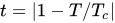
Although the heat capacity has a peak, it does not tend towards infinity (contrary to what the graph may suggest), but has finite limiting values when approaching the transition from above and below.[3] The behavior of the heat capacity near the peak is described by the formula where is the reduced temperature, is the Lambda point temperature, are constants (different above and below the transition temperature), and α is the critical exponent: .[3][5] Since this exponent is negative for the superfluid transition, specific heat remains finite.[6]

The quoted experimental value of α is in a significant disagreement[7][4] with the most precise theoretical determinations[8][9][10] coming from high temperature expansion techniques, Monte Carlo methods and the conformal bootstrap.

See also

[edit]

References

[edit]
[edit]
Revisions and contributorsEdit on WikipediaRead on Wikipedia
from Grokipedia
The lambda point is the temperature of 2.1768 K (approximately 2.17 K; at saturated vapor pressure) at which undergoes a from its normal phase, helium I, to the superfluid phase, helium II. This transition marks the onset of , where the exhibits zero viscosity, allowing it to flow without friction through exceedingly narrow channels and demonstrating other quantum mechanical behaviors such as the fountain effect and Rollin films that enable it to creep up container walls. The name "lambda point" derives from the distinctive lambda-shaped (Λ) anomaly in the plot of versus temperature near this critical point, reflecting a sharp peak in thermal properties without . The discovery of the lambda transition was reported independently in early 1938 by Soviet physicist at the Institute for Physical Problems in and by Canadian researchers John F. Allen and Donald Misener at the , building on earlier observations of anomalies in 's properties by and others since the liquefaction of in 1908. Below the lambda point, helium II displays , including the two-fluid model where the superfluid component carries no and the normal component behaves like a classical viscous fluid, with their proportions varying with temperature. This phase transition is pressure-dependent, occurring up to about 3.0 MPa (30 bar), beyond which the superfluid state is suppressed, and it serves as a prototypical example of in statistical physics, with divergences in correlation length and susceptibility analyzed through renormalization group theory. The lambda point has profound implications for low-temperature physics and cryogenics, enabling applications in dilution refrigerators for reaching millikelvin temperatures and in superconducting technologies, while its study continues to inform understandings of Bose-Einstein condensation and quantum turbulence in ultracold systems.

Definition and Characteristics

Phase Transition Overview

The lambda point is defined as the temperature Tλ2.1768T_\lambda \approx 2.1768 K at saturated vapor pressure, where liquid helium-4 transitions from the normal fluid phase, known as He I, to the superfluid phase, He II. This phase change marks the onset of superfluidity in helium-4, a phenomenon unique to this isotope due to its bosonic nature and identical integer spin of its atoms. The transition at the lambda point is a second-order phase transition, distinguished by the absence of and the presence of a discontinuity in the along with other second derivatives of the free energy. Unlike transitions, it involves no abrupt volume change but rather a continuous evolution of the order parameter associated with superfluid ordering. Liquid forms upon cooling gaseous helium below its normal of 4.2 K at , remaining in a state down to without solidifying under its own . This persistence as a stems from the quantum nature of helium-4, arising from the low of approximately 4 atomic mass units and the weak van der Waals interatomic interactions, which promote significant zero-point motion and prevent . Below the lambda point, the He II phase exhibits key characteristics including the complete loss of , enabling frictionless flow, and a dramatic increase in thermal conductivity, allowing efficient heat transport without thermal gradients in certain regimes. These properties emerge within the framework of the two-fluid model, which describes He II as a of an inviscid superfluid component carrying no and a normal viscous component composed of thermal excitations, with the superfluid fraction approaching unity as temperature decreases toward zero.

Thermodynamic Signatures

The specific heat at constant pressure, CpC_p, of liquid helium-4 exhibits a characteristic lambda-shaped curve when plotted against , featuring a sharp peak at the lambda Tλ2.17T_\lambda \approx 2.17 K at saturated vapor pressure. As the approaches TλT_\lambda from above, CpC_p diverges logarithmically, while below TλT_\lambda, it decreases abruptly, creating an apparent discontinuous jump at the transition despite the second-order nature of the phase change. This behavior is empirically described near TλT_\lambda by the relation CpAlnt+B,C_p \sim -A \ln |t| + B, where t=(TTλ)/Tλt = (T - T_\lambda)/T_\lambda is the reduced temperature, and A>0A > 0 and B>0B > 0 are amplitude constants fitted from experimental data. Additional thermodynamic signatures at the lambda point include anomalies in derived properties that signal the symmetry breaking without associated latent heat or volume change. The thermal expansion coefficient α\alpha displays a clear discontinuity at TλT_\lambda, reflecting a sudden change in the temperature dependence of the liquid's volume response. The isothermal compressibility κT\kappa_T shows a pronounced peak in the vicinity of the transition, indicating enhanced susceptibility to pressure changes due to critical softening. In contrast, the entropy SS remains continuous across TλT_\lambda, consistent with the absence of a first-order latent heat and emphasizing the transition's reliance on fluctuating degrees of freedom rather than macroscopic restructuring. These features collectively distinguish the lambda point as a locus of broken U(1) gauge symmetry in the superfluid phase. Unlike , which predicts a finite discontinuity (jump) in CpC_p at a second-order transition corresponding to a α=0\alpha = 0 with discontinuous behavior, the observed logarithmic divergence in yields an effective α0.013\alpha \approx -0.013 (nearly logarithmic), signaling stronger influences from long-range critical fluctuations that deviate from classical expectations.

Historical Context

Early Observations

The initial indications of unusual behavior in at low temperatures emerged in the 1920s from experiments conducted in the laboratory of at . While Onnes himself had liquefied in 1908 and explored its properties down to about 1.5 K, his group's observations revealed anomalies such as unexpectedly high thermal conductivity and the persistence of liquidity without solidification under below 3 K. These findings, however, were constrained by the technical limitations of early cryogenic apparatus, including inefficient cooling rates and difficulties in maintaining stable temperatures near the of 4.2 K. In 1927, Willem Keesom and Mieczyslaw Wolfke at observed an anomaly in the specific heat of near 2.2 , providing the first indication of a . This was followed in 1932 by sharper measurements from Keesom and Klaus Clusius, revealing a pronounced maximum resembling the Greek letter λ. Significant progress came in 1937–1938, when independent experiments identified the superfluid nature of the transition around 2.2 . In , observed a dramatic increase in the thermal conductivity of below this temperature, indicating a sudden enhancement in heat transport efficiency by orders of magnitude, which he attributed to a novel . Concurrently, at the , John F. Allen and Donald Misener reported superfluid flow of through narrow capillaries below the same threshold, demonstrating frictionless flow, a phenomenon they documented through careful measurements of flow rates. These discoveries highlighted the transition's impact on transport properties but lacked a unifying explanation at the time. The lambda-shaped anomaly in specific heat solidified the transition as a distinct thermodynamic event, bridging the earlier observations and distinguishing the high-temperature helium I phase from the low-temperature helium II phase. Throughout these early investigations, researchers faced substantial technical hurdles in probing temperatures below 2.2 K. Achieving and sustaining such cryogenic conditions required advanced cooling techniques, yet helium's low led to rapid boil-off, complicating long-duration experiments. Additionally, maintaining sample purity was critical, as even trace impurities could suppress the transition or introduce spurious effects, demanding rigorous and handling protocols that were rudimentary in the pre-1940s era.

Naming and Key Milestones

The term "lambda point" originated from the observations of Dutch physicist Hendrik Keesom and his collaborators at , who in 1932 identified a sharp maximum in the specific heat of liquid that visually resembled the Greek letter λ, marking the transition temperature T_λ at approximately 2.19 K. This nomenclature was formalized in the scientific literature during the 1940s, notably in Keesom's comprehensive monograph published in 1942, which synthesized early experimental data and established the lambda point as a key feature distinguishing helium I (above T_λ) from helium II (below T_λ). In the 1940s, significant milestones advanced the understanding of the lambda point's implications. developed the two-fluid model in 1941, proposing that helium II consists of interpenetrating normal and superfluid components, with the lambda transition representing the point where the superfluid fraction emerges, providing a phenomenological explanation for the He I/He II phase distinction. Concurrently, refinements in low-temperature yielded the first precise determination of T_λ at 2.19 K, based on Keesom's earlier measurements, though subsequent work would narrow it further to 2.1768 K. By the , the lambda point had gained recognition as an archetype for second-order phase transitions, influencing broader studies in and low-temperature physics. This period saw connections to foundational work honored later through Nobel Prizes, such as Pyotr Kapitza's 1978 award for discoveries in rooted in 1930s lambda point experiments, and Lev Landau's prize for his theoretical contributions to superfluid . These developments marked a shift in the field, transforming the lambda point from an empirical anomaly into a cornerstone of by the mid-20th century.

Theoretical Framework

Phenomenological Models

The phenomenological description of the lambda point in superfluid helium-4 begins with Lev Landau's two-fluid model, formulated in 1941, which treats the fluid below the lambda temperature TλT_\lambda as a superposition of two interpenetrating components: a normal fluid with density ρn\rho_n and velocity vn\mathbf{v}_n, and a superfluid component with density ρs\rho_s and velocity vs\mathbf{v}_s. The total mass density is conserved as ρ=ρn+ρs\rho = \rho_n + \rho_s, where the normal fluid carries all viscous and thermal effects, including the entire entropy SS, while the superfluid component is inviscid and entropy-free. Near TλT_\lambda, the superfluid density follows ρsρ(TλT)2β\rho_s \sim \rho (T_\lambda - T)^{2\beta} with β0.35\beta \approx 0.35, leading to ρn=ρρs\rho_n = \rho - \rho_s, reflecting the vanishing superfluid fraction as the temperature approaches TλT_\lambda from below. Landau's model incorporates phenomenological hydrodynamic equations to describe the dynamics, including and conservation: tρ+(ρv) =0\partial_t \rho + \nabla \cdot (\rho \mathbf{v})\ = 0 and ts+(svn)=0\partial_t s + \nabla \cdot (s \mathbf{v}_n) = 0, where s=S/ρs = S/\rho is the entropy per unit and v=(ρnvn+ρsvs)/ρ\mathbf{v} = (\rho_n \mathbf{v}_n + \rho_s \mathbf{v}_s)/\rho. The superfluid evolves according to an ideal Euler-like ρs(tvs+vsvs)=ρsμ\rho_s (\partial_t \mathbf{v}_s + \mathbf{v}_s \cdot \nabla \mathbf{v}_s) = -\rho_s \nabla \mu, with μ\mu, while the normal fluid follows a Navier-Stokes with . Counterflow, where vnvs\mathbf{v}_n \neq \mathbf{v}_s, is dissipationless in the ideal model but was later extended by phenomenological mutual terms, such as those introduced by Bekarevich and Khalatnikov in 1956, to account for energy dissipation via Fsn=αρsρn(vnvs)×(×(vnvs))\mathbf{F}_{sn} = -\alpha \rho_s \rho_n (\mathbf{v}_n - \mathbf{v}_s) \times (\nabla \times (\mathbf{v}_n - \mathbf{v}_s)), where α\alpha is a . These extensions capture observed dissipative effects in counterflow experiments. A complementary phenomenological approach is the adaptation of the Ginzburg-Landau framework to neutral superfluids, developed by Ginzburg and Pitaevskii in 1958, which introduces a complex scalar order parameter ψ\psi representing the macroscopic superfluid wavefunction, with ψ2=ρs/m|\psi|^2 = \rho_s / m (where mm is the helium atom mass). The Gibbs free energy density is given by f=αψ2+β2ψ4+22mψ2,f = \alpha |\psi|^2 + \frac{\beta}{2} |\psi|^4 + \frac{\hbar^2}{2m} |\nabla \psi|^2, where α=a(TTλ)\alpha = a (T - T_\lambda) with a>0a > 0, β>0\beta > 0, and higher-order gradient terms may be included for completeness. Minimizing this functional yields the equilibrium order parameter ψ2=α/β|\psi|^2 = -\alpha / \beta for T<TλT < T_\lambda, vanishing above TλT_\lambda, and the time-dependent Ginzburg-Pitaevskii equation governs nonequilibrium dynamics: itψ=22m2ψ+(α+βψ2)ψi \hbar \partial_t \psi = -\frac{\hbar^2}{2m} \nabla^2 \psi + (\alpha + \beta |\psi|^2) \psi. This framework links the lambda point to the spontaneous symmetry breaking of the U(1) phase invariance. In the mean-field approximation of the Ginzburg-Landau theory, the specific heat exhibits a discontinuity at TλT_\lambda, with the jump ΔCp=a2Tλβ\Delta C_p = \frac{a^2 T_\lambda}{\beta}, arising from the second derivative of the free energy with respect to temperature. This provides a quantitative prediction for the thermodynamic signature of the transition. However, the mean-field approach has notable limitations: it fails to capture the observed logarithmic divergence in the specific heat near TλT_\lambda, which stems from critical fluctuations beyond mean-field, necessitating renormalization group techniques to account for the three-dimensional XY universality class behavior. Additionally, the model overlooks logarithmic corrections to scaling near the upper critical dimension.

Microscopic Explanations

The lambda transition in liquid helium-4 arises from quantum mechanical many-body effects, where the system of bosonic ^4He atoms undergoes a to a superfluid state characterized by Bose-Einstein condensation (BEC), albeit modified by strong interatomic interactions. In the ideal non-interacting approximation, the critical temperature for BEC is given by Tc=h22πmkB(nζ(3/2))2/33.13K,T_c = \frac{h^2}{2\pi m k_B} \left( \frac{n}{\zeta(3/2)} \right)^{2/3} \approx 3.13 \, \mathrm{K}, where hh is Planck's constant, mm is the mass of a ^4He atom, kBk_B is Boltzmann's constant, nn is the atomic density, and ζ(3/2)2.612\zeta(3/2) \approx 2.612 is the value; however, repulsive interactions between atoms lower this temperature to the observed Tλ2.17KT_\lambda \approx 2.17 \, \mathrm{K} and transform the transition from a simple ideal-gas BEC into a more complex phenomenon involving collective excitations. Microscopic understanding of the superfluid and excitations has been advanced through path-integral formulations and (QMC) simulations, which treat the many-body wavefunction exactly within the path-integral representation of the partition function. A foundational variational for the ground-state wavefunction was proposed by Feynman in , using a product form ψ0=i<jf(rirj)\psi_0 = \prod_{i<j} f(|\mathbf{r}_i - \mathbf{r}_j|) incorporating pair correlation functions f(r)f(r) to capture short-range repulsion while allowing delocalization, which approximates the energy minimization for the interacting Bose system. Modern path-integral Monte Carlo methods, which sample the imaginary-time paths of atoms to compute thermodynamic properties, confirm the presence of off-diagonal long-range order (ODLRO) in the one-body density matrix below TλT_\lambda, manifesting as superfluid He II with a macroscopic eigenvalue in the density matrix eigenvalues, as originally defined by Penrose and Onsager. Strong short-range correlations due to the repulsive ^4He prevent the formation of an ideal BEC, instead resulting in a "Bose liquid" state where the superfluid component emerges from coherent many-body dynamics rather than a sharp condensate fraction jump. These interactions give rise to elementary excitations described by Landau's , with low-momentum phonons following ϵ(p)=cp\epsilon(p) = c p (where c238m/sc \approx 238 \, \mathrm{m/s} is the ) and higher-momentum rotons exhibiting a gapped minimum at Δ8.65K\Delta \approx 8.65 \, \mathrm{K}, reflecting the roton-like fluctuations in the correlated . The lambda transition belongs to the three-dimensional XY universality class, governed by the spontaneous breaking of U(1) phase symmetry associated with the complex scalar order parameter representing the macroscopic wavefunction of the superfluid component, leading to critical exponents such as ν0.6717\nu \approx 0.6717 and η0.0381\eta \approx 0.0381 that match lattice simulations of the XY model.

Experimental Aspects

Measurement Methods

Calorimetric methods are primary techniques for locating the lambda point through the measurement of specific heat capacity, which exhibits a characteristic lambda-shaped anomaly peaking sharply at Tλ2.1768T_\lambda \approx 2.1768 K at saturated vapor pressure. Adiabatic calorimetry involves thermally isolating a sample of liquid helium-4 in a sealed cell and applying discrete heat inputs while monitoring temperature changes with high-resolution thermometers, such as germanium resistance sensors calibrated against the International Temperature Scale of 1990 (ITS-90). This allows detection of the transition via the divergence in specific heat, with the peak position defining TλT_\lambda. Heat-pulse techniques complement this by delivering small, controlled thermal pulses to the sample and analyzing the transient temperature response to derive heat capacity, enabling dynamic resolution of the anomaly. These methods achieve temperature precision on the order of 10610^{-6} K when combined with stable cryogenic environments, such as those provided by dilution refrigerators for precise control near the transition, minimizing thermal gradients and external perturbations. Viscosity and film flow experiments provide alternative probes of the transition by exploiting the emergence of the zero-viscosity superfluid component below TλT_\lambda. In capillary tube setups, liquid helium is forced through narrow channels (diameters ~1–10 μm), and the flow rate is monitored as a function of temperature; above TλT_\lambda, viscous drag limits the flow, but below it, the superfluid fraction enables dissipationless transport, resulting in a marked increase in volume flow rate. Superfluid film creep experiments observe the spontaneous flow of thin helium films (~100 nm thick) along solid surfaces, such as over container edges or through slits; the creep velocity accelerates dramatically at TλT_\lambda, as the entire film becomes superfluid, allowing rates up to several cm/s without resistance. These techniques resolve the transition to within millikelvin accuracy and are particularly useful for verifying the two-fluid model's predictions on component separation. Modern spectroscopic tools, including neutron , elucidate the dynamics of the order parameter—the complex describing superfluid coherence—near TλT_\lambda. Inelastic neutron probes the excitation , revealing the evolution from phonons and rotons above the transition to a gapped below, with the cross-section reflecting order parameter fluctuations that diverge critically at TλT_\lambda. While nuclear magnetic resonance (NMR) is less for pure due to its spin-0 nucleus, it can monitor dilute 3He impurities as probes of local order parameter variations in mixtures. These methods provide microscopic insights into transition dynamics, complementing macroscopic thermodynamic measurements. The point also exhibits pressure dependence, with TλT_\lambda decreasing as pressure increases, quantified by dTλ/dp8.8dT_\lambda / dp \approx -8.8 mK/bar, necessitating pressure control in experiments to avoid broadening the transition. A key challenge in these measurements is minimizing error sources, particularly impurities that shift TλT_\lambda. The primary contaminant is 3He, which depresses the transition temperature at a rate of dTλ/dx1.45dT_\lambda / dx \approx -1.45 K per molar fraction of 3He, altering the peak position and width in specific heat scans. To achieve sub-millikelvin resolution, isotopic purity exceeding 99.99% (corresponding to 3He concentrations below ~100 ppm) is essential, typically ensured through cryogenic distillation or commercial high-purity sources verified by . Other errors, such as thermal leaks or gravitational effects on the meniscus in ground-based setups, are mitigated using microgravity environments or sealed cells.

Critical Behavior Studies

The lambda point in liquid helium-4 represents a quintessential example of a continuous phase transition in the three-dimensional XY universality class, where scaling laws govern the divergent behavior of thermodynamic quantities as the system approaches the critical temperature Tλ2.1768T_\lambda \approx 2.1768 K. Near this point, the correlation length ξ\xi diverges as ξtν\xi \sim |t|^{-\nu}, with reduced temperature t=(TTλ)/Tλt = (T - T_\lambda)/T_\lambda, leading to critical exponents that describe singularities in response functions. These exponents reflect the system's membership in the O(2) symmetry class, shared with phenomena like planar ferromagnets and certain liquid crystal transitions, ensuring that microscopic details are irrelevant far from criticality. Key critical exponents for the lambda transition have been determined through high-precision experiments and theoretical calculations. The specific heat exponent α\alpha characterizes the logarithmic divergence (or weak cusp) of the heat capacity, with experimental values yielding α0.013\alpha \approx -0.013, consistent with a nearly logarithmic singularity Clnt1/3C \sim |\ln |t||^{1/3} below TλT_\lambda. The correlation length exponent is ν0.671\nu \approx 0.671, dictating the scale over which fluctuations correlate. For the order parameter—the superfluid density ρs\rho_s, which vanishes as ρst2β\rho_s \sim |t|^{2\beta} below Tλ T_\lambda—the exponent is β0.347\beta \approx 0.347. These values arise from analyses of the 3D XY model, aligning experimental data from helium with theoretical predictions. Hyperscaling relations connect these exponents to the spatial dimension d=3d = 3, validating the treatment of the lambda point as a true critical point below the upper dc=4d_c = 4. Specifically, the relation 2α=dν2 - \alpha = d \nu holds, yielding 2(0.013)3×0.6712 - (-0.013) \approx 3 \times 0.671, which confirms the consistency of measured exponents and underscores the role of long-range fluctuations in three dimensions. This equality breaks down above dcd_c, where dominates, but its validity at the lambda point supports the framework for low-dimensional criticality. Renormalization group (RG) theory provides deep insights into the critical behavior, identifying the Wilson-Fisher fixed point as the governing infrared fixed point for the O(2) model in d=3d = 3. This fixed point emerges from an ϵ\epsilon-expansion around d=4ϵd = 4 - \epsilon, where ϵ=1\epsilon = 1 for three dimensions, capturing the crossover from Gaussian (mean-field) behavior at short scales to non-mean-field, interacting criticality at long scales. In , the superfluid transition maps onto this O(2)-symmetric ϕ4\phi^4 theory, with the fixed point explaining the non-classical exponents through resummation of perturbative series and the irrelevance of higher-order operators below dcd_c. The approach resolves discrepancies between naive and experiments by incorporating anomalous dimensions and scaling operators. Finite-size effects become prominent when is confined to geometries smaller than the correlation , such as thin or pores, leading to a rounding of the sharp lambda transition into a smoother crossover. In confined , the effective transition shifts, and the specific peak broadens as ΔTLθ\Delta T \sim L^{-\theta}, where LL is the confinement and θ=1/ν1.49\theta = 1/\nu \approx 1.49, due to the finite system's inability to accommodate infinite-range correlations. Experiments on of thickness 57 μ\mum demonstrate this rounding, with data collapsing onto universal finite-size scaling functions when plotted against tL1/νt L^{1/\nu}. is further confirmed by analogous studies in other XY-class systems, such as smectic-A liquid crystals in thin , where critical exponents match those of bulk , validating the shared O(2) fixed point across disparate materials. High-precision measurements in microgravity environments, such as those conducted on the , have refined these exponents by minimizing gravitational rounding effects that plague Earth-based experiments. Zero-gravity specific heat data near TλT_\lambda achieve sub-nanokelvin resolution, yielding α=0.0127±0.0003\alpha = -0.0127 \pm 0.0003, which resolves prior discrepancies between ground-based values and RG predictions by eliminating density gradients. These results, from missions like the Lambda Point Experiment, affirm hyperscaling and the Wilson-Fisher description.

Role in Superfluidity

Below the lambda point Tλ2.17T_\lambda \approx 2.17 K, liquid undergoes a to a superfluid state characterized by the emergence of remarkable properties, including vanishing (η0\eta \to 0) that allows frictionless flow through narrow channels. This manifests as the ability of helium II to exhibit persistent currents without , a first demonstrated through measurements of flow rates far exceeding those predicted by classical . Key signatures include quantized vortices, where the circulation κ\kappa around a vortex core is quantized in units of h/mh/m (with hh Planck's constant and mm the mass of a helium-4 atom), arising from the wave-like nature of the superfluid order parameter. Additionally, the thermo-mechanical fountain effect drives superfluid flow from colder to warmer regions against a pressure gradient, as heat input creates an osmotic-like pressure difference due to the entropy carried solely by the normal component. The two-fluid hydrodynamics model, introduced by in 1938 and refined by Landau, describes helium II below TλT_\lambda as a mixture of superfluid (ρs\rho_s) and normal (ρn\rho_n) components with total density ρ=ρs+ρn\rho = \rho_s + \rho_n, where the total velocity is given by v=(ρs/ρ)vs+(ρn/ρ)vn\mathbf{v} = (\rho_s / \rho) \mathbf{v}_s + (\rho_n / \rho) \mathbf{v}_n. The superfluid component (vs\mathbf{v}_s) flows without or , while the normal component (vn\mathbf{v}_n) carries all and behaves viscously. This framework explains applications such as Rollin films, where thin superfluid layers creep along surfaces with zero critical , enabling transfer over container walls. It also predicts , propagating temperature waves where vn=vs\mathbf{v}_n = -\mathbf{v}_s and oscillates without mass flow, with speed vanishing at TλT_\lambda. Quantized phenomena further highlight the lambda point's role, as the coherence length ξ\xi diverges at TλT_\lambda, setting the scale for vortex core sizes and interactions. Vortex lattices form in rotating superfluid helium, with individual quanta of circulation visualized using interferometry techniques that track solid hydrogen tracers along vortex lines. The critical velocity vc/(mξ)v_c \sim \hbar / (m \xi) marks the onset of dissipation, where flow exceeds the superfluid's healing capacity, leading to vortex nucleation and proliferation near TλT_\lambda. The lambda point serves as a canonical textbook example of a quantum in bulk matter, illustrating how macroscopic quantum coherence emerges in a strongly interacting bosonic system without long-range order breaking in the classical sense.

Broader Applications

Research on the lambda point has extended beyond helium superfluidity to practical applications in cryogenic , where superfluid helium (He II) is employed for efficient cooling of superconducting magnets due to its exceptionally high thermal conductivity. In large-scale particle accelerators like the (LHC), He II at approximately 1.9 K is used to cool niobium-titanium magnets, enabling operation below the lambda point to enhance superconducting performance and stability. This leverages the counterflow mechanism in He II, which provides an effective thermal conductivity on the order of 10510^5 W/m·K near the lambda , far surpassing that of conventional conductors like copper at cryogenic temperatures. Similar principles apply in , where advanced superconducting magnets for MRI systems benefit from He II cooling in specialized cryostats to achieve higher fields and reduced boil-off, though standard systems operate at 4.2 K with normal . In quantum technologies, the lambda transition serves as a foundational analog for phenomena in Bose-Einstein condensates (BECs) formed in ultracold atomic gases, where the onset of mirrors the macroscopic quantum coherence observed in . Theoretical models of the lambda point, guided by ideal condensation, have informed simulations of BEC dynamics, aiding the design of quantum simulators for complex many-body systems. Additionally, at the lambda point provides insights into astrophysical contexts, such as interiors, where paired neutron exhibits analogous frictionless flow and phase transitions under extreme densities, helping model glitches and cooling rates. The study of at the lambda point has influenced , particularly in understanding high-temperature (TcT_c) superconductors, where the transition belongs to the 3D XY universality class shared with type-II superconductors. This analogy has guided investigations into vortex dynamics and phase coherence in cuprate materials, informing strategies to suppress fluctuations and elevate critical temperatures. Similarly, lambda point research on divergent susceptibilities and scaling behaviors has parallels in quantum criticality of heavy fermion systems, where suppressed Kondo screening near antiferromagnetic transitions leads to non-Fermi liquid , analogous to the jump at TλT_\lambda. Microgravity experiments, such as the Lambda Point Experiment on missions, have provided high-resolution data on specific heat near the lambda point, minimizing gravitational rounding effects and enabling precise tests of theories for the 3D XY model. Recent theoretical analyses as of 2020, including methods, have highlighted small discrepancies between these experimental and predictions, suggesting avenues for further refinement. Furthermore, persistent currents in near the lambda point enable quantum sensors, such as superfluid helium quantum interference devices (SHeQUIDs), which detect rotations via Sagnac phase shifts with sensitivities rivaling atomic clocks, and as of 2025, proposals exist for using superfluid helium gyrometers to measure gravitational effects.

References

Add your contribution
Related Hubs
Contribute something
User Avatar
No comments yet.
