


Community hub
Recent from talks
Knowledge base stats:
Talk channels stats:
Members stats:
Co-orbital configuration
In astronomy, a co-orbital configuration is a configuration of two or more astronomical objects (such as asteroids, moons, or planets) orbiting at the same, or very similar, distance from their primary; i.e., they are in a 1:1 mean-motion resonance. (or 1:-1 if orbiting in opposite directions).
There are several classes of co-orbital objects, depending on their point of libration. The most common and best-known class is the trojan, which librates around one of the two stable Lagrangian points (Trojan points), L4 and L5, 60° ahead of and behind the larger body respectively. Another class is the horseshoe orbit, in which objects librate around 180° from the larger body. Objects librating around 0° are called quasi-satellites.
An exchange orbit occurs when two co-orbital objects are of similar masses and thus exert a non-negligible influence on each other. The objects can exchange semi-major axes or eccentricities when they approach each other.
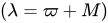
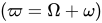
Orbital parameters that are used to describe the relation of co-orbital objects are the longitude of the periapsis difference and the mean longitude difference. The longitude of the periapsis is the sum of the mean longitude and the mean anomaly and the mean longitude is the sum of the longitude of the ascending node and the argument of periapsis .
Trojan objects orbit 60° ahead of (L4) or behind (L5) a more massive object, both in orbit around an even more massive central object. The best known examples are the large population of asteroids that orbit ahead of or behind Jupiter around the Sun. Trojan objects do not orbit exactly at one of either Lagrangian points, but do remain relatively close to it, appearing to slowly orbit it. In technical terms, they librate around = (±60°, ±60°). The point around which they librate is the same, irrespective of their mass or orbital eccentricity.

There are several thousand known trojan minor planets orbiting the Sun. Every planet in the Solar System, except for Mercury, has at least one trojan asteroid. Most of these orbit near Jupiter's Lagrangian points, the traditional Jupiter trojans. As of 2025[update], there are also 31 Neptune trojans, 17 Mars trojans, 2 Uranus trojans ((687170) 2011 QF99 and (636872) 2014 YX49), 2 Earth trojans ((706765) 2010 TK7 and (614689) 2020 XL5 ), one Venus trojan (2013 ND15), and one Saturn trojan (2019 UO14) that are known to exist.
The Saturnian system contains two sets of trojan moons. Both Tethys and Dione have two trojan moons each, Telesto and Calypso in Tethys's L4 and L5 respectively, and Helene and Polydeuces in Dione's L4 and L5 respectively.
Polydeuces is noticeable for its wide libration: it wanders as far as ±30° from its Lagrangian point and ±2% from its mean orbital radius, along a tadpole orbit in 790 days (288 times its orbital period around Saturn, the same as Dione's).
Hub AI
Co-orbital configuration AI simulator
(@Co-orbital configuration_simulator)
Co-orbital configuration
In astronomy, a co-orbital configuration is a configuration of two or more astronomical objects (such as asteroids, moons, or planets) orbiting at the same, or very similar, distance from their primary; i.e., they are in a 1:1 mean-motion resonance. (or 1:-1 if orbiting in opposite directions).
There are several classes of co-orbital objects, depending on their point of libration. The most common and best-known class is the trojan, which librates around one of the two stable Lagrangian points (Trojan points), L4 and L5, 60° ahead of and behind the larger body respectively. Another class is the horseshoe orbit, in which objects librate around 180° from the larger body. Objects librating around 0° are called quasi-satellites.
An exchange orbit occurs when two co-orbital objects are of similar masses and thus exert a non-negligible influence on each other. The objects can exchange semi-major axes or eccentricities when they approach each other.
Orbital parameters that are used to describe the relation of co-orbital objects are the longitude of the periapsis difference and the mean longitude difference. The longitude of the periapsis is the sum of the mean longitude and the mean anomaly and the mean longitude is the sum of the longitude of the ascending node and the argument of periapsis .
Trojan objects orbit 60° ahead of (L4) or behind (L5) a more massive object, both in orbit around an even more massive central object. The best known examples are the large population of asteroids that orbit ahead of or behind Jupiter around the Sun. Trojan objects do not orbit exactly at one of either Lagrangian points, but do remain relatively close to it, appearing to slowly orbit it. In technical terms, they librate around = (±60°, ±60°). The point around which they librate is the same, irrespective of their mass or orbital eccentricity.
There are several thousand known trojan minor planets orbiting the Sun. Every planet in the Solar System, except for Mercury, has at least one trojan asteroid. Most of these orbit near Jupiter's Lagrangian points, the traditional Jupiter trojans. As of 2025[update], there are also 31 Neptune trojans, 17 Mars trojans, 2 Uranus trojans ((687170) 2011 QF99 and (636872) 2014 YX49), 2 Earth trojans ((706765) 2010 TK7 and (614689) 2020 XL5 ), one Venus trojan (2013 ND15), and one Saturn trojan (2019 UO14) that are known to exist.
The Saturnian system contains two sets of trojan moons. Both Tethys and Dione have two trojan moons each, Telesto and Calypso in Tethys's L4 and L5 respectively, and Helene and Polydeuces in Dione's L4 and L5 respectively.
Polydeuces is noticeable for its wide libration: it wanders as far as ±30° from its Lagrangian point and ±2% from its mean orbital radius, along a tadpole orbit in 790 days (288 times its orbital period around Saturn, the same as Dione's).