


Community hub
Recent from talks
Contribute something
Nothing was collected or created yet.
Polydeuces (moon)
View on Wikipedia
 Polydeuces imaged approximately 73,000 km (45,000 mi) away from the Cassini spacecraft on 22 May 2006 | |
| Discovery[1][2] | |
|---|---|
| Discovered by | Cassini Imaging Science Team[a] |
| Discovery date | 21 October 2004 (date of discovery images)[4]: 223 |
| Designations | |
Designation | Saturn XXXIV |
| Pronunciation | /ˌpɒlɪˈdjuːsiːz/[5] |
Named after | Πολυδεύκης Polydeykēs |
| S/2004 S 5 | |
| Adjectives | Polydeucean /ˌpɒlɪdjuːˈsiːən/[6] Polydeucian /ˌpɒlɪˈdjuːsiən/[7] |
| Orbital characteristics [8][9]: 9 | |
| Epoch 1 January 2000 12:00 UT (JD 2451545.0) | |
| Earliest precovery date | 2 April 2004[10]: 695, 702 [11]: 261 |
| 377600 km | |
| Eccentricity | 0.019 |
| 2.736916 d[8] | |
Average orbital speed | 10.03 km/s[12]: 2 |
| Inclination | 0.2°[b] |
| Satellite of | Saturn |
| Group | L5 Dione trojan |
| Physical characteristics | |
| Dimensions | 3.50 × 3.10 × 2.62 km (± 0.40 × 0.40 × 0.40 km)[13]: 7 |
| 3.06±0.40 km[13]: 7 | |
| Volume | 15 km3[c] |
| Mass | ≈ 8×10¹² kg (assumed; unmeasured)[d] |
Mean density | ≈ 0.5 g/cm3 (assumed; unmeasured)[14][15]: 3 [12]: 2 |
| ≈ 0.0002 m/s2 at longest axis to ≈ 0.0003 m/s2 at poles[e] | |
| ≈ 0.0008 km/s at longest axis to ≈ 0.0009 km/s at poles[f] | |
| assumed synchronous[12]: 4 | |
Polydeuces /ˌpɒlɪˈdjuːsiːz/, also designated Saturn XXXIV, is a small trojan moon of Saturn occupying the trailing L5 Lagrange point of Dione. It was discovered by the Cassini Imaging Science Team in images taken by the Cassini space probe on 21 October 2004. With a mean diameter of about 3 km (1.9 mi), Polydeuces is thought to have a smooth surface coated with fine, icy particles accumulated from the cryovolcanic plumes of Enceladus. In its orbit around Saturn, Polydeuces periodically drifts away from Dione's Lagrange point due to gravitational perturbations by other nearby moons of Saturn. Of the four known trojan moons of Saturn, Polydeuces exhibits the largest displacement from its Lagrange point.
Discovery
[edit]
Polydeuces was discovered by the Cassini Imaging Science Team[a] on 24 October 2004 while routinely investigating images taken by the Cassini space probe earlier on 21 October 2004.[4]: 223 The images were visually inspected through the blink comparison technique, which revealed any potential moons that moved relative to the background stars. The discovery images consisted of four frames taken with Cassini's wide-angle camera over less than six minutes, which showed Polydeuces moving 3–6 pixels per frame.[g][4]: 223 The observed motion of Polydeuces immediately suggested that it could be orbiting Saturn at the distance of one of the large moons, Dione, possibly sharing its orbit in a co-orbital configuration.[4]: 223
By 4 November 2004, the Cassini Imaging Science Team obtained more Cassini images of Polydeuces, including two frames taken on 2 November 2004 and another two predating the discovery images by three hours.[4]: 223–226 Preliminary orbit determinations using these images confirmed that Polydeuces was a co-orbital trojan moon residing around Dione's L5 Lagrange point.[4]: 226 With the aid of ephemeris predictions from Polydeuces's newly determined orbit, the Cassini Imaging Science Team was able to identify 52 pre-discovery detections of Polydeuces in Cassini's narrow-angle camera images taken between 9 April 2004 and 9 May 2004.[4]: 226 The International Astronomical Union (IAU) announced the discovery of Polydeuces on 8 November 2004.[16] Besides Polydeuces, Cassini has discovered five other objects orbiting Saturn in 2004: Methone, Pallene, S/2004 S 3, S/2004 S 4, and S/2004 S 6.[17]: 1226–1227
After the discovery announcement, Cassini was retasked to begin targeted observations of Polydeuces in January 2005 to better determine its orbit.[4]: 226 In 2006, researchers found even earlier Cassini pre-discovery images of Polydeuces taken on 2 April 2004.[10]: 695, 702
Name
[edit]The name Polydeuces was approved and announced by the IAU Working Group on Planetary System Nomenclature on 21 January 2005.[18] In Greek mythology, Polydeuces is another name for Pollux, who is the twin brother of Castor and the son of Zeus and Leda.[2] Polydeuces is also known by its official Roman numeral designation Saturn XXXIV (34th moon of Saturn discovered) and was previously known by its provisional designation S/2004 S 5, which was given by the IAU when it announced the moon's discovery.[16][18]
Orbit
[edit]

Polydeuces · Helene · Dione · Saturn
Polydeuces is an inner moon of Saturn in a co-orbital configuration with Dione, meaning they share the same orbit.[11]: 261 [19]: 2 Together with Dione and its other co-orbital companion Helene, Polydeuces orbits Saturn in 2.74 days at an average distance of 377,600 km (234,600 mi) from the planet's center, between the orbits of Tethys and Rhea.[8] Due to gravitational perturbations by other nearby moons of Saturn, Polydeuces's orbital radius can vary by ±7,660 km (4,760 mi) over time.[4]: 232 Its orbit is closely aligned with Saturn's equatorial plane with a low orbital inclination of 0.2°.[b]
Polydeuces has a slightly elliptical orbit with an eccentricity of 0.019, which is unusually higher than Dione's eccentricity of 0.002. While Dione's eccentricity is known to result from its 1:2 mean-motion orbital resonance with Enceladus, the effects of this resonance are too weak to explain Polydeuces's relatively high eccentricity.[4]: 233 One possible explanation is that Polydeuces always had an eccentric orbit since its formation because its orbit did not change much over billions of years.[4]: 233
Polydeuces resides around Dione's L5 Lagrange point trailing 60° behind Dione in its orbit, which makes Polydeuces a trojan moon of Dione. The Lagrange points are locations where the gravitational pulls of Dione and Saturn balance out, allowing for stable co-orbital configurations in Dione's trojans.[20] Dione's other co-orbital moon, Helene, is a trojan residing around the L4 Lagrange point leading 60° ahead of Dione. Trojan moons are not unique to Dione; another large moon of Saturn, Tethys, also has two trojans, named Telesto and Calypso, which reside in its L4 and L5 Lagrange points, respectively.[4]
Because of perturbations by other moons of Saturn, Polydeuces does not stay exactly 60° behind Dione; its angular distance from Dione oscillates or librates over time.[4]: 231 Of Saturn's four known trojan moons, Polydeuces librates the farthest from its Lagrange point: its angular distance behind Dione oscillates from 33.9° to 91.4° with a period of 790.931 days (2.17 years).[10]: 702 [h] In a rotating reference frame with respect to Dione's orbit, Polydeuces appears to travel in a looping path around Dione's L5 point due to its varying relative speed and radial distance from Saturn in its perturbed eccentric orbit.[4]: 231–232 Polydeuces's apparent looping motion combined with its librating angular distance from Dione forms a tadpole orbit about Dione's L5 point.[4]: 231
Origin
[edit]Polydeuces is thought to have formed by accreting out of leftover debris trapped in Dione's L5 Lagrange point, in a similar process experienced by Saturn's other trojan moons. This process likely took place at an intermediate stage of the formation of Saturn's moons, when Tethys and Dione have not finished forming and gases have become depleted in Saturn's circumplanetary disk.[21]: 2133 [12]: 4 Mean-motion orbital resonances by other nearby moons did not appear to play a significant role in the formation of the trojan moons.[21]: 2139
Dynamical modeling of the trojan moons' formation suggests that Tethys's and Dione's L4 and L5 Lagrange points should have started with similar amounts of material for trojan moons to form with roughly similar sizes.[21]: 2136 However, this is not the case for Dione's trojans, Helene and Polydeuces, whose masses significantly differ by more than an order of magnitude. As of yet, this mass asymmetry in Dione's L4 and L5 trojans remains unexplained.[21]: 2139
Physical characteristics
[edit]As of 2020[update], the most recent estimate for Polydeuces's dimensions is 3.50 km × 3.10 km × 2.62 km (2.17 mi × 1.93 mi × 1.63 mi), based on resolved Cassini imagery of the moon from 2015.[13]: 7, 30 These dimensions correspond to a volume-equivalent mean diameter of 3.06 km (1.90 mi) for Polydeuces.[13]: 7 Cassini's highest-resolution images of Polydeuces from 2015 show that it has an elongated shape, with a relatively smooth limb deviating from a simple ellipsoid.[13]: 30 Polydeuces presumably rotates synchronously with its orbital period, similar to the rest of Saturn's trojan moons.[12]: 4
Little is known about Polydeuces's other physical properties because it was never approached up close by Cassini or any other space mission to Saturn.[19]: 3 Because of its very small size, Polydeuces's gravitational perturbations on the trajectory of Cassini spacecraft and other Saturnian moons are negligible, which prevents the measurement of the moon's mass and density.[9]: 5 In spite of this, researchers assume that Polydeuces has a density 0.5 g/cm3, like the other small inner moons of Saturn.[14][15]: 3 [12]: 2 [19]: 2


Polydeuces's small size makes it prone to disruption by impact events. Depending on the size-frequency of impactors in the Saturnian system, Polydeuces is predicted to have suffered at least one disruptive impact in the last one billion years.[12]: 11 This implies that Polydeuces is either very young with an age of less than one billion years, or it is a primordial moon that has consistently reaccreted from each disruptive impact over the Saturnian system's 4.5 billion-year lifespan.[12]: 13
Polydeuces has a bright and likely smooth surface due to the accumulation of fine water ice particles from the surrounding E Ring, which is generated by the cryovolcanic plumes of Enceladus.[22][12]: 11 Because of its small size, any craters on Polydeuces would be completely buried in E Ring material, giving it a craterless appearance resembling Methone or Pallene.[22][12]: 11 Its geometric albedo is unknown since it has never been observed at low phase angles.[13]: 10, 30 Cassini imagery shows that Polydeuces has a uniform surface brightness across its leading and trailing hemispheres.[13]: 23 Its surface is about as bright as Dione's but darker than Helene's.[13]: 23 The trojan moons of Tethys exhibit a similar difference in surface brightness, where Calypso is brighter than Telesto and Tethys.[13]: 23 The reason for these brightness asymmetries in the trojan moons of Dione and Tethys remains unknown; possible explanations include an asymmetric distribution of E Ring particles or recent impacts that brightened Helene and Calypso.[13]: 27–28
Exploration
[edit]Cassini is the only space mission to Saturn that has made targeted observations of Polydeuces.[4] Over the 13-year span of Cassini's mission in orbit around Saturn, the spacecraft has made 22 close approaches within 130,000 km (81,000 mi) of Polydeuces.[23] Cassini's closest encounter with Polydeuces took place on 17 February 2005, when it passed 6,446.7 km (4,005.8 mi) from Polydeuces while moving outbound from periapse.[23] However, Cassini did not take any images of Polydeuces on that date.[24] The only encounters where Cassini has taken resolved images of Polydeuces were on 22 May 2006, 10 May 2015, and 16 June 2015, at closest approach distances of 64,089.9 km (39,823.6 mi), 33,997.8 km (21,125.3 mi), and 34,794.3 km (21,620.2 mi), respectively.[23][13]: 31 [i] Cassini's two close encounters in 2015 provided the first images where Polydeuces was larger than 10 pixels across.[13]: 30
See also
[edit]- Telesto and Calypso, trojan moons of Tethys at its L4 and L5 Lagrange points, respectively
- Janus and Epimetheus, two inner moons of Saturn in a co-orbital exchange orbit with each other
Notes
[edit]- ^ a b Members of the Cassini Imaging Science Team include (in alphabetical surname order): Andre Brahic, Joe Burns, Tony DelGenio, Luke Dones, Andy Ingersoll, Torrence Johnson, Alfred McEwen, Carl D. Murray, Gerhard Neukum, Carolyn Porco, Steve Squyres, Peter Thomas, Joe Veverka, and Bob West.[3]
- ^ a b The mean orbital inclination is given with respect to the Polydeuces's local Laplace plane.[8][9]: 9 Conincidentally, the Laplace plane inclination value is close to the mean orbital inclination with respect to Saturn's equator, given as 0.1774° in Spitale et al. (2006), Table 6.[10]: 695, 698
- ^ Volume calculated from Polydeuces's volume-equivalent sphere radius of 1.53±0.20 km given by Hedman et al. (2020).[13]: 7
- ^ Mass calculated by multiplying Polydeuces's volume with its assumed density of 500 kg/m3 according to the formula .
- ^ Surface gravity g is calculated from the formula , where G is the gravitational constant, M is the body's mass, and r is the body's radius (or semi-axis if nonspherical). For Polydeuces, its mass is approximately 8×10¹² kg for an assumed density of 500 kg/m3. For Polydeuces's longest semi-axis of 1.75 km,[13]: 7 the surface gravity would be about 0.0002 m/s2, while for Polydeuces's shortest (polar) semi-axis of 1.31 km, the surface gravity would be about 0.0003 m/s2.
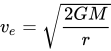
- ^ Escape velocity ve is calculated from the formula , where G is the gravitational constant, M is the body's mass, and r is the body's radius (or semi-axis if nonspherical). For Polydeuces, its mass is approximately 8×10¹² kg for an assumed density of 500 kg/m3. For Polydeuces's longest semi-axis of 1.75 km,[13]: 7 the escape velocity would be about 0.0008 km/s, while for Polydeuces's shortest (polar) semi-axis of 1.31 km, the escape velocity would be about 0.0009 km/s.
- ^ The discovery announcement of Polydeuces in IAUC 8432 mistakenly reports that it was discovered in narrow-angle Cassini images on 21 October 2004.[16] All Cassini images containing Polydeuces on 21 October 2004 were taken with the wide-angle camera, as reported in Murray et al. (2005), Table 1[4]: 224–225 and shown in NASA's Outer Planets Unified Search tool for archived Cassini data.
- ^ The angular distance minimum and maximum are calculated by adding –60° (negative because L5 is behind Dione) to Polydeuces's libration amplitudes of –31.41° and +26.06° given by Spitale et al. (2006)[10]: 702
- ^ Hedman et al. (2020) list all resolved Cassini observations of Polydeuces in Table 7, but they only give the image IDs of these observations.[13]: 31 Inputting these image IDs into NASA's Outer Planets Unified Search query form shows the date on which these images were taken.


References
[edit]- ^ "Planetary Satellite Discovery Circumstances". Jet Propulsion Laboratory. 23 May 2023. Archived from the original on 27 September 2021. Retrieved 5 June 2023.
- ^ a b "Planet and Satellite Names and Discoverers". Gazetteer of Planetary Nomenclature. USGS Astrogeology Science Center. Archived from the original on 21 August 2014. Retrieved 5 June 2023.
- ^ "Cassini Imaging Science Team". Cassini Imaging Central Laboratory for Operations. NASA. Archived from the original on 5 July 2022. Retrieved 13 June 2023.
- ^ a b c d e f g h i j k l m n o p q Murray, C. D.; Cooper, N. J.; Evans, M. W.; Beurle, K. (December 2005). "S/2004 S 5: A new co-orbital companion for Dione". Icarus. 179 (1): 222–234. Bibcode:2005Icar..179..222M. doi:10.1016/j.icarus.2005.06.009. S2CID 120102820.
- ^ "Polydeuces". Lexico UK English Dictionary. Oxford University Press. Archived from the original on 24 October 2021.
- ^ Lundström (1997) Eranos, v. 95
- ^ Levin (1971) Apollonius' Argonautica, v. 1, p. 139
- ^ a b c d "Planetary Satellite Mean Orbital Parameters". Jet Propulsion Laboratory. Archived from the original on 6 October 2021. Retrieved 5 June 2023.
- ^ a b c Jacobson, Robert A. (November 2022). "The Orbits of the Main Saturnian Satellites, the Saturnian System Gravity Field, and the Orientation of Saturn's Pole". The Astronomical Journal. 164 (5): 19. Bibcode:2022AJ....164..199J. doi:10.3847/1538-3881/ac90c9. S2CID 252992162. 199.
- ^ a b c d e Spitale, J. N.; Jacobson, R. A.; Porco, C. C.; Owen, W. M. Jr. (August 2006). "The orbits of Saturn's small satellites derived from combined historic and Cassini imaging observations". The Astronomical Journal. 132 (2): 692–710. Bibcode:2006AJ....132..692S. doi:10.1086/505206. S2CID 26603974.
- ^ a b Jacobson, R. A.; Spitale, J.; Porco, C. C.; Beurle, K.; Cooper, N. J.; Evans, M. W.; Murray, C. D. (January 2008). "Revised Orbits of Saturn's Small Inner Satellites". The Astronomical Journal. 135 (1): 261–263. Bibcode:2008AJ....135..261J. doi:10.1088/0004-6256/135/1/261. S2CID 26603974.
- ^ a b c d e f g h i j Rossignoli, N. L.; Di Sisto, R. P.; Zanardi, M.; Dugaro, A. (July 2019). "Cratering and age of the small Saturnian satellites". Astronomy & Astrophysics. 627: 14. arXiv:1904.13011. Bibcode:2019A&A...627A..12R. doi:10.1051/0004-6361/201834660. S2CID 198473514. A12.
- ^ a b c d e f g h i j k l m n o p Hedman, M. M.; Helfenstein, P.; Chancia, R. O.; Thomas, P.; Roussos, E.; Paranicas, C.; et al. (April 2020). "Photometric Analyses of Saturn's Small Moons: Aegaeon, Methone, and Pallene Are Dark; Helene and Calypso Are Bright". The Astronomical Journal. 159 (4): 48. arXiv:1912.09192. Bibcode:2020AJ....159..129H. doi:10.3847/1538-3881/ab659d. S2CID 209414585. 129.
- ^ a b "Polydeuces By the Numbers". Solar System Exploration. NASA. Archived from the original on 14 June 2023. Retrieved 13 June 2023.
- ^ a b Ćuk, Matija; Dones, Luke; Nesvorný, David (April 2016). "Dynamical Evidence for a Late Formation of Saturn's Moons". The Astrophysical Journal. 820 (2): 16. arXiv:1603.07071. Bibcode:2016ApJ...820...97C. doi:10.3847/0004-637X/820/2/97. S2CID 118604203.
- ^ a b c Green, Daniel W. E. (8 November 2004). "IAUC 8432: Sats, RINGS OF SATURN; 2004fc". International Astronomical Union Circular (8432). Central Bureau for Astronomical Telegrams: 1. Bibcode:2004IAUC.8432....1P. Archived from the original on 29 May 2012. Retrieved 31 December 2011.
- ^ Porco, C. C.; Baker, E.; Barbara, J.; Beurle, K.; Brahic, A.; Burns, J. A.; et al. (February 2005). "Cassini Imaging Science: Initial Results on Saturn's Rings and Small Satellites" (PDF). Science. 307 (5713): 1226–1236. Bibcode:2005Sci...307.1226P. doi:10.1126/science.1108056. PMID 15731439. S2CID 1058405. Archived from the original (PDF) on 13 February 2012.
- ^ a b Green, Daniel W. E. (21 January 2005). "IAUC 8471: 2005O; C/2004 T8, Y5, Y6, Y7, Y8; Sats OF SATURN". International Astronomical Union Circular (8471). Central Bureau for Astronomical Telegrams: 6. Bibcode:2005IAUC.8471....6G. Archived from the original on 25 June 2013. Retrieved 31 December 2011.
- ^ a b c Thomas, P. C.; Helfenstein, P. (July 2020). "The small inner satellites of Saturn: Shapes, structures and some implications". Icarus. 344: 20. Bibcode:2020Icar..34413355T. doi:10.1016/j.icarus.2019.06.016. S2CID 197474587. 113355.
- ^ "Polydeuces In Depth". Solar System Exploration. NASA. 19 December 2019. Archived from the original on 6 June 2023. Retrieved 11 June 2023.
- ^ a b c d Izidoro, A.; Winter, O. C.; Tsuchida, M. (July 2010). "Co-orbital satellites of Saturn: congenital formation". Monthly Notices of the Royal Astronomical Society. 405 (4): 2132–2140. arXiv:1002.4617. Bibcode:2010MNRAS.405.2132I. doi:10.1111/j.1365-2966.2010.16655.x. S2CID 119119468.
- ^ a b Hirata, Naoyuki; Miyamoto, Hideaki; Showman, Adam P. (June 2014). "Particle deposition on the saturnian satellites from ephemeral cryovolcanism on Enceladus". Geophysical Research Letters. 41 (12): 4135–4141. arXiv:2205.11265. Bibcode:2014GeoRL..41.4135H. doi:10.1002/2014GL060470. S2CID 140539103.
- ^ a b c "Cassini Tour Event Summary: Planned Observations of Small Satellites". PDS Atmospheres Node. NASA. Archived from the original on 6 June 2023. Retrieved 6 June 2023.
- ^ Spitale, J. N.; Jacobson, R. A.; Porco, C. C.; Owen, W. M. Jr. (August 2006). "The orbits of Saturn's small satellites derived from combined historic and Cassini imaging observations – Table 3". The Astronomical Journal (Saturian satellite image measurements). 132 (2): 695. Bibcode:2006AJ....132..692S. doi:10.1086/505206. S2CID 26603974.
External links
[edit]
- Polydeuces In Depth, NASA Solar System Exploration, updated 19 December 2019
- PIA08209: New Moon, NASA Photojournal, 28 June 2006
- Cassini finds treasures among Saturn's rings, moons, Cassini news release via Spaceflight Now, 24 February 2005
| Geography | |
|---|---|
| Moons | |
| Astronomy | |
| Exploration | |
| Related | |


Polydeuces (moon)
View on GrokipediaDiscovery and Nomenclature
Discovery
Polydeuces was discovered on October 21, 2004, by the Cassini Imaging Science Team through analysis of images captured by NASA's Cassini spacecraft. The moon was identified in six consecutive narrow-angle camera images spanning three hours, using the blink comparison technique to reveal its motion against the background of stars and Saturn's glare.[11][4] The provisional designation S/2004 S 5 was assigned to the object, and the Cassini team announced the discovery shortly after the imaging via International Astronomical Union Circular 8432.[4] This detection formed part of the extensive survey for small Saturnian satellites conducted by the Cassini mission, which had arrived at Saturn in July 2004 and was systematically imaging the planet's system to uncover faint, irregular moons.Naming
Polydeuces is the official name of this small moon of Saturn, formally designated as Saturn XXXIV. The International Astronomical Union (IAU) approved and announced the name on January 21, 2005, through its Working Group on Planetary System Nomenclature.[12] Prior to this, the moon carried the provisional designation S/2004 S 5, assigned upon its detection.[11] In Greek mythology, Polydeuces—known as Pollux in Roman mythology—is the immortal twin brother of the mortal Castor, both sons of Zeus and Leda and collectively revered as the Dioscuri. The name was selected to evoke this twin brotherhood, reflecting the moon's co-orbital Trojan relationship with Dione, Saturn's fourth-largest moon, much like Castor and Polydeuces share a mythic bond.[12][11] This thematic choice aligns with the naming of Helene, Dione's leading Trojan companion, after Helen, the mythological sister of the Dioscuri.[13] The designation adheres to IAU guidelines for naming Saturn's satellites, which draw from figures in Greek and Roman mythology, including Titans, their descendants, giants, and related deities associated with the god Saturn (equivalent to the Greek Kronos).[14] These conventions ensure consistency across the saturnian system, emphasizing mythological kinship and origins to highlight dynamical or thematic connections among the moons.Orbital Characteristics
Parameters
Polydeuces orbits Saturn in a nearly circular path with a semi-major axis of 377,600 km, equivalent to 6.26 Saturn radii.[6] Its orbital eccentricity is 0.019, indicating a low level of deviation from a perfect circle, while the inclination relative to Saturn's equator measures 0.2°.[15] The orbital period is 2.736916 days, which is synchronous with that of Dione due to their co-orbital configuration.[6] Additional orbital elements include a longitude of ascending node at 167.5°, an argument of pericenter of 94.1°, and a mean anomaly of 359.0° (at epoch J2000).[6] These parameters, derived from Cassini spacecraft observations and incorporated into JPL ephemerides, describe the moon's position and orientation at a reference epoch.[15] The orbit maintains long-term stability through resonant interactions with Dione, showing no significant perturbations from other Saturnian satellites in dynamical models.[15]| Parameter | Value |
|---|---|
| Semi-major axis | 377,600 km (6.26 Saturn radii) |
| Eccentricity | 0.019 |
| Inclination | 0.2° (to Saturn's equator) |
| Orbital period | 2.736916 days |
| Longitude of ascending node | 167.5° (J2000) |
| Argument of pericenter | 94.1° (J2000) |
| Mean anomaly | 359.0° (J2000) |
Trojan Nature and Origin
Polydeuces is a Trojan moon of Saturn, classified as occupying the trailing L5 Lagrangian point in the orbit of the larger satellite Dione. This position places it in a gravitationally stable configuration where the combined gravitational influences of Saturn and Dione balance, allowing Polydeuces to maintain a co-orbital path. Unlike typical Trojan bodies that remain fixed near the nominal 60° separation from their host, Polydeuces exhibits significant libration, with its angular distance behind Dione oscillating between approximately 39° and 92° over a cycle lasting more than two years.[11][16] The dynamical relationship between Polydeuces and Dione is characterized by a shared orbital period of about 2.7 Earth days around Saturn, sustained through gravitational resonance at the L5 point. This resonance ensures long-term stability despite perturbations from other Saturnian moons, with Polydeuces' low mass—estimated at 4.5 × 10^{12} kg—preventing substantial orbital decay over billions of years. Helene, positioned at Dione's leading L4 Lagrangian point, forms the complementary pair, making Polydeuces one of only two known Trojan moons associated with Dione and highlighting the rarity of such configurations in Saturn's system.[11][17] The origin of Polydeuces is theorized to involve accretion of debris particles within Dione's L5 point during the early formation of Saturn's satellite system, likely from a disk of planetesimals or collisional fragments in the circumplanetary environment. This process mirrors the formation of other small Saturnian satellites and may have drawn from disrupted ring material or remnants of larger impacts, leading to gradual buildup in the stable Lagrangian region. Evolutionary models suggest Polydeuces co-formed or was captured alongside Dione in this debris disk, with dynamical evidence indicating a relatively recent assembly around 100 million years ago following orbital instabilities in an earlier generation of mid-sized moons; its minimal mass and position contribute to negligible tidal evolution since then.[17]Physical Characteristics
Dimensions and Shape
Polydeuces exhibits an irregular, elongated shape consistent with a triaxial ellipsoid, as determined from imaging data obtained by the Cassini spacecraft. These observations allowed for the fitting of silhouette models to the moon's limb profiles, yielding triaxial dimensions of 3.0 km × 2.4 km × 2.0 km (semi-axes of 1.5 km × 1.2 km × 1.0 km).[18] The aspect ratios of these dimensions highlight its non-spherical form, typical of small, low-gravity bodies in the Saturnian system. A more recent photometric analysis provides a volume-equivalent mean radius of 1.53 ± 0.20 km, corresponding to a mean diameter of approximately 3.1 km and an estimated volume of about 14.1 km³.[19] Among Saturn's confirmed moons, Polydeuces ranks as one of the smallest, with dimensions smaller than those of many irregular satellites in the Phoebe group.[5]Albedo, Composition, and Density
The albedo of Polydeuces has not been directly measured due to the moon's small size and distant observations, but it appears notably bright in Cassini images, attributed to a thin coating of fine water ice particles accreted from Saturn's E ring, which smooths the surface and enhances reflectivity. This E-ring material, primarily micron-sized ice grains sourced from Enceladus' plumes, preferentially deposits on the leading hemispheres of co-orbital moons like Polydeuces, contributing to their visual brightness without altering underlying material properties significantly.[20] Polydeuces is inferred to consist primarily of water ice, aligning with the composition of other small, irregular Saturnian satellites such as Helene and the inner ring moons, where water ice dominates with potential trace organic or silicate contaminants introduced via E-ring interactions or micrometeoroid bombardment. Limited near-infrared spectroscopy from Cassini's Visual and Infrared Mapping Spectrometer (VIMS) at high phase angles reveals diagnostic water ice absorption bands around 1.5, 2.0, and 3.0 μm, supporting a predominantly icy makeup but lacking resolution for detailed contaminant analysis.[21] Direct measurements of Polydeuces' density and mass remain unavailable owing to the absence of close spacecraft flybys capable of assessing gravitational perturbations. However, density is estimated at approximately 0.5 g/cm³, drawing from dynamical similarities to the co-orbital moon Helene and the low densities (0.25–0.63 g/cm³) observed in comparably sized Saturnian satellites like Methone and Pallene, which imply high porosity (50–70%) consistent with a rubble-pile structure. The moon's mass is likewise unmeasured but inferred to be on the order of 10^{12} kg from its minimal gravitational influence on Dione and surrounding ring structures, underscoring its negligible dynamical role despite its stable Trojan position. These low values highlight significant gaps in knowledge, including the absence of comprehensive spectroscopic data beyond broad water ice signatures; current understandings rely heavily on visual photometry and analogies to E-ring-embedded moons, precluding firm constraints on internal structure or precise porosity. The estimated low density suggests a highly porous, loosely aggregated rubble-pile composition, vulnerable to disruption but stabilized by its co-orbital dynamics.[22][21]Observation History
Spacecraft Exploration
The Cassini-Huygens spacecraft, launched in 1997 and arriving at Saturn in 2004, served as the primary mission for exploring Polydeuces during its 13-year orbital phase ending in 2017. Polydeuces was first observed and discovered by the Cassini Imaging Science Team on October 21, 2004, in images taken from a distance of approximately 3.4 million km.[23] Over the mission, Cassini conducted numerous non-targeted close approaches to Polydeuces, with the closest occurring on February 17, 2005, at a distance of 6,446.7 km during an outbound trajectory from Saturn.[9] Key imaging opportunities included a detailed view on May 22, 2006, from about 73,000 km using the narrow-angle camera, which revealed Polydeuces' irregular shape against the backdrop of Saturn's rings.[24] In 2015, during the mission's later phases, Cassini captured higher-resolution images on May 9 at approximately 34,000 km and on June 15 at about 35,000 km, providing the clearest glimpses of the moon's surface features to date.[25] These encounters relied exclusively on Cassini's remote sensing instruments, particularly the Imaging Science Subsystem cameras, with no dedicated flybys or in-situ analyzers deployed for Polydeuces.[26] The observations refined Polydeuces' orbital parameters, estimated its size at around 3 km across, and characterized its appearance as a dark, irregularly shaped body, forming the basis for all existing knowledge on the moon.[9] However, the distances limited image resolution to a few pixels in early views and tens of pixels in the best cases, precluding detailed surface mapping or compositional analysis beyond visual spectroscopy.[24] Post-mission analyses of Cassini data, including studies on cratering and formation up to 2024, continue to provide insights without new direct observations.[27][28] Active exploration ceased with Cassini's controlled deorbit into Saturn's atmosphere on September 15, 2017, to prevent contamination of the rings and moons; no subsequent missions have approached Polydeuces.[29]Ground-based Observations
Polydeuces presents substantial challenges for ground-based observations due to its diminutive size and low brightness. With a mean diameter of approximately 3 km, the moon is too faint to be resolved by amateur telescopes, requiring professional-grade instruments with apertures exceeding 1 meter for any potential detection. Its estimated apparent visual magnitude exceeds 20 under optimal conditions, far dimmer than the threshold for visual observation from Earth, limiting efforts to specialized astrometric techniques.[11][30] Historical attempts to observe Polydeuces prior to its discovery by the Cassini spacecraft in 2004 yielded no confirmed detections, including searches in ground-based images acquired during Saturn's 1995 ring-plane crossing. Post-discovery, the moon has been sporadically tracked from large professional observatories, such as those contributing to international astrometric databases, primarily to refine its orbital parameters through precise position measurements. These efforts, however, have been infrequent and constrained by the moon's faintness.[16] A key obstacle in ground-based viewing is Polydeuces' co-orbital position with the much brighter Dione, whose apparent magnitude of 10.4 creates significant glare and obscuration, often rendering the smaller moon indistinguishable without advanced adaptive optics or differential imaging. As a result, contributions from Earth-based telescopes remain minimal, focused on supplementary orbital monitoring rather than deriving new physical insights; techniques like stellar occultations have not yielded detections due to the moon's size. High-resolution or spectral data from ground observations are absent, highlighting persistent technical gaps in resolving such faint, distant targets.[31][15] As of 2025, ground-based studies of Polydeuces continue to depend heavily on archived Cassini observations for core data, with no active, dedicated campaigns documented in recent astronomical surveys. This reliance underscores the limitations of terrestrial telescopes for small outer solar system bodies, where space-based platforms provide the necessary resolution and sensitivity.[11]References
- https://commons.wikimedia.org/wiki/File:Polydeuces_discovery_images.gif