Hubbry Logo
TryfanTryfanMain
Open search
Tryfan
Community hub
Tryfan
logo
8 pages, 0 posts
0 subscribers
Be the first to start a discussion here.
Tryfan
Tryfan
from Wikipedia

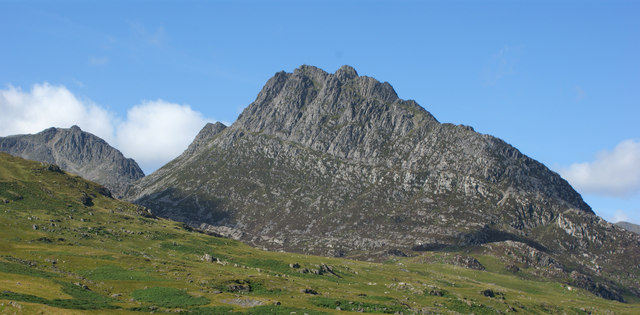
Tryfan (Welsh pronunciation: [ˈtrəvan]) is a mountain in the Ogwen Valley, Snowdonia, Wales. It forms part of the Glyderau group, and is one of the most recognisable peaks in Britain, having a classic pointed shape with rugged crags. At 917.5 metres (3,010 feet) above sea level, it is the fifteenth-highest mountain in Wales. Tryfan was voted Britain's favourite mountain by Trail magazine.[3]

Key Information

Between the mid-1980s and June 2010, its accepted height was 915 metres (3,002 ft). However, it was resurveyed using accurate GPS measurements and found to be 2.4 metres (eight feet) higher (which the pre-1980s surveys also recorded).[1]

Tryfan is said to be the final resting-place of Sir Bedivere (Bedwyr) of Arthurian legend.[4]

Naming

[edit]

The name "Tryfan" is thought to derive from the intensifying particle try– and the noun ban (‘top, peak’), giving the meaning ‘very high peak’.[5]

Routes of ascent

[edit]
Jumping from monoliths Siôn a Siân at the summit of Tryfan.

There are many routes of ascent, ranging from easy ridge scrambling, to multi-pitch mountaineering rock climbs on the east face.

A popular ascent route is its north ridge, which starts close to the A5 road, about one mile (1.6 km) east of Idwal Cottage (a youth hostel) or Ogwen Cottage (an outdoor pursuits centre). From here a route leads directly up the ridge, a Grade 1 scramble by the easiest line. The difficulty can be increased considerably if the most direct line is followed throughout; particularly in the upper sections of the ridge. About a third of the way up there is a distinctive rock known as "The Cannon" which points upwards at 45 degrees and is visible from the valley.

Tryfan may also be climbed by the south ridge, which links the mountain (via Bristly Ridge) to Glyder Fach. The route begins at Bwlch Tryfan, the col between Tryfan and Bristly Ridge. The col is reached by a path leading up from Idwal Cottage to the west, passing through Cwm Bochlwyd. This cwm contains Llyn Bochlwyd.

The summit of Tryfan is famous for the twin monoliths of Siôn a Siân (Adam and Eve in English),[6][7] a pair of rocks some three metres (10') high and separated by 1.2 metres (3.9 ft). The rocks are visible from the Ogwen valley. Those who tackle the "step" between the two rocks are said to gain the "Freedom of Tryfan".[8][9] However, the exposure on one side is quite great, and mountain writer Frank Showell Styles said: "In calm dry weather it is not too hard a step but the penalties of failure are unpleasant in the extreme."[8]

Two prominent pillar-like boulders are visible on the skyline midway through the approach to the summit via the South ridge. As these can be mistaken for Siôn a Siân from a distance, they have become known as Cain and Abel, continuing the biblical theme.

Milestone Buttress

[edit]

Milestone Buttress (Craig Y Foty) at the base of Tryfan is a popular location for climbing. The Buttress is about 10 minutes' walk from roadside laybys. The most popular route is known as the Direct Route: there are often queues of people waiting to climb it. It is 75 metres (246 ft) long, and has a grade of Very Difficult (VD). The route was first climbed by G. Barlow and H. Priestly-Smith in 1910. There is also a popular Grade 3 scramble incorporating the Milestone Buttress. This route is commonly used as an alternative approach to the North Ridge, as is the nearby slabby wedge of Tryfan Bach, on the other side of the mountain.

[edit]

References

[edit]

Bibliography

[edit]
[edit]
Revisions and contributorsEdit on WikipediaRead on Wikipedia
from Grokipedia
Tryfan is a mountain in the range of Eryri (Snowdonia National Park), located in the Ogwen Valley, , , rising to an elevation of 917.5 metres (3,010 feet) with a of 191 metres. It is one of the most recognisable peaks in Britain due to its distinctive pointed, three-headed fin of grey rock overlooking , and it marks the eastern boundary of Cwm Idwal, a classic glacial cirque. The summit's twin monoliths, known as (or Sion a in Welsh), stand about 1.2 metres apart and are central to a local tradition that requires visitors to leap between them to prove their credentials. Feral goats roam its slopes, adding to its wild character. Geologically, Tryfan consists primarily of rhyolitic lavas and tuffs from ancient volcanic activity in the region, shaped by multiple glaciations into its rugged, pinnacled form with steep north and south ridges. As the 15th highest peak in and the lowest of the 15 summits exceeding 3,000 feet, it exemplifies the transition from straightforward hiking to technical , with a minimum Grade 1 scramble required for ascent, demanding the use of hands on its rocky terrain. The mountain's north ridge, starting near the A5 road east of Ogwen Cottage, is the most popular route, offering exposure and views across the Nant Ffrancon Pass to the range. Tryfan holds historical significance in British climbing, hosting some of the earliest rock climbs in 1907 by , who later attempted , and serving as training ground for figures like Sir . Its proximity to the Ogwen Valley Mountain Rescue Post underscores its challenges, with frequent call-outs due to its technical scrambles and unpredictable weather, yet it attracts thousands annually for its thrilling ascent and panoramic vistas encompassing Y Garn, the , and distant . Conservation efforts by the focus on managing erosion from heavy foot traffic while preserving its natural and cultural heritage.

Geography and Topography

Location and Setting

Tryfan is situated in , , within Eryri (Snowdonia) National Park, at coordinates 53°06′54″N 03°59′51″W. Rising to an elevation of 917.5 metres (3,010 ft), it ranks as the fifteenth-highest mountain in and forms part of the , a collection of fifteen peaks exceeding 914 metres. It qualifies as a Nuttall, Hewitt, and Marilyn due to its height and of 191 metres. As a prominent member of the group, Tryfan lies to the north of Glyder Fawr and east of Y Garn, contributing to the rugged eastern spine of the range. It overlooks the Ogwen Valley to the east and the lake of , a glacial feature that serves as a key access point and holds cultural significance in Welsh legend. Administratively positioned between the towns of and Bangor, Tryfan is readily accessible via the A5 road, which runs along the northern shore of and provides parking near the mountain's eastern base. To the north, it borders the range, while its eastern flanks transition into expansive moorlands, integrating it into broader challenges like the traverse that tests endurance across Snowdonia's high peaks.

Physical Description

Tryfan is renowned for its iconic pointed and jagged profile, often likened to a broken or the of a , which makes it one of the most distinctive peaks in the British landscape. This dramatic form arises from its rocky, blade-like structure, featuring steep east and west faces that plunge over from the summit to the surrounding valleys below . The mountain's craggy appearance is accentuated by multiple ridges and buttresses, creating a sense of isolation and grandeur when viewed from afar. The mountain extends as a north-south approximately 2 km in length, beginning broad at its base near the Ogwen Valley and tapering to a sharp, precipitous summit at 917.5 metres above . Its measures 191 metres, underscoring its status as a significant standalone feature within the range despite not being the highest peak. Tryfan frequently appears cloud-capped due to its exposure to prevailing westerly winds, enhancing its brooding and mysterious presence in the often changeable weather. On clear days, however, the summit offers expansive panoramic views, stretching across other peaks, towards , and out to the . In contrast to its more rounded neighbors, such as Pen yr Ole Wen with its gentler, dome-like summit, Tryfan stands out for its sharper, more precipitous form, emphasizing its rugged character in the Ogwen Valley skyline.

Geological Formation

Tryfan's geological composition is dominated by volcanic rocks from the period, specifically the Caradoc stage approximately 458–449 million years ago, formed as part of the volcanic arc within a marginal basin setting. The mountain primarily consists of rhyolitic lavas and acidic ash-flow , including feldspar-phyric rhyolites and welded such as those in the Pitts Head Tuff Formation and Lower Rhyolitic Tuff Formation of the Snowdon Volcanic Group. These rocks reflect intense subaqueous and volcanic activity, with intercalations of siltstones and minor basaltic components from bimodal eruptions associated with processes along the margin. The formative processes began with Ordovician volcanism driven by the subduction of oceanic crust beneath the Avalonia microcontinent, leading to caldera development and explosive eruptions that deposited thick sequences of rhyolitic material. Subsequent uplift and deformation occurred during the Caledonian Orogeny in the late Silurian to early Devonian (around 420–390 million years ago), involving south-easterly directed compression that folded, cleaved, and faulted the volcanic pile to low greenschist facies metamorphism, creating steep scarps along structures like the Tryfan Fault. In the Quaternary period, repeated glaciations, particularly during the Late Devensian (27,000–10,000 years ago), sculpted the landscape through ice scour, sharpening arêtes and cirques while exposing the resistant rhyolitic core. Distinct features include the blocky, shattered rhyolite on the eastern face, resulting from jointing and fracturing during tectonic uplift and periglacial weathering, which contributes to its jagged appearance. Extensive slopes mantle the lower flanks, derived from the mechanical breakdown of these brittle volcanics under freeze-thaw cycles. Minor dolerite intrusions, appearing as sills and dykes, punctuate the sequence, adding basaltic contrasts to the predominantly acidic assemblage. Geologically, Tryfan exemplifies Cambro-Ordovician volcanism in Wales, serving as a key exposure of arc-related magmatism tied to the closure of the Iapetus Ocean and early plate tectonic reconstructions. Its well-preserved sequences have been instrumental in studying subduction dynamics, caldera evolution, and the transition from volcanic arc to orogenic belt, informing broader models of Paleozoic tectonics in the British Isles.

History and Naming

Etymology and Naming

The name Tryfan originates from the , specifically Brythonic Celtic roots that predate Roman influence in Britain, reflecting the ancient linguistic heritage of the region. One primary interpretation derives it from "tri" (three) and "faen" (rock or stone), translating to "three rocks," which alludes to the mountain's distinctive profile of three prominent rocky summits or ridges visible from certain angles, such as along . An alternative breaks it down as "try-" (an intensifying prefix) combined with "ban" (summit, peak, or head), yielding "very high peak" or a "mountain with a clear/sharp summit," emphasizing its pointed, prominent form in contrast to neighboring, more rounded peaks like Glyder Fawr. Historically, the name has appeared in anglicized forms in English-language maps and records, such as variations like "Trivan" or "Tryvan," though it retains its Welsh form in modern bilingual usage across signage, literature, and official designations in Eryri (Snowdonia). This dual naming tradition is evident even on the summit, where the iconic stone pillars are known as "Sion a Siân" in Welsh or "Adam and Eve" in English. By the 19th century, Tryfan's name had become firmly established in English travel literature and guidebooks, such as those documenting ascents in the burgeoning mountaineering scene, which popularized it as an iconic Welsh landmark and contributed to its enduring cultural recognition.

Early Exploration and Records

The earliest documented reference to Tryfan appears in the medieval Welsh poem Englynion y Beddau (Stanzas of the Graves), a collection of stanzas attributed to the bard Taliesin and preserved in manuscripts dating from the 13th to 15th centuries, though the composition is believed to originate in the 9th or 10th century. One stanza locates the grave of Bedwyr, a figure from Arthurian legend, "in alld Tryvan," interpreted as "on the slope of Tryfan," marking the mountain's integration into early Welsh literary and mythological traditions as a site of heroic significance. This poetic mention underscores Tryfan's longstanding presence in Welsh cultural memory, though no contemporary prose records or physical evidence from this period confirm direct human activity on the peak. By the 18th century, systematic surveys began to document Tryfan's imposing topography. In his Tours in Wales (published 1778–1784), naturalist Thomas Pennant described the mountain during an ascent of nearby Glyder Bach, portraying it as a "singular mountain" rising pyramidally in the vale below, "naked" and "very rugged," with a precipitous face that rendered closer inspection inaccessible and formidable. Pennant's account, based on travels in 1770 and 1778, highlighted Tryfan's dramatic silhouette within the Snowdonian range, contributing to growing interest in Welsh landscapes among British intellectuals and travelers. The saw more precise mapping and the first recorded ascents, formalizing Tryfan's place in geographical records. The Ordnance Survey's initial topographic surveys of , commencing in the 1810s and culminating in detailed one-inch maps by the 1840s, accurately delineated Tryfan's contours and elevations, integrating it into national cartography for the first time. The earliest documented summit attempt occurred in 1798, when Reverend William Bingley and local cleric Peter Bayley Williams scrambled up the south ridge from the Ogwen Valley during a botanical tour, as detailed in Bingley's A Tour Round (1800); their arduous climb, involving handholds on loose and rocks, emphasized the peak's challenges and wild isolation. Later, in Wild Wales (1862), recounted viewing Tryfan from the roadside near in 1854, describing it as a "tremendous mountain" with "pillar-like summits" that seemed to overhang the valley, evoking its untamed majesty and reinforcing its allure amid the era's burgeoning Romantic appreciation of rugged nature. Victorian tourism further elevated Tryfan's profile, spurred by railway expansions that democratized access to . The opening of lines such as the London and North Western Railway's branch in 1868 and the Ffestiniog Railway's slate-quarry extensions in the facilitated influxes of day-trippers and climbers, transforming remote peaks like Tryfan into sought-after destinations for middle-class excursions. However, historical coverage remains uneven: pre-18th-century indigenous accounts are scarce, relying primarily on poetic allusions rather than prosaic narratives, while potential prehistoric utilization lacks verification through excavation. Recent archaeological efforts in , including geophysical surveys in the 2020s, have uncovered broader prehistoric activity in the region but yield no confirmed new insights specific to Tryfan, highlighting persistent gaps in the record.

Ascent and Climbing

Scrambling Routes

Tryfan offers several routes that provide accessible yet exhilarating ascents for hikers seeking an introduction to hands-on , characterized by Grade 1 difficulties requiring balance and route-finding rather than technical skills. These paths traverse the mountain's rugged terrain, often involving fields, short exposed sections, and no fixed protections, making them suitable for fit individuals with prior hillwalking experience. Unlike more demanding rock climbs, scrambling routes on Tryfan emphasize natural progression along ridges and faces, culminating at the summit where participants may undertake the traditional "Freedom of Tryfan" leap between the iconic monoliths. The North Ridge stands as the most renowned scrambling route, a classic Grade 1 path that ascends directly from the A5 roadside near Ogwen Cottage, spanning approximately 4-5 hours for the ascent with around 670 meters of elevation gain. Beginning with a boulder-strewn approach past Milestone Buttress, the route follows the crest's spiky outline, featuring key highlights such as the North Tower—a rounded pinnacle demanding careful foot placement on polished slabs—and the Stone, a detached block offering an optional thrilling detour. Exposed sections along the ridge require confidence in heights, particularly in windy conditions, while the path converges on multiple lines to the summit, rewarding scramblers with panoramic views of the range. This route's popularity stems from its thrilling yet non-technical nature, serving as an ideal entry to , though wet weather can render rocks slippery and navigation challenging without a map or GPS. In contrast, the South Ridge provides a milder Grade 1 alternative, starting from Llyn y Cwn or via an approach from Pen-y-Pass, typically taking 3-4 hours with less overall exposure than the North Ridge but including steeper bouldery sections near the at Bwlch Tryfan. From the , the scramble follows a grassy and rocky rampart upward, involving hands-on clambering over slabs and short drops, with the terrain easing toward the summit plateau. An alternative ascent from the east via the old coach road to Cwm Tryfan adds variety, though the route demands good to avoid veering into rougher ground on either flank. This path suits those preferring a more gradual build-up to the summit, yet it still requires caution on loose stones and in poor visibility. For those approaching from the eastern side, moderate options via Heather Terrace offer beginner-friendly access, though not without challenges, with the traverse taking about 45 minutes to an hour across the east face's undulating ledge system. This heather-lined, boulder-strewn terrace, accessed from the north via slopes below the North Ridge or from the south near Llyn y Cwn, leads to various gullies and ridges for summit continuation, providing shelter from westerly winds. However, the lack of a defined path, combined with loose and potential for disorientation in , necessitates careful route choice and sturdy footwear; it is best combined with a descent via the North or South Ridge for a full circuit. Warnings emphasize avoiding the terrace in wet conditions due to slippery surfaces and the risk of straying into steeper terrain. General guidance for all Tryfan scrambling routes underscores the absence of waymarked paths, with typical round-trip durations of 6-8 hours depending on fitness and weather, advising starters to carry maps, compasses, and helmets for protection. In 2024, for example, the Ogwen Valley Organisation responded to 47 incidents on Tryfan, highlighting the need for caution. These routes attract significant footfall, reflecting Tryfan's status as a icon, but demand respect for variable conditions—strong winds, rain, or ice can escalate difficulties, recommending clear days and group travel for .

Rock Climbing Areas

Tryfan's rock climbing areas are concentrated on its east face, where technical roped routes ascend steep rhyolite crags, often accessed via preliminary scrambling on the North Ridge or Heather Terrace. These lines, graded from Difficult to E3, demand experience with multi-pitch trad climbing, reliable protection placements in cracks and grooves, and awareness of exposure, with drops exceeding 200m on longer routes. The mountain's rock quality is generally excellent—grippy and solid—but polished from traffic and occasionally friable on ledges, requiring careful route selection and gear like a standard rack of nuts, cams, and slings for belays. The most prominent area is Milestone Buttress (also known as Craig y Foty), situated at the foot of Tryfan's North Ridge on the eastern side, just a 10-minute approach from the A5 roadside layby near Llyn Ogwen. This compact crag rises about 100m and offers a dozen moderate multi-pitch routes, making it ideal for building mountain skills in an accessible setting. The classic Direct Route (HVD, 85m), first ascended by G. Barlow and H. Priestley-Smith in 1910, follows a series of grooves, slabs, and short chimneys with good holds and natural protection opportunities; modern ascents recommend a double rack up to Camalot #3 for cracks, plus 60m ropes for efficient pitches. Nearby, the Ordinary Route (Diff, 100m), first ascended by Owen Glynne Jones, provides an easier alternative via crack starts and slabby terrain, while Super Direct (VS 4c, 80m) adds steeper moves on the left side of the buttress. These V Diff and below lines, totaling over 20 across the crag, feature juggy holds interspersed with technical slab climbing, though the rock can feel slippery when damp. Climbing development on Tryfan dates to the late 19th and early 20th centuries, when innovators like the Abraham brothers explored and photographed routes in the Ogwen Valley, establishing foundational lines amid Snowdonia's emerging scene. Local groups, including the Liverpool-based Wayfarers Club founded in , further advanced moderate routes through regular meets, contributing to the area's reputation for reliable middle-grade cragging by the 1920s. Post-2010 additions remain limited, with focus on cleaning existing lines rather than new developments, though at the base has grown in popularity for low-level warm-ups on compact rhyolite problems up to V4. Higher on the east face, the Heather Terrace ledge unlocks longer expeditions like Grooved Arête (HVD 4a, 230m), a Severe-graded masterpiece with overhanging cracks, exposed traversing, and thrilling positions overlooking 300m voids toward the Glyders. Established in the early 1900s as part of broader east face exploration, it combines sustained climbing on excellent rock with transitions, protected by hexes and cams in parallel cracks; parties often simul-climb easier sections to manage its eight pitches efficiently. This route exemplifies Tryfan's appeal for experienced climbers seeking adventurous lines beyond the buttress. The western slopes host fewer dedicated rock climbing areas, with technical routes overshadowed by Grade 2-3 scrambles like the West Face Route; however, isolated moderate lines on outcrops such as those near Craig Wen offer crack and with similar rhyolite characteristics and high exposure, though less documented and trafficked than eastern venues.

Notable Features and Areas

Summit and

The summit of Tryfan consists of a small, rocky platform at an elevation of 917.51 metres above , marking it as one of the fifteen Welsh peaks exceeding 3,000 feet (914.4 m) in height. This exposed area provides expansive 360-degree views across Eryri (Snowdonia National Park), encompassing the Ogwen Valley to the north and the range to the south, though it offers no natural shelter from the elements. The platform is particularly susceptible to , with wind gusts in the region frequently reaching 86 mph or higher during storms, as recorded during Storm Amy in October 2025. At the highest point of this platform stand the twin monoliths known as (Siôn a Siân in Welsh), a pair of natural rock pillars composed of weathered rhyolite, the dominant forming much of Tryfan's structure. Each pillar rises to approximately 2.4 metres in height and stands about 1 apart, though the effective gap for crossing requires a leap of around 1.2 metres due to the irregular footing and sheer drop on one side. A longstanding tradition holds that successfully jumping the gap between grants the "freedom of Tryfan," a attempted by many visitors despite the inherent risks, including exposure to heights and potential falls on the unsheltered . The site's popularity contributes to frequent incidents, often involving scramblers navigating to the via routes like the north ridge who become disoriented or injured in adverse conditions. While specific erosion studies from the 2020s are limited, the concentrated foot traffic around the monoliths has raised minor concerns about wear on the rhyolite surfaces, though the formations remain stable as natural features.

Milestone Buttress and Eastern Side

Milestone Buttress rises prominently on Tryfan's eastern face as a roughly 100-150 m high crag of solid rhyolite, offering accessible multi-pitch routes just steps from the A5 road. Named for the nearby 19th-century 10th milepost from Bangor—now reinstated—it has been a favored spot for since the early development of British in the late 19th and early 20th centuries. The buttress features excellent, quick-drying rock with a mix of slabs, cracks, and chimneys, though some holds are polished from heavy use; key routes include the classic Direct Route (Very Difficult), a 250-foot line first ascended in , and the Ordinary Route (Difficult), both providing straightforward yet exposed with good protection. The eastern side of Tryfan presents a steep, rugged terrain dominated by broad fields, deep gullies, and rocky buttresses, contrasting with the mountain's more dramatic north ridge. Access is typically via the Heather Terrace, a geological ledge that contours the face and leads to major features like the Milestone Buttress and East Face gullies, allowing for grade 1-3 scrambles such as Milestone Gully or Nor Nor Groove. This aspect is less vegetated overall, with exposed inclusions adding texture to the predominantly rhyolitic rock, though loose and potential demand caution; it offers stunning views across and the Ogwen Valley. Historically, the Milestone Buttress area pioneered early 20th-century climbing techniques in the Ogwen Valley, including innovations like artificial aid and peg placements on harder lines, though such practices later sparked debates, such as the over vegetation removal on routes like Moonchild to expose cleaner rock. Recent conservation efforts have addressed erosion on the eastern approaches, with the British Mountaineering Council installing along a 50 m boggy section below Tryfan in 2024 to channel foot traffic and prevent path degradation, updating access amid post-2020 environmental management in Eryri ; these measures have also facilitated route maintenance, including cleans on popular lines to remove loose material.

Western Slopes and Craig Wen

The western slopes of Tryfan present a milder alternative to the mountain's steeper eastern aspects, featuring relatively gentler gradients that facilitate easier access for scramblers and hikers seeking less exposure. Covered in dense heather and , the terrain transitions from grassy ledges to areas of loose and scattered boulders, creating a more broken and vegetated landscape ideal for introductory training or solitary exploration. This side, often described as the "Cinderella" of Tryfan's faces due to its understated appeal compared to the busier east, remains less crowded, allowing for a quieter ascent amid expansive views toward Llyn Idwal and the range. Craig Wen, a vegetated crag on the lower western slopes, offers moderate and options amid heather-covered terrain, contributing to the area's appeal for less technical ascents. Key scrambling routes on these slopes emphasize mountaineering-style challenges on rhyolite rock that holds well even when damp. The West Face Route, graded at 3, starts from a grass ledge with below a prominent , ascending via water-washed steps, heather rakes, and corners to an awkward move near the top; easier variations lie to the right of the main line. Nearby, the Notch Arete (grade 3) offers an exposed climb accessed high on the face, while the Y Gully (grade 2) provides a straightforward ascent suitable for building confidence amid the boulders and . These routes, typically 150-200 in length, highlight the west's suitability for moderate adventures without the severity of eastern pinnacles.

Cultural and Environmental Significance

Legends and Folklore

Tryfan holds a prominent place in Arthurian legend as the purported final resting place of Sir Bedivere, the knight who returned King Arthur's sword Excalibur to the Lady of the Lake by casting it into the nearby waters of Llyn Ogwen. Local folklore also connects the mountain to broader tales of Arthur, suggesting it as a site where the king may have drawn his sword or engaged in battles against foes. At the summit, two distinctive standing stones named inspire a longstanding among climbers: leaping the narrow gap between them is said to confer the "freedom of Tryfan," a symbolic rite granting good luck or honorary status on the peak. Tryfan's extends to encounters, including reports of a figure dubbed the "Ghost of Tryfan," described in accounts as a mysterious elderly mountaineer appearing on the slopes near Bwlch Tryfan before vanishing without trace. These legends have influenced modern cultural depictions, with Tryfan serving as a filming location in the 2017 film King Arthur: Legend of the Sword, directed by , which draws on Welsh mythological elements tied to the mountain's Arthurian associations.

Ecology and Conservation

Tryfan's is characterized by alpine and montane habitats shaped by its rugged terrain and exposure to harsh weather, supporting a range of specialized plant and animal species adapted to high-altitude conditions. The mountain's crags and ledges host arctic-alpine flora, including cushion-forming plants like moss campion (Silene acaulis), which forms dense, moss-like mats on rocky outcrops and screes in Snowdonia's upland areas, including Tryfan's summits. Similarly, purple saxifrage (Saxifraga oppositifolia), a resilient arctic-alpine species with vibrant flowers, clings to rocky crevices on the mountain's crags, thriving in the cold, windswept environment typical of Eryri's peaks. Lower slopes feature heather moorland dominated by Calluna vulgaris, providing a carpet during summer blooms and stabilizing the on areas like the Heather Terrace. In sheltered gullies and damp fissures, rarer moisture-loving species such as starry saxifrage (Saxifraga stellaris) occur, contributing to the area's botanical diversity. Faunal communities on Tryfan reflect its role as a predator stronghold and breeding ground for montane species. Peregrine falcons (Falco peregrinus) nest on the mountain's steep faces, utilizing the cliffs for high-speed hunting dives over the Ogwen Valley; these birds are a key indicator of the habitat's health in Eryri. Ravens (Corvus corax) are occasional visitors, soaring over the ridges and scavenging in the vicinity, while ring ouzels (Turdus torquatus)—a thrush adapted to rocky uplands—forage on the lower flanks, particularly during breeding seasons. Red grouse (Lagopus lagopus scotica), which rely on the moorland for nesting amid the acidic soils. Feral goats roam the eastern flanks, grazing on sparse vegetation and occasionally impacting regrowth in eroded areas. Efforts to monitor , such as non-native plants encroaching from lower altitudes, are integrated into broader Eryri assessments to prevent disruption to native assemblages. As part of , designated on 18 October 1951, Tryfan benefits from protective measures aimed at preserving its ecosystems amid increasing visitor pressure and environmental change. The park's management includes initiatives, such as path repairs and revegetation on high-use routes like the Heather Terrace, where volunteer-led projects by organizations like the British Mountaineering Council have stabilized degraded sections to reduce soil loss and protect underlying habitats. In 2022, targeted works addressed peat hags and drainage issues near Tryfan as part of wider peatland restoration efforts, blocking ditches and re-profiling eroded areas to prevent further degradation and support carbon storage. poses ongoing threats, including accelerated peat degradation from warmer, drier conditions, which could release stored carbon and alter moisture-dependent habitats; surveys indicate rising temperatures are stressing alpine flora like saxifrages. Recent surveys in the 2020s, such as the 2021 Ogwen assessment covering Tryfan, have documented shifts in species abundance—e.g., reduced vegetation cover due to footfall and weather variability—while highlighting hotspots for birds like meadow pipits and ring ouzels. Peregrine nesting sites on Tryfan fall under Eryri's protected zones, with seasonal monitoring to minimize disturbance during breeding, aligning with UK-wide conservation for this once-endangered raptor. These efforts underscore Tryfan's importance as a sentinel for montane ecosystem resilience in the face of global pressures.

Modern Access and Safety

Access to Tryfan is free, as it lies within Eryri National Park, with no entry fees required for visitors. Parking options are available in the Ogwen Valley and at Cwm Idwal, including over 250 legal spaces, many of which are free, though availability is limited during peak seasons like summer holidays. The mountain attracts hundreds of thousands of visitors annually to the surrounding Eryri peaks, bolstered by its recognition as Britain's favourite mountain in a 2014 reader poll by Trail magazine. This popularity has been amplified by social media, contributing to overcrowding on routes and a rise in mountain rescue call-outs from inexperienced hikers seeking photogenic summits. Recent developments include path upgrades in 2024, where British Mountaineering Council volunteers constructed 50 meters of to mitigate erosion below Tryfan's slopes. Following the , Eryri experienced a surge in visitors, leading to increased path damage and erosion from higher footfall. Drone use is restricted in the area to protect nesting birds, with guidelines prohibiting flights near protected species or their habitats to avoid disturbance. Safety concerns are significant due to Tryfan's rugged terrain, with primary risks including exposure to sudden changes, slips on scrambles, and navigation errors in poor visibility. The Ogwen Valley Organisation (OVMRO) handles a high volume of incidents, responding to 47 call-outs on Tryfan in 2024—27% of their total 173 operations—and 37 out of 167 as of November 2025. Fatalities underscore these hazards, with at least two in 2024 from falls during descents and at least two in 2025, including one in February from a fall of approximately 20 meters and one in August from a collapse during descent; overall, the peak has seen multiple deaths since 2015, including three in 2015 alone. Visitors are advised to check forecasts, carry appropriate gear, and consider guided options for less experienced scramblers to mitigate these dangers.

References

Add your contribution
Related Hubs
User Avatar
No comments yet.